The St. Petersburg Metro is the rapid transit system of Saint Petersburg, Russia, and a core part of local public transport. Construction began in early 1941, stopped during World War II and the Siege of Leningrad, and the system opened to passengers on 15 November 1955. Today it has 5 lines, 129.6 km (80.5 mi) of track, 73 stations, and about 2 million daily riders. It is known for deep stations, Soviet-era architecture, artwork, and reliable city transport across the main districts.
| Key | Information |
|---|---|
| System | St. Petersburg Metro rapid transit system |
| Opened | 15 November 1955 |
| Lines | 5 operating lines |
| Network length | 129.6 km (80.5 mi) |
| Stations | 73 stations, including 7 transfer points |
| Daily ridership | About 2 million passengers |
| Notable feature | One of the world’s deepest metro systems |
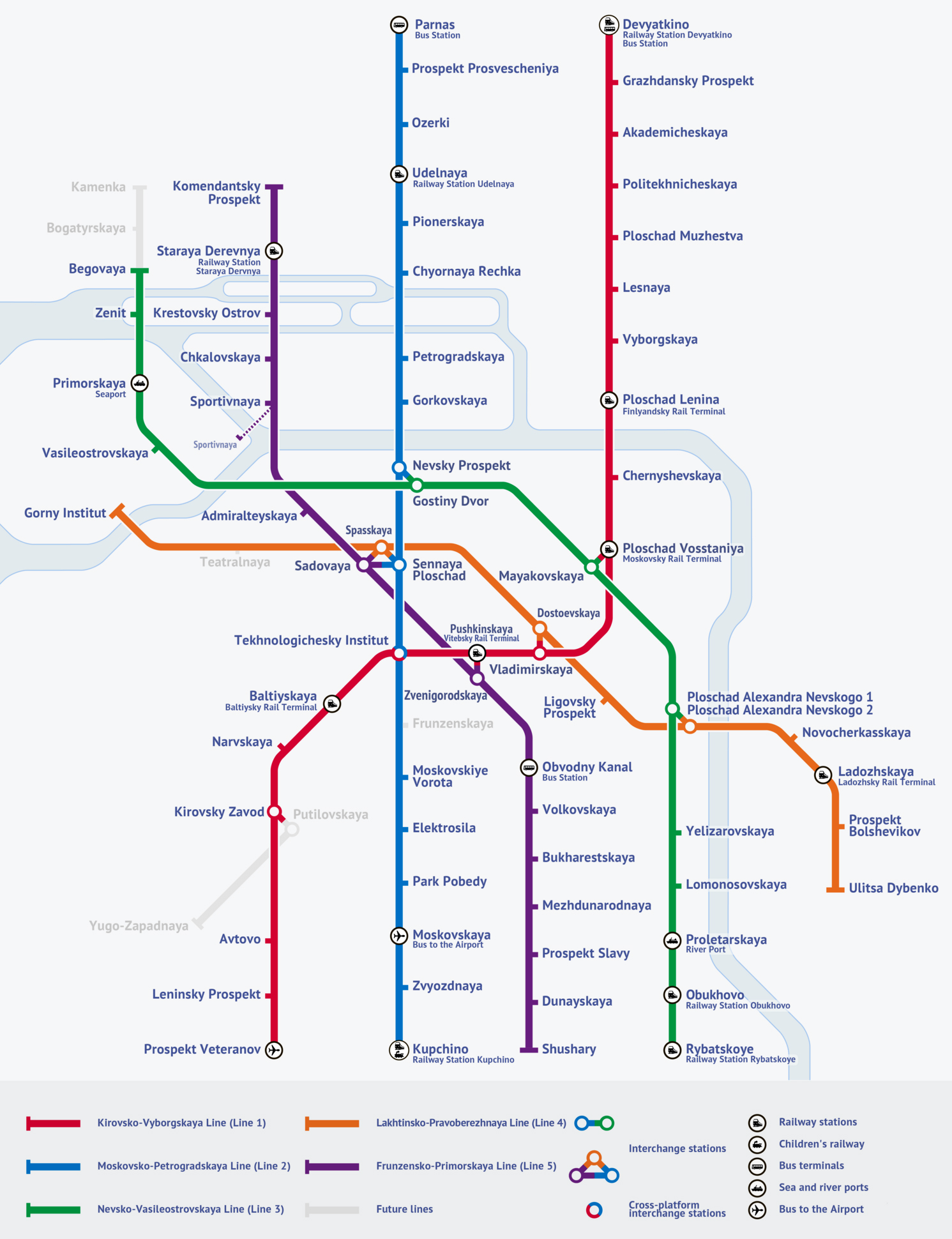
St. Petersburg Metro Map
Map of Saint Petersburg Metro showing different lines and stations. Click on the map to enlarge it or download the Saint Petersburg Metro map in PDF format.
Lines and Stations Overview
The St. Petersburg Metro route network covers central areas, residential districts, railway terminals, and major transport hubs. A stations map is useful before travel, but the stations list below gives a quick route plan for the five operating lines and their main stops.
| Station | Details |
|---|---|
| Line 1: Kirovsko-Vyborgskaya Line | Oldest line in the system, opened in 1955. Listed stations include Devyatkino, Grazhdansky Prospekt, Akademicheskaya, Ploshchad Muzhestva, Parnas, and Prospekt Veteranov. |
| Line 2: Moskovsko-Petrogradskaya Line | Opened in 1961. Key stations include Parnas, Prospekt Prosvescheniya, Ozerki, Udelnaya, and Kupchino. |
| Line 3: Nevsko-Vasileostrovskaya Line | Opened in 1967. Noted stations include Rybatskoye, Obvodny Kanal, Vostaniya, Zenit, and Begovaya. |
| Line 4: Pravoberezhnaya Line | Opened in 1985. Stations listed include Spasskaya, Ploshchad / Sadovaya, Ligovsky Prospekt, Novocherkasskaya, Ladozhskaya, and Ulitsa Dybenko. |
| Line 5: Frunzensko-Primorskaya Line | Opened in 2008. Stations include Komendantsky Prospekt, Staraya Derevnya, Krestovsky Ostrov, Volkovskaya, Bukharestskaya, Mezhdunarodnaya, Prospekt Slavy, Dunayskaya, and Shushary. |
| Admiralteyskaya | A landmark deep-level station and one of the best-known stations in the network. |
| Nevsky Prospekt / Gostiny Dvor | Major central transfer point for cross-city travel. |
| Spasskaya / Sennaya / Sadovaya | Important interchange group connecting several lines. |
| Ploshchad Alexandra Nevskogo I and II | Transfer stations serving the eastern side of the central area. |
| Parnas, Devyatkino, Prospekt Veteranov, Kupchino, Rybatskoye, Shushary, Ulitsa Dybenko | Important termini and daily travel anchors across the metro system. |
Operating Hours and Frequency
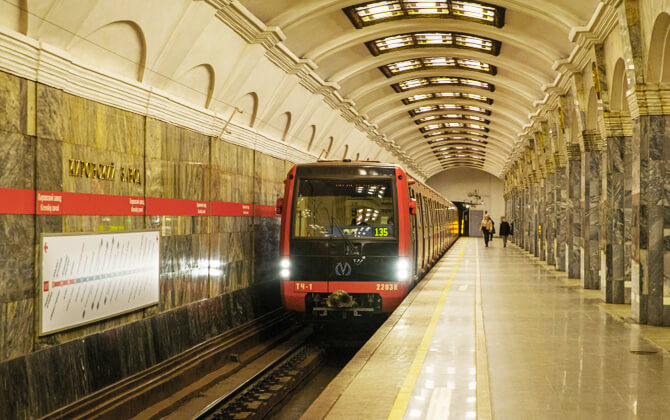
The St. Petersburg Metro operates daily. General operating hours run from about 5:30 or 5:45 in the morning until around 00:30 at night, depending on the station. Opening hours, opening times, starting time, closing time, and the last train can vary slightly, so check the station timetable before you travel.
| Service detail | Timings |
|---|---|
| General working hours | About 5:30–5:45 a.m. to around 00:30 |
| Peak-hour frequency | Usually every 2–3 minutes |
| Off-peak frequency | Generally about every 4–5 minutes |
| Interchange closing time | Transfers between lines end at 00:15 |
| Schedule today | First train, last train, and station timings today should be checked for the exact stop. |
Trains are known for punctual service, and the train schedule is usually easy to follow once you know your route timetable. If you are making a late connection, allow time for the transfer corridors to close before the final station closing time.
Fares, Tickets, and Passes
The St. Petersburg Metro fare system is straightforward: you can pay for a single ride, use a rechargeable card, or buy a day pass if you plan to combine the metro with buses, trams, trolleybuses, or other local transport. Prices below are listed in rubles with approximate dollar equivalents.
| Key | Information |
|---|---|
| Single trip token | 81 RUB, about $0.90 |
| 1-day unified ticket | 311 RUB, about $3.45 |
| 3-day unified ticket | 598 RUB, about $6.65 |
| 5-day unified ticket | 1,058 RUB, about $11.75 |
| 90-minute ticket | 90 RUB, about $1.00 |
| Podorozhnik card cost | 80 RUB, about $0.90 |
| Metro ride with Podorozhnik | 56 RUB, about $0.62 |
| Surface transport ride with Podorozhnik | 56 RUB, about $0.62 |
The 1-day, 3-day, and 5-day unified tickets are valid on the metro and surface transport. The 90-minute ticket includes one metro ride and unlimited surface transfers within 90 minutes, which can be handy if your path by train continues by bus or tramway.
The Podorozhnik rechargeable card works on the metro, buses, trams, and trolleybuses. It gives a lower ticket price than a standard single ride, but if you tap twice within a short time on the rechargeable “Unified Ticket” card, the full fare is charged.
Contactless bank-card payment is available at metro turnstiles, though accepted card types may be limited. Russian MIR cards are specifically noted, and MIR EKP uses the discounted 56 RUB, about $0.62, fare. With mostly flat prices, most visitors will not need a fare calculator; the main choice is whether a single ticket, card, or pass gives the lower cost for the day.
- 5-day unified ticket: best for frequent rides and unlimited travel during a longer stay.
- Podorozhnik card: useful for fewer daily trips and a lower per-ride price.
- Bank card payment: convenient where accepted, but check card compatibility first.
Interconnections
The St. Petersburg Metro system is built around practical transfers between lines and connections to wider transportation in the city. Interchanges usually operate as linked station pairs or groups, so you can change route without leaving the paid area.
Interconnections between Lines
These transfer stations connect the main metro lines and make cross-city travel easier.
| Station | Details |
|---|---|
| Tekhnologichesky Institut 1 / Tekhnologichesky Institut 2 | Transfer between Line 1 and Line 2. |
| Ploshchad Vosstaniya / Mayakovskaya | Transfer between Line 1 and Line 3. |
| Vladimirskaya / Dostoyevskaya | Transfer between Line 1 and Line 4. |
| Pushkinskaya / Zvenigorodskaya | Transfer between Line 1 and Line 5. |
| Nevsky Prospekt / Gostiny Dvor | Transfer between Line 2 and Line 3. |
| Sennaya Ploschad / Spasskaya / Sadovaya | Transfer group for Line 2, Line 4, and Line 5. |
| Ploshchad Alexandra Nevskogo 1 / Ploshchad Alexandra Nevskogo 2 | Transfer between Line 3 and Line 4. |
The metro also has service connecting branches used for train movements between lines. These are operational links, not regular passenger routes. Sadovaya is noted as the only station in Saint Petersburg with track forks on both sides.
Connections to Other Transportation Systems
The metro is closely tied to the city’s railway terminals, ports, buses, trams, and other urban transit. That makes it a useful backbone for transportation in Saint Petersburg, especially when changing between long-distance rail and city transport.
| Station | Details |
|---|---|
| Ploshchad Lenina | Connection to Finlyandsky Vokzal. |
| Ploshchad Vosstania / Mayakovskaya | Connection to Moskovsky Vokzal. |
| Pushkinskaya / Zvenigorodskaya | Connection to Vitebsky Vokzal. |
| Baltiyskaya | Connection to Baltiysky Vokzal. |
| Ladozhskaya | Connection to Ladozhsky Vokzal. |
| Devyatkino | Connection to Devyatkino railway station. |
| Obukhovo | Connection to Obukhovo railway station. |
| Rybatskoye | Connection to Rybatskoye railway station. |
| Kupchino | Connection to Kupchino railway station. |
| Udelnaya | Connection to Udelnaya railway station. |
| Staraya Derevnya | Connection to Staraya Derevnya railway station. |
| Primorskaya | Connection to Morskoy Vokzal maritime port. |
| Proletarskaya | Connection to Rechnoy Vokzal river port. |
Access to the Airport
Pulkovo Airport serves St. Petersburg and is located south of the city, about 15 km (9.3 mi) from the city center, or around 23 km (14.3 mi) by some routes. The metro does not run directly to the airport, but the bus-and-metro connection is simple.
If you are using public transport, travel by bus or marshrutka to Moskovskaya station on the blue line, then continue by metro toward the center. From Moskovskaya, the route gives direct access toward central stations without changing lines.
| Station | Details |
|---|---|
| Moskovskaya | Nearest metro station to Pulkovo Airport; served by the blue line. |
| Buses 39 and 39E | Run between the airport and Moskovskaya metro station. |
| Marshrutka K39 | Also connects the airport with Moskovskaya. |
| Service frequency | Airport bus services operate about every 20–35 minutes. |
| Central onward route | The blue line continues toward central areas and stations such as Ploshad Vosstaniya, Pushkinskaya, and Ploshchad Lenina. |
Taxi is the simplest option if you arrive late or have heavy luggage. The airport recommends booking through official taxi points or the Yandex Go application. When departing, arrive early, and keep your immigration card safe during your stay because it must be handed in when you leave.
For other transport hubs, the metro is often the easiest connection. Moskovsky station is linked with Ploshad Vosstaniya, Vitebsky station with Pushkinskaya, and the bus station can be reached by walking about 15 minutes to Ligovsky Prospekt.
Regulations, Tips, and Warnings
The St. Petersburg Metro has rules for passenger safety, ticket control, inspections, and smooth movement through stations and trains. They apply inside entrances, halls, platforms, escalators, and carriages.
Key regulations to remember:
- Travel and hand luggage beyond the standard allowance are carried according to approved fares.
- Passengers must have a valid ticket, pass, or proof of the right to free or discounted travel.
- Boarding starts only after passengers have exited the train.
- Passengers must keep their travel document until the end of the trip, except when using tokens.
- Inspection is mandatory for passengers, hand luggage, and personal belongings. Refusing inspection means leaving metro territory.
Passenger responsibilities:
- Follow instructions from metro staff and comply with transport safety rules.
- Report smoke, fire, suspicious activity, or unattended belongings to metro employees or police officers.
- Pay for travel before passing through checkpoints.
- Leave the station within 10 minutes after the last passenger train has passed.
- Do not block or interfere with other passengers.
Practical safety tips:
- Stand facing the direction of travel on escalators and hold the handrail.
- Do not run on escalators or stand near the platform edge before the train stops completely.
- Let passengers exit before boarding.
- Keep bags and backpacks in front of you in crowded areas.
- Offer seats to passengers with children, pregnant women, people with disabilities, and elderly passengers when possible.
Common restrictions:
- Do not smoke, drink alcohol, or use narcotic or psychotropic substances in the metro.
- Do not carry weapons, explosives, hazardous substances, or household gas cylinders.
- Do not leave luggage unattended.
- Do not bring bicycles, scooters, motorcycles, or similar transport devices into the metro, except in cases allowed by the rules.
- Do not use open food or drinks, and do not enter with dirty or strong-smelling clothing.
Warnings:
- Refusing inspection or ignoring staff instructions may result in being asked to leave the metro.
- If passenger safety is at risk, the carrier may change station opening hours or train schedules.
- Passengers using special inspection rights or reduced fares must present the required documents on request.
- Wheelchair use on escalators is allowed only when accompanied by metro staff under the established procedure.
Noteworthy Facts
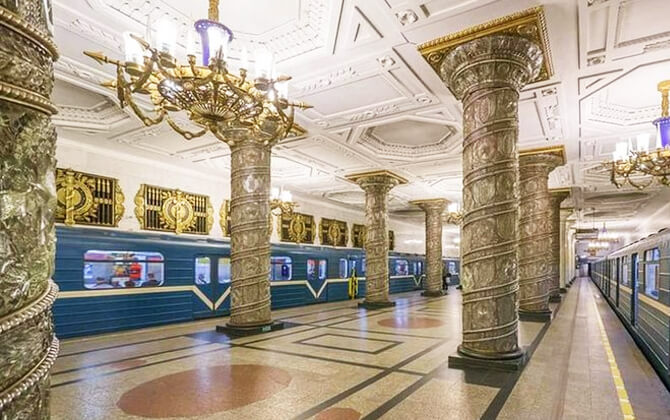
The St. Petersburg Metro is famous for deep construction, decorated stations, and heavy passenger flow. Admiralteyskaya is one of its best-known deep stations, and the network is often described as one of the deepest metro systems in the world.
Geography adds to its identity. St. Petersburg Metro was once the most northerly metro system in the world until Helsinki opened its subway in 1982, and it is now the most northerly metro in Russia. Parnas is the northernmost station in Russia, while Primorskaya is the westernmost.
The system also has several operational distinctions. Prospekt Veteranov is noted as the busiest station in Russia. The red line uses 8-car trains, while the other four lines run 6-car trains. The maximum train speed is listed as 90 km/h (56 mph).
Important firsts also belong to the city. Horizontal lift platform doors were first built here, and Tekhnologichesky Institute became the first Soviet station with a cross-platform transfer and the first Leningrad metro transfer station. Spasskaya is unusual because it is the only station in the city without a lobby.
The network has its quirks too. Devyatkino lies in the Leningrad region, so the metro extends across two federal subjects. Dachnoe is a closed station that remains shut permanently. Pushkinskaya’s opening was delayed after an escalator collapse, and the section between Lesnaya and Ploshad Muzhestva was closed for years because of tunnel erosion.
History
The idea of an underground railway in Saint Petersburg goes back to 1820, when Torgovanov proposed a tunnel from the city center to Vasilyevsky Island. Tsar Alexander I rejected the plan, and later proposals also stayed on paper. By the end of the 19th century, interest had returned, but the city still lacked the technical experience for such a demanding project.
In 1901, engineer Vladimir Pechkovsky proposed an elevated station on Nevsky Prospect connected to the Baltiysky and Varshavsky rail terminals. That same year, Reshevsky and railway engineer P. I. Balinsky introduced broader plans to connect the city’s main railway stations. Balinsky’s project included six urban lines with a total length of 172 km (106.9 mi), but Emperor Nicholas II rejected it in 1903.
After the October Revolution, metro plans in Petrograd stalled for more than a decade. The project was revived in 1938, when Alexei Kosygin supported new work for Leningrad, and engineer Ivan Zubkov became the first construction director. By April 1941, 34 shafts had been completed, but World War II stopped the work. During the Siege of Leningrad, unfinished stations served as bomb shelters, and Zubkov died in 1944 before the metro opened.
Construction resumed after the war. Lenmetroproyekt was created in 1946 to complete the first phase, and work restarted in 1947. The first stage entered operation in November 1955, and the metro opened to the public on 15 November 1955 with seven stations. Pushkinskaya followed a few months later. These stations formed the base of the Kirovsko-Vyborgskaya Line, linking the Moscow Rail Terminal with the Kirovsky industrial area.
The system expanded steadily. The first line was extended beneath the Neva in 1958. The second line opened in 1961 and later gained the USSR’s first cross-platform interchange at Tekhnologichesky Institut in 1963. The third line opened in 1967, the fourth in 1985, and the fifth developed much later, with key stations opening in 2008 and 2009. By the dissolution of the Soviet Union, the metro had 54 stations and 94.2 km (58.5 mi) of track.
Post-Soviet development continued despite difficult geology and funding problems. Several delayed stations and extensions opened only in the 2000s and 2010s. In 2004, service was restored after a major tunnel flooding had cut off part of the Kirovsko-Vyborgskaya Line for more than nine years.
Metro Parking
St. Petersburg Metro offers station parking for commuters, including options that cover parking and two journeys per day. In those cases, you do not need to buy a separate transit ticket after paying for parking.
| Station | Details |
|---|---|
| Leninskiy Prospekt, Kirovskiy Zavod, Politekhnicheskaya, Grazhdanskiy Prospekt | Intercept parking listed on Line 1. |
| Prospekt Prosvescheniya, Pionerskaya, Parnas, Kupchino | Intercept parking listed on Line 2. |
| Ploschad Alexandra Nevskogo, Obukhovo | Intercept parking listed on Line 3. |
| Ladozhskaya | Intercept parking listed on Line 4. |
| Volkovskaya | Intercept parking listed on Line 5. |
For vehicles entering between 6:01 a.m. and 8:00 p.m., parking is free for commuters who continue by public transport. Vehicles must leave before 11:59 p.m. on the same day. Separate city parking facilities and paid zones also exist, but no separate metro parking charges per day are listed for this commuter parking option.
Future Expansions
St. Petersburg Metro expansion has been planned for decades, though progress has often moved more slowly than expected. In 1994, officials planned to nearly double the system within 10 years by building three new lines and 61 new stations, but by 2004 only six stations had opened. At one point, the metro even considered funding construction through sponsorship of individual stations.
As of 2025, the main priority is the Krasnoselsko-Kalininskaya Line. Its first stage, with Yugo-Zapadnaya and Putilovskaya, opened in 2025, and additional stations are planned for 2029 and 2030. Work is also underway to extend the line farther northeast, with continued development expected through the end of the decade.
Other future projects include extending the Pravoberezhnaya Line westward, then north to Lakhta and onward to Yuntolovo. A two-station extension of Line 3 from Begovaya to Bogatyrskaya and Kamenka is also under development, with opening planned around 2030.
Looking further ahead, the metro plans three new lines: Krasnoselsko-Kalininskaya, Admiralteysko-Okhtinskaya, and Koltsevaya. The latter two are projected after the 2030s. Short- and mid-term upgrades are also planned, including escalator replacements and lighting improvements at existing stations.
The current strategy expects 16 new stations between 2025 and 2035, including 10 by 2030, plus one new depot as part of the wider expansion program.
Nearby Attractions
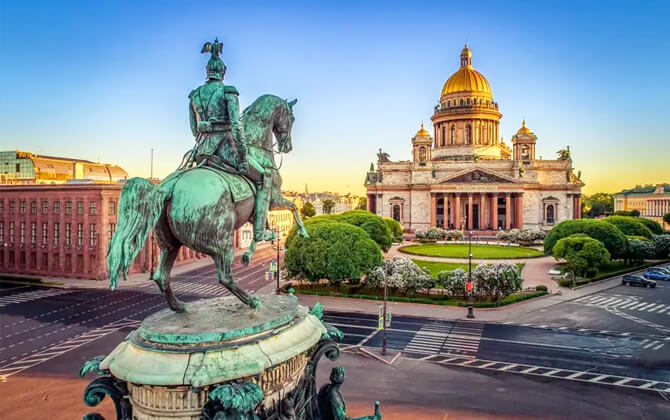
Many St. Petersburg Metro stations sit close to major sights, so the subway is a practical way to combine transport with sightseeing. If you are planning a day out, choose your route around the nearest station.
| Station | Details |
|---|---|
| Admiralteyskaya | Palace Square, the Winter Palace, the Hermitage Museum, St. Isaac’s Cathedral, the Admiralty, and Alexander Garden. |
| Ploshchad Vosstaniya | Uprising Square, Moskovsky Railway Station, Galeria Shopping Mall, Nevsky Avenue, and the Hero City of Leningrad Obelisk. |
| Narvskaya | Narva Gate and Yekateringof Park. |
| Kirovsky Zavod | Kirov Industrial Plant and its history museum, plus the Church of St. Nicholas of Myra. |
| Avtovo | Peter Semenenko Square, the “Anna Akhmatova. The Silver Age” Museum, and Avtovo Circus. |
| Alexander Nevsky Square-2 | Alexander Nevsky Lavra, the Necropolis of famous Russians, and the start of Nevsky Avenue. |
| Zenit | Gazprom Arena stadium, Maritime Victory Park, and Divo Ostrov amusement park. |
Central stations also help you reach well-known destinations such as Nevsky Avenue, the Hermitage, and Peter and Paul Fortress with fewer changes.