Samara Metro, formerly known as the Kuybyshev Metro, is the rapid transit system serving Samara, Russia, an industrial city at the meeting point of the Samara and Volga rivers. The metro opened on 25 December 1987 and became the fifth metro system in Russia and the twelfth in the former Soviet Union. Today the system has one operating route, ten stations, and about 12.7 kilometres (7.9 miles) of bi-directional track, making it a compact but important part of public transport and city transport in Samara.
| Key | Information |
|---|---|
| System | Samara Metro, also known in Russian as Samarskoe Metro |
| Former name | Kuybyshev Metro |
| Opened | 25 December 1987 |
| Operator | Samarsky Metropoliten |
| Route | Line 1, from Yungorodok to Alabinskaya |
| Stations | 10 stations on one operating line |
| Track length | About 12.7 kilometres (7.9 miles) |
| Basic fare | 35 rubles, about US$0.40, for a single trip ticket |
Samara Metro Map
Map of Samara Metro showing different lines. Click on the map to enlarge it or download the Samara Metro map in PDF format.
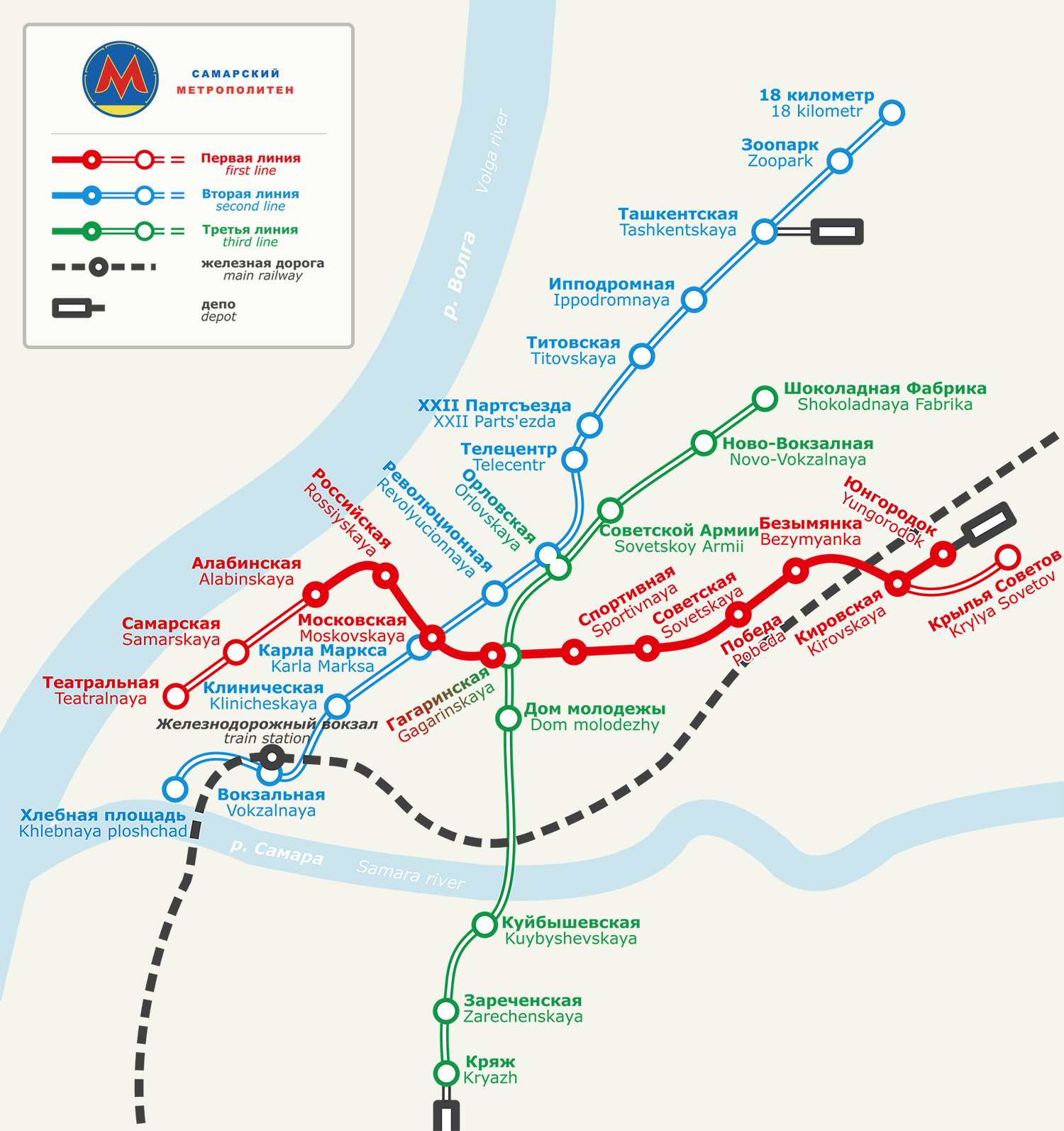
Samara Metro Lines and stations
The Samara Metro currently runs one line, Line 1, between Yungorodok and Alabinskaya. The route plan is simple: a single corridor with ten stations, useful for everyday local transport and for visitors checking the stations map before a trip.
The line opened in stages from 1987 to 2015. The first section, Yungorodok to Pobeda, opened on 26 December 1987. Later extensions added the remaining stations, with Alabinskaya opening on 1 February 2015.
| Station | Details |
|---|---|
| Yungorodok | The only surface station on the Samara Metro. |
| Kirovskaya | Named in honour of Sergei Kirov. |
| Bezymyanka | The name means Unnamed district. |
| Pobeda | The name means Victory. |
| Sovetskaya | The name means Soviet. |
| Sportivnaya | The name refers to sport. |
| Gagarinskaya | Named in honour of Yuri Gagarin. |
| Moskovskaya | Named after Moscow. |
| Rossiyskaya | Opened in December 2007. |
| Alabinskaya | The newest station on the operating line. |
Planning materials also describe a future second line. Figures vary: some list it as 8.77 kilometres (5.45 miles) with six stations, while other expansion descriptions give 9.57 kilometres (5.95 miles). No confirmed opening date has been announced.
Schedule and frequency
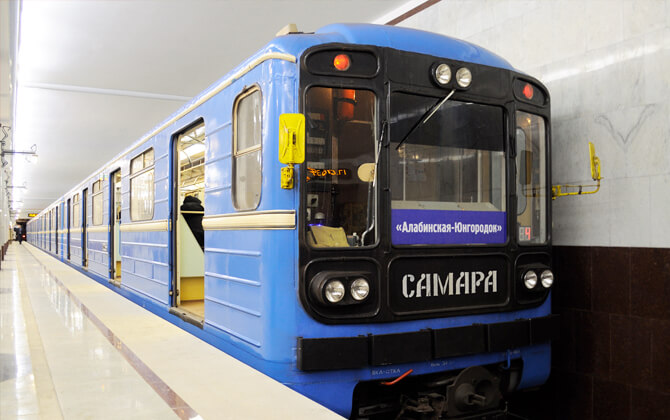
Line 1 operates daily between Yungorodok and Alabinskaya. The main operating hours are listed as 05:30 to 00:30, though some published information describes the opening hours as roughly 6:00 a.m. to midnight. First train and last train times can vary by station, so the most reliable option is to check the timetable for the stop you plan to use.
| Service detail | Timings |
|---|---|
| Starting time | 05:30 in the main published schedule |
| Opening times | Some sources describe service as roughly 6:00 a.m. to midnight |
| Closing time | 00:30 in the main published schedule |
| Frequency | About every 10 to 12 minutes during the day |
| Running time | About 21 minutes across the full line |
| Route timetable | Daily service between Yungorodok and Alabinskaya |
The train schedule does not include extra peak-hour trains in the available information. Average speed is around 34 kilometres per hour, and stations may occasionally close for up to 24 hours when maintenance work is required. For timings today or the schedule today, check the station timetable before you travel.
Fares, Tickets, and Cards
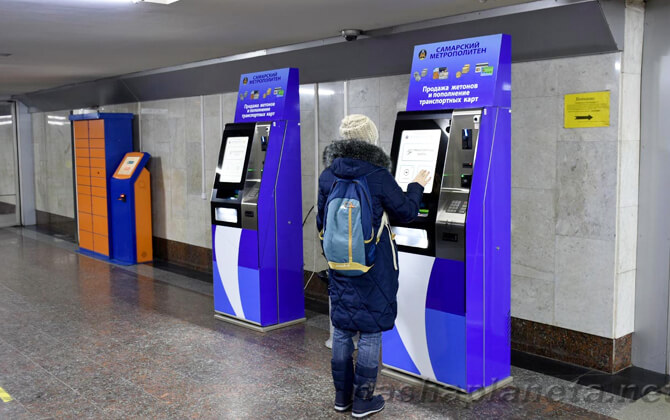
Samara Metro uses a simple fare system with single-trip tickets, transport cards, and monthly passes. The listed ticket price for one ride is 35 rubles, about US$0.40. Tickets can be bought from automatic ticket machines or manual ticket counters inside metro stations.
Because the metro fare is straightforward, most passengers do not need a fare calculator for a single ride. If you use the system often, a card or monthly pass may be more convenient than buying a separate ticket each time.
| Ticket or card | Price |
|---|---|
| Single trip ticket | 35 rubles, about US$0.40 |
| Concession ticket for students and seniors | 17 rubles, about US$0.19 |
| Monthly pass | Approximately 1,500 rubles, about US$16.70 |
Transport cards are available at metro ticket offices and may include student discounts. Some information also mentions bank card payment, along with other card-based fares and monthly passes.
Free travel is available for some passengers, including children under 7 years old, veterans, certain honor recipients, social workers, and honorary citizens of Samara.
Connections
The Samara Metro connects with buses, trams, minibuses, and trolleys across the city. These transfers make the metro a useful part of transportation in Samara, especially where the rail route meets the wider bus and tramway network.
| Station | Details |
|---|---|
| Yungorodok | Buses 8, 12, 29, and 38; tram lines 2, 3, 9, 10, 12, 13, 19, 24, and 24k; minibuses 6, 47, 230, 266, and 283. |
| Kirovskaya | Buses 21, 29, 30, 38, 47, 51, and 55; minibuses 6, 30, 38, 47, 203, 206, 207, 213, 221, 230, 247, 261, 266, 283, and 297; tram lines 2, 3, 8, 10, 19, and 25; trolleys 8, 10, 12, 13, and 18. |
| Bezymyanka | Buses 34, 41, 55, 68, 75, and 78; minibuses 34, 41, 68, 74м, 75, 89, 94, 124k, 126с, 126ю, 131, 205, 210, 217, 226, 240, 241, 247, 253, 272, 281, 298, and 480; trolleys 7 and 8в. |
| Pobeda | Buses 9, 30, 34, 41, 55, 65, 68, and 75; tram lines 2, 4, 7, 11, 12, 19, 21, and 23; minibuses 10, 34, 41, 62, 68, 74м, 75, 89, 94, 124к, 126с, 126ю, 131, 205, 210, 213, 217, 226, 240, 247, 253, 279, 281, 295, and 480; trolleys 7 and 8в. |
For airport travel, Bezymyanka is the key transfer point. Passengers can take the metro there and continue by bus 78 to Kurumoch International Airport.
Connection to the Airport
The Samara Metro does not close the gap to Kurumoch International Airport with a direct rail link. The practical route is a metro and bus combination via Bezymyanka station.
From the city, take the metro to Bezymyanka and transfer to bus 78. The bus stop is located in front of the station, and bus 78 goes directly to the airport.
For the return trip, use the same route in reverse. At the airport, board bus 78 outside the terminal, ride to Bezymyanka station, and continue on the metro.
Security
Samara Metro treats passenger safety as a core part of daily operation. The system uses railway safety checks, equipment inspections, passenger screening, and staff monitoring to keep trains and stations safe.
Every station has CCTV cameras, with video feeds sent to the station manager, the control centre, and the police. A digital system records and stores footage. Similar surveillance is used at the metro headquarters and Kirovskoe depot, where access control and alarms protect restricted areas.
Several safety upgrades have been added over time. In 2005, the metro installed a train radio system and a security system. In 2008, it added fire protection. In 2011, three stations received special security check equipment. Escalator safety has also been a priority, helping reduce escalator-related accidents.
Passenger inspection is used to reduce terrorist risks, including the monitoring of suspicious behaviour. Newer AI-based video analytics have also been introduced at Alabinskaya, Rossiyskaya, and Pobeda to detect unattended objects, unusual behaviour, and other irregularities in passenger flow.
Security work also covers traction substations, ventilation, escalators, and other infrastructure. Fire protection, remote escalator control at Moskovskaya, and routine inspections all support the wider modernization of the system.
Future Expansions
Samara Metro has long been planned as a system that could grow beyond its current single line. The main future expansion project is Line 2, intended to complement Line 1 and improve the overall transport route network.
Earlier expansion plans were delayed several times. Some work stopped because of concerns about possible damage to buildings of historical and cultural value. Political, financial, and bureaucratic issues also slowed the completion of the first line.
More recent reports say officials are again studying expansion options. Governor Vyacheslav Fedoryshchev said the region is reviewing locations for five additional stations, with a focus on making the metro more complete, integrated, and economically effective. A development scheme for the metro is expected to be approved in 2027.
Future growth is also being considered as part of a wider public transport network, including links with light rail and other modes. Another development scheme mentions additional sections of Line 2 and a new branch from Moskovskaya toward Sozgorod, crossing the Samara River, with several stations and a depot. These plans still depend heavily on funding.
The opening of Teatralnaya is expected to be an important milestone. Officials have said passenger numbers in Samara could rise after the station opens in the first quarter of 2027, and its performance may influence the next stage of metro development.
History
Samara, known as Kuybyshev during the Soviet period, sits at the confluence of the Samara and Volga rivers. The city grew quickly in the 20th century thanks to its waterways, railways, and industry. By the late 1970s, its population had passed one million, meeting the Soviet threshold for a rapid transit system.
Metro planning followed the standard Soviet triangle concept, but Samara’s layout required changes. The business, commercial, and historical center lies along the Volga River at the edge of the city, so the first stage was designed beneath the central corridor before future growth westward along the riverbank toward the central railway terminal.
Construction began in 1980 with a first four-station section of 4.5 kilometres (2.8 miles). The metro opened to passengers on 25 December 1987, becoming the fifth metro system in Russia and the twelfth in the former Soviet Union. Despite its modest size, the new line quickly became heavily used.
The second stage was planned soon after, but the collapse of the Soviet Union and the economic problems that followed slowed progress. A three-station extension originally expected in 1991 opened gradually between December 1992 and December 1993.
Work on the third planned stage began in 1991, then moved very slowly. The first station of this stage opened in December 2002, and the second followed in 2007. Alabinskaya was planned for 2010 but opened in 2015. Samara Metro builders also helped complete Kazan Metro in 2005, and Kazan later provided a newer tunnel boring machine for work between Rossiyskaya and Alabinskaya.
Timeline
| Segment | Date opened | Length |
|---|---|---|
| Yungorodok – Pobeda | 26 December 1987 | 4.5 km (2.8 mi) |
| Pobeda – Sovetskaya | 31 December 1992 | 1.6 km (1.0 mi) |
| Sovetskaya – Sportivnaya | 25 March 1993 | 1.4 km (0.9 mi) |
| Sportivnaya – Gagarinskaya | 30 December 1993 | 1.5 km (0.9 mi) |
| Gagarinskaya – Moskovskaya | 12 December 2002 | 1.3 km (0.8 mi) |
| Moskovskaya – Rossiyskaya | 26 December 2007 | 1.1 km (0.7 mi) |
| Rossiyskaya – Alabinskaya | 1 February 2015 | 1.3 km (0.8 mi) |
| Total | 10 stations | 12.7 km (7.9 mi) |
The metro is operated by Samarsky Metropoliten, a municipal company privatized from the Russian Ministry of Rail services in the early 1990s. It manages and repairs tunnels, track, rolling stock, stations, and construction coordination.
Although the first line was originally planned for completion in 2015, much of the development was delayed by political, financial, and bureaucratic problems. Work on two planned extension stations stopped because of risks to buildings of historical and cultural value.
Nearby Attractions
Samara Metro is a handy starting point for sightseeing, especially if you want to combine transport history with city walks. Several well-known places are within reach of stations or can be visited after a short ride and walk.
| Station | Details |
|---|---|
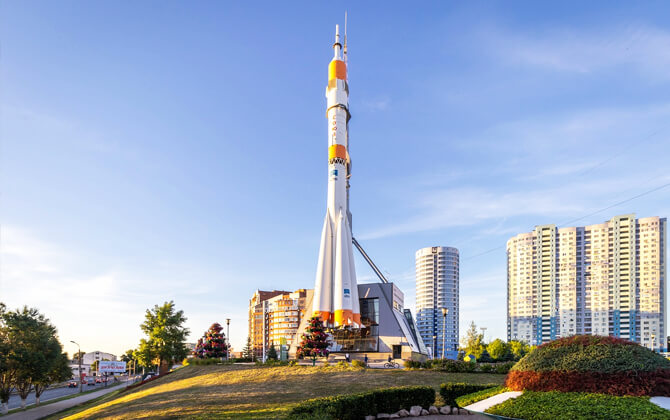
| Rossiyskaya | A practical stop for the Municipal Museum Cosmic Samara, where exhibits focus on space technology and the city’s role in the Space Race. |
| Alabinskaya | Close to the Samara Regional State Library of Science, known for its architecture and cultural events. |
| Bezymyanka | Useful for passengers heading toward Kurumoch International Airport by bus 78. |
- Kuibyshev Square, Leningradskaya Pedestrian Street, and the Samara embankment are major city-center walking areas and can be combined into one sightseeing route.
- Stalin’s Bunker is one of Samara’s best-known museums, but it requires a guided visit by appointment.
- Samara Space Museum, Zhiguli Brewery, and the Monument of Glory are also listed among the city’s popular attractions.
- For children, useful options include the Raduga Cultural and Exhibition Center, the Children’s Art Gallery, the Frog Museum, the Volga Museum of Railway Equipment, Victoria Water Park, and Samara Zoo.
Before planning a visit, check opening hours carefully. Many museums in Samara close on weekends or holidays, and some may have sanitary days or seasonal closures.