Los Angeles Metro Bus is the main transit bus service operated by the Los Angeles County Metropolitan Transportation Authority, or Metro, in Los Angeles County, California. It serves the Los Angeles Basin, the San Fernando Valley, and the western San Gabriel Valley, with local transport, regional connections, and links to Metro Rail, Metro Busway, Metrolink, Amtrak, and other public transport agencies. As of December 2024, the system includes 116 routes excluding Metro Busway lines, uses a large CNG and battery-electric fleet, and remains a core part of transportation in Los Angeles County.
| Key | Information |
|---|---|
| Operator | Los Angeles County Metropolitan Transportation Authority, known as Metro |
| Service area | Los Angeles Basin, San Fernando Valley, and western San Gabriel Valley |
| Route network | 116 routes as of December 2024, excluding Metro Busway lines |
| Main service types | Local, Rapid, Limited, Express, shuttle, and busway-related services |
| Fleet | 2,066 buses as of 2024, including CNG and battery-electric vehicles |
| Ridership | 242,600,700 annual rides in 2024, with about 763,700 weekday boardings in the fourth quarter |
| Fare payment | TAP card, Apple Wallet, TAP app, and cash on eligible buses |
| Regular fare | $1.75 (US$1.75) for a one-way Metro ride |
Los Angeles Metro Bus Map
Los Angeles Metro Bus map shows all available stops. Click on the map to enlarge it, or download a high-quality PDF version of the Los Angeles bus route map.
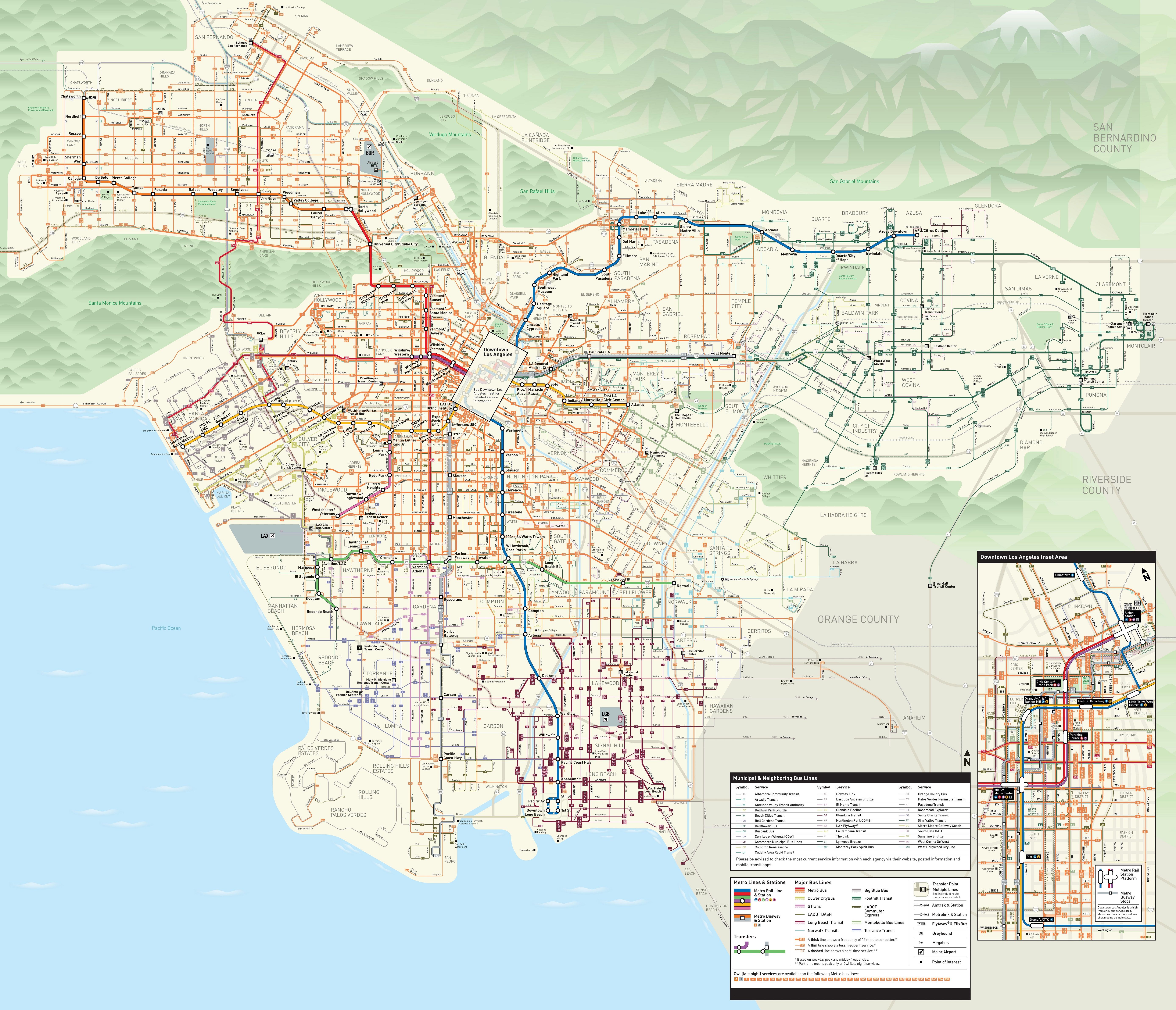
Routes, Stops, and Service Types
Los Angeles Metro Bus is built around a broad route network rather than one central bus terminal. Routes serve neighborhood streets, major corridors, rail stations, park-and-ride lots, transit centers, and regional destinations across the county.
Most lines are local services that stop at marked stops roughly every two blocks. Limited-stop and Rapid-style routes focus on major intersections, while Express routes use Southern California freeways for faster regional travel. Metro Busway routes are numbered separately in the 900s and operate as bus rapid transit services.
For trip planning, riders usually start with a stations map or route map, then check the stations list, stop list, route timetable, and real-time arrivals for the specific line. That matters because operating hours, opening times, working hours, and frequency vary widely by route.
Local, Limited-Stop, Express, and Busway Services
Metro uses route numbers and service patterns to help riders understand the bus system at a glance. Local routes handle most neighborhood and corridor trips. Limited-stop and Rapid routes reduce the number of stops to speed up travel. Express routes are designed for longer regional trips, often using freeways.
- 400s: freeway express routes to and from Downtown Los Angeles
- 500s: freeway express routes in other areas
- 600s: shuttle and circulator routes
- 700s: limited-stop rapid routes
- 800s: Metro Rail routes and supplementary shuttles for suspended rail service
- 900s: Metro Busway routes
Examples include Line 344 as a limited-stop route and Line 460 as a freeway express route to and from Downtown Los Angeles. Metro has also used service branding such as Metro Local, Metro Rapid, Metro Express, and Metro Liner, although separate bus brand colors were retired in 2020 as part of the NextGen Bus Plan.
Major Corridors and Transit Hubs
Major corridors include Wilshire Boulevard, West Olympic Boulevard, West Pico Boulevard, West Washington Boulevard, West Jefferson Boulevard, and West Adams Boulevard. These streets connect dense activity centers such as Downtown Los Angeles, Westwood, Santa Monica, Century City, Miracle Mile, Culver City, and the Arts District.
Several hubs are especially useful when building a route plan, transferring between bus and rail, or checking a stations map before you travel.
| Station | Details |
|---|---|
| Union Station | Major downtown hub for Metro Bus, Metro Rail, Metrolink, Amtrak, FlyAway, municipal buses, and regional connections |
| 7th Street/Metro Center | Central transfer point for downtown rail and bus service |
| North Hollywood station | Important San Fernando Valley transfer point for Metro Rail and bus routes |
| Pico/Rimpau Transit Center | Bus transfer hub serving central Los Angeles corridors |
| Washington/Fairfax Transit Hub | Transfer point for routes serving the Mid-City and Westside area |
| LAX/Metro Transit Center | Airport-area hub for Metro Bus, Metro Rail, regional buses, and the free LAX shuttle |
| Willowbrook/Rosa Parks station | Major South Los Angeles transfer point for bus and rail service |
| Harbor Gateway Transit Center | South Bay and Harbor-area bus hub with park-and-ride access |
| Wilshire/Western station | Key transfer point in the Wilshire corridor |
Some lines play a major cross-county role. Line 40 links Union Station with Redondo Beach Transit Center and LAX/Metro Transit Center. Line 51 connects Westlake/MacArthur Park and Downtown LA with CSU Dominguez Hills in Carson. Line 460 is one of the longest Metro bus routes, connecting Downtown Los Angeles with Anaheim.
Frequent Service and Night Bus Options
Metro Bus includes frequent daytime service on busy corridors, late-night service on selected routes, and 24-hour operation on some lines. Many routes operate before 5 am and after midnight, while others run only during the day or weekday peak periods.
Selected 24-hour routes include Lines 4, 18, 20, 30, 40, 45, 55, 111, 162, 204, 224, 233, 246, and 251. Other frequent lines include major corridor routes such as 2, 16, 28, 33, 51, 232, 251, 720, and 901, with frequency depending on the time of day and day of week.
If your trip includes Metro Rail, check the train schedule as well as the bus timetable. Recent Metro rail service updates include later trains on the A and E Lines, with last train departures listed by line and direction, so the closing time for a full trip can depend on both bus and rail timings.
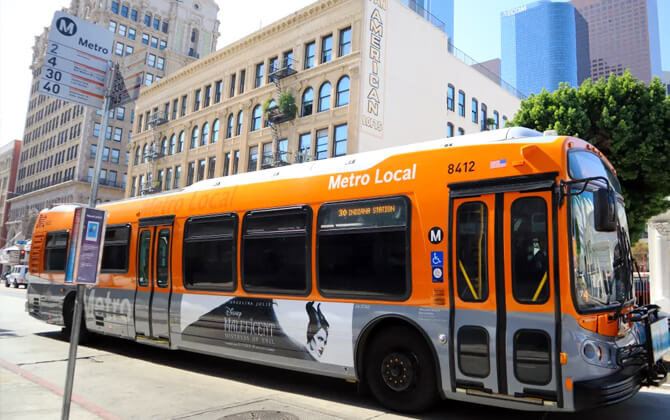
Schedule and Frequency
Los Angeles Metro Bus schedules vary by route, direction, and day of operation. Some buses run daily, some are weekday-only, and others operate mainly during peak commute periods. For schedule today, timings today, opening hours, starting time, closing time, and last bus details, always check the specific route timetable before leaving.
| Service detail | Timings |
|---|---|
| Typical daily coverage | Many routes begin before 5 am and continue after midnight |
| 24-hour bus examples | Lines 4, 18, 20, 30, 40, 45, 55, 111, 162, 204, 224, 233, 246, and 251 |
| Line 2 weekday peak frequency | About every 7.5 minutes |
| Line 16 weekday peak frequency | About every 5 to 6 minutes |
| Line 28 weekday peak frequency | About every 6 to 8 minutes |
| Line 33 service | About every 7.5 minutes on weekdays and every 10 minutes on weekends |
| Line 111 weekday service | About every 10 minutes |
| Line 125 weekday midday service | About every 20 minutes |
Several routes have revised schedules to improve reliability, including Lines 20, 30, 40, 45, 51, 60, 70, 81, 92, 102, 105, 111, 115, 117, 120, 152, 154, 162, 204, 232, 251, 460, 501, 603, 605, 690, 720, and 761. A few contracted routes may not appear in Metro real-time arrival data, so the printed or PDF timetable can still be useful.
How to Check a Specific Route Schedule
To check a Metro bus schedule, search by bus number, choose your direction, and select a bus stop or rail station. This is the quickest way to see the current route, opening times, frequency, and real-time arrivals without sorting through the full system.
- Select the route number.
- Choose the travel direction.
- Pick a bus stop or rail station.
- Review real-time arrivals, service notes, and PDF timetable details.
Regional System Maps show transit service in five sectors of Metro’s service area. They are useful for comparing routes, building a route plan, and checking bus-to-rail connections across the wider public transport network.
Weekday, Weekend, and Holiday Service
Weekday, Saturday, Sunday, and holiday service can differ on the same route. Some lines operate every day, some run only on weekdays, and some are designed for weekday peak hours. Holiday timings vary, so check the individual train schedule or bus schedule today if your trip falls on a holiday.
| Service detail | Timings |
|---|---|
| Daily service examples | Lines 4, 20, 28, 30, 40, 45, 205, 206, 207, 210, 212, 218, 287, 501, and 665 |
| Weekday-only service examples | Lines 202, 209, and 235 |
| Weekday peak service examples | Lines 489 and 550 |
| Weekend and holiday differences | Line 287 has separate weekday and weekend terminal patterns; Line 212 notes that holiday service varies |
For the most accurate running time, check the exact route timetable in your direction. Traffic, construction, special events, and service changes can all affect bus timings today.
Fares, TAP Cards, and Transfers
The regular Metro fare is $1.75 (US$1.75) for a one-way ride on Metro bus or rail. Paying with a TAP card, Apple Wallet, or the TAP app includes 2 hours of free Metro transfers. Cash is accepted on eligible buses, but cash does not include transfers and cannot be used to ride Metro Rail.
A TAP card costs $2 (US$2) plus fare and works across Metro bus and rail, as well as many TAP partner agencies in LA County. For most Metro-only trips, a fare calculator is simple: one regular ride is $1.75 (US$1.75), and fare capping limits how much you pay in a day or week when you keep using the same TAP card or Apple Wallet.
Paying with TAP, Mobile Wallet, or the TAP App
TAP is the easiest way to pay for Metro Bus because it unlocks free Metro transfers and fare capping. You can use a physical TAP card, add TAP to Apple Wallet, or use the TAP app to load Stored Value, manage your card, and check your balance.
TAP cards are available at TAP vending machines at Metro rail, J Line, and G Line stations, at Metro Customer Centers, online, by phone, and through many retail partners across Los Angeles County, including Ralph’s, Northgate Market, and Continental Currency.
For events or busy stations, mobile payment can save time. Metro suggests loading $3.50 (US$3.50) for a round trip if you are taking two regular Metro rides.
Paying Cash on the Bus
Exact change is accepted on buses that do not have All-Door Boarding. Cash works at bus fareboxes, but it does not include transfers. If your trip includes Metro Rail, use a TAP card, Apple Wallet, or the TAP app instead.
Alert Metro tokens are no longer accepted. If you ride more than once, TAP is usually the better option because it supports transfers, fare caps, and balance protection when the card is registered.
Transfers and Fare Capping
With each paid TAP ride, Metro includes 2 hours of free transfers to other Metro lines. You still need to tap at each boarding, and the trip must be completed within the 2-hour window. Exiting and re-entering a station counts as a new ride.
Fare capping means you pay per ride until you reach a cap, then additional Metro rides are free for the rest of that cap period. Regular fare riders never pay more than $5 (US$5) in a day or $18 (US$18) within seven days. Reduced fare caps are lower: seniors and persons with disabilities pay no more than $2.50 (US$2.50) per day and $5 (US$5) within seven days, while students pay no more than $2.50 (US$2.50) per day and $6 (US$6) within seven days.
Transfers from municipal operators to Metro can be made with TAP within 2½ hours from the first tap. The regular transfer fee is 50¢ (US$0.50), and the reduced fare transfer fee is 25¢ (US$0.25). If you transfer from Metro to another municipal operator and then back to Metro, you must pay the Metro base fare again when re-entering the Metro system.
- Load Stored Value onto your TAP card before the trip.
- Tap when you first board.
- Tap again when you transfer.
- The transfer fare is deducted automatically when required.
Reduced Fares and Student Programs
Metro offers reduced fare programs for eligible riders. Seniors 62+, Medicare customers, and customers with disabilities can receive up to 80% off regular Metro fares. Children under age 6 may ride free with a fare-paying adult on bus or rail.
K-12 and community college students at participating GoPass schools ride free. Students without GoPass may still qualify for reduced student fares and fare caps.
- Student K-12 base fare: $0.75 (US$0.75)
- Student K-12 1-Day cap: $2.50 (US$2.50)
- Student K-12 7-Day cap: $6 (US$6)
- College/Vocational base fare: $1 (US$1)
- College/Vocational 1-Day cap: $2.50 (US$2.50)
- College/Vocational 7-Day cap: $6 (US$6)
The LIFE Program also offers savings for households with income below $53,000 (US$53,000) per year. Other options include college and university discounts, employer pass programs, EZ Pass, and Metrolink Mobility-4-All for riders with a valid California Electronic Benefit Transfer card.
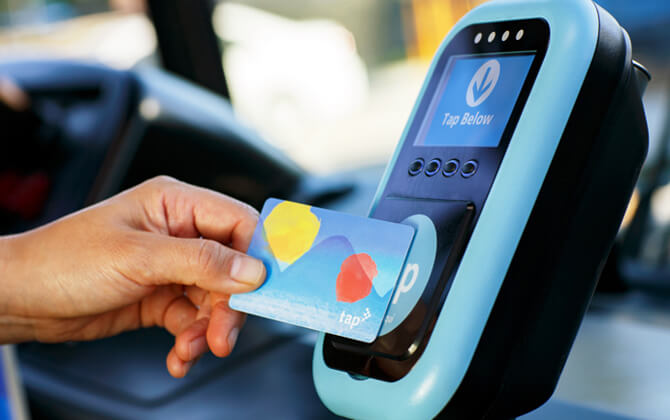
Connections with Metro Rail and Other Transit
Metro Bus connects with Metro Rail, Metro Busway, Metrolink, Amtrak, Metro Bike Share, Metro Micro, FlyAway, and municipal bus agencies across Los Angeles County. These links make the bus system part of a wider city transport network rather than a stand-alone bus service.
Many transfers happen at rail stations and transit centers. TAP payment helps simplify these trips because one card can be used on Metro bus and rail and on many partner agencies. If your route plan includes a bus-to-train connection, check both the bus timetable and the train schedule before traveling.
Metro Rail and Metro Busway Transfers
Metro includes 2 hours of free transfers between Metro Bus, Metro Rail, and other Metro lines when you pay with TAP, Apple Wallet, or the TAP app. The regular ride price is $1.75 (US$1.75), and children under age 6 may ride free with a fare-paying adult.
Tap when you first board, then tap again for each transfer. If you leave and re-enter a station, Metro charges a new ride. Fare capping still applies when you use the same TAP card or Apple Wallet.
Metro Busway routes use the 900s numbering series and provide bus rapid transit service. The G Line and J Line have their own station-based service patterns and require TAP payment.
Union Station, Metrolink, and Amtrak
Los Angeles Union Station is one of the most important public transport hubs in Southern California. It connects Metro Bus, Metro Rail, Metrolink, Amtrak, Metro Bike Share, FlyAway, Greyhound, and several municipal bus services.
Metro A, B, D, and J Line services reach Union Station. Metrolink lines serving the station include the 91/Perris Valley, Antelope Valley, Orange County, Riverside, San Bernardino, and Ventura County lines. Valid tickets are required on Metrolink platforms and trains.
Amtrak services at Union Station include the Pacific Surfliner and long-distance trains such as the Coast Starlight, Southwest Chief, Sunset Limited, and Texas Eagle. Patsaouras Transit Plaza on the east side of the station serves connecting bus service, including Metro buses, municipal buses, FlyAway service to LAX, and other regional connections.
Municipal Bus Agencies and TAP Partners
Metro is the main bus operator in the Los Angeles Basin, the San Fernando Valley, and the western San Gabriel Valley, but it works within a much larger local transport network. TAP is accepted by many partner agencies, making regional transfers easier.
Partner and connecting services include Big Blue Bus, Foothill Transit, Culver CityBus, Long Beach Transit, Montebello Bus Lines, Norwalk Transit System, Torrance Transit, Access Services, Metrolink, Metro Bike Share, and Metro Micro. One TAP card or virtual TAP card can be used across many of these systems, with fare products available through vending machines, stores, customer centers, and mobile tools.
Los Angeles Metro Bus to LAX
Los Angeles Metro Bus serves the LAX/Metro Transit Center, the main Metro hub for airport connections. Riders can reach the station by Metro Bus, Metro C Line, Metro K Line, and regional bus services, then use the free LAX shuttle to airport terminals.
The regular Metro fare to reach the transit center is $1.75 (US$1.75) and includes 2 hours of free Metro transfers when paid with TAP. From the transit center, the airport shuttle is free and serves all terminals.
Metro Bus Lines Serving LAX/Metro Transit Center
Metro Bus lines 102, 111, 117, 120, and 232 serve LAX/Metro Transit Center. Line 40 also serves the station as an owl route. The station is also served by other agencies, including Big Blue Bus, Culver CityBus, Beach Cities Transit, GTrans, and Torrance Transit.
| Station | Details |
|---|---|
| LAX/Metro Transit Center | Metro Bus 102 to Westchester, Huntington Park, and University Park |
| LAX/Metro Transit Center | Metro Bus 111 to Westchester and Norwalk |
| LAX/Metro Transit Center | Metro Bus 117 to Downey |
| LAX/Metro Transit Center | Metro Bus 120 to Whittier and Norwalk |
| LAX/Metro Transit Center | Metro Bus 232 to Long Beach |
| LAX/Metro Transit Center | Metro Bus 40 owl route to Downtown LA |
| Bus Bays 1 and 2 | Free LAX shuttle to all airport terminals |
The bus plaza has 16 bays, and bus bay hours align with the service of each Metro and municipal route. For airport trips, give yourself extra time, especially if you are traveling with luggage or during heavy traffic.
Free Shuttle Between LAX/Metro Transit Center and Airport Terminals
From LAX/Metro Transit Center, follow signs to Bus Bays 1 and 2 for the free LAX shuttle. The shuttle runs every 10 minutes, serves every terminal, and is wheelchair accessible.
| Service detail | Timings |
|---|---|
| LAX shuttle operating hours | Daily from 5:00 am to 1:00 am |
| LAX shuttle frequency | Every 10 minutes |
| Downtown Los Angeles to LAX estimate | About 45 to 60 minutes, depending on starting point and conditions |
The LAX People Mover is expected to provide a direct rail link from LAX/Metro Transit Center to the terminals in 2026. Until then, the free shuttle remains the connection between the station and the airport terminals.
Tips and Rules
Riding Metro Bus is straightforward once you know the basics. Have your ticket, TAP card, or phone ready before boarding, stand where the operator can see you, and check the head sign for the route number and destination.
- Arrive a few minutes early, especially if the route has limited frequency.
- Make eye contact or wave as the bus approaches if you need to signal it to stop.
- Wait for the bus to come to a complete stop before boarding.
- Let riders using wheelchairs or mobility devices board and exit first.
- Watch and listen for your stop.
- About one block before your stop, press the STOP button or pull the yellow cord.
- Exit through the rear door when possible.
- Never run after or alongside a moving bus.
- If you use the front bike rack, tell the operator before removing your bike.
Strollers, luggage, mobility devices, and bikes are allowed when space is available. Riders with wheelchairs have priority in securement areas. Service animals are welcome; pets and emotional support animals must be in enclosed carriers.
During an earthquake, stay onboard unless the operator gives other instructions. If evacuation is needed, the operator will direct riders to a safe area. In everyday travel, staying alert and standing back from the curb makes the ride safer for everyone.
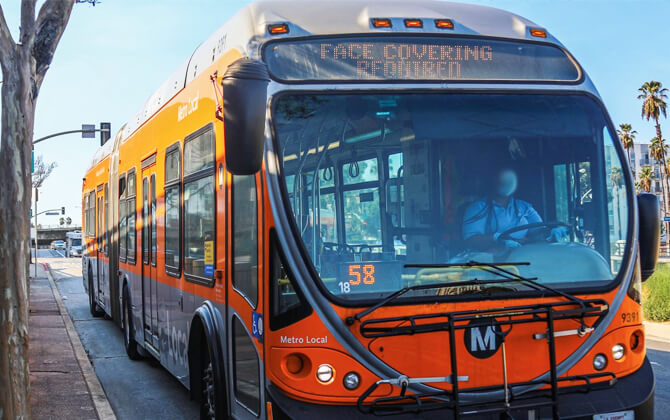
Metro Parking and Park-and-Ride Lots
Metro station parking varies by location. Some stations have large lots, while many stations, especially in city centers, have no parking. System-wide, Metro has 24,121 parking spaces for commuters who drive to stations and continue by public transport.
Parking charges, parking charges per day, permit rules, and availability can change by station and event. Regular transit parking is available at many lots, and parking is permitted in Metro lots for up to 72 consecutive hours while using transit. For stays longer than 72 hours, an extended permit is required.
For 2026 World Cup match days on June 12, 15, 18, 21, 25, 28, and July 2 and 10, regular transit parking will be $10 (US$10) at Harbor Gateway Transit Center, North Hollywood, Norwalk, Aviation/Imperial, Lakewood Bl, El Monte, and Atlantic stations. Regular transit parking will not be available at Hawthorne/Lennox, Crenshaw, and Pierce College stations on those match days. Union Station event rates will apply for regular non-reserved parking, with details to be checked closer to travel.
Some of the largest free lots are at El Monte, Norwalk, and Sepulveda. Park-and-ride lots across the SoCal 511 region can also help riders connect with a carpool, vanpool, bus, or train. Most are free, though some require permits or fees.
Brief History and Network Changes
Metro Bus traces its modern history to 1993, when the Southern California Rapid Transit District and the Los Angeles County Transportation Commission merged to form Metro. The new authority became responsible for operating the bus system, financing rail construction, and coordinating transportation programs across Los Angeles County.
In the 1990s, Metro faced major debates over bus service, fare policy, and rail investment. A class action lawsuit challenged funding priorities, and the resulting consent decree required Metro to expand bus service.
Metro Rapid launched in 2000 on Wilshire/Whittier and Ventura boulevards. The limited-stop service was designed to be faster than conventional local buses and quickly attracted strong ridership, shorter travel times, and improved customer satisfaction.
Metro also modernized its fleet with low-floor buses and compressed natural gas vehicles. By 2003, it was the largest operator of CNG buses in the United States. TAP arrived in 2008 and later replaced paper interagency transfers, making bus, rail, and partner-agency trips easier to combine.
The NextGen Bus Plan, introduced in 2019 and approved in 2021, brought a major redesign. It eliminated most Metro Rapid routes, simplified routing, converted some low-ridership services to Metro Micro, removed some closely spaced stops, and retired separate orange, red, and blue bus branding in favor of a more unified system.
By February 2026, Metro Bus operated a fleet of 2,086 buses, including CNG and battery-electric vehicles, with additional hydrogen fuel-cell and battery-electric buses on order. Ridership remained substantial, with 236,942,000 trips in 2025 and about 719,300 weekday riders in the fourth quarter.
Future Improvements and Service Updates
Metro continues to adjust bus service based on rider feedback, operator input, ridership, and travel time data. The goal is simple: better reliability, shorter waits, added capacity where demand is growing, and stronger connections to major destinations.
In the San Fernando Valley, Lines 152 and 166 are planned to run every 10 minutes during the busiest weekday peak periods, with added weekday trips. Line 158 will add 25 trips on part of the route, while Lines 165 and 169 will receive added peak or weekday service.
In the San Gabriel Valley, Line 76 will be rerouted for faster access to Downtown Los Angeles and direct service via Alameda Street to Little Tokyo/Arts District Station. Line 267 will be extended from Pasadena to Altadena, replacing Line 686, with later evening service and weekday frequency increasing to every 30 minutes on the former Line 686 segment. Line 268 will be extended to better serve Sierra Madre and rerouted to improve access to El Monte Metrolink Station.
In the Gateway Cities, Line 265 on Paramount Boulevard will improve weekday frequency from every 60 minutes to every 40 to 45 minutes. In the South Bay, Line 108 in the City of Commerce will shift its terminus slightly north to Harbor Street.
On the Westside and in Central Los Angeles, Line 81 will move its northbound terminal near Eagle Rock Plaza, and two southbound weekday peak trips will be added. Line 217 will extend from Vermont/Hollywood to Eagle Rock via Glendale, with Lines 180 and 217 scheduled together to improve shared-segment frequency. In Westwood, Lines 20, 602, and 720 will no longer travel through the federal GSA building parking lot, resulting in a new Line 602 terminus and revised eastbound routing for Lines 20 and 720.
Metro will also revise schedules on 49 weekday, 42 Saturday, and 41 Sunday bus lines to improve reliability. These changes fit the broader NextGen Bus Plan, which focuses on a faster, more frequent, more reliable, and more accessible bus network.
Popular Places Reachable by Los Angeles Metro Bus
Los Angeles Metro Bus reaches many major destinations across the Greater Los Angeles area, either directly or with a transfer to rail, shuttle, or another bus. It is useful for downtown trips, airport access, stadium events, museums, neighborhood centers, and beach-area connections.
- Downtown Los Angeles
- Long Beach
- Little Tokyo
- Pasadena
- Hollywood
- Universal Studios
- Santa Monica
- Expo Park
- Los Angeles Memorial Coliseum
- BMO Stadium
- Los Angeles Convention Center
- Crypto.com Arena
- Dodger Stadium
- SoFi Stadium
- Intuit Dome
Some venues are easiest with a transfer or dedicated shuttle. Dodger Stadium has bus service from Union Station, while SoFi Stadium and the Intuit Dome have shuttles from the LAX Transit Center. Check your route before you go, especially on event days.
FAQ
Is Los Angeles Metro Bus the same as LA Metro?
Los Angeles Metro Bus is part of LA Metro, the agency officially known as the Los Angeles County Metropolitan Transportation Authority. Metro plans, operates, and coordinates much of the public transportation in Los Angeles County, and Metro Bus is its main local bus service.
LA Metro also operates Metro Rail, Metro Busway, and Metro Micro. In the city of Los Angeles, Metro Bus carries most public bus service, while LADOT operates the smaller DASH bus system in some overlapping areas.
How do I pay for a Metro bus ride in Los Angeles?
You can pay with a TAP card, Apple Wallet, the TAP app, or cash on eligible buses. The regular ticket price is $1.75 (US$1.75). TAP is usually the best option because it includes 2 hours of free Metro transfers and supports fare capping.
If you pay cash, use exact change. Cash does not include transfers and is not accepted for Metro Rail, where TAP payment is required.
Can I transfer from Metro Bus to Metro Rail?
Yes. When you pay with TAP, Apple Wallet, or the TAP app, Metro includes 2 hours of free transfers between Metro Bus and Metro Rail as part of a one-way trip. Tap at each boarding so the system recognizes the transfer.
Exiting and re-entering a station is charged as a new ride. Transfers from a municipal operator to Metro must be made within 2½ hours of the first tap and may include a transfer fee.
Do Metro buses go to LAX?
Yes. Metro Bus lines 102, 111, 117, 120, and 232 serve LAX/Metro Transit Center, and Line 40 serves it as an owl route. From Bus Bays 1 and 2, a free shuttle connects the transit center with all LAX terminals.
The station also connects with the Metro C Line, Metro K Line, and other bus agencies including Big Blue Bus, Culver CityBus, Beach Cities Transit, GTrans, and Torrance Transit.
How do I know when the next bus is coming?
Select your route, direction, and stop to view real-time arrivals. You can also look up predictions by bus stop number and save frequent routes or stops as favorites.
For the most reliable planning, check both real-time arrivals and the published timetable, especially late at night, on weekends, or during service changes.
Can I bring a bike, stroller, or luggage on the bus?
Yes. Bikes, strollers, luggage, and mobility devices are allowed when space is available. All Metro buses have front bike racks, and G Line buses have three racks. Tandem, 3-wheeled, and fuel-powered bikes are not allowed.
Strollers may use the wheelchair securement area when available, but riders using wheelchairs have priority. If you are removing a bike from the rack, tell the bus operator first.
Are Los Angeles Metro buses accessible?
Yes. Metro buses include accessibility features such as low-floor entry, ramps, automated stop announcements, and operator assistance. The wheelchair securement area is 30″ x 48″, and two wheelchairs are allowed on the bus at a time.
Most scooters and power chairs can be accommodated if they fit safely on the ramp and within the securement area. Service animals are welcome on Metro buses and trains, while pets and emotional support animals must be in enclosed carriers.