Port Authority Trans-Hudson, usually called PATH, is a 13.8-mile (22.2 km / 13.8 mi) rapid transit system linking Newark, Harrison, Jersey City, and Hoboken in New Jersey with Lower and Midtown Manhattan in New York City. It is operated by the Port Authority of New York and New Jersey and runs 24 hours a day, all year. On weekdays, four routes serve 13 stations during the day, while two routes operate on weekends, late nights, and holidays. Although it works much like a metro, PATH is legally classified as a commuter railroad and remains an important part of public transport and city transport on both sides of the Hudson.
| Key | Information |
|---|---|
| System name | PATH (Port Authority Trans-Hudson) |
| Type | Rapid transit system, legally classified as a commuter railroad |
| Route length | 13.8 miles / 22.2 km |
| Service area | Newark, Harrison, Jersey City, Hoboken, Lower Manhattan, Midtown Manhattan |
| Stations | 13 |
| Operating hours | 24 hours a day, 7 days a week |
| Weekday service | 4 daytime routes |
| Weekend and late-night service | 2 routes |
| Operator | Port Authority of New York and New Jersey |
| Rolling stock | PA5 |
PATH Rail Sistem Map
Map of Port Authority Trans-Hudson Rail Sistem showing different lines and stations. Click on the map to enlarge it or download the Rail map in PDF format.
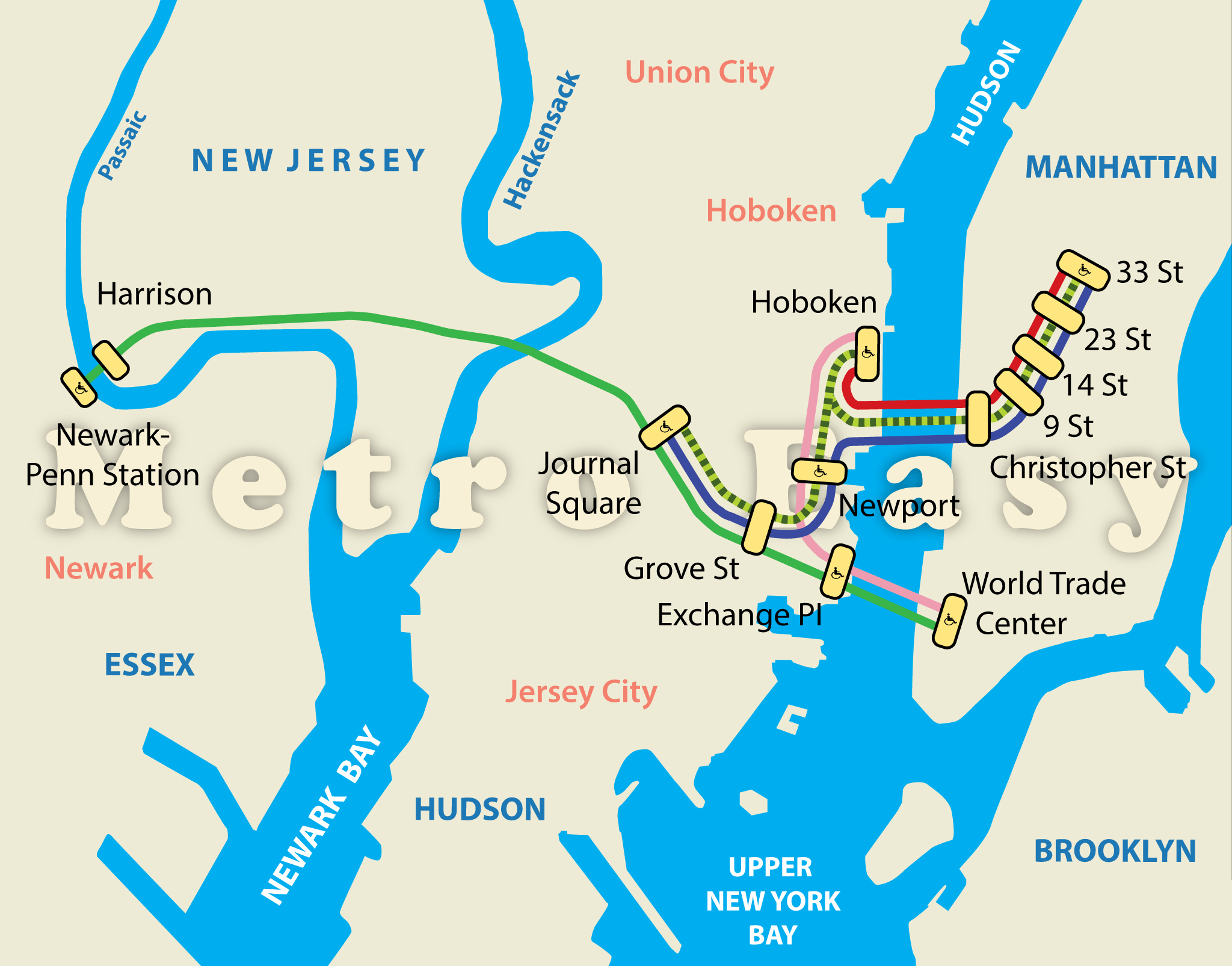
PATH Lines and Stations
Newark – World Trade Center:
- Newark
- Harrison
- Journal Square
- Grove Street
- Exchange Place
- World Trade Center
Hoboken – World Trade Center:
- Hoboken
- Newport
- Exchange Place
- World Trade Center
Journal Square – 33rd Street (via Hoboken, late night/weekends):
- Journal Square
- Grove Street
- Newport
- Hoboken
- Christopher Street
- 9th Street
- 14th Street
- 23rd Street
- 33rd Street
Journal Square – 33rd Street (via Christopher Street, weekday):
- Journal Square
- Grove Street
- Christopher Street
- 9th Street
- 14th Street
- 23rd Street
- 33rd Street
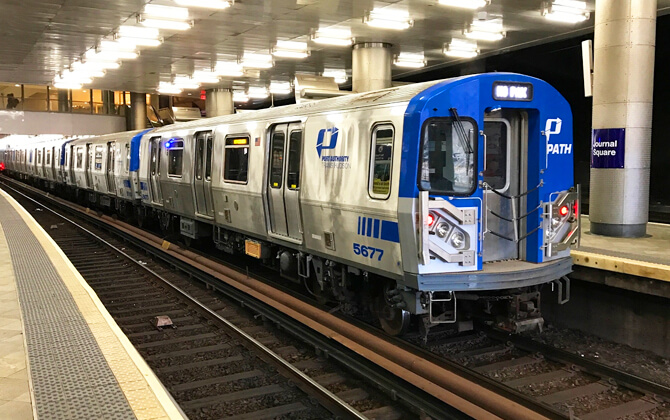
PATH Hours
PATH operating hours are 24 hours a day, seven days a week, so the system never fully closes. If you are checking opening hours, opening times, or closing time, the simple answer is that trains run around the clock.
During weekday daytime hours, four services run across the network. On weekends, late nights, and holidays, PATH operates two services instead. That means the schedule today can vary depending on the day and time, so it is worth checking the route timetable before you travel.
During peak periods, trains generally run every four to eight minutes on each service. At most stations, frequency is typically every two to three minutes in peak hours, except at Newark and Harrison, with about 20 to 30 trains per hour.
Service patterns
| Service detail | Timings |
|---|---|
| Weekdays | Newark-World Trade Center, Hoboken-World Trade Center, Journal Square-33rd Street, and Hoboken-33rd Street |
| Late nights, weekends, and holidays | Newark-World Trade Center and Journal Square-33rd Street (via Hoboken) |
| Peak frequency | Generally every 4 to 8 minutes on each service |
| Peak service at most stations | Typically every 2 to 3 minutes, except Newark and Harrison |
The Journal Square-33rd Street (via Hoboken) service combines PATH’s two Midtown services and appears with two colors on the timetable and stations map.
For exact timings today, last train information, and the latest train schedule, PATH advises riders to check the official timetable and schedule for their route.
PATH Fares, Tickets and Cards
PATH fare payment options include TAPP, SmartLink, SmartLink Gray, and MetroCard. PATH does not accept MTA OMNY cards. If you are comparing ticket price, fare, or cost, SmartLink is the main card used across the system.
SmartLink is a reloadable fare card that shows the number of days remaining and any prepaid rides available. You can buy it online, from blue SmartLink vending machines at stations, or from participating kiosks. Riders aged 65 and over can use discounted SmartLink cards.
| Fare Option | Price | Price Per Trip |
|---|---|---|
| 1-Trip SmartLink / PATH Single Ride Ticket / TAPP / Pay-Per-Ride MetroCard | $3.00 | $3.00 |
| PATH 2-Trip Ticket | $6.00 | $3.00 |
| 10 Trip SmartLink | $28.50 | $2.85 |
| 20 Trip SmartLink | $57.00 | $2.85 |
| 40 Trip SmartLink | $114.00 | $2.85 |
| Senior SmartLink Card | $1.50 | $1.50 |
| SmartLink Unlimited 1-Day Pass | $11.50 | N/A |
| SmartLink Unlimited 7-Day Pass | $39.25 | N/A |
| SmartLink Unlimited 30-Day Pass | $120.75 | N/A |
SmartLink Gray is the paper version of the card. It is sold in 10, 20, and 40 trip packs, and these tickets stay valid until all rides are used or until the expiry date. They are non-refundable.
MetroCards can also be used on PATH with pay-per-ride value, and the fare is deducted at the turnstile. A PATH 2-trip MetroCard is available as well.
There is no fare calculator included here, but the table above gives a clear price breakdown for each ticket, pass, and card option.
Connections to Other Systems
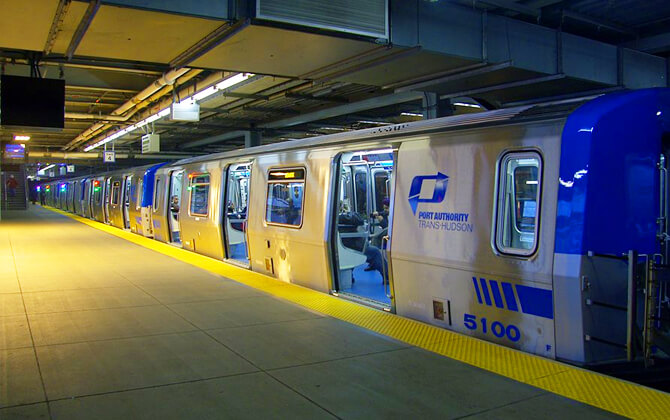
PATH connects with several other rail networks in New Jersey and New York, though transfers are not free. For many riders, it is a key part of transportation in the region and an important link between local transport, city transport, and longer-distance rail services.
In Manhattan, World Trade Center station connects directly to Cortlandt Street on the BMT Broadway Line and Chambers Street on the IND Eighth Avenue/Fulton Street/Rockaway Line. Riders can also reach multiple subway lines through the World Trade Center Transportation Hub.
In New Jersey, PATH has strong connections at Newark Penn Station and Hoboken Terminal. The Newark-World Trade Center route connects with NJ Transit commuter rail at Newark, while Hoboken offers access to NJ Transit at Hoboken Terminal. Journal Square is another major transportation hub on the system.
PATH’s route between Jersey City and Newark runs close to Conrail, NJ Transit, and Amtrak tracks, and it shares the Dock Bridge with intercity and commuter trains. Because of that arrangement, PATH is legally treated as a commuter railroad even though it functions like rapid transit.
Proposed transfer improvements and expansion plans have also focused on better airport access, including a possible extension to Newark Liberty International Airport with a connection to AirTrain Newark.
Airport Connections
PATH does not currently offer a direct airport rail link. For Newark Liberty International Airport, a PATH extension has been proposed several times, but it has not been built.
The most developed plan would extend service from Newark Penn Station to NJ Transit’s Newark Liberty International Airport Station, where passengers could transfer to AirTrain Newark for the terminals. In 2014, the Port Authority approved the project in a 10-year capital plan. Later plans continued to include it, but funding was deferred in 2023.
In December 2025, the Port Authority said the extension would be delayed by ten years because it was prioritizing the replacement of AirTrain Newark.
Earlier ideas also included a stop at Elizabeth as part of possible airport service. As things stand, PATH still does not directly serve any airport.
Parking
If you are driving to PATH, reserving a space in advance can make the trip a lot easier. Nearby station parking options are available at different price points, including spots suited to commuting, weekend travel, events, and overnight stays.
Reserve a Parking Spot Nearby
- 11 Enos Pl. (30 Journal Square – Valet Lot) — starting at $31.80
- State Square – Garage — starting at $21.20
- 2 Journal Square Plaza – Journal Square Garage — starting at $16.99
- 63 Cottage St. – Spot #1 Only — starting at $15.99
- 23 Wayne St. (95 Columbus) – Garage — starting at $15.99
- 49 Mall Drive West – Garage — starting at $13.42
Parking Rates Near PATH (Port Authority Trans-Hudson)
| Parking Type | SpotHero Average Rental Price |
|---|---|
| Commuter Parking | $20 – $30 |
| Weekend Parking | $20 – $20 |
| Event Parking | $20 – $20 |
| Overnight Parking | $25 – $25 |
If you are comparing parking charges or parking charges per day, these rates give a quick snapshot of typical costs near the system.
Reservations work much like hotel bookings: you can enter after the start time on the reservation and leave before the end time. Parking outside that window may lead to an extra charge, a ticket, or towing by the parking facility.
SpotHero customer support is available by phone at (312) 566-7768 or by email at [email protected].
Use promo code WAY5 to get an extra 5% off.
PATH Rules and Tips
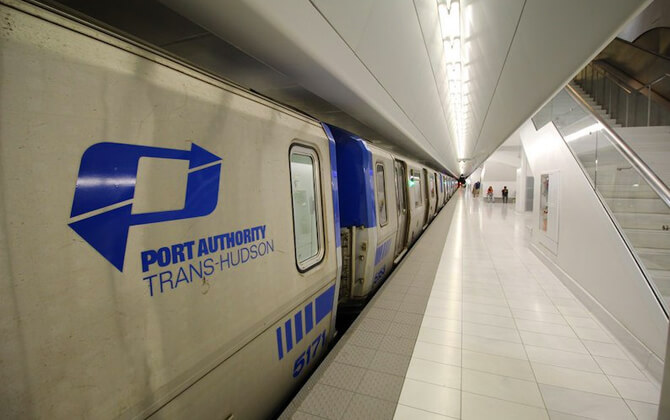
PATH has rules designed to keep the system safe and usable for everyone. Passengers must pay the required fare, or use an authorized non-revenue credential, before entering the fare zone. Access is limited to people boarding, leaving, or otherwise permitted to be there.
Hazardous items are restricted. That includes radioactive materials, explosives, acids, flammables, compressed gases, signal flares, and containers with petroleum products, paint, or varnish. Riders should also avoid any behavior that creates a fire or life-safety hazard.
PATH also prohibits actions that interfere with operations or other passengers. Skateboards, roller skates, skate wheels, bicycles, scooters, and other self-propelled devices are not allowed in PATH buildings or cars, except for wheelchairs or similar mobility devices used by disabled passengers. Blocking walkways, obstructing traffic, making disruptive noise, or tampering with station equipment is also prohibited.
Closed and restricted areas may only be entered with permission. That includes posted closed areas and spaces reserved for authorized personnel.
Passenger elevators and escalators cannot be used to carry freight. If an elevator or escalator stops unexpectedly, the incident should be reported right away to the nearest PATH Control Center through a Patron Assistance Telephone, or to the Manager if the equipment is in the Center.
At the Center, people and vehicles must not block walks, roadways, entrances, exits, waiting rooms, or other shared spaces. Access to the Bus Station portion is limited to those working there, doing business with a carrier, holding permission, or traveling to board or having recently left a bus within the allowed time.
Photography and expressive activity are subject to permit rules and location restrictions. Some areas do not allow expressive activity at all, and approved activity may require a written permit displayed on request.
When in doubt, follow posted signs, stay in authorized areas, and listen to PATH staff or police officers. That’s the simplest way to travel safe and avoid problems.
PATH Lines & Service
PATH runs 24 hours a day, seven days a week. The system has four weekday daytime services and two services during weekends, late nights, and holidays. Each line has its own color on the route map, timetable, and service materials.
- Newark-World Trade Center (NWK-WTC) runs between Newark and Lower Manhattan.
- Hoboken-World Trade Center (HOB-WTC) runs between Hoboken and Lower Manhattan.
- Journal Square-33rd Street (JSQ-33) runs between Journal Square and Midtown Manhattan.
- Hoboken-33rd Street (HOB-33) runs between Hoboken and Midtown Manhattan.
During weekends, late nights, and holidays, PATH runs two services:
- Newark-World Trade Center
- Journal Square-33rd Street (via Hoboken), also written as JSQ-33 (via HOB)
The Journal Square-33rd Street (via Hoboken) service is the only PATH line shown with two colors, yellow and blue, because it combines the two Midtown patterns.
PATH does not usually run directly from Newark to Midtown Manhattan. Riders heading there normally transfer at Journal Square or Grove Street. During peak hours, trains generally arrive every four to eight minutes on each service.
| Station | Details |
|---|---|
| Newark | PATH station in Newark; not listed as ADA-accessible in the non-accessible group |
| Harrison | PATH station in Harrison; not listed as ADA-accessible in the non-accessible group |
| Journal Square | Major Jersey City hub |
| Grove Street | Transfer point often used for Midtown trips from Newark |
| Exchange Place | Jersey City waterfront station |
| Newport | Jersey City station |
| Hoboken | Connection to Hoboken Terminal |
| World Trade Center | Lower Manhattan terminal; ADA-compliant |
| 33rd Street | Midtown Manhattan terminal; ADA-compliant |
| 23rd Street | Non-accessible station |
| 14th Street | Non-accessible station |
| 9th Street | Non-accessible station |
| Christopher Street | Non-accessible station |
All New Jersey stations, plus World Trade Center and 33rd Street in New York, are ADA-compliant. Christopher Street, 9th Street, 14th Street, and 23rd Street are the only non-accessible stations.
The system covers 13.8 miles (22.2 km / 13.8 mi) and uses tunnels, open-cut sections, at-grade track, and elevated track depending on the route. In 2025, PATH recorded 64,318,300 rides, making it the fifth-busiest rapid transit system in the United States.
History
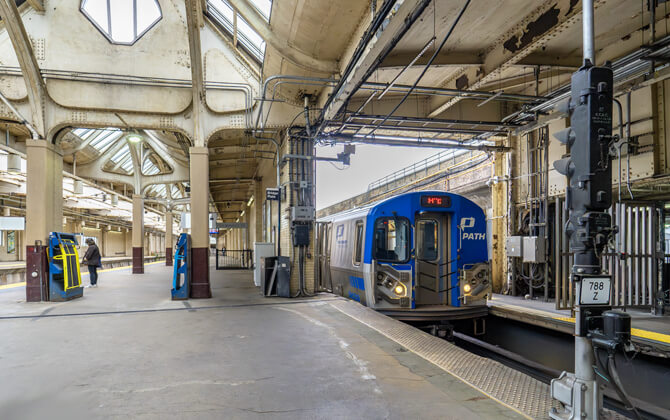
PATH has a long history that goes back to the Hudson & Manhattan Railroad, or H&M. Plans for the earlier system appeared in 1874. Construction under the Hudson River started in 1890 but was interrupted by financial trouble and serious accidents. A new effort began in 1900 under William Gibbs McAdoo, and the tunnels became widely known as the McAdoo Tubes.
Construction and opening
The first tunnel, now called the Uptown Hudson Tubes, was built using compressed air and brick lining. Work stopped after a lawsuit, and accidents, including one in 1880 that killed 20 workers, caused more delays. Construction resumed in 1902 under Charles M. Jacobs, who used a tunnelling shield and cast iron lining. The uptown tubes were completed in 1906, and test trains began running in late 1907.
Revenue service started on February 26, 1908, between Hoboken Terminal and 19th Street, when President Theodore Roosevelt activated the electric lines from the White House. The system then expanded in stages: 23rd Street opened in June 1908, service between Hudson Terminal and Exchange Place began in July 1909, and the route later extended west to Grove Street, Manhattan Transfer, and Park Place in Newark. The full H&M system was completed in 1911. Summit Avenue, now Journal Square, opened in 1912, followed by Harrison in 1913.
Expansion, decline, and takeover
From the start, the Hudson Tubes were meant to connect major New Jersey rail terminals with New York City. McAdoo also proposed further expansion, including service to Grand Central Terminal and a second north-south Midtown line, but those plans were never built.
Over time, the system faced stronger competition from automobiles, bridges, and Hudson River tunnels. Ridership fell during the Great Depression, and H&M entered bankruptcy in 1954.
In the early 1960s, planning for the World Trade Center led to an agreement between the Port Authority and the two states. The Port Authority bought and maintained the Tubes in exchange for the right to build the World Trade Center on the Hudson Terminal site. It formally took over H&M in 1962, renamed it PATH, modernized stations, and ordered new rolling stock.
Late 20th century and recovery
During the 1970s, PATH changed significantly as part of World Trade Center construction. Hudson Terminal was demolished and replaced by a new World Trade Center terminal that opened in 1971. An extension to Plainfield was studied in the 1970s but canceled in 1978. PATH’s longest service disruption followed an 81-day strike in 1980. In the 1980s and early 1990s, the Port Authority invested heavily in station and infrastructure upgrades.
The system was hit by flooding in December 1992, suspending Hoboken service for 10 days. After the 1993 World Trade Center bombing, PATH service to Lower Manhattan was disrupted. The damaged station was later destroyed in the September 11, 2001 attacks, Exchange Place also closed, and service to Lower Manhattan was suspended.
Recovery began in 2003. Exchange Place reopened in June, and PATH returned to the World Trade Center in November. A temporary station was later replaced by the permanent World Trade Center Transportation Hub, whose platforms opened in stages from 2014 to 2016. In recent years, the system has added improvements such as cellphone service and countdown clocks while continuing to operate under FRA rules.
Future Extensions
Several PATH expansion proposals have been discussed over the years, but none had funding in place as of 2025. The best-known plan is an extension from Newark Penn Station to Newark Liberty International Airport Station. Different versions of the project have included a connection to AirTrain Newark, possible park-and-ride facilities, and a new entrance from the Dayton neighborhood.
In March 2023, the Port Authority said funding for the Newark Airport extension would be deferred to a future capital plan. In December 2025, the agency said the project would be delayed by ten years while it prioritized replacing AirTrain Newark.
Another long-running proposal is an infill station in Jersey City’s Marion Section, west of Journal Square, where the Newark-World Trade Center line runs parallel to a freight line. Jersey City and the Port Authority agreed in 2018 to study the location, and the feasibility study kept the project under discussion. Local leaders have continued to push for it, but construction funding has not been identified.
PATH’s 2026-2035 capital planning discussions have also focused on broader service improvements, including more frequent weekend service. Still, future expansion depends on available funding and agency priorities.
Nearby Attractions
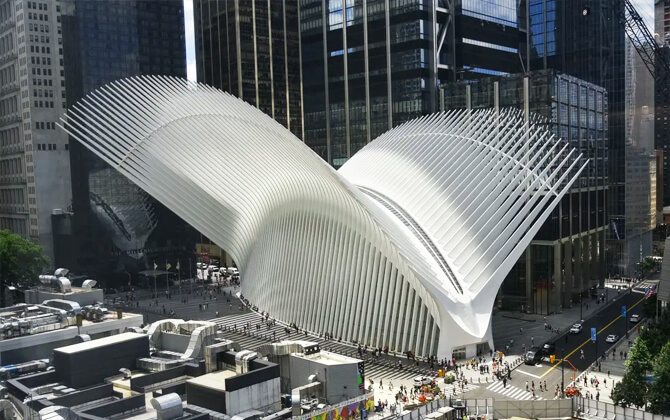
PATH is a practical way to reach major destinations in New York City and northern New Jersey. The 33rd Street station sits one block from NY Penn Station, making it easy to connect with Amtrak and NJ Transit. The World Trade Center branch gives direct access to Lower Manhattan, while other routes serve Newark, Harrison, Jersey City, and Hoboken.
For sightseeing, PATH can be a convenient part of your route plan. It is especially useful for trips to the World Trade Center area, Hoboken Terminal, and Jersey City’s waterfront districts. The system also helps riders reach Newark and airport-related connections.
- World Trade Center, Lower Manhattan
- NY Penn Station area, near 33rd Street
- Hoboken Terminal
- Jersey City waterfront and Exchange Place area
- Newark Penn Station
- Newark Airport connections
Beyond these transport hubs, PATH also serves neighborhoods with access to museums, parks, and cultural sites. It’s a handy option if you want to combine rail travel with walking, subway transfers, bus links, or other local transport.
Great post! The detailed map and information on the PATH routes really helped me plan my trip. I appreciate the clarity on the hours and ticket options as well. Looking forward to exploring more with this guide!
Great overview of the PATH system! The map and route details are super helpful for planning my trips to NYC. Thanks for including the info on hours and ticket prices—definitely makes it easier to navigate.
Great insights on the PATH service! The detailed map and information about hours and fares are super helpful for planning trips. It’s also great to see updates on station services. Thanks for sharing this!
Great information! The detailed PATH map and service hours are super helpful for planning my trips. I appreciate the breakdown of fares too; it’s nice to have everything in one place. Keep up the good work!