The Moscow Metro is the rapid transit system serving Moscow and nearby cities including Krasnogorsk, Reutov, Lyubertsy, and Kotelniki. It opened in 1935 with one 11-kilometre (6.8-mile) line and 13 stations, becoming the first underground railway in the Soviet Union. As of January 2026, the system has 304 stations and 535.3 km (332.6 mi) of route length, making it the longest metro in Europe and the longest outside China. It is also known for very high train frequency, deep stations such as Park Pobedy, and grand interiors that make many stations tourist attractions in their own right.
| Key | Information |
|---|---|
| System type | Rapid transit system |
| Opened | 1935 |
| Initial network | 11 km (6.8 mi), 13 stations |
| Stations | 304 |
| Route length | 535.3 km (332.6 mi) |
| Coverage | Moscow, Krasnogorsk, Reutov, Lyubertsy, Kotelniki |
| Deepest station section | 73 m at Park Pobedy |
| Special feature | Only metro system in Russia with two circle lines |
| Service frequency | Peak intervals often 90 seconds; reduced to 80 seconds in February 2023 |
| Reputation | Busiest metro in Europe and a major public transport landmark |
Moscow Metro Map
Map of Moscow Metro showing various lines and stations. Click on the map to enlarge it or download the Moscow Metro map in PDF format.
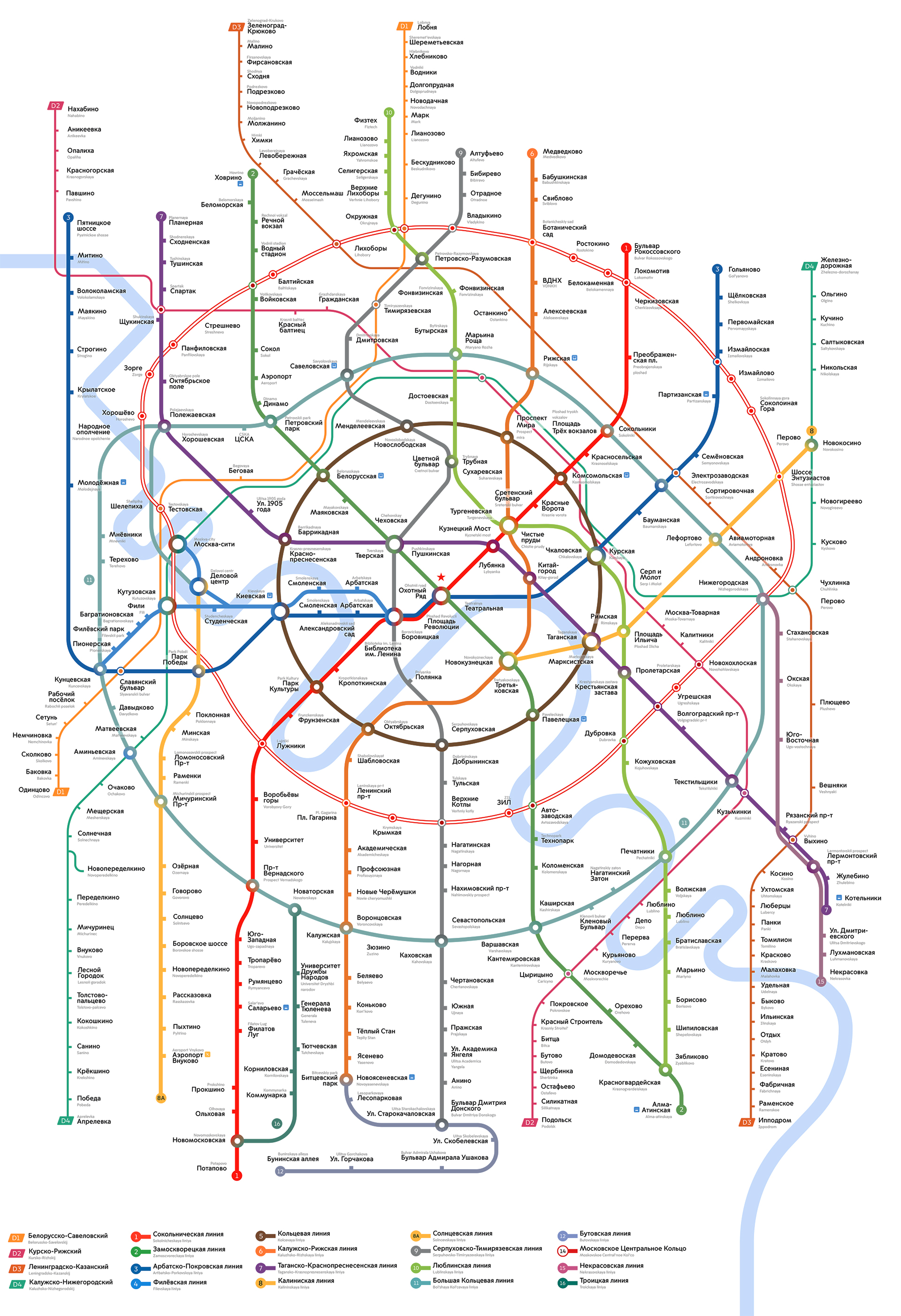
Moscow Metro Lines and Stations
The Moscow Metro stations map covers a very large system. As of January 2026, there are 304 active stations. Of these, 275 are on the Moscow Metro proper and 31 are on the Moscow Central Circle. By station count, the network ranks eighth among metro systems worldwide.
Park Pobedy is the deepest station in the Moscow Metro and the third-deepest metro station in the world. Four stations have been closed: old Kaluzhskaya and old Pervomayskaya were closed permanently, while one Shelepikha station and one Delovoy Tsentr station were closed temporarily. The six-station monorail line also closed in June 2025.
Physical characteristics
Of the 236 stations described by physical type, 80 are deep underground, 114 are shallow, and 42 are at or above ground level, including 25 on the Moscow Central Circle. Among the above-ground group, there are 12 ground-level stations, four elevated stations, and one station on a bridge: Vorobyovy Gory.
The deep stations include 55 triple-vaulted pylon stations, 19 triple-vaulted column stations, and one single-vault station. The shallow group includes 72 spanned column stations, 33 single-vaulted stations, and three single-spanned stations.
Two stations have three tracks, and one has double halls. Seven stations use side platforms, with only one of them underground. There were also two temporary stations inside rail yards.
Line structure
The system uses line numbers, names, and colours, which makes the route plan easier to follow. The Moscow Central Circle is line 14, while the former monorail used line 13 before it closed. The network combines radial lines and circle lines, and many stations work as interchanges.
The best-known active lines include Sokolnicheskaya, Zamoskvoretskaya, Arbatsko-Pokrovskaya, Filyovskaya, Koltsevaya, Kaluzhsko-Rizhskaya, Tagansko-Krasnopresnenskaya, Kalininskaya, Solntsevskaya, Serpukhovsko-Timiryazevskaya, Lyublinsko-Dmitrovskaya, Bolshaya Koltsevaya, Butovskaya, Moscow Central Circle, Nekrasovskaya, and Troitskaya.
| Station | Details |
|---|---|
| Sokolnicheskaya | First opened 1935; latest extension 2024; length 43.4 km (27.0 mi); 27 stations |
| Zamoskvoretskaya | First opened 1938; latest extension 2018; length 43.0 km (26.7 mi); 24 stations |
| Arbatsko-Pokrovskaya | First opened 1938; latest extension 2012; length 45.9 km (28.5 mi); 22 stations |
| Filyovskaya | First opened 1958 (1935); latest extension 2006; length 14.5 km (9.0 mi); 13 stations |
| Koltsevaya | First opened 1950; latest extension 1954; length 19.3 km (12.0 mi); 12 stations |
| Kaluzhsko-Rizhskaya | First opened 1958; latest extension 1990; length 37.6 km (23.4 mi); 24 stations |
| Tagansko-Krasnopresnenskaya | First opened 1966; latest extension 2015; length 42.3 km (26.3 mi); 23 stations |
| Kalininskaya | First opened 1979; latest extension 2012; length 16.3 km (10.1 mi); 8 stations |
| Solntsevskaya | First opened 2014; latest extension 2023; length 28.3 km (17.6 mi); 14 stations |
| Serpukhovsko-Timiryazevskaya | First opened 1983; latest extension 2002; length 41.5 km (25.8 mi); 25 stations |
| Lyublinsko-Dmitrovskaya | First opened 1995; latest extension 2023; length 44.0 km (27.3 mi); 26 stations |
| Bolshaya Koltsevaya | First opened 2018; latest extension 2023; length 57.6 km (35.8 mi); 29 stations |
| Butovskaya | First opened 2003; latest extension 2014; length 10.0 km (6.2 mi); 7 stations |
| Moscow Central Circle | First opened 2016; latest extension 2016; length 54.0 km (33.6 mi); 31 stations |
| Nekrasovskaya | First opened 2019; latest extension 2020; length 13.9 km (8.6 mi); 8 stations |
| Troitskaya | First opened 2024; latest extension 2025; length 23.9 km (14.9 mi); 11 stations |
| Total | 535.3 km (332.6 mi); 304 stations |
The wider route includes related urban rail services shown on the stations map, especially the Moscow Central Circle and the MCD lines. The former Moscow Monorail linked Timiryazevskaya and VDNKh until its closure in 2025.
Some stations later reopened under new line assignments after reconstruction and expansion, including Kakhovskaya, Varshavskaya, and Kashirskaya on the Bolshaya Koltsevaya line.
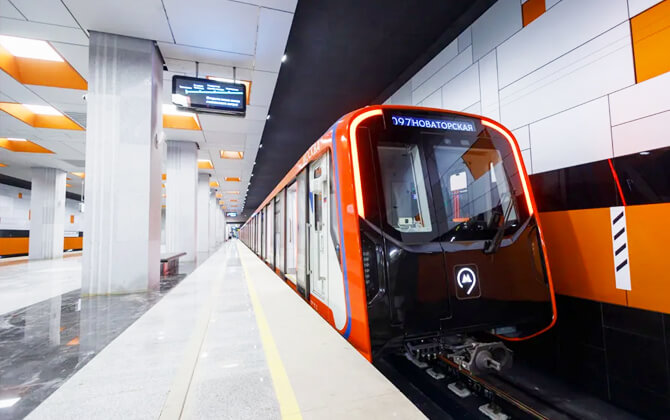
Schedules and Frequency
If you are checking Moscow Metro operating hours, opening hours, or timings today, the core schedule is straightforward. The metro starts operating at 06:00 am, while station entrances open at 05:30 am. Entrances close at 01:00 am, and passengers must complete transfers by then. The last train leaves terminal stations at 01:03 am.
Train frequency depends on the time of day. During peak hours, waiting time can be as short as 90 seconds on some lines. Outside rush hour, trains usually run every 4 to 7 minutes depending on the line and current timetable.
The Moscow Central Circle, or MCC, has slightly different working hours. It runs daily from 05:45 am to 00:30 am. Transfers between the Metro and the MCC are free for 90 minutes from the first entry.
The Moscow Central Diameters are also part of the wider public transport system and run from early morning until late at night.
For the latest schedule today, route timetable details, train schedule updates, and station-specific opening times, passengers can check signboards at station entrances or use the Moscow Metro mobile app in Russian or English.
| Service detail | Timings |
|---|---|
| Station entrance opening time | 05:30 am |
| Metro starting time | 06:00 am |
| Station entrance closing time | 01:00 am |
| Last train from terminal stations | 01:03 am |
| Peak frequency | As short as 90 seconds |
| Off-peak frequency | Usually every 4 to 7 minutes |
| Moscow Central Circle opening hours | 05:45 am to 00:30 am daily |
Prices, tickets and discounts
For fares, tickets, and pass options, the Troika card is the main choice. You can buy a Troika card, top it up right away, and use it across the metro, MCC, MCD, and other city transport. Another option is the Ediny ticket, sold at Metro or MCC station vestibules, suburban train stations, and Mosgortrans ticket machines.
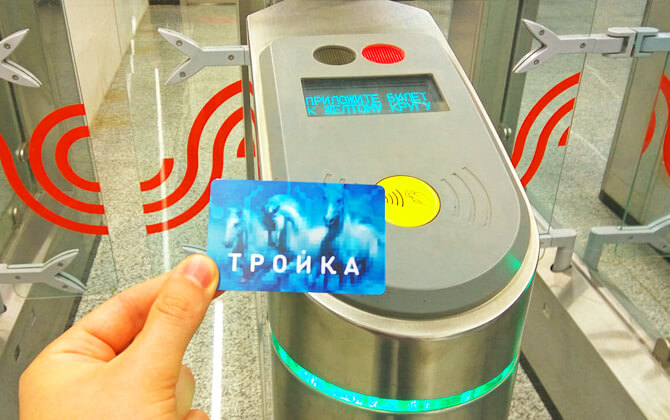
There is one important note on fare information in the source material: one section gives the Troika fare as 75 RUB, while another says a trip by any mode of public transport with Troika costs 42 RUB. Because the source is inconsistent, both figures should be treated as listed values rather than a confirmed single ticket price. The Troika card deposit is refundable, and the maximum top-up mentioned is 10,000 RUB.
| Ticket type | Details |
|---|---|
| 1 trip with Ediny limit ticket | 90 RUB (about $0.95) |
| 1 trip with prepaid Troika card | 75 RUB (about $0.79) |
| 1 trip with bank card or smartphone pay | 83 RUB (about $0.88) |
| 1 trip with FacePay | 71 RUB (about $0.75) |
| 1 trip with 90 minutes ticket | 112 RUB (about $1.18) |
| Monthly pass for schoolchildren and students, Metro, MCC, MCD | 720 RUB (about $7.60) |
| Monthly pass for schoolchildren and students, bus and tram | 460 RUB (about $4.85) |
| Monthly unlimited Ediny pass for schoolchildren and students, Metro, MCC, MCD, bus and tram | 985 RUB (about $10.39) |
| Three-month unlimited Ediny pass for schoolchildren and students, Metro, MCC, MCD, bus and tram | 2,800 RUB (about $29.53) |
For frequent travel, an unlimited pass can be more convenient and may reduce overall cost. Unlimited tickets for 30, 90, and 365 days can be activated within 10 days after purchase on first entry; otherwise, they activate automatically on day 11.
Transfers are covered by the integrated fare system. According to the source materials, no extra fee is charged regardless of ride duration or the number of transfers, and transfer between Metro and MCC lines is free within 90 minutes from first entry.
If you are looking for a fare calculator, the source does not provide one, but the listed fare and ticket price options give a practical idea of the price range.
Connections with other systems
The Moscow Metro is tightly connected to the city transport network, so it works as the backbone of transportation in Moscow. Free transfers are available within a 90-minute window between different transport modes, including the Moscow Central Circle, the Moscow Central Diameters, trams, and bus services. Troika is the common card used across much of this local transport system.
The MCC, opened in 2016, is an orbital railway with 31 stations. It is operated by Russian Railways, uses Lastochka trains, and offers free transfers to the metro within 90 minutes under the unified ticketing system.
The MCD lines were added to the metro map in 2019 as commuter rail routes crossing the city. They connect with the metro, the MCC, and Moscow land transport, and can be paid for with Troika, contactless bank cards, or a regular train ticket.
Several mainline railway stations connect directly to the metro, including Belorusski, Kazanski, Kiyevski, Kurski, Leningradski, Pavletski, Rizhski, Savolovski, and Yaroslavski. Moscow airports are linked to the rail network through AeroExpress services from Belorusski, Kiyevski, and Pavletski railway stations.
The metro also used to connect with the Moscow Monorail, the tramway-like elevated system between Timiryazevskaya and VDNKh. That line shut down on 27 June 2025.
Interchanges with tram and bus routes are widespread, and information counters plus mobility assistance services help passengers move between different parts of the public transport system.
Connection to the airport
Aeroport station is part of Moscow public transport, but it is not directly connected to an airport. From Teatralnaya, Line 2 reaches Aeroport in about 11 minutes, with trains roughly every 5 minutes. The fare is about 57 to 70 RUB, or around $0.60 to $0.74.
There is also a surface transport option: a bus from Metro Okhotny Ryad to Metro Aeroport. The trip takes about 18 minutes and usually runs every 2 hours, with a similar fare of around 57 to 70 RUB, or about $0.60 to $0.74.
For road travel, the distance is about 7.6 km (4.7 mi), and the trip usually takes around 7 minutes. A taxi costs about 250 to 300 RUB, or roughly $2.64 to $3.16.
Based on the provided travel information, driving is the cheapest option and a taxi is the fastest. If you are planning an onward airport transfer from Aeroport station, it makes sense to check the latest schedule and timings in advance.
Tips
Check the stations map before you travel so your route is clear from the start. Signs usually include English translations, and station names are transliterated, which helps a lot.
For payment, the Troika card is usually the most practical ticket option, especially if you plan to use the metro more than once or connect to bus, trams, or other city transport.
Ticket machines are handy if you want to buy on the spot. Staffed booths are also available, though they are most useful if you speak some Russian or can keep the request simple.
At the gates, place your ticket or card on the reader and wait for the green light. Then take the correct escalator and double-check the platform direction at busy interchanges.
Inside stations and trains, use the route map to confirm where you are. If you miss your stop, do not panic. Just continue and change direction at the next suitable station.
When planning a trip, keep the operating hours in mind. In general, station opening hours begin around 5:30 am and the system stays open until about 1:00 am, though exact opening times and closing time can vary by station.
On the way out, you may pass another turnstile area near the escalator exit. Usually you will not need to show your ticket again, but it is worth staying alert in busy stations.
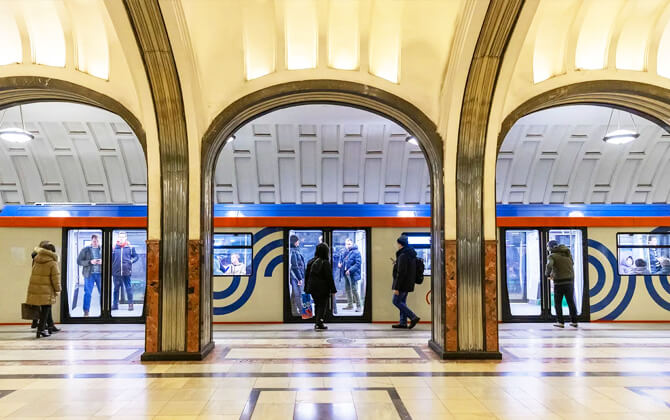
The metro is also a major attraction, not just a transport system. Some stations are so ornate that it is worth slowing down for a minute and looking around.
Interesting Facts
The Moscow Metro is often described as one of the most beautiful metro systems in the world, and its history is just as striking as its architecture. It is also one of the busiest systems globally.
- In 2014, the metro carried 2.4 billion passengers, and over 80 years it recorded more than 145 billion rides.
- It has a punctuality record of 99.99% for departures and arrivals.
- During rush hour, train frequency can drop to just 90 seconds.
- The system includes nearly 200 stations in one source note, and 44 of them are listed as cultural heritage sites.
- The first subway plans for Moscow appeared in 1875, but construction began only in 1931.
- The first 13 stations opened on 15 May 1935.
- During World War II, the metro served as a bomb shelter for about half a million people.
- Construction continued even during the war, and seven new stations were built.
- For its first 20 years, the system was named after Lazar Kaganovich before being renamed for Vladimir Lenin in 1955.
- A famous legend says the Circle Line began with a coffee cup stain on Stalin’s metro map.
There are smaller details people remember too. One station has a fountain, Vorobyovy Gory was the first station in the world built on a bridge, and station announcements use men’s and women’s voices to help blind passengers orient themselves.
The system also keeps evolving, with expansion projects and newer technologies aimed at improving service and safety.
History
The history of the Moscow Metro began in the Russian Empire, but World War I, the October Revolution, and the Russian Civil War delayed the project. In 1923, the Moscow City Council created the Underground Railway Design Office at the Moscow Board of Urban Railways. By 1928, it had prepared a first route from Sokolniki to the city centre.
Construction was approved in June 1931 by the Central Committee of the Communist Party of the Soviet Union. In January 1932, the first lines were planned, and on 21 March 1933 the Soviet government approved a 10-line system with a total route length of 80 km (50 mi). The metro was named after Lazar Kaganovich until 1955.
The first line opened to the public on 15 May 1935 at 07:00 am. It was 11 km (6.8 mi) long with 13 stations. Around 285,000 people rode the metro on opening day. The original route connected Sokolniki to Okhotny Ryad, with branches to Park Kultury and Smolenskaya.
Expansion continued before, during, and after World War II. Before the war, the Arbatskaya branch was extended to Kurskaya in 1938, and the Gorkovskaya Line between Sokol and Teatralnaya opened that same year. During the war, Teatralnaya-Avtozavodskaya and Kurskaya-Partizanskaya opened in 1943 and 1944, while stations were used as air-raid shelters during the Siege of Moscow.
After the war, work began on the fourth stage, including the Koltsevaya Line, a deep section of the Arbatsko-Pokrovskaya line, and a surface extension to Pervomaiskaya. The first section of the Koltsevaya Line opened in 1950, and the full line was completed in 1954. In 1955, the metro received its current official name.
In the late 1950s and through the 1960s, Nikita Khrushchev pushed for simpler, more functional station design. Many new stations adopted standard shallow layouts known as Sorokonozhka, or centipede.
Expansion returned strongly in the 21st century. The Moscow Central Circle opened in 2016, and the Big Circle Line was completed in 2023. These projects helped turn the metro into one of the world’s largest rapid transit systems.
Future expansions
The Moscow Metro expansion program remains active. As of January 2026, the system has 304 stations and 535.3 km (332.6 mi) of route length, and more additions are planned as part of the city’s transport strategy.
Between 2026 and 2028, the city plans to commission 26.9 km (16.7 mi) of lines, 13 stations, and one electric depot. Key projects include the Rublyovo-Arkhangelskaya line, the Biryulyovskaya line, extensions on the Arbatsko-Pokrovskaya and Lyublinsko-Dmitrovskaya lines, and continued work on the Troitskaya line. The first section of the Rublyovo-Arkhangelskaya line is planned to link Delovoy Tsentr with Bulvar Generala Karbysheva, while the full line is expected to connect Moscow-City with Krasnogorsk.
Other planned works include Golyanovo station on the Arbatsko-Pokrovskaya line, Yuzhny Port station on the Lyublinsko-Dmitrovskaya line, and the southern Troitskaya section from Novomoskovskaya to Troitsk. Budget plans for 2026 to 2028 also place strong emphasis on public transport development.
Further ahead, the city transport strategy says the first self-driving metro line is scheduled for 2030, with the Big Circle Line selected as the initial candidate. Testing of driverless technology is already underway there.
Sights to see via Moscow’s metro
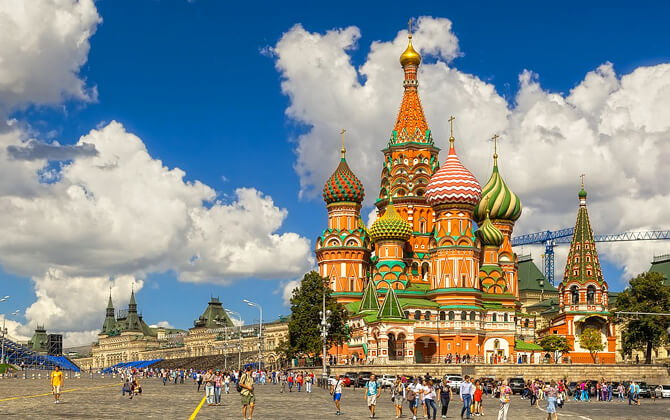
Moscow Metro is more than transport. In many places, it feels like an underground museum, with marble halls, chandeliers, mosaics, stained glass, and sculptural details along the route.
If you want a simple stations list for sightseeing, start with Arbatskaya, Ploshchad Revolyutsii, Kurskaya, Komsomolskaya, Novoslobodskaya, Belorusskaya, and Mayakovskaya. Each stands out for different reasons, from pink marble pillars and bronze chandeliers to stained glass and Art Deco design.
- Arbatskaya is known for pink marble pillars, an ornate ceiling, and its historic role as a deep shelter.
- Ploshchad Revolyutsii is famous for bronze statues that many passengers rub for luck.
- Kurskaya has a large central space, marble walls, granite floors, and conical chandeliers.
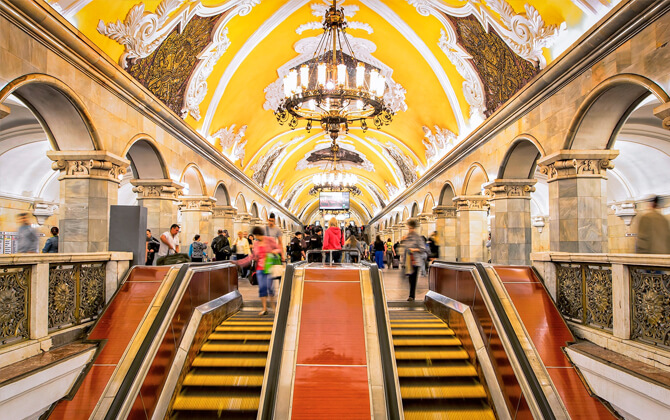
- Komsomolskaya is one of the most impressive stations, with a yellow baroque ceiling, huge chandeliers, and 68 white marble columns.
- Novoslobodskaya is best known for its stained glass panels and the mosaic Peace Through the World.
- Belorusskaya features Belarusian motifs, Florentine mosaics, and the sculptural group Belorussian Partisans.
- Mayakovskaya combines white marble, pink rhodonite columns, stainless steel arches, and ceiling mosaics.
For a broader sightseeing route, the Circle Line is especially useful because several of the most decorated stations are located there. It is an easy way to see multiple highlights in one trip.
Try to avoid rush hour if you want time for photos or a slower look around. Off-peak periods make the experience much more relaxed.