The Nizhny Novgorod Metro, also known as the former Gorky Metro, is the rapid-transit system serving Nizhny Novgorod, Russia. Opened in 1985, this public transport system has two lines, 15 stations, and a total network length of 21.6 kilometres (13.4 miles). It links key parts of the city, including the historic upper city and the lower industrial districts, with Moskovskaya as the main interchange station.
| Key | Information |
|---|---|
| System name | Nizhny Novgorod Metro (former Gorky Metro) |
| Opened | 1985 |
| Lines | 2 |
| Stations | 15 |
| Network length | 21.6 kilometres (13.4 miles) |
| Main interchange | Moskovskaya |
| Daily ridership | About 109,500 passengers |
| Airport rail link | None at present |
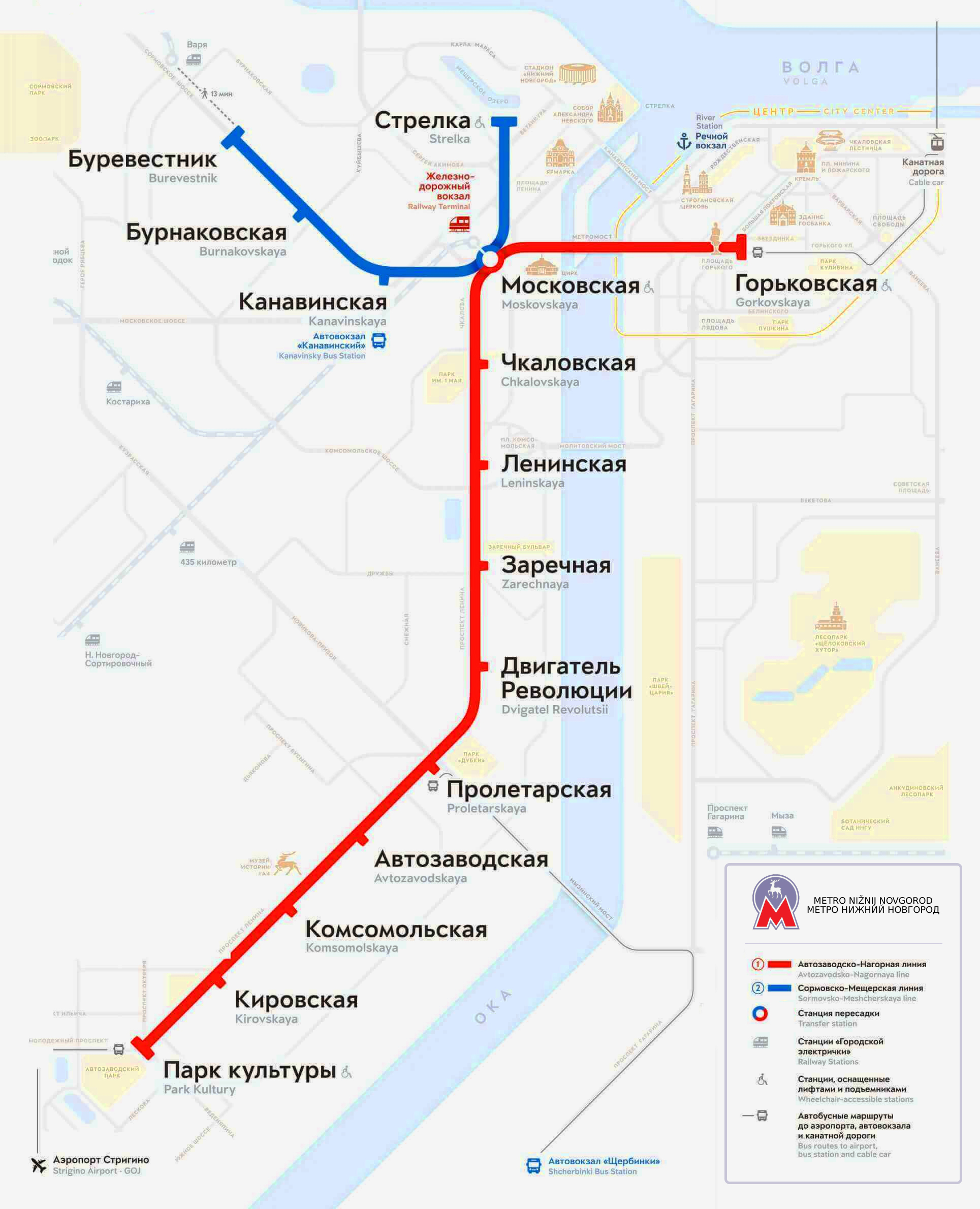
Nizhny Novgorod Metro Map
Map of Nizhny Novgorod Metro showing different lines. Click on the map to enlarge it or download the Nizhny Novgorod map in PDF format.
Lines and Stations
The Nizhny Novgorod Metro has two operating lines and 15 stations. Most are underground; only Burevestnik is above ground. Moskovskaya is the key interchange, connecting the two metro lines as well as City Rail and the Nizhny Novgorod Central Diameters system.
The network route plan is simple. Line 1 is the Avtozavodskaya Line, while Line 2 is the Sormovsko-Meshcherskaya Line. There is also a ghost station, Yarmarka, whose construction was dropped in favor of Strelka.
| Station | Details |
|---|---|
| Avtozavodskaya Line | Runs between Gorkovskaya and Park Kultury, has 11 stations, is 14.5 kilometres (9.0 miles) long, and the end-to-end running time is about 18 minutes. |
| Sormovsko-Meshcherskaya Line | Runs between Moskovskaya and Burevestnik, has 5 stations, is 7.1 kilometres (4.4 miles) long, and the end-to-end running time is about 10 minutes. |
| Moskovskaya | Main interchange station with a cross-platform transfer; also connects to City Rail and Central Diameters. |
| Burevestnik | The only surface station in the system. |
| Yarmarka | Unfinished ghost station abandoned in favor of Strelka. |
There are a few unusual operating details too. Line 1 uses right-hand traffic, while Line 2 uses left-hand traffic because of the track layout at Moskovskaya. Most underground stations are shallow-level designs.
Line 3, also called Nagornaya, is planned for the future. If built, it is expected to add transfer stations at Operny Teatr and Olgino.
Operating Hours and Frequency
The metro does not run 24 hours. In general, station opening hours start around 5:15 am, while the system closes at midnight. Depending on the station, closing time is usually between 12:05 am and 12:15 am. Some exits have different opening times and may open later, from 7:00 am, or close earlier in the evening.
If you are checking timings today, keep in mind that service varies by line, station, and day of the week. So the timetable is not identical across the whole system.
| Service detail | Timings |
|---|---|
| General station opening hours | Around 5:15 am |
| General system closing time | Midnight |
| Station closing times | Usually 12:05 am to 12:15 am |
| Some station exits | Open from 7:00 am; some close earlier in the evening |
| Line 1 first train from Gorkovskaya | 5:32 am on weekdays; 5:31 am on weekends |
| Line 1 last train | Arrives at Park Kultury at 12:15 am; 12:12 am on weekends |
| Line 2 first train | 5:20 am from Moskovskaya toward Burevestnik |
| Line 2 last train | Arrives at Burevestnik at 12:28 am; 12:27 am on weekends |
| Typical frequency | About every 5 to 6 minutes |
| Midday frequency | About every 7.5 to 8 minutes |
| Evening frequency | About every 8 to 15 minutes |
During peak periods, trains may be more frequent. On weekends, the schedule today is usually a bit lighter. For practical trip planning, the last train and route timetable matter more than the advertised general hours.
Pricing, Tickets, and Cards
The metro uses a flat fare, so the ticket price does not depend on distance. A standard trip costs 28 rubles (about $0.48), while a card-based trip costs 26 rubles (about $0.45).
Tokens are still widely used for single rides. If you travel more often, a rechargeable card can lower the cost a little and may include transfer options to other city transport within 60 or 90 minutes of entry.
| Payment option | Price | Notes |
|---|---|---|
| Single trip fare | 28 rubles (about $0.48) | Flat fare for the whole metro system |
| Card-based trip | 26 rubles (about $0.45) | Includes transfer options within 60 or 90 minutes |
| Standard card | 1000 rubles (about $17.19) | Reduced fares available for students and seniors |
| Electronic rechargeable card | 90 rubles (about $1.55) | A practical option for regular travel |
There is no fare calculator mentioned for the system, since the fare is unified. Children under 7 travel free.
If you are carrying large baggage, extra rules apply. Total dimensions should not exceed 150 centimetres (1.5 metres, 4.9 feet), and no single dimension should be over 120 centimetres (1.2 metres, 3.9 feet). Larger items require a baggage ticket, and passengers are limited to two pieces.
Connections
Moskovskaya is the main hub for local transport connections. Here, passengers can switch between both metro lines and also connect to City Rail and the Nizhny Novgorod Central Diameters system.
The metro also links with the tramway network at several stations. Moskovskaya connects to tram lines 1, 3, 6, 7, 27, and 417. Other stations with tram or trams connections include Chkalovskaya, Proletarskaya, Avtozavodskaya, Komsomolskaya, Kirovskaya, Park Kultury, and Burevestnik.
For wider transportation in the city, there are also bus and marshrutka links. One useful example is the bus connection from Park Kultury to Nizhny Novgorod-Strigino International Airport.
The system currently has one cross-platform interchange, at Moskovskaya. Future expansion plans mention additional transfer points at Operny Teatr and Olgino after Line 3 is built.
Access to the Airport
Nizhny Novgorod-Strigino International Airport is about 14 kilometres (8.7 miles) from the city center, in the Avtozavodsky district outside the city limits.
There is no direct metro, rail, or suburban railway link to the airport at present. For now, the practical route is to take bus 11 or marshrutka 46 to Park Kultury station on Line 1.
If you have an early flight, double-check the metro opening hours and train schedule. The system starts around 5:15 am, though some exits open later at 7:00 am, and the metro generally closes at midnight. Station closing times vary slightly, usually between 12:05 am and 12:15 am.
System Regulations
The metro has clear passenger rules. Luggage must not exceed 150 centimetres (1.5 metres, 4.9 feet) in total dimensions, and no single side may be more than 120 centimetres (1.2 metres, 3.9 feet). If baggage is larger, a separate baggage ticket is required, and no more than two pieces are allowed.
Sports equipment such as skateboards and ski equipment is treated the same way as hand baggage. Children under 7 travel free. Animals are allowed only in cages or containers, except dogs, which must wear a muzzle.
For safe travel, stand on the right side of escalators and stairs if you are not walking. Pass on the left while holding the handrail. Do not sit, run, or walk on an idle escalator.
On platforms, stay back from the edge until the train stops fully. Keep door areas clear so people can get off first. Inside trains, do not lean on the doors, try to open them while moving, or place luggage on seats.
Do not go onto the tracks. Use the passenger-to-driver intercom only when necessary, and always follow station signs and staff instructions. If you notice a suspicious package, avoid using your mobile phone and alert the authorities immediately.
One practical note: staff in ticket offices rarely speak English, so it helps to know station names and basic numbers in advance.
Operations and Usage
The metro is managed by the city government and is an important part of city transport in Nizhny Novgorod. It serves five of the city’s eight districts and connects with other rail services at Moskovskaya.
Daily ridership is about 109,500 passengers. Reported annual usage figures vary by source and year: one figure gives 37.24 million in 2015, while another gives 30.11 million and an average of about 82,000 passengers per day.
Operating hours begin early and continue until around midnight. In practice, service patterns change through the day rather than staying fixed, with different frequency levels in the morning, midday, evening, and on weekends.
The system does not operate 24 hours a day. It also does not use driverless trains or platform screen doors. Trains are not air-conditioned, and passengers cannot move between platforms once inside the system.
Even with those limits, the metro remains a core part of public transport and local transport for daily commuting across the city.
History
Nizhny Novgorod was known as Gorky from 1932 to 1990. By the mid-1960s, its population had passed one million, meeting the Soviet requirement for a metro system.
Planning began in 1970. The construction license was granted in 1973, the technical project for the first section was completed in November 1975, and the USSR Council of Ministers approved construction on July 15, 1977. Work officially started on December 17, 1977, near Leninskaya station.
Tunnel boring began in September 1978. Early work also involved rebuilding roads and tram lines and demolishing houses. In 1979, foundation piles were driven for Moskovskaya station, and in June 1980 an expansion to three lines was proposed.
On July 13, 1984, a wall collapsed during construction at Moskovskaya station, killing two workers from a student brigade. An urban legend says their ghosts still walk through the tunnels and stations.
The metro opened to the public on November 20, 1985. It became Russia’s third subway system and the tenth in the former Soviet Union. The first section was 7.8 kilometres (4.8 miles) long and included six stations: Moskovskaya, Chkalovskaya, Leninskaya, Zarechnaya, Dvigatel Revolyutsii, and Proletarskaya, plus a depot and an engineering building.
Expansion continued in stages. Avtozavodskaya and Komsomolskaya opened in 1987, Kirovskaya and Park Kultury in 1989, Kanavinskaya and Burnakovskaya on December 20, 1993, and Burevestnik on September 9, 2002.
In September 2012, the metro closed for the first time to switch power to a new control system at Gorkovskaya station. That station opened on November 4, 2012. Strelka opened on June 12, 2018, and construction of Ploschad Svobody and Sennaya began on March 1, 2022.
Future Expansion
Future expansion is aimed at improving coverage, since the metro currently reaches only five of Nizhny Novgorod’s eight districts.
One major project is the extension of the Sormovsko-Meshcherskaya Line toward Sormovo and, under post-World Cup plans, toward Volga station in Meshchera. Earlier proposals also mentioned a station at Varya in Sormovo.
Another focus is the city center. Planned stations include Operny Teatr and Sennaya, which would improve the route network and create new transfer options.
The biggest long-term plan is Line 3, also described as the Mountain Line. It is planned to run parallel to Line 1 along the Oka River and add many new stations.
There are also proposals for better transport access to the airport area, which still has no rail connection.
Interesting Facts
The Nizhny Novgorod Metro opened in 1985 and still carries its old name, Gorky Metro, in many references. With 15 stations and 21.6 kilometres (13.4 miles) of track, it has the third-largest stations list among Russian metro systems after Moscow and St. Petersburg.
One of the most unusual features is how the lines operate: Line 1 uses right-hand traffic, while Line 2 uses left-hand traffic. The two meet at Moskovskaya, where passengers can make a cross-platform transfer.
The network layout also reflects the city’s geography. Instead of a classic Soviet triangular pattern, the route was shaped by development on both sides of the Volga and Oka rivers.
Burevestnik is the only fully above-ground station. Another curious detail is Yarmarka, the ghost station that was abandoned in favor of Strelka.
The first section opened on November 20, 1985, but Gorkovskaya, the first station east of the Oka River, did not open until 2012. The metro bridge across the Oka later became a key link between the two sides of the city.
Travel Tips
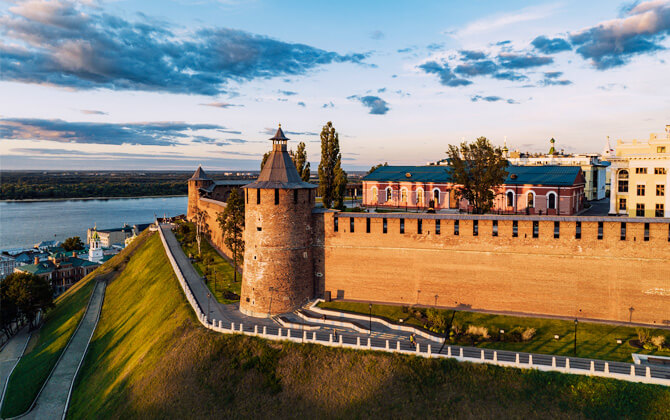
To get around the city, you can use the metro, bus, tramway, taxi, or a car. At night, taxi is the only option mentioned for getting around.
By taxi
Ordering by phone is the easiest option. You can also find taxis in busy places, central squares, and near train stations.
- Lucky: +7 (831) 215-55-55
- Friends: +7 (831) 277-70-00
- Dubrovka: +7 (831) 433-30-00
- Mustang: +7 (831) 248-84-88
- Nizhegorodets: +7 (831) 421-61-16
- Saturn: +7 (831) 246-00-00
Public transport
Buses, trolleybuses, and trams run across the city from 6:00 am to 10:00 pm. Regular buses stop at every stop on the route, while minibuses stop on request.
For the city center, the tram is often the most practical choice. Tram No. 2 is a ring route crossing Bolshaya Pokrovskaya and is within walking distance of many major sights.
Tickets are bought on board from the conductor or driver. Each ticket is valid for one trip only, and each type of transport requires its own ticket.
In the historic part of the city, tram No. 11 operates as an excursion tram called the First Tram of Russia.
By car
Parking charges are not listed, but parking in the city center is almost always banned, and wrongly parked cars may be towed. Many central streets are one-way, and traffic jams are common during rush hour and on bridges across the Oka.
If you are planning to drive, check station parking and parking charges per day separately, because no metro station parking details are provided here.
Metro
The metro has 2 lines and 15 stations. All stations except Gorkovskaya are in the river part of the city. Gorkovskaya is the terminal station of the Avtozavodskaya Line and the first station in the historic part of the city.
The metro runs from about 5:30 am to midnight, with trains every 7 to 10 minutes in general use. Single-trip tokens are available, and monthly transport cards are also mentioned.
For an easier trip, plan your route ahead of time and keep in mind that station rules and access details can vary a little.