Novosibirsk Metro is the rapid transit system of Novosibirsk, Russia. It is the only metro in Siberia and the easternmost subway system in the country. The system has two lines, 14 stations, and a route length of about 15.9 kilometres (9.9 miles). Opened on 7 January 1986, it remains a core part of city transport, carrying hundreds of thousands of passengers a day. The network is also known for its late-Soviet station design, four-car trains, and the covered metro bridge over the Ob River, which stretches 2,145 metres or about 2.1 kilometres (1.33 miles).
| Key | Information |
|---|---|
| System | Rapid transit system in Novosibirsk, Russia |
| Opened | 7 January 1986 |
| Lines | 2 |
| Stations | 14 |
| Network length | About 15.9 km (9.9 miles) |
| Operating hours | Daily from 6:00 AM to 12:00 AM |
| Payment | Tokens, transport card, bank card |
| Notable feature | Covered bridge across the Ob River, 2.145 km (1.33 miles) long |
Novosibirsk Metro Map
Map of Novosibirsk Metro showing different lines and stations. Click on the map to enlarge it or download the Novosibirsk Metro map in PDF format.
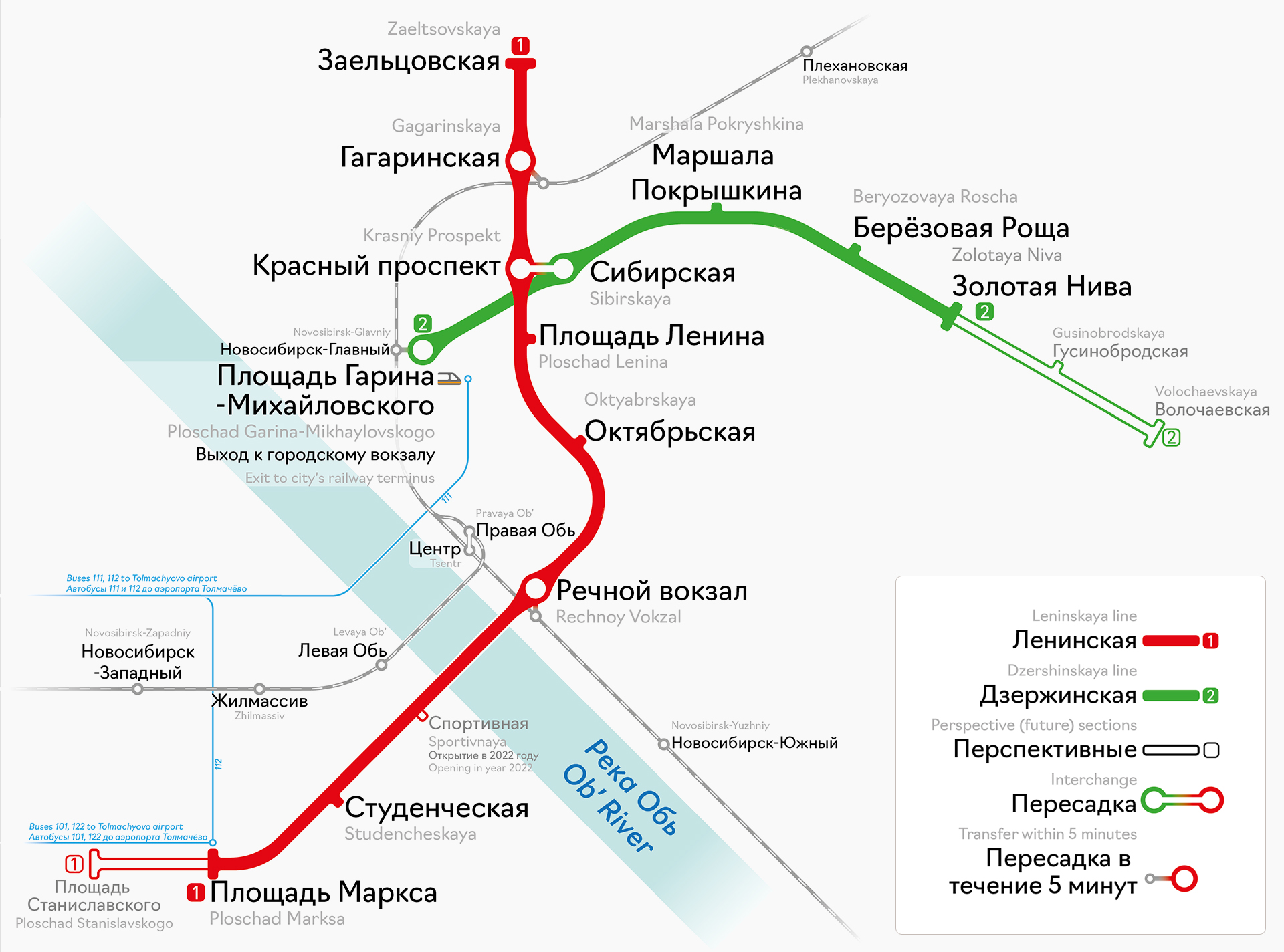
Novosibirsk Metro Lines and Stations
Novosibirsk Metro has a compact but busy system with two lines and 14 stations. Passenger service began on 7 January 1986, and today the network covers about 15.9 kilometres (9.9 miles). For local transport in the city, it plays a major role despite its modest size.
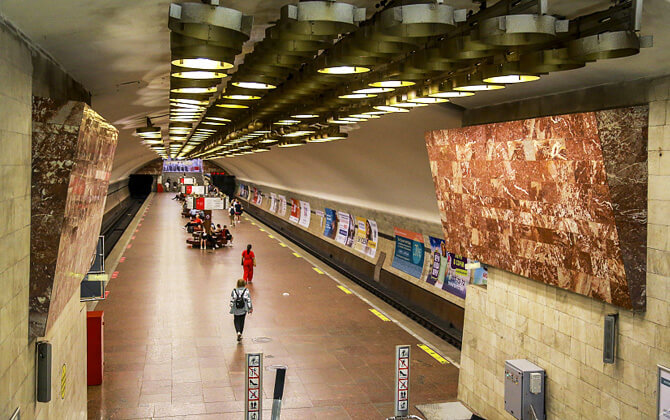
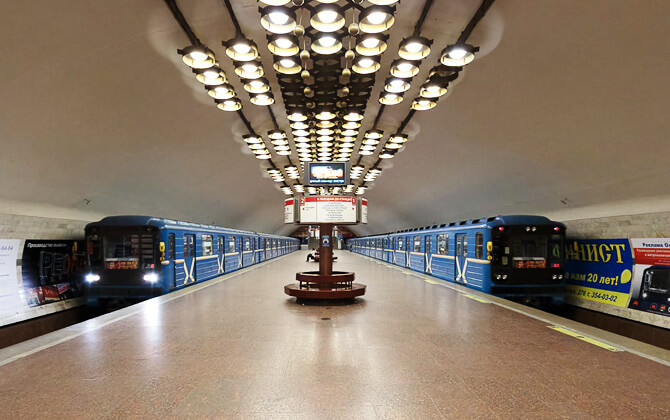
The stations stand out for their late-Soviet architecture and varied layouts. The system includes shallow column stations, single-vault stations, and one side-platform station. Rechnoy Vokzal is the most unusual, as it is partly above ground and partly below ground after the covered bridge crossing over the Ob River.
Metro Lines
| Line | Opened | Length | Stations |
|---|---|---|---|
| Leninskaya Line | 1986 | 10.5 km (6.5 miles) | 9 |
| Dzerzhinskaya Line | 1987 | 5.5 km (3.4 miles) | 5 |
The current stations map includes nine stations on the Leninskaya Line and five on the Dzerzhinskaya Line. If you need a stations list, here it is in a clearer format.
| Station | Details |
|---|---|
| Zayeltsovskaya | Leninskaya Line station |
| Gagarinskaya | Leninskaya Line station |
| Krasny Prospekt | Leninskaya Line station; transfer to Sibirskaya |
| Ploshchad Lenina | Leninskaya Line station |
| Oktyabrskaya | Leninskaya Line station |
| Rechnoy Vokzal | Leninskaya Line station; side platforms; linked to the Ob River crossing |
| Studencheskaya | Leninskaya Line station |
| Ploshchad Marksa | Leninskaya Line station |
| Sportivnaya | Leninskaya Line station |
| Ploshchad Garina-Mikhaylovskogo | Dzerzhinskaya Line station |
| Sibirskaya | Dzerzhinskaya Line station; transfer to Krasny Prospekt |
| Marshala Pokryshkina | Dzerzhinskaya Line station |
| Beryozovaya Roshcha | Dzerzhinskaya Line station |
| Zolotaya Niva | Dzerzhinskaya Line station |
Station Transfers
The main transfer in the system is between Krasny Prospekt and Sibirskaya. The two stations are connected by a dual pedestrian tunnel, so changing lines is straightforward.
Station Types
- Seven three-span shallow column stations: Studencheskaya, Oktyabrskaya, Krasny Prospekt, Gagarinskaya, Ploshchad Garina-Mikhaylovskogo, Sibirskaya, and Marshala Pokryshkina.
- One two-span shallow column station: Zolotaya Niva.
- Four single-vault stations: Ploshchad Lenina, Ploshchad Marksa, Zayeltsovskaya, and Beryozovaya Roshcha.
- One station with side platforms: Rechnoy Vokzal.
Available figures show about 235,300 passengers a day and 86.1 million riders in 2024, making it one of the busiest metro systems in Russia.
Novosibirsk Metro Fares and Tickets
The Novosibirsk Metro uses a flat fare, so the ticket price does not depend on distance or route. A single trip costs 19 roubles (about $0.19).
There is also a surcharge for handbags: 20 roubles (about $0.20). Children under 7 travel free, some passengers may receive discounts of up to 50%, and students pay a reduced fare of 10 roubles (about $0.10).
For regular travel, the system offers an unlimited monthly pass for 850 roubles (about $8.50). Travel card options with 30 or 50 preloaded trips are also available. Payment can be made with tokens, a transport card, bank card, or a mobile application with contactless support.
You may carry one piece of luggage at no extra cost, except handbags, as long as it does not exceed 150 cm in length and 120 cm in height and width.
There is no fare calculator mentioned in the available information, because the metro uses a fixed price rather than distance-based fares.
Hours and Frequency
The Novosibirsk Metro operating hours are daily from 6:00 AM to 12:00 AM. If you are checking opening hours, opening times, or working hours today, the standard schedule is the same across the system.
| Service detail | Timings |
|---|---|
| Starting time / opening time | 6:00 AM |
| Closing time / close | 12:00 AM |
| Leninskaya Line frequency | Every 5 minutes |
| Dzerzhinskaya Line frequency | Every 6 minutes |
| Zayeltsovskaya | 6:00 AM to 12:00 AM |
| Marshala Pokryshkina | 6:21 AM to 12:21 AM |
| Ploshchad Garina-Mikhaylovskogo | 6:00 AM to 12:00 AM |
| Berezovaya Roshcha | 6:11 AM to 12:11 AM |
Train timings vary slightly by station, so the first train and last train are not identical everywhere. For timetable planning, it is worth checking your departure station rather than relying only on the general schedule today.
On most days, service is regular and easy to follow. The route timetable is simple: trains run every 5 minutes on the Leninskaya Line and every 6 minutes on the Dzerzhinskaya Line.
Service to the Airport
The Novosibirsk Metro does not provide direct airport service. To reach Novosibirsk Airport (OVB), passengers need to switch to public transport on the surface.
Bus routes 111 and 112, along with minibus 1122, connect the airport with the main train and bus stations. These services run every day, with departures about every 30 minutes.
For airport transfers, Novosibirsk-Glavny is the main interchange point. From there, you can continue by bus or other city transport. If you arrive after the last departure, taxi and transfer options are available.
Interesting Facts
Novosibirsk Metro is the only metro system in Siberia and the easternmost one in Russia. It opened on 7 January 1986 and became the eleventh metro in the USSR and the ninth in the Russian SFSR.
Even with just two lines, 14 stations, and about 15.9 kilometres (9.9 miles) of track, it ranks behind only Moscow and Saint Petersburg in annual ridership among Russian metro systems.
Its most famous feature is the Ob River crossing between Rechnoy Vokzal and Studencheskaya. The bridge is 2,145 metres long, or about 2.1 kilometres (1.33 miles), including 896 metres across the river itself, and it is known as the world’s longest covered metro bridge.
The station architecture is another highlight. Many stations keep a distinct late-Soviet style, and some entrances were built into residential buildings because the city was already densely developed when the metro opened.
The metro was the first in Russia to introduce electronic payment. Transport cards appeared in 1996, bank card payment started in 2016, and metal tokens are still used.
Engineers also developed track designs with rubber pads to reduce vibration near residential buildings. Later, this solution was adopted in Moscow and other Russian systems.
The network was originally planned as a much larger system. Construction started in 1979, the first section opened in 1986, and expansion resumed in later years after the difficulties of the early 1990s.
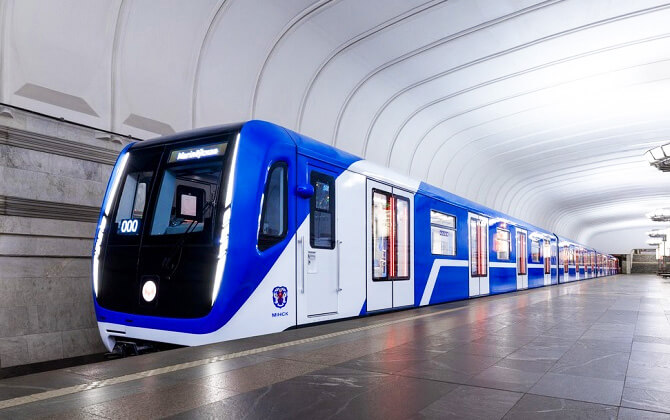
Rolling stock includes Soviet 81-717/81-714 cars and Russian 81-540.2/541.2 cars. A new 81-725.3/726.3/727.3 Ermak train entered service on 21 October 2025, and trains run in four-car formations.
History
Plans for the Novosibirsk Metro date back to 1962. The construction project was approved in November 1978, and work began on 12 May 1979.
Using experience from metro builders in other Soviet cities, the first five-station section was completed in seven and a half years. The system opened to passengers on 7 January 1986 and became the eleventh metro in the USSR and the ninth in the Russian SFSR.
The original route plan called for a four-line network with a total length of 62 kilometres (38.5 miles). Financial problems in the early 1990s froze much of the project. Construction resumed in the 2000s, but after the opening of the 13th station, development was suspended again because of a funding gap.
The metro was designed for efficient transportation in Siberian conditions, and most stations are shallow. Builders used both cut-and-cover methods and tunnel boring in dense urban areas. One of the defining engineering features from the start was the long bridge across the Ob River.
By 2017, the metro was the third-busiest in Russia after Moscow and Saint Petersburg. It now carries about 235,300 passengers daily, and in 2024 the system handled 86.1 million riders.
| Line | Opened | Newest station added | Length | Stations |
|---|---|---|---|---|
| Leninskaya Line | 1986 | 2025 | 10.5 km (6.5 miles) | 9 |
| Dzerzhinskaya Line | 1987 | 2010 | 5.5 km (3.4 miles) | 5 |
| Total | – | – | 16 km (9.9 miles) | 14 |
The system uses four-car electric trains. Over time, rolling stock has included Soviet 81-717/81-714 cars, Russian 81-540.2/541.2 cars, and the newer 81-725.3/726.3/727.3 Ermak train.
Future Extensions
Long-term expansion plans for the Novosibirsk Metro go beyond the two lines now in service. Earlier planning documents described a much larger system, and later materials still point to further extension.
According to the development plan, the Leninskaya Line is expected to expand in two directions by 2030. On the left bank of the Ob, the planned stations are Stanislawsky Square and Perm. On the right bank, the line is planned to reach Northern, with the extension running from Saltsovskaya toward five or six residential districts.
Northern is expected to be built at the intersection of North and Red Avenue. It is intended to become a major transport hub with a bus station, a terminal for surface transport, and park-and-ride facilities, including station parking.
Another project involves extending the Dzerzhinsky line by 5.4 kilometres (3.4 miles) by 2030. The line is also expected to get its own depot, Volochayevskaya. Funding remains the key issue, and expansion is expected to begin only after Sports station is commissioned.
Design work is underway for a second running tunnel between Beryozovaya Roshcha and Zolotaya Niva, where trains currently run in shuttle mode. Earlier plans also mentioned extension toward Dovatora and Volochaevskaya.
In March 2021, officials said the metro could add five stations by 2030. More recently, city authorities discussed possible cooperation with a major Chinese construction company on design and transport infrastructure expansion.
Nearby Attractions
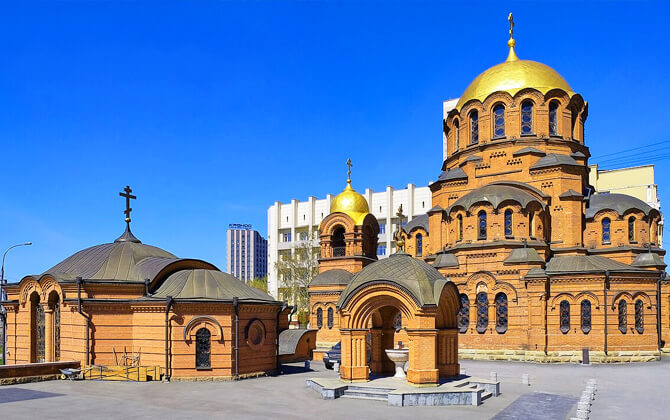
Novosibirsk Metro makes it easy to reach several key sights around the city. For many visitors, it is the simplest way to get around central Novosibirsk using public transport.
The Novosibirsk State Academic Opera and Ballet Theatre is one of the top landmarks and is easy to reach from Ploshchad Lenina station. The Ob River Embankment is another popular stop and can be reached via Rechnoy Vokzal for a walk by the water.
The Novosibirsk Zoo is one of the best-known attractions in the city and remains a popular destination for families using the local transport network. In the center, the Alexandre Nevsky Cathedral also fits well into a short sightseeing route.
Some stations are worth noticing in their own right. Ploshchad Lenina, Marshala Pokryshkina, and Gagarinskaya are often mentioned for their design or convenience.
- Best for culture: Novosibirsk State Academic Opera and Ballet Theatre
- Best for nature and walking: Ob River Embankment
- Best for family visits: Novosibirsk Zoo
- Best for central sightseeing: Alexandre Nevsky Cathedral
- Best metro stops to notice: Ploshchad Lenina, Marshala Pokryshkina, and Gagarinskaya