The Green Line is a CTA rapid transit route in Chicago and part of the Chicago “L” system. It is the only fully elevated line in the network, runs 20.695 miles (33.305 km), serves 31 stations, and connects Harlem/Lake in Forest Park and Oak Park with the Loop and two South Side branches: Ashland/63rd and Cottage Grove. Trains from Harlem/Lake alternate between the two southern terminals, so checking the destination sign matters before you board.
| Key | Information |
|---|---|
| System | Chicago Transit Authority “L” rapid transit |
| Route length | 20.695 miles (33.305 km) |
| Stations | 31 stations |
| Terminals | Harlem/Lake, Ashland/63rd, Cottage Grove |
| Route pattern | Harlem/Lake trains alternate between Ashland/63rd and Cottage Grove |
| Downtown path | Lake Street and Wabash Avenue sides of the Loop |
| Typical operating hours | Weekdays about 4:00 AM–1:00 AM; weekends about 5:00 AM–1:00 AM |
| History | Uses some of the oldest Chicago “L” segments, dating back to 1892 |
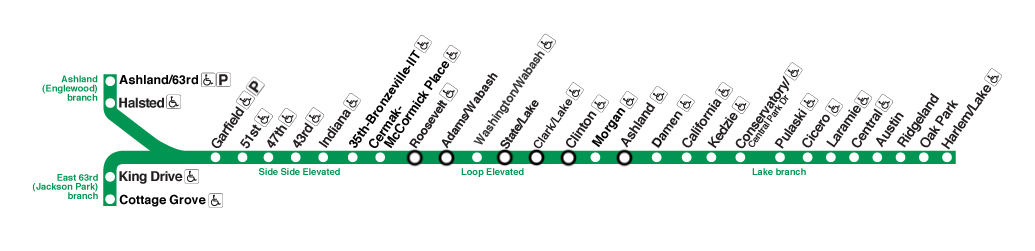
Green Line Chicago “L” Map
The Green Line Chicago “L” map shows all available stations. Click on the map to enlarge it or download the Green Line Chicago “L” map in PDF format.
Stations and Key Stops
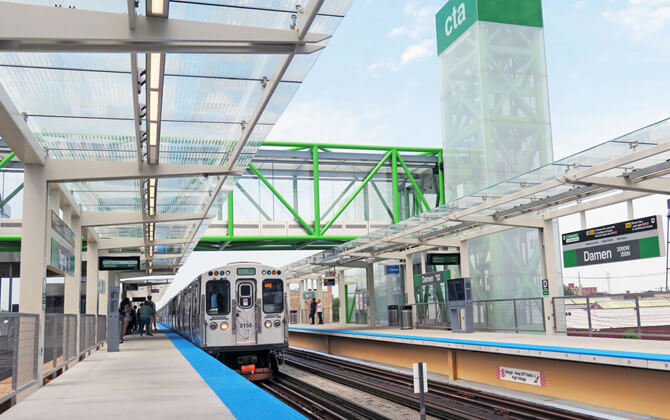
The Green Line stations list covers the West Side, the Loop, and the South Side. It is a useful route for downtown transfers, McCormick Place, Oak Park, Garfield Park, Bronzeville, Woodlawn, and West Englewood. The newest Green Line station is Damen, which opened on August 5, 2024.
State/Lake is currently closed for construction until 2029. The Austin station main stationhouse is temporarily closed, with riders directed to a temporary entrance one block east at Mason Street.
| Station | Details |
|---|---|
| Harlem/Lake | Western terminal serving Forest Park and Oak Park |
| Oak Park | West Side and Oak Park stop with Metra Union Pacific West Line connection |
| Ridgeland | Oak Park station |
| Austin | Temporary entrance one block east at Mason Street while the main stationhouse is closed |
| Central | West Side station |
| Laramie | West Side station |
| Cicero | West Side station |
| Pulaski | Useful for Garfield Park area trips |
| Conservatory-Central Park Drive | Station near Garfield Park Conservatory |
| Kedzie | West Side station |
| California | West Side station |
| Damen | Newest Green Line station, opened August 5, 2024 |
| Ashland | Transfer area for CTA bus routes and Pink Line connections nearby |
| Morgan | Near West Side station |
| Clinton | Near Ogilvie Transportation Center, Union Station, Amtrak, and Metra connections |
| Clark/Lake | Major Loop transfer station, including Blue Line access |
| State/Lake | Loop station closed for construction until 2029 |
| Washington/Wabash | Loop station near Millennium Station and downtown attractions |
| Adams/Wabash | Loop station serving the central business district |
| Roosevelt | Transfer point for Orange Line and Red Line connections |
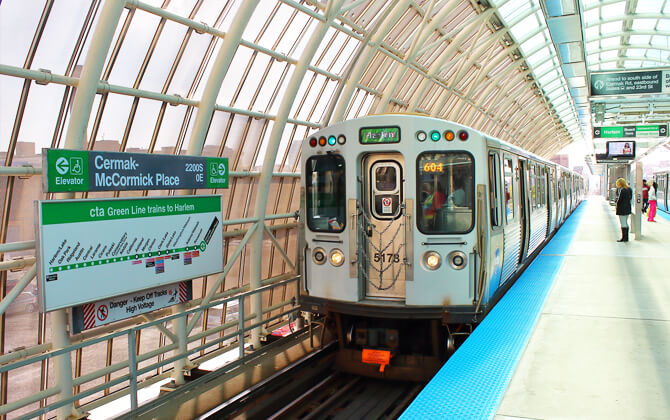
| Cermak-McCormick Place | Closest CTA rail station to McCormick Place |
| 35th-Bronzeville-IIT | Connection to Metra at 35th Street |
| Indiana | South Side station |
| 43rd | South Side station |
| 47th | South Side station |
| 51st | South Side station |
| Garfield | Branching point for Ashland/63rd and Cottage Grove service |
| King Drive | East 63rd branch station |
| Cottage Grove | East 63rd branch terminal in Woodlawn |
| Halsted | Ashland branch station |
| Ashland/63rd | Ashland branch terminal in West Englewood |
Full Station List by Route Section
The Green Line route plan is easiest to understand in sections: west from Harlem/Lake, through the Loop, south to Garfield, then onto one of two branches. The full stations map follows this same split-service pattern.
| Station | Details |
|---|---|
| Harlem/Lake to Clinton | Harlem/Lake, Oak Park, Ridgeland, Austin, Central, Laramie, Cicero, Pulaski, Conservatory-Central Park Drive, Kedzie, California, Damen, Ashland, Morgan, Clinton |
| Loop stations | Clark/Lake, State/Lake, Washington/Wabash, Adams/Wabash, Roosevelt |
| South Side main section | Cermak-McCormick Place, 35th-Bronzeville-IIT, Indiana, 43rd, 47th, 51st, Garfield |
| East 63rd branch | King Drive, Cottage Grove |
| Ashland branch | Halsted, Ashland/63rd |
South of Garfield, trains split. One branch goes to Cottage Grove, and the other goes to Ashland/63rd. Since trains alternate, the destination display is the simplest way to confirm the correct path train before boarding.
Major Transfer Stations
Downtown stations carry most Green Line transfers because the route runs through the Loop instead of ending there. Roosevelt and 35th-Bronzeville-IIT are also important for riders connecting to other city transport and regional rail.
| Station | Details |
|---|---|
| Clark/Lake | Major Loop transfer station with Blue Line access |
| State/Lake | Loop transfer area; station closed for construction until 2029 |
| Washington/Wabash | Loop transfer point near Millennium Station |
| Adams/Wabash | Loop transfer point for elevated services |
| Roosevelt | Transfer point between the Green Line and Orange Line, with Red Line access nearby |
| 35th-Bronzeville-IIT | Connection to Metra at 35th Street |
| Garfield | Branching point for Ashland/63rd and Cottage Grove trains |
Route Overview and Branches
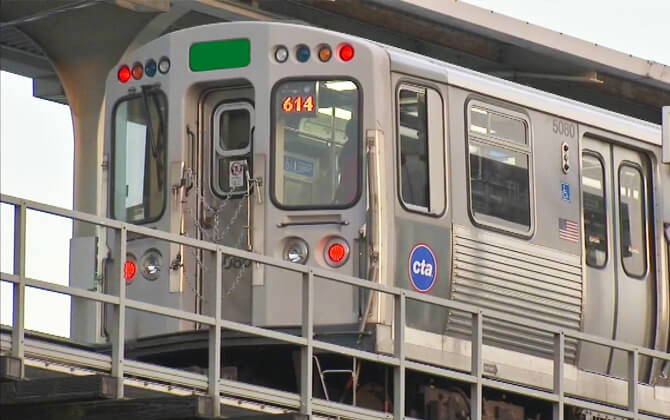
The Green Line is part of Chicago’s spoke-hub public transport network, with the Loop acting as the central hub. It approaches downtown from the west, runs along the Lake and Wabash sides of the elevated Loop, and then continues to the South Side.
Unlike other Loop services, Green Line trains do not use the Wells Street or Van Buren Street sides. The line also does not terminate in the Loop, which makes it unusual within the CTA system.
- Ashland branch: formerly known as the Englewood branch, ending at Ashland/63rd in West Englewood.
- East 63rd branch: formerly known as the Jackson Park branch, ending at Cottage Grove in Woodlawn.
Harlem/Lake to Downtown Chicago
From Harlem/Lake, the Green Line runs east through Oak Park and Chicago’s West Side toward downtown. The route then enters the Loop, where it serves key stations such as Clark/Lake, Washington/Wabash, Adams/Wabash, and Roosevelt.
Between Harlem/Lake and Garfield, weekday service is generally at least every 12 minutes, with shorter headways during rush hours. If you are checking the route timetable or train schedule today, look for both the arrival time and the train’s final destination.
Cottage Grove and Ashland/63rd Branches
South of Garfield, the line separates into two branches. The Ashland/63rd branch continues toward West Englewood, while the Cottage Grove branch curves east over 63rd Street and ends in Woodlawn.
The Ashland/63rd branch was permanently renamed from Englewood to Ashland in March 2013. The Cottage Grove branch became the permanent East 63rd terminus when the Green Line reopened in 1996. Both branches remain tied to the Green Line’s long history as one of the oldest elevated rapid transit corridors in Chicago.
Schedule, Frequency, and Live Arrivals
The Green Line schedule runs daily, but timings vary by day, time of day, and branch. For timings today, live arrivals are the best tool because staff may adjust service to keep trains evenly spaced and reduce delays.
| Service detail | Timings |
|---|---|
| Weekday operating hours | About 4:00 AM–1:00 AM |
| Saturday opening hours | About 5:00 AM–1:00 AM |
| Sunday opening times | About 5:00 AM–1:00 AM |
| Harlem/Lake to Garfield frequency | Typically every 12–17 minutes, with service as frequent as about 10 minutes during weekday rush hours |
| Branch frequency | Less frequent on Ashland/63rd and Cottage Grove branches because trains alternate |
| Weekend frequency | About 20–24 minutes in the schedule summary |
| Closing time and last train | Service generally ends around 1:00 AM, but check live arrivals before late-night travel |
Overnight owl bus routes such as N9, N20, N63, and N4 help cover some late-night trips when Green Line trains are not running.
Operating Hours
Green Line working hours are early morning through late evening. Weekday starting time is about 4:00 AM, while Saturday and Sunday service starts about 5:00 AM. The typical closing time is about 1:00 AM.
| Service detail | Timings |
|---|---|
| Monday–Friday | About 4:00 AM–1:00 AM |
| Saturday | About 5:00 AM–1:00 AM |
| Sunday | About 5:00 AM–1:00 AM |
Construction, station work, and service management can change the exact running time. Before a late trip, check alerts and live arrivals so you do not miss the last train.
Frequency by Time of Day
Frequency is strongest on weekdays and on the shared trunk between Harlem/Lake and Garfield. The branches run less often because trains alternate between Ashland/63rd and Cottage Grove.
| Service detail | Timings |
|---|---|
| Weekday rush hours | As often as about every 10 minutes between Harlem/Lake and Garfield |
| Weekday standard service | Typically every 12–17 minutes on the shared section |
| Branches | Longer waits than the shared section |
| Saturday and Sunday | About 20–24 minutes in the schedule summary |
Some schedule summaries also show wider frequency ranges, including 4–14 minutes on weekdays and 6–16 minutes on weekends. Treat live arrivals as the most practical timetable at the station.
Fares, Tickets, and Ventra
CTA fares are paid through Ventra. At Green Line stations, you can use a Ventra Card, a disposable Ventra ticket, or contactless pay-as-you-go with a mobile wallet or contactless bank card.
The standard CTA “L” train fare is US$2.50 ($2.50) at most stations. The O’Hare fare on the Blue Line is US$5.00 ($5.00) when deducted on entry at O’Hare station only, but an unlimited pass can be used there for no extra charge. A Single-Ride Ventra Ticket costs US$3.00 ($3.00) and includes up to two transfers within two hours plus the limited-use media fee.
| Payment option | Details |
|---|---|
| Ventra Card | Use transit value or passes for regular fares and transfers |
| Ventra Ticket | Disposable Single-Ride and 1-Day tickets from station vending machines |
| Contactless payment | Apple Pay, Google Pay, Samsung Pay, and contactless bankcards |
| Cash | Accepted at Ventra vending machines and retailers to load value or buy tickets; not used directly at train turnstiles |
There is no separate Green Line fare calculator at the platform: the price follows CTA fare rules. For a simple train trip, the ticket price is based on the CTA fare type you use.
How to Pay at Green Line Stations
At Green Line stations, pay before boarding by tapping your card, ticket, or device at the Ventra reader. Touch only the payment method you want to use. If you keep multiple cards in a wallet, take out the one you intend to tap.
Disposable Single-Ride and 1-Day tickets are sold at vending machines in every “L” station. New Ventra Cards can also be bought there, and you can add fare value or passes at the same machines.
Ventra Cards, Contactless Payments, and Passes
Ventra Cards can hold transit value and passes. You can manage them at vending machines, in the Ventra app, online, by phone, or at retail locations. New cards are sold at all “L” station vending machines and at more than 1,000 retail locations.
Unlimited ride passes are available for one person and begin from first use. Multiple passes can be loaded to a Ventra Card so the next pass is ready when the current one expires. A 1-Day CTA pass may also be sold as a disposable Ventra ticket at vending machines.
Ventra Cards can be added to Android devices with Google Pay and to iPhone or Apple Watch. The Ventra app also supports balance checks, value loading, pass management, arrival information, and mobile Metra tickets.
Transfers, Reduced Fares, and Regional Payment Options
Transfers between CTA and Pace are free for up to two additional rides within two hours when using eligible Ventra or contactless payment methods. Cash is accepted on buses, but cash payments do not include transfers.
Reduced fares are available only to eligible riders, including passengers with RTA-issued Reduced Fare permits. Children may qualify for reduced or free travel depending on age and the transit agency.
For regional travel, riders may use Ventra for CTA and Pace and buy mobile Metra tickets through the app. A Regional Day Pass is available only in the Ventra app starting June 20, 2025. Metra monthly pass holders can purchase the Regional Connect Pass for US$30 ($30), offering unlimited CTA and Pace rides for one month with no time or day restrictions.
Transfers and Connections
The Green Line is useful for transfers because it crosses downtown Chicago and links local transport with commuter rail, airport routes, bus service, and other CTA “L” lines. The most important transfer zones are in the Loop, at Roosevelt, at Clinton, and at 35th-Bronzeville-IIT.
From O’Hare, riders can take the Blue Line to Clark/Lake and transfer to the Green Line. From Midway, take the Orange Line to Roosevelt and transfer there. Clinton is useful for reaching Ogilvie Transportation Center, Union Station, Amtrak, and nearby Metra services.
Connections to Other CTA “L” Lines
In the Loop, the Green Line connects with other elevated services, including the Brown, Orange, Pink, and Purple Line Express. Clark/Lake also connects riders with the Blue Line, while Roosevelt provides a Green Line connection to the Orange Line and access to the Red Line nearby.
The Green Line shares tracks with the Orange Line between the Loop and 17th Street. Unlike other Loop lines, it continues through downtown instead of ending there.
CTA Bus Connections
CTA bus connections are available at many Green Line stations, making the route practical for city transport beyond the rail stations.
| Station | Details |
|---|---|
| Harlem/Lake | CTA bus 90 |
| Ridgeland | CTA bus 86 |
| Austin | CTA buses 91, 85, 57, and 54 at nearby Austin-area Green Line stations |
| Pulaski | CTA bus 53 |
| Kedzie | CTA bus 52 |
| California | CTA bus 94 |
| Damen | CTA bus 50 |
| Ashland | CTA buses 9 and X9, with Pink Line transfer nearby |
| Clinton | CTA bus 56, Pink Line transfer nearby, and Metra access at Ogilvie |
| Clark/Lake | CTA buses 22, 24, 134, 135, 136, and 156; transfers to Blue, Brown, Orange, Purple, and Pink lines |
| Washington/Wabash | CTA buses N4, J14, 20, 56, 60, N66, 124, 147, and 157; Metra and NICTD connections at Millennium Station |
| Adams/Wabash | CTA buses 1, 7, 28, 126, and 151; transfers to Purple, Orange, Brown, and Pink lines |
| Roosevelt | CTA buses 1, 3, 4, X4, 12, 18, 29, 62, 130, 146, and 192; transfers to Red and Orange lines |
| Cermak-McCormick Place | CTA buses 1, 3, 4, X4, 21, and 29 |
Overnight bus service is available on selected routes, including N4, N9, N20, and N63. Most owl routes operate at about 30-minute intervals.
Metra and South Shore Line Connections
The Green Line connects directly to Metra at Oak Park, where riders can use the Union Pacific West Line. At 35th-Bronzeville-IIT, riders can connect to Metra at 35th Street.
Downtown, Washington/Wabash is useful for Millennium Station, where riders can reach Metra Electric District and South Shore Line service. Clinton is close to Ogilvie Transportation Center, Union Station, and Amtrak, which makes the Green Line a practical link between CTA and regional transportation in Chicago.
Airport Connections
The Green Line does not serve O’Hare or Midway directly, but it connects to both airport rail routes. Use the Blue Line for O’Hare and the Orange Line for Midway, then transfer to the Green Line in the Loop or at Roosevelt.
For McCormick Place, use Cermak-McCormick Place station. It is about 2 blocks, or 0.15 mile (0.24 km), from the northwest corner of the McCormick Place West Building.
From O’Hare Airport to the Green Line
From O’Hare International Airport, take the Blue Line to Clark/Lake and transfer to a southbound Green Line train. The transfer is free when made within the CTA system using an eligible payment method.
Check the destination display before boarding the Green Line. Southbound trains may be heading to Ashland/63rd or Cottage Grove. For McCormick Place, ride to Cermak-McCormick Place.
From Midway Airport to the Green Line
From Midway Airport, take the Orange Line to Roosevelt and transfer to the elevated Green Line. From Roosevelt, continue southbound if you are going toward Cermak-McCormick Place, Bronzeville, Garfield, or the South Side branches.
For the return trip toward Midway, use the Green Line to Roosevelt and transfer to the Orange Line. Northbound Green Line trains toward the Loop and West Side are marked Harlem/Lake.
Parking and Bike Parking at Stations
CTA Park & Ride lots are available at selected stations for daily parking. Some lots use numbered slotbox payment or posted lot instructions. The draft information does not list Green Line-specific parking charges per day, but it does list monthly station parking spaces under the “L” at US$95–US$150 ($95–$150), depending on location.
- Parking.com mobile payment is available at 14 CTA Park & Ride lots, including locations near stations on the Blue, Brown, Green, Orange, and Pink lines.
- Monthly spaces are reserved for monthly parkers where permits are offered.
- Always follow the lot instructions posted at the station parking area.
Bike racks are installed outside most “L” stations, and some stations also have sheltered outdoor or indoor bike parking. Bikes are permitted on CTA “L” trains during most hours, except weekday rush periods from 7:00–9:00 AM and 4:00–6:00 PM. Bikes are allowed all day on Saturdays, Sundays, and holidays.
Use wide accessible swing gates when available. Bikes may be taken on elevators or carried on stairs, but they are not allowed on escalators. Up to two bicycles are allowed per railcar during permitted hours.
Accessibility, Tips and Rules
All CTA railcars are accessible. At accessible stations, riders can ask staff for help with gap fillers when boarding. Service alerts matter, especially when elevators, station entrances, or construction work affect a trip.
Priority seating is reserved for seniors and people with disabilities. Please yield those seats when needed or when asked by staff or another rider.
Watch the destination signs closely. Because Green Line trains alternate between Ashland/63rd and Cottage Grove, getting on the next train without checking can send you to the wrong branch.
For travel planning, use the Ventra app or call the RTA Travel Information Center at 312-836-7000. Service may change because of construction, staffing, or interval management.
Safety and Etiquette
On platforms, stand behind the safety line and watch the gap when boarding or exiting. Let passengers exit first, then board from the sides so the doorway stays clear.
On board, move away from the doors when you can, keep bags close, and hold a rail if you are standing. As your stop approaches, get ready early and check exit signs for the correct street or direction.
Cash is not accepted directly at “L” train turnstiles. Use a Ventra Card, ticket, pass, contactless bank card, or mobile wallet. If you need to use cash, buy or load a fare product at a vending machine first.
Stay aware of your surroundings, secure your wallet, and keep your phone put away when approaching stops or moving through crowded station areas. Emergency intercoms are available on platforms and in train cars.
Brief History and Modernization
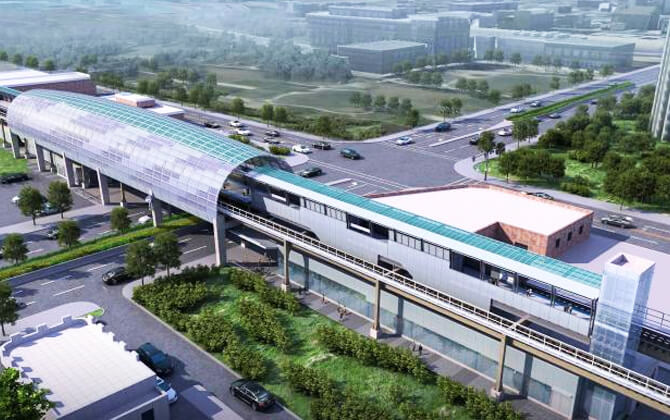
The Green Line combines two of the oldest rapid transit segments in Chicago. Its roots go back to 1892, when the Chicago and South Side Rapid Transit Railroad opened service from Wabash Avenue and State Street south to 39th Street. The route was built to provide affordable mass transportation between downtown Chicago and the area that would host the World’s Columbian Exposition, and it reached Jackson Park by 1893.
In 1993, the CTA created the Green Line by linking the Lake Street and Englewood-Jackson Park routes through the Loop. Because both sections were already among the oldest parts of the “L,” the line needed major rehabilitation. In January 1994, the CTA closed the entire route for reconstruction, and service returned on May 12, 1996.
The modernization replaced worn infrastructure, including tracks, ties, signals, and parts of the elevated structure. When the line reopened, it had fewer stations than before, and branch naming and routing changes followed. The work was controversial, but it was presented as necessary for an aging route with declining ridership.
Later upgrades continued on the West Side, in the Loop, and on the South Side. The Green Line was also fully equipped with Bombardier 5000-series railcars, with the last 2400-series cars reassigned in 2013.
Attractions near Green Line Stops
The Green Line serves several popular Chicago destinations, especially in the Loop, Oak Park, the Near South Side, Bronzeville, and around McCormick Place.
- Cermak-McCormick Place: nearest CTA rail stop for McCormick Place, with restaurants and nightlife nearby.
- State/Lake: useful for Millennium Park and the Art Institute of Chicago, though the station is closed for construction until 2029.
- Washington/Wabash: central Loop station near major downtown attractions and Millennium Station.
- Clark/Lake: practical for the Chicago Theatre and Willis Tower trips.
- Pulaski and Conservatory-Central Park Drive: useful for Garfield Park Conservatory.
- Ashland: access to the United Center and Little Italy area.
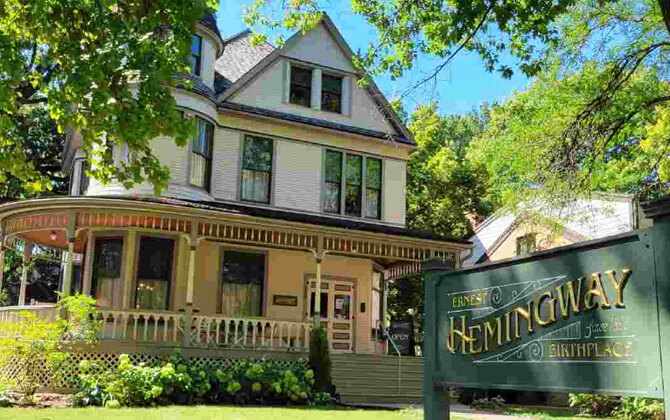
- Harlem/Lake and Ridgeland: Oak Park stops, including access to Ernest Hemingway’s birthplace and the Oak Park Public Library.
- Cermak-McCormick Place and nearby South Side stops: access to attractions such as Chess Records / Blues Heaven Foundation, Chicago Women’s Park and Gardens, Clarke House, Reggie’s Rock Club and Music Joint / Record Breakers, the Shrine, Tommy Gun’s Garage, and Velvet Lounge.
With bus or rail transfers, Green Line riders can also reach Chinatown, Wintrust Arena, Museum Campus, Guaranteed Rate Field, Union Station, the United Center, Willis Tower, and other major Chicago destinations.