The Brown Line is a Chicago “L” rapid transit route linking Kimball in Albany Park with downtown Chicago and the Loop. It runs 11.4 miles (18.3 kilometers), serves 27 stations, operates entirely above ground, and is almost fully grade-separated. In 2024, it was the third-busiest “L” route, averaging 35,176 weekday boardings.
| Key | Information |
|---|---|
| Route | Kimball in Albany Park to the Chicago Loop |
| Length | 11.4 miles (18.3 kilometers) |
| Stations | 27 stations |
| Former name | Ravenswood Route before CTA color coding began in 1993 |
| Loop direction | Counter-clockwise on the Outer track |
| Service pattern | Daily service from early morning until late evening, with later closing time on some days |
| Railcars | 2600-series and 3200-series railcars |
Blue Line Chicago “L” Map
The Blue Line Chicago “L” map shows all available stations. Click on the map to enlarge it or download the Blue Line Chicago “L” map in PDF format.
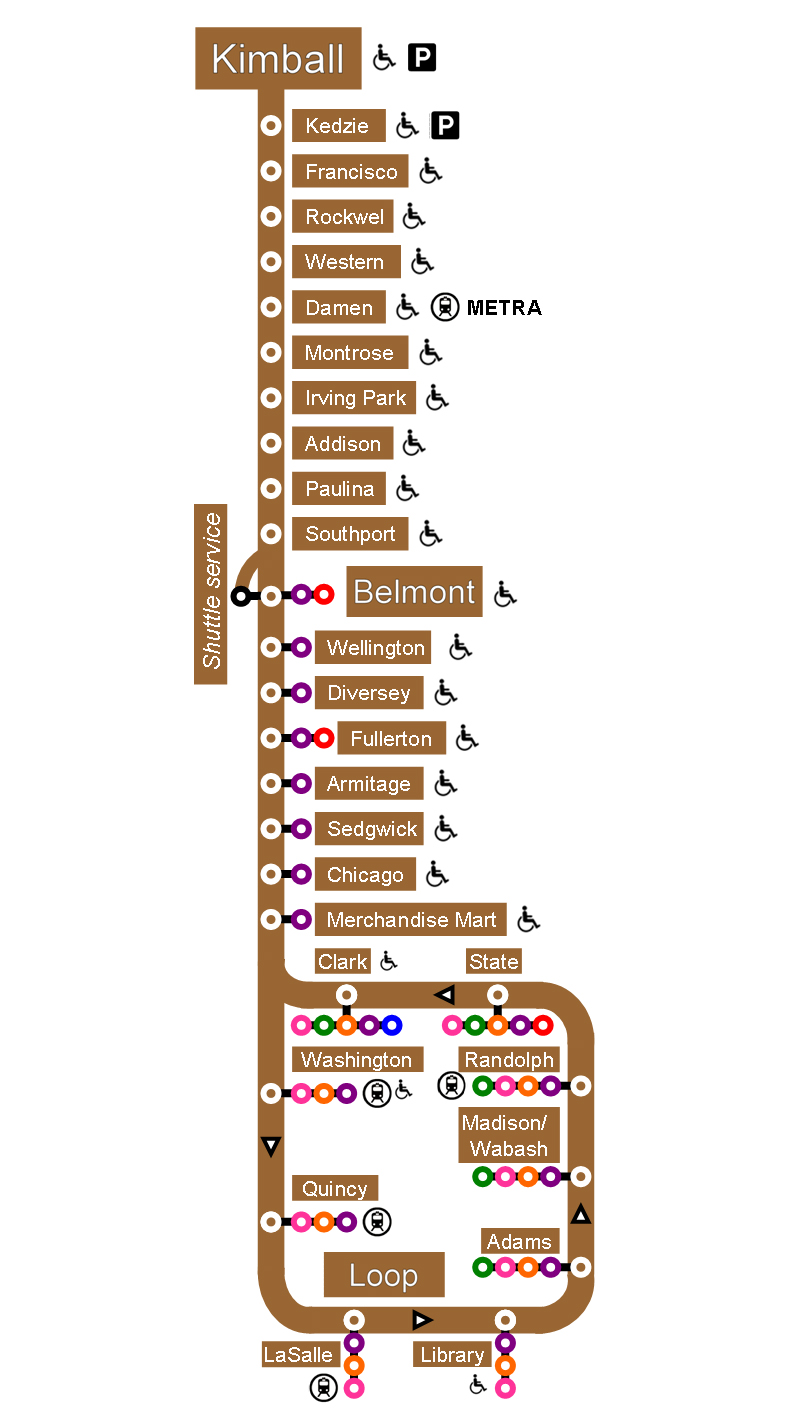
Stations and Route
The Brown Line route runs from Kimball to downtown Chicago, then circles the Loop before returning north. For trip planning, the route plan is simple: the Ravenswood branch runs from Kimball to Belmont, the North Side Main Line continues toward Merchandise Mart, and the Loop segment carries trains counter-clockwise through downtown.
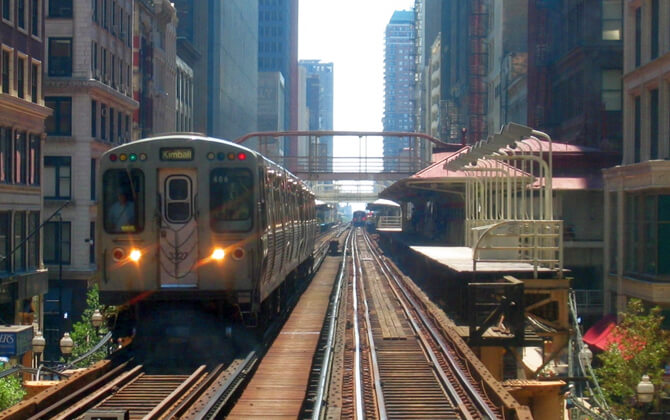
Trains begin at Kimball, where a storage yard and servicing shop sit east of the passenger station. From there, the line runs at street level to Rockwell, then rises onto elevated tracks for the rest of the trip. South of Damen, the path passes through Lincoln Square, Lakeview, Lincoln Park, the Near North Side, River North, and the Loop.
| Station | Details |
|---|---|
| Kimball | Northern terminal in Albany Park; yard and servicing shop nearby |
| Kedzie | Ravenswood branch station |
| Francisco | Ravenswood branch station |
| Rockwell | Street-level section ends near this part of the route |
| Western | Lincoln Square area station |
| Damen | Metra Union Pacific North connection at Ravenswood |
| Montrose | North Side station |
| Irving Park | North Center area station |
| Addison | North Center area station |
| Paulina | Lakeview area station |
| Southport | Lakeview area station |
| Belmont | Major transfer to Red and Purple lines |
| Wellington | North Side Main Line station |
| Diversey | Lincoln Park area station |
| Fullerton | Major transfer to Red and Purple lines |
| Armitage | Lincoln Park area station |
| Sedgwick | Old Town and Near North Side access |
| Chicago | Near North Side station |
| Merchandise Mart | Downtown station before the Loop; Purple Line connection |
| Washington/Wells | Loop station and downtown transfer point |
| Quincy | Loop station with access toward Union Station connections |
| LaSalle/Van Buren | Loop station with access toward LaSalle Street Station |
| Harold Washington Library-State/Van Buren | Loop station; some morning rush hour through-routing with the Orange Line |
| Adams/Wabash | Loop station; some Orange Line trains continue as Brown Line trains during morning rush hour |
| Washington/Wabash | Loop station |
| State/Lake | Loop station; closed for construction until 2029 |
| Clark/Lake | Loop station and key transfer point for the Blue Line |
North Side and Ravenswood Branch Stations
The North Side portion includes the historic Ravenswood branch from Kimball to Belmont and the North Side Main Line from Belmont to Merchandise Mart. Before CTA lines received colors in 1993, riders knew today’s Brown Line as the Ravenswood Route, and the Kimball-to-Belmont shuttle was called the Ravenswood Shuttle.
| Station | Details |
|---|---|
| Kimball to Belmont | Ravenswood branch, serving Albany Park, Ravenswood, Lincoln Square, North Center, and Lakeview |
| Belmont to Merchandise Mart | North Side Main Line segment toward downtown Chicago |
| Sedgwick, Chicago, Merchandise Mart | Elevated approach through the Near North Side before crossing the Chicago River |
South of Armitage, Brown and Purple Line trains continue toward the Chicago Loop on elevated tracks, stop at Sedgwick, Chicago, and Merchandise Mart, then cross the Chicago River on the upper level of the Wells Street Bridge.
Loop Stations and Direction of Travel
In the Loop, Brown Line trains travel counter-clockwise on the Outer track. This fixed station order matters when you are checking a stations map, planning a route timetable, or trying to decide which platform gets you to the next stop fastest.
| Station | Details |
|---|---|
| Washington/Wells | First Loop stop after Merchandise Mart |
| Quincy | Served after Washington/Wells |
| LaSalle/Van Buren | Served after Quincy |
| Harold Washington Library-State/Van Buren | Served after LaSalle/Van Buren |
| Adams/Wabash | Served after Harold Washington Library-State/Van Buren |
| Washington/Wabash | Served after Adams/Wabash |
| State/Lake | Closed for construction until 2029 |
| Clark/Lake | Last Loop stop before trains return north |
The Brown Line is the only Chicago “L” route that makes a full counter-clockwise circuit around the Loop. The station order above follows the train route, not geographic position.
Major Transfer Stations
Several Brown Line stations are especially useful for transfers across Chicago public transport. Belmont and Fullerton connect with the Red and Purple lines, while Merchandise Mart links with the Purple Line. In the Loop, Adams/Wabash connects with the Green, Orange, Pink, and Purple lines, and nearby Van Buren Street provides access to Metra and the South Shore Line.
| Station | Details |
|---|---|
| Belmont | Transfer between Brown, Red, and Purple lines |
| Fullerton | Transfer between Brown, Red, and Purple lines |
| Chicago | Brown and Purple Line service |
| Merchandise Mart | Brown and Purple Line service; major downtown interchange |
| Washington/Wells | Loop transfer point with access toward Ogilvie Transportation Center |
| Adams/Wabash | Connections to Green, Orange, Pink, and Purple lines; nearby regional rail access |
| Clark/Lake | Key Loop transfer point, including Blue Line access |
Fares, Tickets, and Ventra
Brown Line fare payment is handled through Ventra. You can use a Ventra Card, a Ventra Ticket, a contactless bankcard, or a mobile wallet. CTA passes also work on CTA buses and trains and on Pace buses, making Ventra the main card for city transport and local transport connections.
The standard CTA “L” train fare is US$2.50 ($2.50) when paid with Ventra transit value or a contactless payment method. Reduced fare riders pay US$1.25 ($1.25). A special US$5.00 ($5.00) fare applies when boarding the Blue Line at O’Hare, but that premium fare does not apply to the Brown Line.
Single-Ride Ventra Tickets are sold at Ventra vending machines. They cost US$3.00 ($3.00) at most locations and include up to two transfers within two hours. They are handy if you do not have a Ventra Card or contactless payment method.
Ventra Cards and tickets can be bought at station vending machines, and new cards are also available at participating retail locations. You can load value, buy a pass, manage your account, and check balances in the Ventra app.
Paying with Ventra or a Contactless Card
At Brown Line stations, pay before entering the boarding area by tapping your card or ticket on the Ventra reader at the turnstile. On buses, you pay as you board. When accepted, the reader gives a sound and shows a message telling you to go or stop.
Tap the card flat against the reader and remove it from your wallet to avoid card clash, where the reader detects the wrong payment card. Ventra accepts reloadable Ventra Cards, disposable Ventra Tickets, contactless bankcards, Apple Pay, Google Pay, Samsung Pay, and Ventra Cards on supported mobile devices and Apple Watch.
A Ventra Card can pay for up to seven riders at once. Passes cover only the first rider, so load enough transit value if you are paying for other people.
Cash and coins are accepted on buses, but exact change is required and no transfer is available with cash. At all CTA “L” stations, vending machines sell new Ventra Cards and disposable tickets and can load value or passes.
Passes and Transfers
CTA passes for the Brown Line are added to Ventra and provide unlimited rides for one person during the pass period after first use. Transfers allow up to two additional CTA rides within two hours of a new fare.
| Type | Details |
|---|---|
| Transfers | Up to 2 additional CTA rides within 2 hours of a new fare |
| Pass | Unlimited rides for one person for the pass length after first use |
| Day pass | 1-Day Pass valid for 24 hours |
| 3-Day Pass | Valid for 72 hours |
Free rail connections are available between all “L” lines marked as transfers on CTA maps. The Ventra app can also be used to manage pass products and balances.
Reduced Fares and Student Fares
Reduced fares are available only to eligible riders. On CTA, children ages 7 to 11, seniors 65 and older, and riders with disabilities who have an RTA-issued Reduced Fare permit may pay reduced fares. Children under 7 ride free with a fare-paying customer on CTA.
Student Reduced Fare is available on CTA buses and trains for full-time students ages 7 to 20 traveling to and from regular day classes at public, parochial, private elementary, or high schools. It is valid only on school days, Monday through Friday from 5:30 a.m. to 8:30 p.m., and students must use a Student Ventra Card or CTA Student Riding Permit.
Student Ventra Cards can be loaded at Ventra vending machines, retailers, online, in the Ventra app, or by phone. Outside student fare hours or outside the school term, regular fares are automatically deducted from transit value.
Schedule, Frequency, and Live Train Tracking
The Brown Line train schedule changes by day and time of day. Service usually starts early, runs through late evening, and continues past midnight on operating days. For timings today, check live train tracking before you leave, especially if your trip depends on the last train or a tight transfer.
| Service detail | Timings |
|---|---|
| Weekdays | 4:00 a.m. to 1:30 a.m. |
| Saturday | 5:00 a.m. to 1:00 a.m. |
| Sunday/Holiday | 4:40 a.m. to 2:10 a.m. |
| Additional late-night weekday service | 5:40 a.m. to 1:40 a.m. |
Frequency is highest during busy periods and lower late at night, early in the morning, and on parts of the weekend. CTA may adjust service to keep trains evenly spaced and reduce delays.
For live arrivals and schedule today details, use a real-time transit app or station-specific timetable tools. State/Lake is closed for construction until 2029, and the Washington/Wells elevator between street level and the Orange, Pink, and Purple Line platform is temporarily out of service due to elevator upgrades.
Operating Hours
Brown Line operating hours generally cover early morning through late evening, with service continuing after midnight. Opening hours and closing time vary by day, so do not assume the same starting time every morning.
| Service detail | Timings |
|---|---|
| Weekdays and Saturdays | 4:00 a.m. to 2:10 a.m. |
| Sundays | 5:00 a.m. to 1:40 a.m. |
| Rush hour frequency | Every 3 to 8 minutes |
| Midday frequency | Every 7 to 8 minutes |
| Night frequency | Every 6 to 12 minutes |
| Weekend early morning frequency | Every 15 minutes |
| Late-night frequency | Every 15 minutes until the end of service |
These working hours are useful for general planning, but real-time updates are better when you need the next train or the last train.
Rush Hour, Weekend, and Holiday Service
During weekday rush hour, Brown Line trains run most often, usually every 3 to 8 minutes. Midday service is typically every 7 to 8 minutes, while nighttime intervals range from 6 to 12 minutes.
On weekends, early morning trains usually run every 15 minutes. Saturday daytime service improves to every 7 to 8 minutes, while Sunday daytime service runs about every 10 minutes. At night, weekend trains operate every 10 to 12 minutes, with late-night service every 15 minutes until closing time.
During the morning rush hour, some Loop-bound Brown Line trains continue as Orange Line trains after Harold Washington Library, and some Orange Line trains bound for Kimball continue as Brown Line trains after Adams/Wabash.
Transfers and Connections
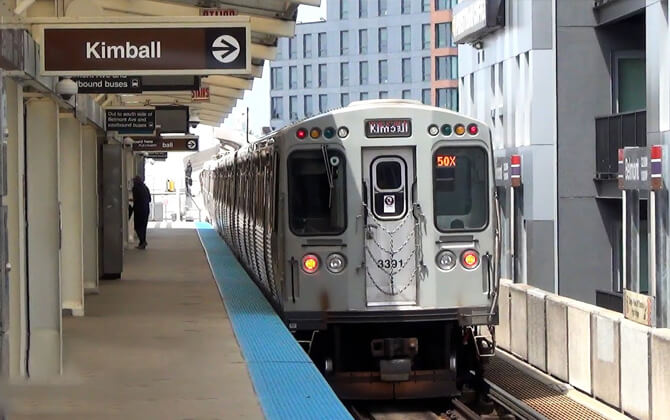
The Brown Line is a useful link in Chicago transportation because it connects neighborhood stations, downtown transfer points, CTA bus routes, other “L” lines, and regional rail. At Kimball, riders can connect with CTA buses 81 and 82. Farther south, the line links with Metra at Damen and with several downtown rail hubs near Loop stations.
| Station | Details |
|---|---|
| Kimball | CTA buses 81 and 82 |
| Kedzie | CTA bus 93 |
| Western | CTA buses 11, 49, 49B, X49 |
| Damen | Metra Union Pacific North at Ravenswood; CTA buses 50 and 81 |
| Montrose | CTA bus 78 |
| Irving Park | CTA bus 80 |
| Addison | CTA bus 152 |
| Paulina | CTA buses 9 and X9 |
| Belmont | Red and Purple lines; CTA buses 22 and 77 |
| Fullerton | Red and Purple lines; CTA buses 37 and 74 |
| Merchandise Mart | Purple Line; CTA buses 37 and 125 |
| Washington/Wells | Access toward Ogilvie Transportation Center and multiple CTA bus routes |
Former Brown Line stations listed as closed or demolished include Ravenswood, Wrightwood, Webster, Willow, Halsted, Larrabee, Schiller, Oak, Grand, Kinzie, and Randolph/Wells. They are not active transfer points.
Connections to Other “L” Lines
The Brown Line shares tracks with other Chicago “L” services along parts of its route. From just north of Belmont to Armitage, Brown Line trains run alongside the Red Line, and Purple Line Express trains use the same tracks during weekday rush hours.
In the Loop, Brown Line trains run counter-clockwise via Wells, Van Buren, Wabash, and Lake. On the north and east sides of the Loop, Harlem-bound Green Line trains share tracks with the Brown Line.
| Station | Details |
|---|---|
| Belmont | Red and Purple Line transfers |
| Fullerton | Red and Purple Line transfers |
| Merchandise Mart | Purple Line connection |
| Harold Washington Library-State/Van Buren | Some Brown Line trains continue as Orange Line trains during morning rush hour |
| Adams/Wabash | Some Orange Line trains continue as Brown Line trains during morning rush hour |
Bus Connections Along the Route
Brown Line stations connect with many CTA bus routes, which makes the line useful beyond the rail corridor. These bus links help riders reach local streets, lakefront areas, shopping corridors, and neighborhoods not directly on the “L”.
| Station | Details |
|---|---|
| Kimball | CTA buses 81, 82 |
| Kedzie | CTA bus 93 |
| Western | CTA buses 11, 49, 49B, X49 |
| Damen | CTA buses 50, 81 |
| Montrose | CTA bus 78 |
| Irving Park | CTA bus 80 |
| Addison | CTA bus 152 |
| Paulina | CTA buses 9, X9 |
| Belmont | CTA buses 22, 77 |
| Diversey | CTA bus 76 |
| Fullerton | CTA buses 37, 74 |
| Armitage | CTA bus 73 |
| Sedgwick | CTA buses N9, 37, 72 |
| Chicago | CTA buses 37, 66 |
| Merchandise Mart | CTA buses 37, 125 |
Metra and Regional Rail Connections
Damen is the Brown Line’s direct north-side Metra connection, linking riders with Metra’s Union Pacific North line at Ravenswood. It is especially useful for Lincoln Square and nearby neighborhoods.
Downtown, the Brown Line also connects riders to regional rail hubs. Washington/Wells provides access toward Ogilvie Transportation Center for Metra Union Pacific North, Union Pacific Northwest, and Union Pacific West services. Quincy provides access toward Union Station, where Metra lines include BNSF Railway, Heritage Corridor, Milwaukee District North, Milwaukee District West, North Central Service, and Southwest Service. LaSalle/Van Buren connects with Metra’s Rock Island District at LaSalle Street Station.
Airport Connections
The Brown Line does not serve O’Hare or Midway directly. For airport trips, use the Brown Line to reach a transfer station, then change to a route with direct airport service.
Clark/Lake is one of the most useful transfer points because it connects the Brown Line with the Blue Line for O’Hare. For Midway, riders connect in the Loop to the Orange Line. Belmont is another important station, linking the Brown, Red, and Purple lines.
Getting to O’Hare from the Brown Line
There is no direct Brown Line train to O’Hare. The usual rail option is to ride downtown and transfer to the Blue Line at Clark/Lake, then continue to O’Hare.
| Service detail | Timings |
|---|---|
| Line 76 bus plus Blue Line subway | About 52 minutes; about US$4–US$7 ($4–$7) |
| Subway via Clark/Lake | About 1 hour 11 minutes; about US$4–US$10 ($4–$10) |
| Drive | About 20 minutes; about US$3–US$4 ($3–$4) |
| Taxi | About 20 minutes; about US$45–US$60 ($45–$60) |
| Shuttle | About 25 minutes; about US$70 ($70) |
| Towncar | About 20 minutes; about US$95–US$140 ($95–$140) |
The road distance to O’Hare is about 15 miles (24 kilometers), and driving takes roughly 20 minutes under normal conditions.
Getting to Midway from the Brown Line
The Brown Line does not go directly to Midway, but it works well as the first part of the trip from the North Side. Ride to the Loop, then transfer to the Orange Line, which continues to Midway.
Clark/Lake and other Loop stations are useful for changing lines. Before you travel, check current service information, because construction and schedule changes can affect routing.
Accessibility, Bikes, and Parking
All CTA railcars are accessible. At accessible stations, staff can help with boarding gap fillers when needed, and riders should check current alerts before traveling.
Federal law requires priority seating for seniors and people with disabilities. Yield these seats when asked or when they are needed.
Up to 2 bicycles are permitted per railcar during most hours and most days, except weekday rush periods. That makes the Brown Line useful for bike-and-ride trips outside peak commuting times.
Accessible station and Park & Ride information is included in timetable materials. Complete station parking details, including parking charges and parking charges per day where available, should be checked before you drive to a station.
Pay attention to destination signs and announcements. Some trains may not travel the full length of the line when service is adjusted for spacing or delays.
Tips and Rules
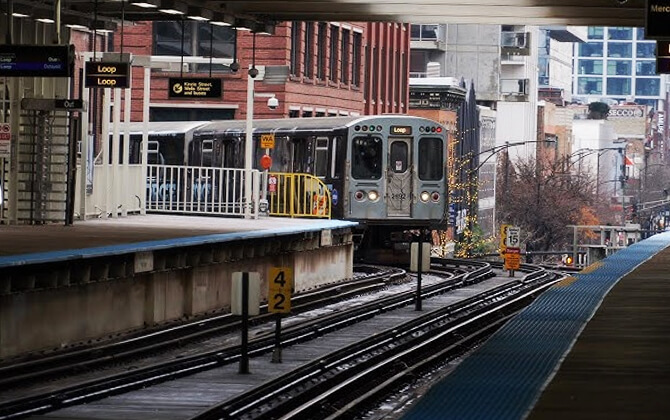
Check destination signs before boarding. Northbound Brown Line trains head to Kimball, while Loop-bound trains circle downtown counter-clockwise before returning north.
- Use live train tracking if you need timings today or the last train.
- Allow extra time when transferring in the Loop, especially during construction or elevator outages.
- Yield priority seating to seniors and riders with disabilities.
- Bring a Ventra Card, ticket, contactless card, or mobile wallet for the easiest fare payment.
- Bikes are not allowed during weekday rush periods.
- State/Lake is closed for construction until 2029.
- The Washington/Wells elevator between street level and the Orange, Pink, and Purple Line platform is temporarily out of service due to elevator upgrades.
How to Ride the Brown Line
To ride the Brown Line, enter any station on the route, pay at the turnstile, and choose the correct direction. Trains toward Kimball go north. Trains toward the Loop continue downtown and travel counter-clockwise through all Loop stations before heading back north.
If you are new to the system, think of the Brown Line as a north-side route with a downtown loop at the end. The stations list runs from Kimball through Ravenswood, Lakeview, Lincoln Park, River North, and the Loop.
Use the Ventra app for fare balance and trip information, or call the RTA Travel Information Center at 312-836-7000. Spanish-language assistance is available through the same number.
Some stations are accessible, and Park & Ride is available at selected locations. If your trip includes State/Lake, plan around the closure through 2029.
Brief History and Modernization
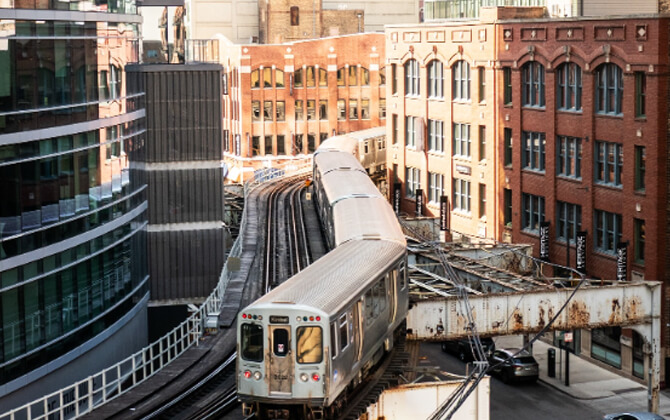
The Brown Line traces its history to the Ravenswood Route, which became the Brown Line when CTA color coding began in 1993. The line opened in phases under the Northwestern Elevated Railroad, reaching Lincoln Square on May 18, 1907, and Kimball on December 14, 1907.
In 1949, the present-day Brown Line service pattern was created between Kimball and the Loop. Over time, the route became one of the busiest parts of the Chicago “L” system and a key public transport link between the Northwest Side and downtown.
Modernization focused on accessibility, capacity, signals, traction power, train control, and communications. Beginning in March 2008, eight-car trains became standard during rush hours. Later that year, CTA completed rehabilitation of 3200-series cars with updated destination signs, air conditioning, propulsion systems, door motors, and wheel and axle assemblies. In 2021, the Red-Purple Bypass opened north of Belmont, reducing conflicts between Brown, Red, and Purple Line trains.
Ravenswood Route Origins
Before 1993, the Brown Line was known as the Ravenswood Route. The name came from the branch between Belmont and Kimball, and the Kimball-Belmont shuttle was called the Ravenswood Shuttle.
The route began with the Northwestern Elevated Railroad. Service to Western Avenue in Lincoln Square opened on May 18, 1907, and the extension to Kimball opened on December 14, 1907, giving the growing northwest side a direct rail link to downtown Chicago.
In 1913, crosstown service was introduced and the branch was connected through the Loop. After the Chicago Transit Authority takeover in 1947, service was reorganized, and on August 1, 1949, the Ravenswood Line was established in its modern form. The line was officially renamed the Brown Line on February 21, 1993.
Brown Line Capacity Expansion Project
The Brown Line Capacity Expansion Project ran from 2004 to 2009. It was launched to repair aging infrastructure, increase passenger capacity, improve accessibility, and support better service.
The project budget was US$530 million ($530 million). Its main goals were to lengthen station platforms for eight-car trains instead of six-car trains, rehabilitate stations and rail infrastructure, meet ADA accessibility requirements, upgrade or replace traction power, signals, and communications equipment, and reduce or eliminate slow zones.
Work began in late 2004 with signal upgrades, especially at Clark Junction. Station reconstruction started in early 2006, and platforms at 16 stations were extended for eight-car trains, creating a one-third capacity increase over the earlier six-car setup.
Merchandise Mart was not included because it was already modern, ADA-compliant, and able to handle eight-car trains. Kimball and Western received small platform extensions and limited additional work, while the other 16 stations were completely or largely rebuilt. Kedzie and Rockwell reopened on August 16, 2006, and Wellington was the final project station to enter service on July 30, 2009.
The project also added a new substation, rehabilitated an existing substation, installed a new signal system at Clark Junction, improved the Clark Tower facility, and added a new fiber optic communication network. Station upgrades included accessible turnstiles, escalators, brighter lighting, new signage including Braille, bike racks, and original artwork. At Belmont and Fullerton, historic stationhouses were preserved and relocated across the street as secondary entrances.
Neighborhoods and Attractions Along the Brown Line
The Brown Line is one of the best Chicago “L” routes for seeing neighborhood change from the train. It passes through Albany Park, Ravenswood, Lincoln Square, Lakeview, Lincoln Park, Old Town, River North, and the Loop, with a mix of local businesses, older institutions, redevelopment areas, and elevated city views.
Along the way, riders can see places such as the Old Town Ale House near Sedgwick, the former Cabrini-Green area west of the line, New City near Halsted Street, Chicago Bagel Authority near Armitage, Timber Lanes near Irving Park, and Lincoln Square’s German heritage sites and events, including Oktoberfest and the Von Steuben Day Parade.
Albany Park, Ravenswood, and Lincoln Square
The Brown Line begins at Kimball in Albany Park and runs through several stations tied to the route’s original Ravenswood identity. This stretch includes Kimball, Kedzie, Francisco, Rockwell, Western, Damen, Montrose, Irving Park, and Addison.
| Station | Details |
|---|---|
| Kimball, Kedzie, Francisco | Albany Park access |
| Rockwell, Western, Damen | Lincoln Square and Ravenswood area access |
| Montrose | Lincoln Square and North Center area access |
| Irving Park, Addison | North Center area access |
| Damen | Metra connection at Ravenswood |
For riders exploring local streets and bus connections, this section is one of the most practical parts of the route.
Lakeview, Lincoln Park, and Old Town
In Lakeview, the Brown Line serves Paulina, Southport, Belmont, and Wellington. Belmont is a major transfer station for the Red and Purple lines and also has CTA bus connections.
In Lincoln Park, the line serves Diversey, Fullerton, and Armitage. Fullerton connects with the Red and Purple lines, while Armitage is served by CTA bus 73. Old Town is represented by Sedgwick, one of the stops south of Armitage before the line continues into downtown Chicago.
River North and the Downtown Loop
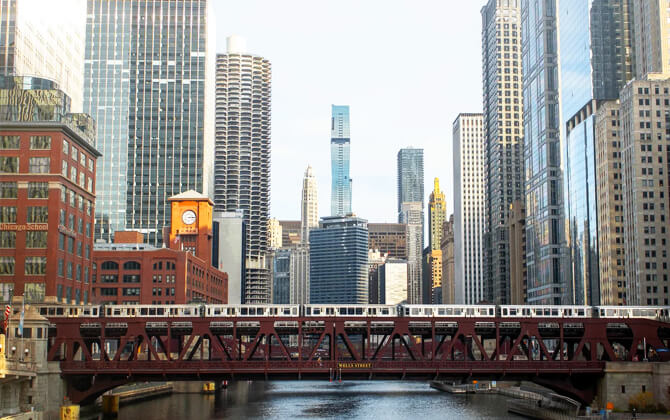
South of Armitage, Brown Line trains continue on elevated tracks through Lincoln Park and the Near North Side, stopping at Sedgwick and Chicago before reaching Merchandise Mart. The line then crosses the Chicago River on the upper level of the Wells Street Bridge and joins the Loop Elevated at Lake Street.
In the Loop, trains run counter-clockwise on the Outer track via Wells, Van Buren, Wabash, and Lake. This downtown segment includes Tower 18 near Wells and Lake, where the Brown, Purple, Pink, Green, and Orange lines intersect and move through the elevated system.
Scenic Views and Sightseeing Tips
The Brown Line can feel like a moving sightseeing tramway, especially on the southbound ride from River North into the Loop. For some of the best views, ride south from any stop north of Merchandise Mart, sit on the left side, and watch the train cross the river into downtown. The fare is US$2.50 ($2.50), which makes it an affordable city view.
Highlights include the North Branch of the Chicago River, Merchandise Mart, the downtown skyline, the Wells Street Bridge, the Harold Washington Library Center, and the elevated tracks winding through the Loop.
- Ride south for the best skyline and river views.
- Start north of Merchandise Mart to catch the most scenic stretch.
- Sit on the left side of the train.
- Get off at Clark/Lake for a quick photo near the Wells Street Bridge.