Mumbai Monorail is a city transport system operated by the Mumbai Metropolitan Region Development Authority (MMRDA). The line runs from Chembur in the eastern suburbs to Sant Gadge Maharaj Chowk at Mahalaxmi, linking key rail corridors in Mumbai. Commercial service began in 2014, Phase 2 opened in 2019, and as of 2025 it remains the only operating monorail in India. Built on a narrow single track with a lightweight structure, it was designed to handle sharp turns in dense urban areas.
| Key | Information |
|---|---|
| Operator | MMRDA |
| Route | Chembur to Sant Gadge Maharaj Chowk |
| System type | Monorail |
| Opened | 2014 |
| Phase 2 opened | 2019 |
| Network status | Only operating monorail in India as of 2025 |
| Interchanges | Harbour Line, Central Line, and Western Line |
Mumbai Monorail Route Map
Mumbai Monorail map showing 1 lines and 18 stations. Click on the map to enlarge it or download the Mumbai Monorail map in PDF format.
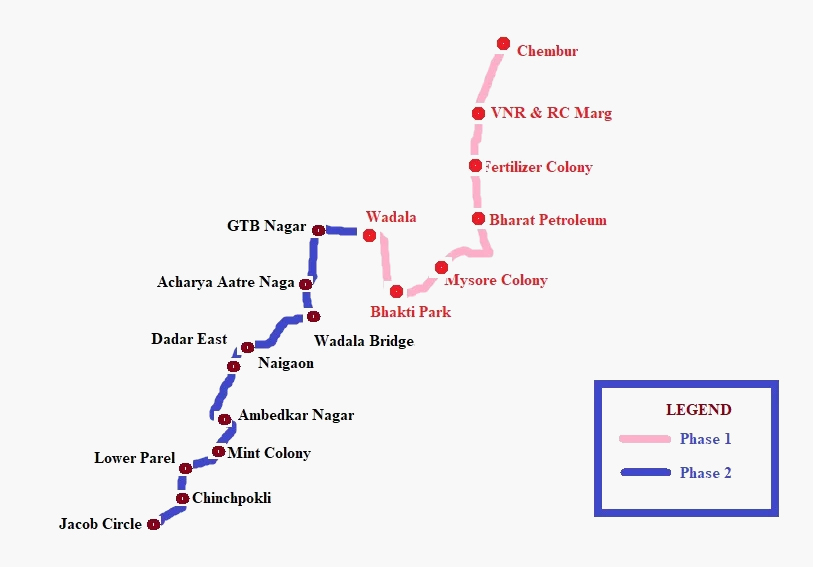
Mumbai Monorail Line and Stations
The monorail system consists of multiple elevated stations, each built to handle high passenger flow with modern facilities such as ticketing counters, escalators, and security systems. Stations like Wadala Depot Monorail Station and Chembur Monorail Station act as key transit points, connecting commuters to other modes of transport such as buses and suburban railways.
Line 1 of the Mumbai Monorail will run from Wadala and Chembur in the eastern part of Mumbai.
Stations
- Chembur Monorail Station
- Fertilizer Township Monorail Station
- VNP & RC Marg Junction Monorail Station
- Chembur Naka Monorail Station
- Ashok Nagar Monorail Station
- Bhakti Park Monorail Station
- Wadala Depot Monorail Station
- Anik Nagar Monorail Station
- Sion Trombay Road Monorail Station
- Wadala Bridge Monorail Station
- GTB Nagar Monorail Station
- Sant Gadge Maharaj Chowk Monorail Station
- Acharya Atre Nagar Monorail Station
- Naigaon Monorail Station
- Mint Colony Monorail Station
- Lower Parel Monorail Station
- Mahalaxmi Monorail Station
- Jacob Circle Monorail Station
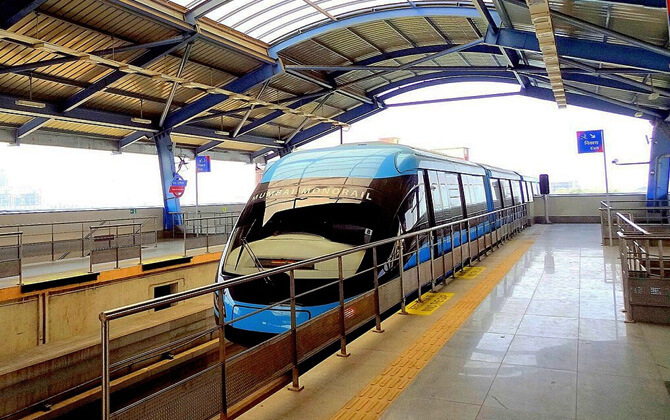
Mumbai Monorail Timing
Mumbai Monorail operating hours currently run from 06:00 AM to 11:00 PM. The starting time from both Chembur and Jacob Circle is 06:00 AM, and the last train from both ends leaves at 11:00 PM.
On the regular schedule, frequency is generally every 15 minutes. The system was originally designed for a 3-minute headway and longer opening hours from 05:00 to 24:00, but the public service timings shown here are 06:00 AM to 11:00 PM.
Service hours were shorter when the line first opened and were extended later. MMRDA also announced a temporary suspension from 20 September 2025, and both directions between Chembur and Sant Gadge Maharaj Chowk remain suspended until further notice. So if you are checking timings today or the closing time for travel planning, it is smart to confirm the latest status before you go.
| Service detail | Timings |
|---|---|
| First train from Chembur | 06:00 AM |
| Last train from Chembur | 11:00 PM |
| First train from Jacob Circle | 06:00 AM |
| Last train from Jacob Circle | 11:00 PM |
| Usual frequency | Every 15 minutes |
Timetable & Operating Hours
Mumbai Monorail Line 1 connects Chembur with Sant Gadge Maharaj Chowk and serves as part of Mumbai public transport on this corridor. The timetable and working hours can change during maintenance or upgrade work.
According to the available route timetable, trains run from 6:00 AM to 10:00 PM. The last train schedule shows departures from both Wadala Depot and Chembur at 10:07 PM, with trains generally every 15 minutes.
Earlier opening times were more limited. At first, trains ran between 7:00 AM and 3:00 PM. From 15 April 2014, opening hours were extended to 6:00 AM to 8:00 PM, and from 15 August 2014 they were extended again to 10:00 PM.
Technical planning documents also mention designed operating hours of 05:00 to 24:00, a 3-minute headway, and a scheduled speed of 31 km/h (19.3 mph). In practice, the published service frequency has been every 15 minutes.
Running time depends on the phase:
- Phase I: 22 minutes
- Phase II: 32 minutes
The system has 17 stations and a total route length of about 19.54 to 20 km, or roughly 12.1 to 12.4 miles. Real-time schedule today updates for departures and arrivals are available in the app.
MMRDA has also announced a temporary suspension of monorail services from 20 September 2025, with trains suspended in both directions until further notice.
| Service detail | Timings |
|---|---|
| Regular operating hours | 6:00 AM to 10:00 PM |
| Last train from Wadala Depot | 10:07 PM |
| Last train from Chembur | 10:07 PM |
| Typical frequency | Every 15 minutes |
| Earlier service window at launch | 7:00 AM to 3:00 PM |
| Extended hours from 15 April 2014 | 6:00 AM to 8:00 PM |
| Extended hours from 15 August 2014 | Up to 10:00 PM |
| Designed operating window | 05:00 to 24:00 |
Prices, tickets
Mumbai Monorail uses an automated fare system. You can travel with an electronically programmed journey token, and a smart card is available for regular users.
The fare information in the available materials is not fully consistent. One set of details gives a minimum fare of ₹5 ($0.06) and a maximum fare of ₹11 ($0.13). Another fare chart lists distance-based ticket price bands from ₹10 to ₹40, or about $0.12 to $0.48.
| Distance (km) | Cost |
|---|---|
| 0 – 3 km / 0 – 1.9 miles | ₹10 ($0.12) |
| 3 – 12 km / 1.9 – 7.5 miles | ₹20 ($0.24) |
| 12 – 18 km / 7.5 – 11.2 miles | ₹30 ($0.36) |
| 18 – 24 km / 11.2 – 14.9 miles | ₹40 ($0.48) |
Tokens are valid for 20 minutes when used at the same station and for 90 minutes when exiting at another station. Same-day return journey tokens were introduced in October 2014.
A smart card costs ₹100 ($1.20). That includes a refundable security deposit of ₹50 ($0.60) and ₹50 ($0.60) of travel value. Children below 90 cm ride free.
There is no confirmed day pass for tourists. Plans for daily, monthly, and quarterly passes were mentioned, but the available information only confirms single journey tickets, return tokens, and smart card travel.
Available ticket types include:
- Single journey token
- Return journey token
- Smart card
For station-to-station trips, the fare calculator is effectively distance-based, with the final price depending on the travel slab.
Connections to Other Systems
Mumbai Monorail was planned as a feeder system for the city’s wider public transport network, especially in dense corridors and narrower urban areas. Its role is to support local transport where direct suburban rail or metro access is limited.
The line connects with the suburban rail system at Wadala and Chembur. It also links broader transportation in Mumbai by running between the eastern suburbs and South Mumbai.
There is also a connection to Metro-II at V.N. Purav Marg station. Future integration with Metro Line 3 has been mentioned as well.
At Sant Gadge Maharaj Chowk, the monorail station is planned to connect with Mahalaxmi station on Western Railway, which should improve interchange options.
The system was intended to provide safe, air-conditioned, comfortable, and affordable city transport while linking suburban rail, metro services, and other transport modes.
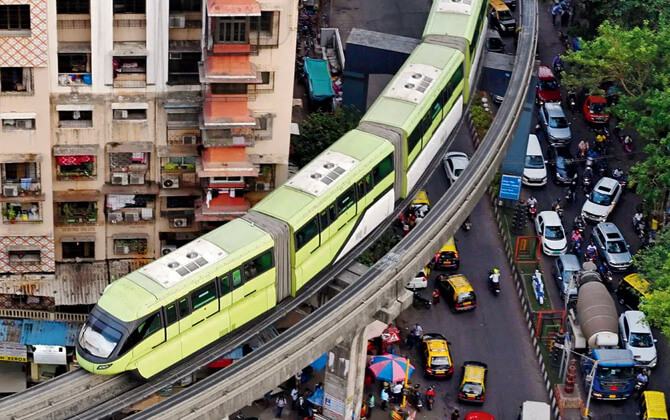
Airport Connections
Mumbai Monorail does not directly serve the airports. Its only operating route runs between Chembur and Sant Gadge Maharaj Chowk.
For airport trips, the most useful connection is through the wider rail network. The monorail links with the Harbour Line, Central Line, and Western Line, allowing passengers to continue toward airport areas using other services.
Available transport information also notes that the closest Mumbai Metro stations to Chhatrapati Shivaji Maharaj International Airport are on Line 3. Stations on Metro Line 1 such as Airport Road, Marol Naka, and Western Express Highway are also mentioned for access to Terminal 2 and Terminal 1.
A future airport connection is planned through Metro Line 8, the Gold Line, which would link Chhatrapati Shivaji Maharaj International Airport and Navi Mumbai International Airport.
For travel between Mumbai Airport and Chembur monorail station, the listed options include bus, train, taxi, towncar, subway, and walking. Taxi is the fastest option, while bus and train are the cheapest.
Tips and Rules
For a smooth and safe trip, passengers are expected to follow station and onboard rules. These guidelines help keep the transport system orderly and comfortable for everyone.
Do’s
- Follow the queue while waiting for the train.
- Stand behind the yellow line on the platform.
- Keep right on escalators and let others pass on the left.
- Offer seats to elderly passengers, pregnant women, and physically challenged people.
- Use dustbins and help keep trains and stations clean.
- Keep luggage in a way that does not inconvenience others.
- Stay alert and report suspicious objects or activity to staff.
- Follow instructions from staff and security personnel.
- Use earphones when listening to music.
Don’ts
- Do not board or get off a moving train.
- Do not lean on the train doors or cross the yellow line.
- Do not sit on the floor of the train or station.
- Do not litter, smoke, eat, drink, or play loud music inside the train.
- Do not carry inflammable or hazardous materials, pets, raw meat, or fish.
- Do not damage or deface transport property.
- Do not enter or exit a station without a valid ticket.
- Do not cause nuisance to other passengers or ignore announcements.
Important Note
Breaking these rules may lead to fines, removal from the premises, or legal action. Authorities may deny entry or remove passengers who do not comply.
Additional Safety Rules
- Travel with a valid ticket at all times.
- Do not carry dangerous or offensive materials.
- Passengers with declared infectious or contagious diseases are not permitted to travel.
- Security personnel may use a sniffer dog for security purposes.
| Station | Details |
|---|---|
| Passenger Emergency Communication Unit (PECU) | Available inside coaches to contact the Train Pilot. |
| Information Displays | Route plan, stations map, station indicators, and announcements are provided inside trains. |
| Safety Support | First aid kits, CCTV surveillance, and security staff are available at stations. |
If you need help, speak with station staff or the customer care centre.
History
The Mumbai Monorail was first proposed by MMRDA in 2005. In 2008, the project moved ahead as a feeder service for crowded and narrow corridors, intended to connect areas not directly served by suburban rail or the planned metro system.
On 11 November 2008, Larsen and Toubro partnered with Scomi Engineering Bhd of Malaysia, and the joint venture received a contract worth ₹24.6 billion ($295.2 million) to build, operate, and maintain the project. The route was planned in phases between Chembur, Wadala, and Sant Gadge Maharaj Chowk.
The foundation stone was laid on 9 February 2009 at Acres Club in Chembur. Construction then faced delays caused by land issues, encroachment removal, permission delays, and alignment changes.
Testing began before opening. A 108-meter test run was completed on 26 January 2010, followed by a 1-km (0.6-mile) test run from Wadala to Bhakti Park on 18 February 2012. The first full-route test run took place in November 2012, and safety certification was completed in late 2013.
Line 1 was inaugurated on 1 February 2014 at Wadala Depot. Phase I, from Chembur to Wadala Depot, opened to the public on 2 February 2014. Phase II, extending the line to Jacob Circle, opened on 3 March 2019.
The monorail has remained the only operating monorail in India, but it has also been widely described as a troubled project because of high costs, delays, and operational problems. In December 2018, MMRDA terminated the operating contract with the L&T-Scomi consortium and took over operations and maintenance.
| Station | Details |
|---|---|
| Phase I | Chembur to Wadala Depot, opened 2 February 2014 |
| Phase II | Wadala Depot to Jacob Circle, opened 3 March 2019 |
| Total Line 1 | Chembur to Jacob Circle, length 19.52 km / 12.1 miles |
As of 2025, it remains the only operating monorail in India.
Future Extensions
The future expansion of Mumbai Monorail has been uncertain for years. Earlier master plans proposed a much larger network, with around 135 km (83.9 miles) of line planned in phases between 2011 and 2031, including eight routes across the Mumbai Metropolitan Region.
Proposed corridors over time included Thane-Bhiwandi-Kalyan, Mulund-Goregaon-Borivali, Lokhandwala-SEEPZ-Kanjurmarg, and Thane-Mira-Bhayandar-Dahisar. Several of these ideas were later shelved or put on hold, and no major new monorail routes have moved forward.
For Line 1, some experts have suggested extending the route south from Jacob Circle toward Babulnath Mandir and Gopalrao Deshmukh Marg, and north from Chembur toward Ghatkopar via Mahul Road to improve links between currently unconnected transport hubs. Official planning for these extensions has not started.
For now, the system remains focused on the existing Line 1 route, while broader network expansion is still uncertain.
Nearby Attractions
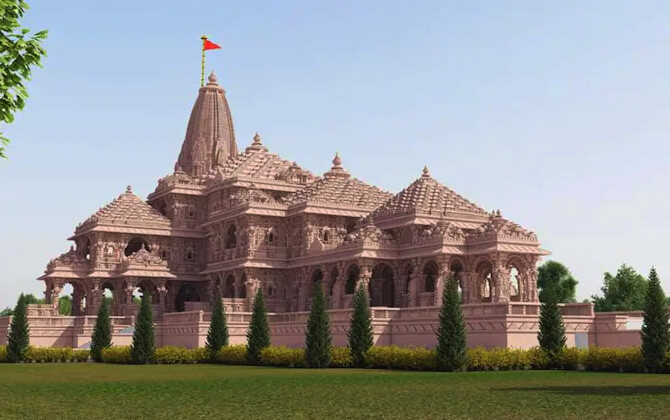
The Wadala and Bhakti Park stretch of the Mumbai Monorail gives visitors access to waterfront views, local landmarks, and a few family-friendly stops. Riding the elevated line also offers a different look at Mumbai’s eastern side.
Popular nearby places include:
- IMAX Dome Theatre, Wadala
- Shree Ram Mandir, Wadala
- Eastern Freeway Scenic Drive
- Carnival Cinemas IMAX, Wadala
- Flamingo Point (Sewri Mudflats)
- VJTI (Veermata Jijabai Technological Institute)
- Institute of Chemical Technology (ICT)
- Sewri Flamingo Point
- Sewri Fort
If you are planning a longer outing, the monorail corridor also sits within reach of major Mumbai attractions such as the Gateway of India, Chhatrapati Shivaji Terminus, Marine Drive, beaches, gardens, museums, and religious sites.
Access is fairly straightforward: the nearest metro station is Dadar on Line 3, and the nearest local train station is GTB Nagar on the Harbour Line. You can also reach Bhakti Park by bus or use the monorail from Chembur or Wadala.