The Delhi Metro Rail is a rapid transit system serving Delhi and nearby NCR cities including Faridabad, Gurugram, Ghaziabad, Noida, Bahadurgarh, and Ballabhgarh. It is India’s largest and busiest metro system, with 10 colour-coded lines, 271 stations, and a network length of 374.466 km (232.682 mi). The system includes underground, elevated, and at-grade sections, and it is operated by the Delhi Metro Rail Corporation (DMRC). Construction began in 1998, the first section opened in 2002, and the network has expanded in phases while also connecting with Rapid Metro Gurgaon, Noida Metro, and the Delhi-Meerut RRTS.
| Key | Information |
|---|---|
| System | Delhi Metro Rail |
| Service area | Delhi and NCR cities including Faridabad, Gurugram, Ghaziabad, Noida, Bahadurgarh, and Ballabhgarh |
| Operator | Delhi Metro Rail Corporation (DMRC) |
| Lines | 10 |
| Stations | 271 |
| Network length | 374.466 km (232.682 mi) |
| Station types | Underground, elevated, and at-grade |
| Track types | Broad gauge and standard gauge |
| First section opened | 25 December 2002 |
| Trips per day | More than 4,300 |
| Annual ridership | 235.8 crore (2.35 billion) in 2025 |
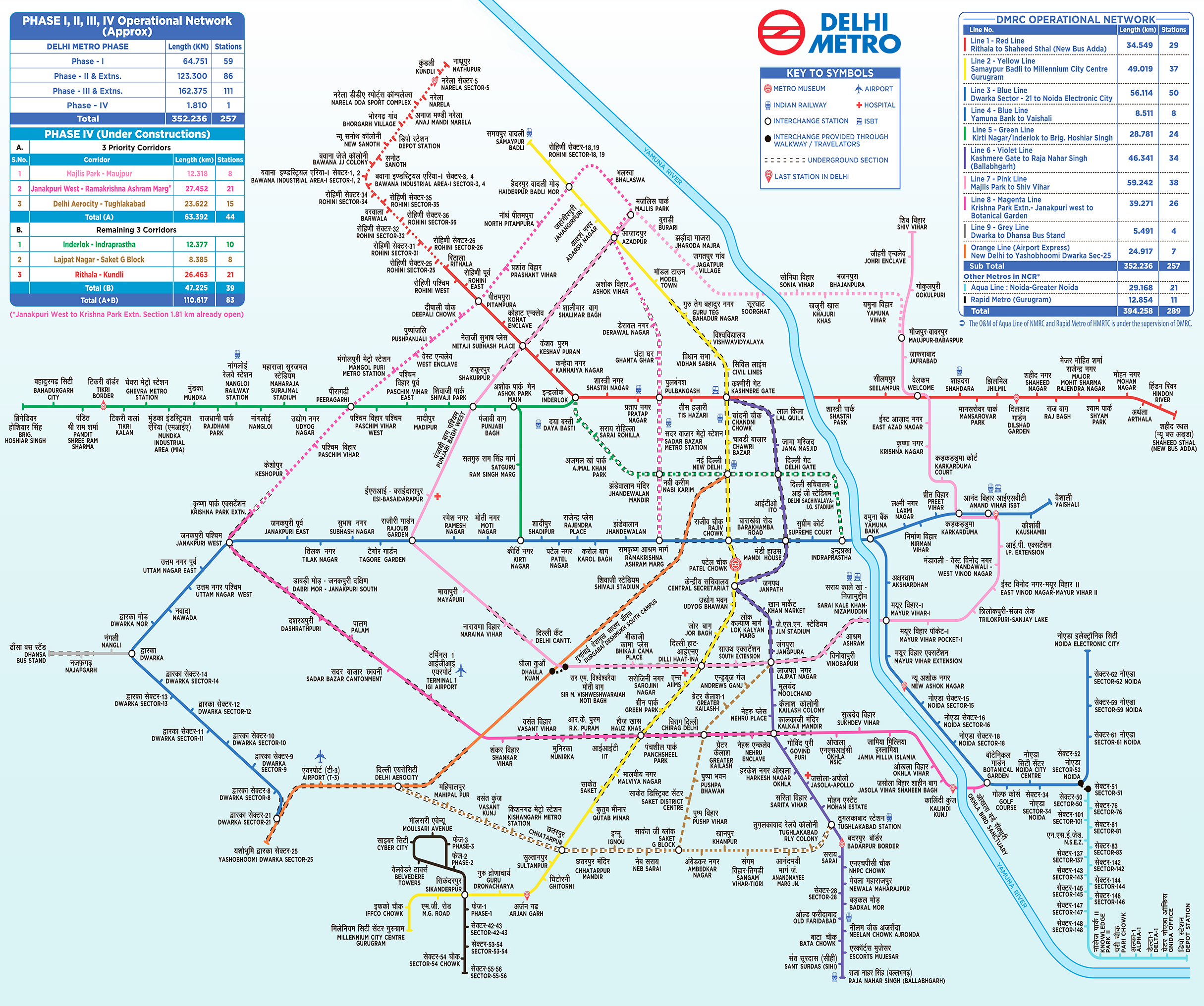
Delhi Metro Map
Map of Delhi Metro showing different lines. Click on the map to enlarge it or download the Delhi Metro map in PDF format.
Lines and Stations
Delhi Metro is a 10-line rapid transit network covering Delhi and several adjoining NCR cities. The system has 271 stations across 374.466 km (232.682 mi), with a mix of underground, elevated, and at-grade stops. Its route plan is colour-coded, which makes the stations map and stations list easier to follow, especially if you are new to transportation in Delhi.
The network uses both broad-gauge and standard-gauge tracks and handles more than 4,300 trips daily. Some routes work as major city corridors, while others extend outward to neighboring urban areas.
Major lines
| Station | Details |
|---|---|
| Red Line (Line 1) | Connects Rithala to Shaheed Sthal (New Bus Adda). |
| Yellow Line (Line 2) | Runs from Samaypur Badli to Millennium City Centre Gurugram. |
| Blue Line (Line 3) | Main east-west corridor with a branch to Vaishali and an extension toward Dwarka Sector 21 on one section of the route. |
| Green Line (Line 5) | Runs from Inderlok to Brigadier Hoshiyar Singh, with a branch to Kirti Nagar. |
| Violet Line (Line 6) | Connects Raja Nahar Singh in Ballabgarh to Kashmere Gate. |
| Airport Express Line / Orange Line | Links New Delhi and Yashobhoomi Dwarka Sector – 25. |
| Pink Line (Line 7) | Forms a ring-shaped route through Delhi. |
| Magenta Line (Line 8 ) | Connects Janakpuri West and Botanical Garden, with later extensions in Phase IV. |
| Grey Line (Line 9) | The shortest line, running from Dwarka to Dhansa Bus Stand. |
Key stations and interchanges
Several stations act as important interchange points within the system and with other public transport networks. Kashmere Gate connects the Red, Yellow, and Violet Lines. Rajiv Chowk is an interchange between the Yellow and Blue Lines, while New Delhi links the Yellow Line, the Airport Express, and Indian Railways.
Other notable interchange stations include Dwarka, Janakpuri West, Hauz Khas, Botanical Garden, Anand Vihar, and Sikanderpur. The metro also connects with Rapid Metro Gurgaon, Noida Metro, and the Delhi-Meerut RRTS, making it a key part of local transport and wider city transport in the region.
Line development by phase
The network was built in phases. Phase I introduced the first sections of the Red, Yellow, and Blue Lines. Phase II added extensions and new corridors, while Phase III brought in the Pink, Magenta, and Grey Lines along with more route extensions. Phase IV began in 2019 and continues to add new sections as part of the system expansion.
Construction started in 1998. The first elevated section opened on the Red Line in December 2002, and the first underground section opened on the Yellow Line in December 2004.
| Phase | Stations | Length | Notes |
|---|---|---|---|
| Phase I | 59 | 64.75 km (40.23 mi) | Initial sections of the Red, Yellow, and Blue Lines |
| Phase II | 86 | 123.3 km (76.61 mi) | Extensions and new routes, including links to surrounding NCR cities |
| Phase III | 109 | 160.07 km (99.46 mi) | New ring and corridor lines, including Pink, Magenta, and Grey |
| Phase IV | — | — | Ongoing and planned additions |
DMRC operates the network and continues to expand the line and station system across the capital region.
Fares, Tickets and Cards
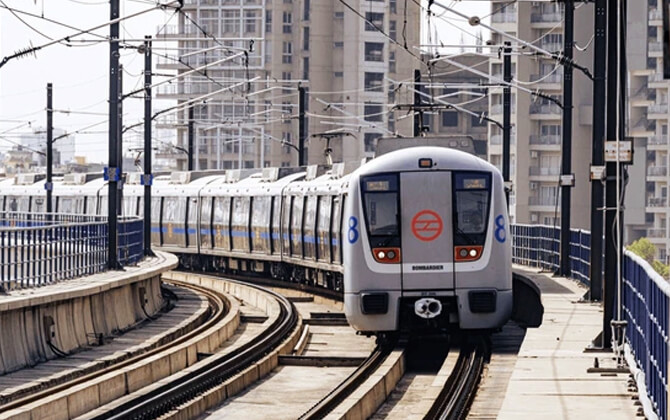
Delhi Metro fare depends on route, distance, and ticket type. In general, the ticket price starts from Rs 10 ($0.12) and increases with journey length. Smart Cards usually offer a discount compared with token fares. Prices can also vary between weekdays and Sundays or National Holidays, so checking the fare calculator or fare table before you travel is a good idea.
Metro Fare
The system uses distance-based pricing. To find the exact fare between two stations, you need to select the stations in the official fare calculator. The table below shows the regular weekday price structure and maximum running time allowed for each fare band.
| Distance | Weekday Token Fare | Smart Card Fare | Max Travel Time |
|---|---|---|---|
| 0 – 2 KM | Rs 11 ($0.13) | Rs 10 ($0.12) | 65 mins |
| 2 – 5 KM | Rs 21 ($0.25) | Rs 19 ($0.23) | 65 mins |
| 5 – 12 KM | Rs 32 ($0.38) | Rs 29 ($0.35) | 90 mins |
| 12 – 21 KM | Rs 43 ($0.52) | Rs 39 ($0.47) | 100 mins |
| 21 – 32 KM | Rs 54 ($0.65) | Rs 49 ($0.59) | 180 mins |
| More than 32 KM | Rs 64 ($0.77) | Rs 58 ($0.70) | 240 mins |
On Sundays and National Holidays, longer trips cost less. Smart Card users still get a discount, and travel must be completed within the allowed time.
| Distance | Sunday / Holiday Token Fare | Smart Card Fare | Saving vs Weekday |
|---|---|---|---|
| 0 – 2 KM | Rs 11 ($0.13) | Rs 10 ($0.12) | Same |
| 2 – 5 KM | Rs 11 ($0.13) | Rs 10 ($0.12) | Save Rs 10 ($0.12) |
| 5 – 12 KM | Rs 21 ($0.25) | Rs 19 ($0.23) | Save Rs 11 ($0.13) |
| 12 – 21 KM | Rs 32 ($0.38) | Rs 29 ($0.35) | Save Rs 11 ($0.13) |
| 21 – 32 KM | Rs 43 ($0.52) | Rs 39 ($0.47) | Save Rs 11 ($0.13) |
| More than 32 KM | Rs 54 ($0.65) | Rs 49 ($0.59) | Save Rs 10 ($0.12) |
Rapid Metro has a flat fare of Rs 20 ($0.24) between any two stations in its network.
Tickets and Cards
Passengers can use single-journey tokens, Smart Cards, Tourist Cards, contactless payment options, and QR-based tickets. Paper QR tickets are available at ticket windows and Customer Care Centres, while electronic QR tickets can be purchased through apps such as Paytm, One Delhi, and Tummoc.
A Smart Card is useful for regular travel because it gives a 10% discount on normal days. It costs Rs 150 ($1.81), including a refundable security deposit and add value, and it can be recharged. DMRC also states that Smart Cards can be purchased without photo ID proof.
Tourist Cards are available as a 1 Day pass for Rs 200 ($2.41) and a 3 Days pass for Rs 500 ($6.02), both including a refundable security deposit. They are valid on all DMRC lines except the Airport Metro Express. On the Airport Express line, special trip cards and store value cards are also accepted, with discounts depending on card type.
Important Notes
- Children below 5 years travel free.
- Half fare applies for children aged 5 to 12 years.
- Senior citizens and students may get special concession cards with valid ID.
- If you exceed the allowed travel time, an additional fare may be charged at the exit gate.
- DMRC also accepts contactless cards, mobile wallets, and QR codes.
For Smart Cards, same-station entry and exit is charged separately if completed within 20 minutes. Off-peak discounts are also available during specified hours on weekdays and Saturdays.
Operating Hours and Frequency
The Delhi Metro operating hours generally run daily from around 5:00 am to 11:00 pm, though exact opening hours, opening times, starting time, and closing time vary by line, station, and day. If you are checking timings today or looking for the last train, it is worth confirming the train schedule for your specific route.
Frequency is usually strong throughout the day. Average headway across the network is about 8 minutes, with trains every 1 to 5 minutes on some lines during peak periods and longer gaps off-peak.
Typical service patterns by line
| Service detail | Timings |
|---|---|
| Red Line | First train from Dilshad Garden at 5:45 am; last train to Rithala at 11:20 pm. On Saturdays, Sundays, and holidays, service runs from 6:00 am to 10:50 pm. Frequency is about every 5 minutes at peak times and every 13 minutes off-peak. |
| Yellow Line | First train from Samaypur Badli at 5:50 am; last train to Huda City Centre at 11:13 pm. On Saturdays, Sundays, and public holidays, service runs from 6:05 am to 11:00 pm, with trains every 4 minutes at peak times and about every 8 minutes off-peak. |
| Blue Line | First train from Noida City Centre at 5:40 am; last train to Vaishali at 11:20 pm. Peak frequency is about every 3 minutes, with around 8 minutes off-peak. On Saturdays, Sundays, and holidays, trains usually run every 12 to 13 minutes. |
| Green Line | First train starts at 6:05 am from Inderlok, and the last train arrives at Kirti Nagar at 11:00 pm. Trains usually run every 5 minutes at peak times and every 13 minutes off-peak, weekends, and holidays. |
| Violet Line | First train from Kashmere Gate at 6:00 am; last train to Escorts Mujesar at 11:00 pm. On Saturdays, Sundays, and holidays, service runs from 6:10 am to 10:40 pm. |
| Orange Line | Service runs from 5:50 am to 11:00 pm, with trains every 10 minutes at peak times and every 18 to 20 minutes off-peak. |
| Magenta Line | First train from Botanical Garden at 6:00 am; last train to Janakpuri West at 11:00 pm. On Saturdays, Sundays, and holidays, service runs from 6:10 am to 10:50 pm. |
| Pink Line | Service runs from 6:00 am to 10:50 pm on weekdays, weekends, and public holidays, with trains every 7 minutes at peak times and every 13 minutes off-peak. |
The metro makes more than 4,300 trips a day, and station announcements are provided in Hindi and English. For schedule today, route timetable, or working hours on a specific line, line-by-line timings are the most useful reference.
Connections to Other Systems
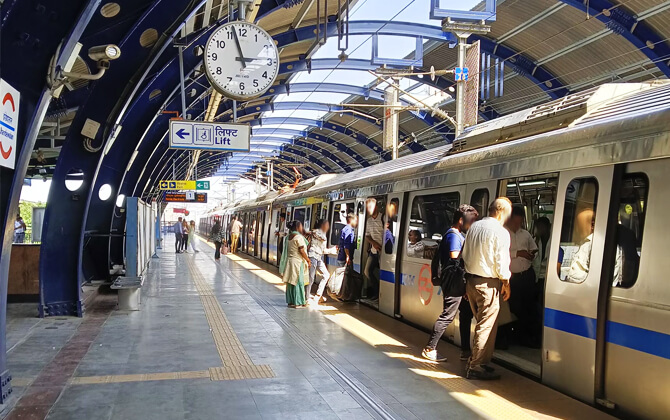
Delhi Metro is tightly integrated with other transport systems in the National Capital Region. It connects with Rapid Metro Gurgaon and Noida Metro, and Rapid Metro Gurgaon works with a shared ticket system. DMRC took over operations of Rapid Metro Gurgaon on 22 October 2019.
The network also links with the Delhi-Meerut RRTS, with seamless integration planned at Sarai Kale Khan, New Ashok Nagar, and Anand Vihar. This adds another layer to public transport and regional transportation in and around Delhi.
Several lines already provide direct or practical interchange links with other systems:
- Yellow Line connects with Rapid Metro Gurgaon at Sikanderpur.
- Blue Line connects with Noida Metro at Noida Sector 52 via Noida Sector 51 station, and also links with Indian Railways and the ISBT at Anand Vihar.
- Airport Express Line connects with Indian Railways at New Delhi and with the Yellow Line, Blue Line, and Pink Line at key transfer points.
- Violet Line serves Faridabad and provides a major connection beyond Delhi city limits.
Planned or developing regional links also point toward Ghaziabad, Gurugram, Bahadurgarh, Rohtak, Palwal, and Sonipat. That gives the metro an even bigger role as the backbone of city transport and local transport across Delhi-NCR.
Airport Connection
The Airport Express Line, also called the Orange Line, connects New Delhi to Indira Gandhi International Airport and Yashobhoomi Dwarka Sector 25. It has six main stations and is designed as the fast airport route within the Delhi Metro system.
| Station | Details |
|---|---|
| New Delhi | City centre terminal and interchange with the Yellow Line and Indian Railways. |
| Shivaji Stadium | Intermediate station on the airport route. |
| Dhaula Kuan | Intermediate station on the airport route. |
| Delhi Aerocity | Useful for the Aerocity area near the airport. |
| IGI Airport (T-3) | Direct station for Terminal 3. |
| Dwarka Sector 21 | Western terminal linked with the wider metro network. |
The trip from New Delhi to IGI Airport takes about 15 to 20 minutes, and trains run at speeds of up to 120 km/h (74.6 mph). The line operates from around 4:45 am to 11:15 pm from Dwarka Sector 21, with peak frequency every 10 minutes and non-peak service every 15 minutes.
Key airport travel points are simple enough:
- Terminal 3 is directly connected to the Airport Express Line at IGI Airport station.
- Terminal 2 can be reached on foot from IGI Airport station.
- Terminal 1 is served by the Magenta Line, not the Airport Express Line.
- New Delhi station offers city check-in facilities for select airlines, including Air India and Vistara.
Stations on this line have strong security arrangements, including explosive detectors, baggage scanners, under-vehicle scanners, quick reaction teams, and dog squads. They are also wheelchair accessible, with ramps and lifts.
Fare on the airport route starts at Rs 10 ($0.12) and goes up to Rs 60 ($0.72) for the New Delhi to IGI Airport or Dwarka Sector 21 trip. Passengers can also use 30-trip and 45-trip cards on this corridor. The listed helpline number for the Airport Express Line is 011-22561231.
A Brief History
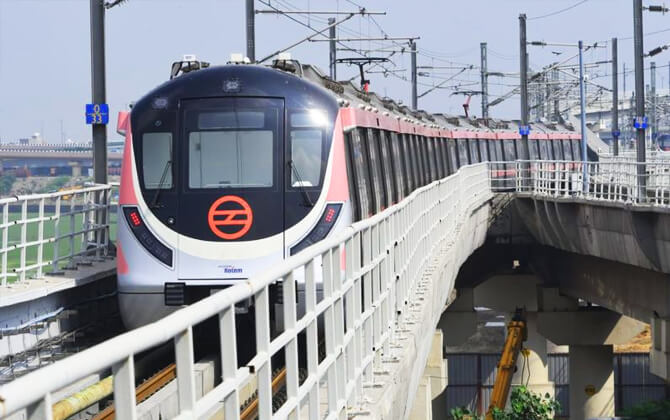
The idea of a mass rapid transit system for New Delhi dates back to a 1969 traffic and travel characteristics study. Later, government committees reviewed route alignment, technology, and jurisdiction, and in 1984 the Urban Arts Commission proposed a multi-modal transport system with three underground corridors.
By the late 1980s and 1990s, rapid population growth, more private vehicles, congestion, and pollution made a reliable rail-based system much more urgent. A failed attempt to privatise the bus network in 1992 further highlighted the need for better public transport.
DMRC was established on 3 May 1995 as a joint venture of the Government of India and the Government of Delhi, with Elattuvalapil Sreedharan as managing director. After project approval in September 1996 and development assistance loans from Japan in 1997, construction began on 1 October 1998.
The first Red Line section between Shahdara and Tis Hazari opened on 25 December 2002. The first underground section, between Vishwa Vidyalaya and Kashmere Gate on the Yellow Line, opened on 20 December 2004. Phase I was completed in 2006, ahead of schedule and on budget.
Expansion continued through Phase II, completed in 2011, and Phase III, completed in 2021, with a later Airport Line extension opening in 2023. Phase IV work began on 30 December 2019.
One notable milestone came in 2011, when DMRC was certified by the United Nations as the first metro rail and rail-based system in the world to receive carbon credits for reducing greenhouse-gas emissions.
Future Expansions
Delhi Metro expansion is focused on broader coverage, better interchange options, and stronger regional links. Current materials point to Phase IV works in Delhi and the approved Phase V-A package, along with other longer-term ideas.
Phase IV corridors
Phase IV includes priority corridors already under construction as well as other approved links. These include the Pink Line extension, the Magenta Line extension, the Golden Line from Aerocity to Tughlakabad, the Inderlok-–Indraprastha corridor, and the Rithala–Narela–Nathupur extension of the Red Line.
The approved Phase V-A package adds three more corridors: R.K. Ashram Marg to Indraprastha, Aerocity to IGI Airport Terminal 1, and Tughlakabad to Kalindi Kunj. These routes are intended to improve access to Central Delhi, the airport area, and South Delhi.
Proposed Phase V ideas
Several additional future corridors have also been discussed. These include a Blue Line extension from Yamuna Bank to Loni, a Central Vista Loop Line, and a Yellow Line extension from Samaypur Badli to Khera Kalan. The source material also mentions a proposed Delhi Airport Air Train at Indira Gandhi International Airport.
Regional extensions and integration
Longer-term plans also mention possible extensions toward Bahadurgarh, Rohtak, Jhajjar, and Sonipat in Haryana. Alongside that, the metro is expected to integrate more closely with the Delhi-Meerut RRTS through seamless links at Sarai Kale Khan, New Ashok Nagar, and Anand Vihar.
These expansion plans are aimed at reducing congestion, improving connectivity, and extending rapid transit access across Delhi-NCR.
Tips
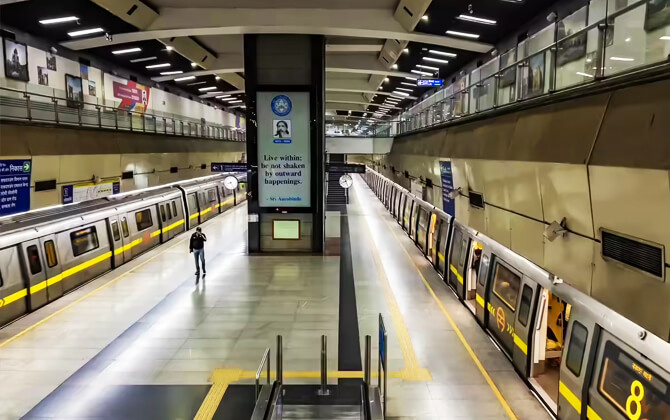
Delhi Metro connects a huge part of the National Capital Region, including Gurugram, Ghaziabad, Noida, Bahadurgarh, and Ballabhgarh. If it is your first time using the system, the easiest approach is to plan your route by line colour and terminal station.
Before You Travel
- Use Google Maps or the Delhi Momentum 2.0 app to plan your route.
- You can buy QR tickets in the app, or get a token or Smart Card at the station.
- Look for the metro logo and ask for the station name if you are arriving by auto or cab.
- Most stations are on major roads and can also help with crossing busy streets.
At the Station
- Expect a security check before entering the paid area.
- Keep your wallet, phone, and other items ready for screening.
- Follow signs for the correct line colour and direction.
- Check the platform display for the next train time and platform details.
- Stand behind the yellow line and let passengers exit before boarding.
Tickets and Smart Cards
- Distance-based fare means the price depends on your destination.
- Stations usually have counters and vending machines for token purchase and card recharge.
- Keep your receipt or QR ticket until you exit.
- Tourist Cards work as a short-term day pass option for unlimited travel, except on the Airport Express Line.
On Board
- The first coach in the direction of travel is reserved for women only.
- Delhi Metro coaches are clean, air-conditioned, and generally safe.
- You can walk through the coaches, which makes moving around easier.
- Keep your belongings close and listen to announcements.
If you need to change lines, follow the line colour, intermediate station signs, and floor markings where available. During peak hours, crowded interchanges such as Rajiv Chowk and Hauz Khas can be hectic, so avoiding them when possible is not a bad idea.
Interesting Facts
The Delhi Metro is India’s largest and busiest metro rail system, with 10 colour-coded lines, 271 stations, and a route length of 374.466 km (232.682 mi). It serves Delhi and nearby cities including Faridabad, Gurugram, Ghaziabad, Noida, Bahadurgarh, and Ballabhgarh, and it operates more than 4,300 trips every day.
Construction began in 1998, and the network opened in phases. The first elevated section on the Red Line opened on 25 December 2002, while the first underground section on the Yellow Line opened on 20 December 2004. Phase I was completed in 2006, Phase II in 2011, Phase III was mostly finished in 2021, the Airport Line extension opened in 2023, and Phase IV began on 30 December 2019.
DMRC, a joint venture between the Government of India and Delhi, operates the system. In 2011, the United Nations certified it as the first metro rail and rail-based system in the world to receive carbon credits for reducing greenhouse-gas emissions, with an annual reduction of 630,000 tonnes.
The network also connects with Rapid Metro Gurgaon, Noida Metro, and the Delhi-Meerut RRTS. DMRC took over operations of Rapid Metro Gurgaon on 22 October 2019. By 2025, annual ridership had reached 235.8 crore, or 2.35 billion passengers.
- The system uses underground, at-grade, and elevated stations.
- Its lines run on both broad-gauge and standard-gauge tracks.
- Driverless operations began on the Magenta Line in 2021, making it the first driverless metro line in India.
- The Pink Line also began driverless operations in 2021.
- The CBTC system on Phase III trains supports a 90-second headway.
Sightseeing via the Delhi Metro
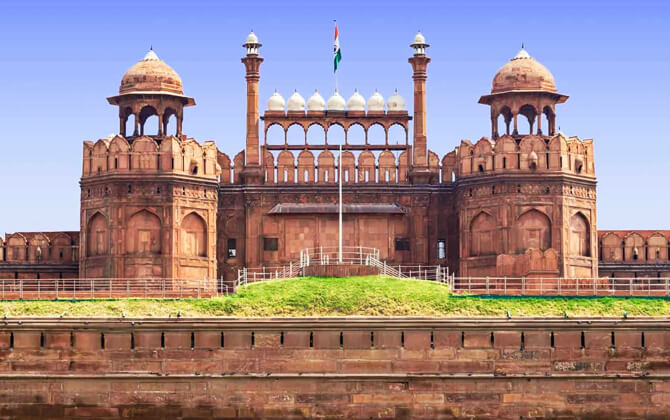
In a city known for heavy traffic, the Delhi Metro is often the easiest way to get around. It saves time, keeps transport costs down, and makes sightseeing much simpler.
The network includes red, yellow, blue, green, violet, magenta, pink, and Orange Line services, and stations are spread across underground and above-ground sections. Because fare is distance-based, trip cost depends on where you are going.
If you can, avoid peak hours, when trains get very crowded. According to the source material, the busiest times are from 9 am to 12 pm and from 6 pm to 8 pm. When it is busy, keep an eye on your bag and be ready for close standing space.
Security checks are part of the routine. Every station has X-ray scanning for bags before boarding, and at some stations passengers cannot board if a bag weighs more than 15 kilograms.
Food and drink are not allowed on the train, though many stations have kiosks selling coffee, tea, and snacks. Some also include food courts with local and international options.
Useful stations for sightseeing
| Station | Details |
|---|---|
| Chandni Chowk | On the Yellow Line; useful for Old Delhi, the Red Fort, and street food. |
| Rajiv Chowk | On the Yellow and Blue Lines; close to Connaught Place and its markets. |
| Hauz Khas | On the Yellow Line; convenient for Hauz Khas village, cafes, boutiques, and alleyways. |
| Nehru Place | On the Violet Line; close to Lotus Temple. |
| Central Secretariat | On the Yellow and Violet Lines; convenient for India Gate, Parliament House, President House, Lodhi Garden, and nearby memorials. |
The airport is also easy to reach by metro. The Orange Line connects Terminal 3 and Aerocity with New Delhi Metro Station, opposite New Delhi Railway Station, and trains run about every 10 minutes from around 5:00 am to 11:30 pm. Another option is the Magenta Line, which serves the airport from Terminal 1.
For visitors, the metro is not just transport. It is one of the most efficient ways to move between Delhi’s major landmarks without spending half the day in traffic.