Hyderabad Metro is a rapid transit system in Hyderabad, Telangana, India, and a major part of the city’s public transport network. The system operates through three lines and, according to the source material, currently includes 57 stations, while other sections mention 59 stations across Phase I. It was developed as a public-private partnership by Larsen & Toubro through L&T Metro Rail Hyderabad Limited. Since opening in 2017, the network has expanded in phases and grown into an important option for daily transport across the city.
| Key | Information |
|---|---|
| System type | Rapid transit metro |
| City | Hyderabad, Telangana, India |
| Developer | L&T Metro Rail Hyderabad Limited (L&TMRHL) |
| Project model | Public-private partnership with a minority state government equity stake |
| Lines | 3 |
| Stations | 57 stations mentioned in the introduction; 59 stations mentioned for Phase I in the source material |
| First opening | 28 November 2017 |
| Initial opened stretch | 30 km / 18.6 miles from Miyapur to Nagole with 24 stations |
| Estimated project cost | ₹18,800 crore (US$2.2 billion) |
| Ridership | About 490,000 daily passengers by February 2020; about 450,000 daily by December 2022; 0.51 million on 3 July 2023 |
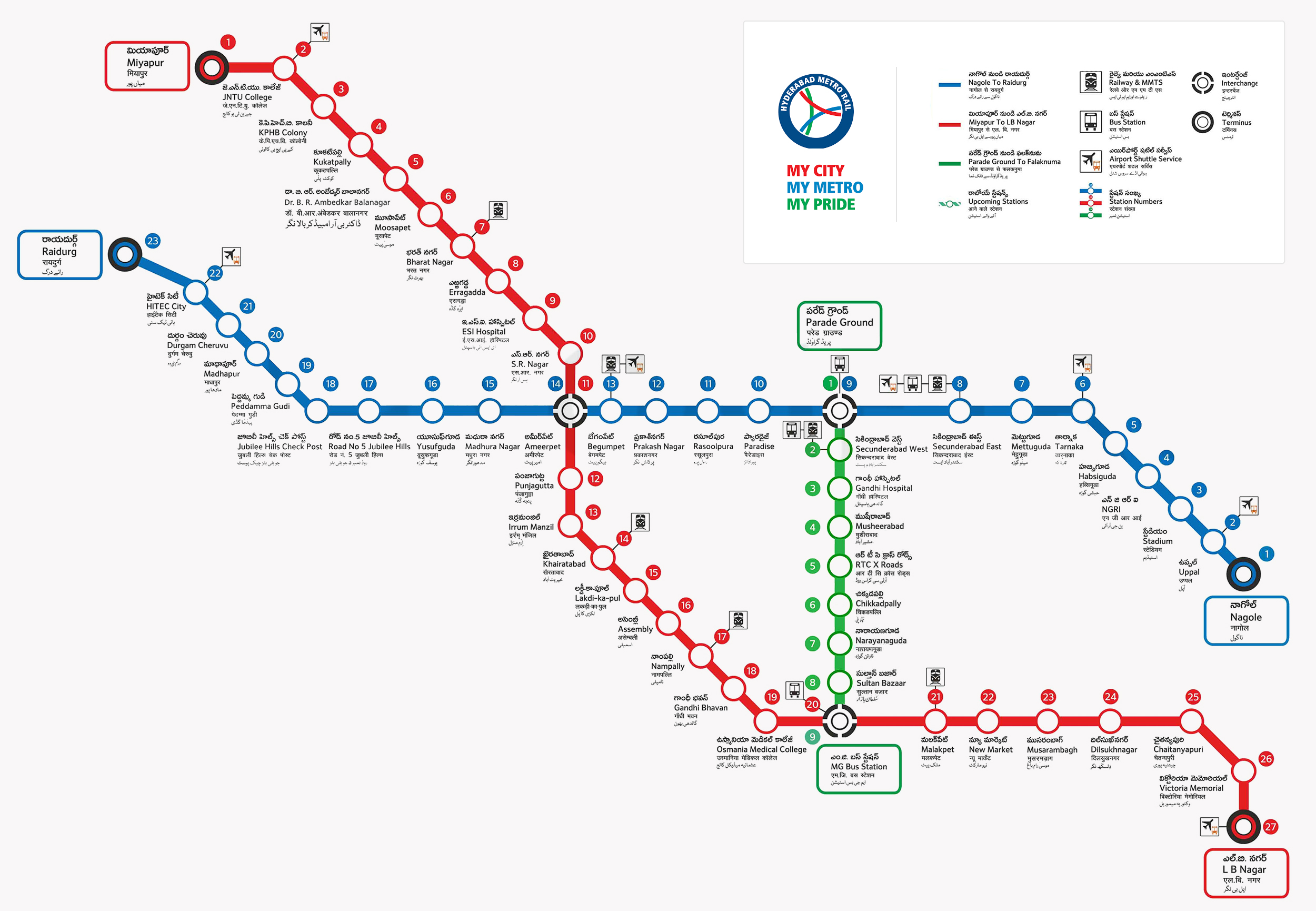
Hyderabad Metro Map
Map of Hyderabad Metro showing different lines. Click on the map to enlarge it or download the Hyderabad Metro map in PDF format.
Hyderabad Metro Lines and Stations
Hyderabad Metro is built around Phase I, with Phase II covering approved and proposed expansion corridors. Phase I forms the core route plan of the system and consists of three fully elevated lines: Red, Blue, and Green. Together, they span 67.21 km / 41.76 miles and include 59 stations according to the source material.
The first commercial services started in November 2017. The network was later completed with the opening of the Green Line in 2020. If you are checking the stations map or planning a route, these are the main operational corridors in Phase I.
| Station | Details |
|---|---|
| Red Line | LB Nagar to Miyapur, 29.21 km / 18.15 miles, 27 stations |
| Green Line | JBS Parade Ground to Falaknuma, 11 km / 6.84 miles, 10 stations |
| Blue Line | Nagole to Raidurg, 27 km / 16.78 miles, 24 stations |
| Miyapur | Major terminal station |
| Ameerpet | Key interchange station |
| LB Nagar | Major terminal and interchange point mentioned in source material |
| Nagole | Major terminal and interchange point mentioned in source material |
| Raidurg | Major terminal station |
| JBS Parade Ground | Key interchange station |
| M.G. Bus Station | Key interchange station |
| Secunderabad | Important connection point |
| Falaknuma | Terminal station listed in the source material |
| Chandrayangutta | Interchange point mentioned in source material |
The original 2017 opening covered the Miyapur to Nagole stretch with 24 stations. After that, the Red Line was extended from Ameerpet to LB Nagar in 2018, and the Blue Line was extended in stages until it reached Raidurg in 2019.
Phase II includes both approved and proposed extensions. The source material mentions Red Line extensions from Miyapur to Patancheruvu and from LB Nagar to Hayathnagar, a Green Line extension from MGBS to Falaknuma, a Blue Line extension from Raidurg to Kokapet Neopolis, and a Purple Line from Nagole to RGIA.
For route planning, the most important interchange stations are Ameerpet, M.G. Bus Station, Parade Ground, Nagole, LB Nagar, and Chandrayangutta. These stations improve transfers between metro corridors and other local transport services.
Schedule and Frequency
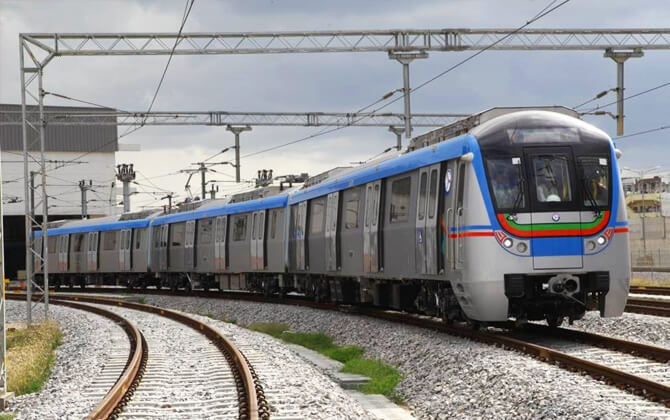
Hyderabad Metro runs seven days a week. Its operating hours are designed for daily commuters, with an early starting time and late closing time across the network.
| Service detail | Timings |
|---|---|
| First train | 06:00 hrs |
| Last train from terminal stations on Red and Blue Lines | 23:00 hrs |
| Last train on Green Line | 23:35 hrs |
| General opening hours | 06:00 AM |
| General closing time on most corridors | 11:00 PM |
| Peak frequency on Corridor 1 | Every 4 minutes |
| Peak frequency on Corridor 2 | Every 12 minutes |
| Peak frequency on Corridor 3 | Every 4 minutes |
| Non-peak frequency | Every 5 to 12 minutes |
If you are looking for Hyderabad Metro timings today, opening times, or the last train, the source material gives a clear working hours window: service begins at 06:00 AM and usually runs until 11:00 PM, with the Green Line operating a little later.
The main route timetable by corridor is listed below:
- Red Line: Miyapur to L B Nagar via MG Bus Station, Nampally, and Ameerpet
- Green Line: JBS Parade Ground to MG Bus Station via Secunderabad
- Blue Line: Nagole to Raidurg via Secunderabad and Ameerpet
Frequency is strongest during peak periods, especially on the Red and Blue lines. Outside rush hours, trains continue at regular intervals, so the train schedule remains practical for both work trips and general city transport.
Fares, Tickets, and Cards
Hyderabad Metro uses a distance-based fare system. Fare charts are available at stations and on official metro platforms, and passengers can check the fare for a chosen route between source and destination stations.
The system offers several ticket options for different travel needs:
- Paper QR Ticket
- Smart Card
- Digital QR Ticket
- Token
All tickets are valid for one business day from the date of purchase. A 10% discount is applied to the percentage increase on fares, as determined by the Fare Fixation Committee zone wise.
For regular riders, the smart card is the most practical option. It allows faster entry and exit and also gives discounted travel. If you only need a single ride, a token or QR ticket may be enough.
The draft does not provide a full fare table, exact ticket price by distance, or a fare calculator result, so specific price and cost values for each trip are not available here. No day pass information is provided in the source material either.
Connections with Other Systems
Hyderabad Metro was planned as a multi-modal public transport system, with built-in links to MMTS, railway stations, bus terminals, and other local transport options. The idea was simple: make switching between transport modes easier and reduce pressure on road traffic.
According to the source material, metro-MMTS connections are available at Bharatnagar, Begumpet, Malakpet, and Falaknuma. Main railway integration is also provided at Nampally, Secunderabad, and Begumpet, with Secunderabad railway station linked by a skywalk.
The metro also connects with major bus points, including Miyapur, MGBS, Dilsukhnagar, Jubilee Bus Station, Koti, and Rathifile. Designated transfer areas at stations support bus and cab interchange, and shuttle services help connect stations to nearby colonies, companies, and other destinations.
Within the metro system itself, interchange stations improve the route network and day-to-day travel. The source material identifies Nagole, LB Nagar, Chandrayangutta, Raidurg, Miyapur, and MGBS as key points supporting wider connectivity.
Future plans keep this focus on integrated transportation in Hyderabad. Phase II proposals include an Airport Express link to Rajiv Gandhi International Airport, and the state government later announced Hyderabad Airport Metro Limited to extend the Blue Line from Raidurg to the airport.
Connections with the Airport
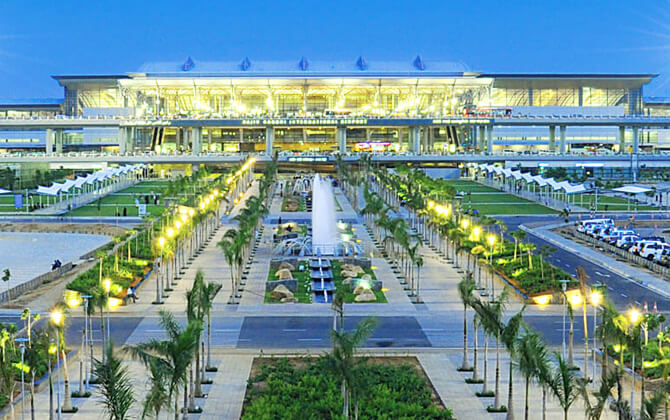
The Hyderabad Airport Express Metro, also referred to as Corridor IV, was planned to connect Raidurg metro station with Rajiv Gandhi International Airport. The proposed route is 31 km / 19.26 miles long and would link the western metro corridor with the airport in Shamshabad.
Based on the available plan, the line would include 9 elevated stations and 1 underground station at the airport terminal. The route would pass through Biodiversity Junction, Nanakramguda Junction, and the Outer Ring Road corridor before reaching the airport.
A key part of the project is the planned interchange at Raidurg with the existing Blue Line. The extended Blue Line terminal and the Airport Metro station were planned as a stacked interchange, creating an integrated transfer point for air travelers.
The source material also mentions a check-in facility at Raidurg, where passengers could check in and continue to the airport with their baggage. At the airport end, the station was planned underneath the passenger terminal, with access via lifts, escalators, and stairs.
As of December 2023, the project was still awaiting in-principle approval from the Union Government.
| Station | Details |
|---|---|
| Raidurg | Planned interchange with Airport Shuttle Blue Line |
| Airport Cargo | Planned airport station on the line |
| RGIA Terminal | Planned airport terminal station on the line |
System Rules
Hyderabad Metro Rail passengers are required to follow rules set under the Metro Railways (Operations & Maintenance) Act, 2002, along with station-level policies. These rules are meant to keep the system safe, orderly, and easy to use.
Key travel rules include carrying a valid ticket or smart card, following security checks, and staying within allowed areas only. Ticketless travel is a punishable offence. Tokens are valid for 30 minutes from purchase, and if a passenger does not reach the platform within that time, the token is cancelled without refund.
- Passengers must travel with a valid token or smart card.
- Only smart card users or token holders may remain within the premises for up to 2 hours, excluding the platform.
- Public areas are open to all, but private areas and platforms are restricted.
- Passengers should not sit on the floor of the train compartment.
- Only luggage within permitted limits may be carried.
- Gunny bags of rice or wheat are not allowed.
- Prohibited items include matchboxes, lighters, petrol, kerosene, gas cylinders, stoves, explosives, knives, scissors, and other sharp objects.
Common offences and penalties are listed below.
| Offence | Penalty |
| Drunkenness, nuisance, spitting, sitting on the floor of the train, or quarrelling | Fine of ₹500 (about US$6), forfeiture of pass or ticket, and removal from the carriage |
| Taking offensive materials | Fine of ₹500 (about US$6) and payment for any damage caused |
| Taking dangerous materials | Fine of ₹5,000 (about US$60) and/or imprisonment up to 4 years |
| Unlawful entry | Fine of ₹250 (about US$3) and/or imprisonment up to 3 months |
| Walking on the metro track | Fine of ₹500 (about US$6) and/or imprisonment up to 6 months |
| Obstructing running of trains | Fine of ₹5,000 (about US$60) and/or imprisonment up to 4 years, plus removal from the premises |
| Obstructing officials on duty | Fine of ₹1,000 (about US$12) and/or imprisonment up to 1 year |
| Misusing alarm or interfering with communication in the train | Fine of ₹1,000 (about US$12) and/or imprisonment up to 1 year |
| Altering, defacing, or counterfeiting a pass or ticket | Imprisonment up to 6 months |
| Defacing metro properties | Fine of ₹250 (about US$3) and/or imprisonment up to 2 months |
| Unauthorized sale of articles on the metro railway | Fine of ₹500 (about US$6) and/or imprisonment up to 6 months |
| Unauthorized sale of tickets | Fine of ₹500 (about US$6) and/or imprisonment up to 3 months |
| Maliciously wrecking a train or causing sabotage | Life imprisonment or rigorous imprisonment up to 10 years |
| Maliciously hurting or attempting to hurt passengers | Life imprisonment or imprisonment up to 10 years |
| Endangering passenger safety by rash or negligent act or omission | Imprisonment up to 1 year and/or fine |
| Damage to or destruction of metro railway properties | Imprisonment up to 10 years |
| Endangering passenger safety by willful act or omission | Imprisonment up to 7 years |
Additional fare-related penalties apply as well.
| Violation | Penalty |
| Traveling without ticket or pass | ₹50 (about US$0.60) plus the maximum fare, or 1 month imprisonment |
| Carrying away a token without depositing it at the exit gate | ₹50 (about US$0.60) plus the ordinary single fare for the distance traveled, or 1 month imprisonment |
| Traveling beyond the authorized distance | ₹50 (about US$0.60) plus the difference in fare, or 1 month imprisonment |
| Overtime penalty: same station, maximum exit time 60 minutes; destination station, maximum exit time 120 minutes | ₹250 (about US$3) or up to 3 months imprisonment |
| Ticket mismatch at exit | ₹75 (about US$0.90) |
| Physical damage to a smart card or ticket not recognized at the gates | ₹100 (about US$1.20) |
Passengers are also expected to respect security screening, use bins, avoid littering and smoking, stay behind the yellow line, avoid forcing doors, and not share smart cards or tokens with others.
History of the Hyderabad Metro
The Hyderabad Metro project began in 2003, when rising population and road traffic made it clear that the existing MMTS alone could not meet the city’s transport needs. The Union Ministry of Urban Development approved the project and asked Delhi Metro Rail Corporation to survey the corridors and prepare a Detailed Project Report.
In August 2005, MMTS was launched by the state government and South Central Railway to meet immediate transportation needs in Hyderabad and Secunderabad. The metro was planned as a complementary system with connections to MMTS and other public transport.
In 2007, N. V. S. Reddy was appointed Managing Director of Hyderabad Metro Rail Limited, and the Central Government approved ₹1,639 crore (about US$197 million) under the Viability Gap Funding scheme.
The first bidding round took place in 2008 and the project was awarded to Maytas, but the company failed to achieve financial closure in time. The contract was cancelled. In July 2010, the project was rebid, and Larsen & Toubro emerged as the lowest bidder for the ₹121.32 billion project. An underground system was ruled out because of Hyderabad’s hard rock, boulders, and soil conditions.
Construction officially began on 26 April 2012. Rail laying started in November 2013 between Nagole and Mettuguda, and the first train arrived from Korea in May 2014. Trial runs followed, along with staged safety approvals.
Commercial operations began in November 2017 with the opening of the Red Line section between Miyapur and Ameerpet and the Blue Line section between Ameerpet and Nagole. Prime Minister Narendra Modi inaugurated the 30 km / 18.6 mile stretch from Miyapur to Nagole on 28 November 2017, and it opened to the public the next day.
Further expansion followed quickly. The Red Line reached LB Nagar in September 2018, the Blue Line reached HITECH City in March 2019 and Raidurg in November 2019, and the Green Line between Jubilee Bus Station and MGBS opened in February 2020. By May 2019, construction of all 2,599 pillars, excluding the Old City stretch, had been completed. A ladies-only coach was introduced on all trains from 7 May 2018.
Ridership grew strongly over time. The metro crossed 200,000 passengers on day one, reached about 490,000 daily passengers by February 2020, averaged about 450,000 daily by December 2022 after the COVID period, and recorded 0.51 million riders in one day on 3 July 2023.
Phase II planning started after the first lines opened. In 2018, the Telangana Government announced Hyderabad Airport Metro Limited to extend the Blue Line from Raidurg to Rajiv Gandhi International Airport. Later plans were delayed by funding issues, operating losses, and disagreements over structure. After further negotiations, the state government and L&T reached an agreement for the government to acquire L&T’s stake for ₹15,000 crore (about US$1.8 billion), including loan transfer and payout, paving the way for a shift from the original PPP model to a state-central joint venture.
Future Plans
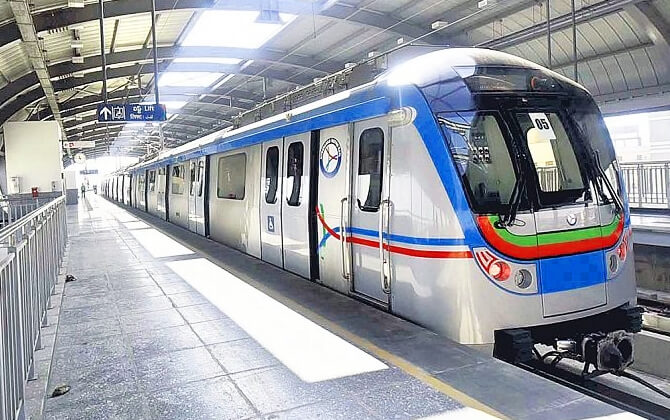
Hyderabad Metro’s next stage focuses on expansion, funding, and possible changes in how the system is managed. On 18 November 2025, the city hosted the regional meeting of Urban Development Ministers, where Union Housing and Urban Affairs Minister Shri Manohar Lal Khattar and Telangana Chief Minister Shri A. Revanth Reddy reviewed the metro’s progress and roadmap.
At the HMDA and HMRL stalls, Shri Sarfaraz Ahmed presented ongoing metro works, future corridors under planning, and proposals still awaiting Central approval. He also urged the Union Minister to speed up sanctions for Hyderabad Metro Phase 2.
One of the biggest developments under discussion was a proposed transition from the current PPP structure to a 50:50 joint venture between the Government of India and the Government of Telangana. The idea is to improve funding, execution, and accountability.
Phase 2 expansion under review
Nearly 162 km / 100.7 miles of new metro corridors are under evaluation by the Central Government. A decision is expected by March 2026, when feasible corridors, priority alignments, and possible timelines may be identified.
If approved, this expansion would be the largest since the system first opened. The proposed corridors are intended to improve access to IT areas, commercial districts, residential neighborhoods, educational clusters, and other parts of the city that still need stronger rail connectivity.
What the expansion is meant to achieve
- Strengthen links between employment hubs and residential areas
- Reduce dependence on road-based transport
- Support the city’s Smart Mobility goals
- Improve long-term access for commuters, businesses, and investors
The planned expansion is meant to do more than extend the route map. It is also intended to support sustainable urban growth, reduce travel time, and reinforce Hyderabad’s wider city transport network.
Interesting Facts
Hyderabad Metro is arranged in a secant model, which makes its route structure a bit different from many other metro systems.
The project was developed through a public-private partnership by Larsen & Toubro via L&T Metro Rail Hyderabad Limited, while the Government of Telangana retained a minority equity stake.
The 30 km / 18.6 mile stretch from Miyapur to Nagole, with 24 stations, was inaugurated on 28 November 2017. At the time, it was the longest rapid transit metro line opened in one go in India.
The project cost was estimated at ₹18,800 crore (US$2.2 billion).
Ridership climbed steadily, reaching about 490,000 daily passengers by February 2020, about 450,000 by December 2022 after the COVID period, and 0.51 million riders on 3 July 2023.
A ladies-only coach has been available on all trains since 7 May 2018.
Phase I includes three fully elevated corridors. The Blue and Red lines opened first in 2017, and the Green Line followed in 2020 to complete the initial network.
Stations are designed with escalators, elevators, announcement boards, electronic display systems, tactile pathways, and Braille-equipped elevator buttons. Signboards appear in Telugu, English, Hindi, and Urdu.
The system also connects with other forms of transport, including feeder services, which makes end-to-end travel easier.
Travel Tips
Before you travel, check the stations map and pick the station closest to your starting point and destination. For first-time riders, that simple step makes the whole trip easier.
If you need help with wheelchairs or other assistance, contact station staff or call 040-23332555. Where available, elevators are the easiest option.
- Buy your ticket online or offline, depending on what works best for you.
- Complete the security check, scan your baggage, and tap your ticket at the automatic entry gates.
- Follow the signs and color-coded indicators to reach the correct platform.
- Wait behind the marked safety line and let passengers get off first.
- Offer your seat to elderly passengers, pregnant women, and parents with infants when needed.
- Get ready to exit one station before your destination, then use escalators, stairs, or elevators to reach the concourse and tap out at the automatic exit gate.
For last-mile transport, Hyderabad Metro also connects with Rapido, SVIDA vehicles, Ola, and Uber. That can make a big difference if your final stop is a little away from the station.
Exploring Hyderabad Via Metro
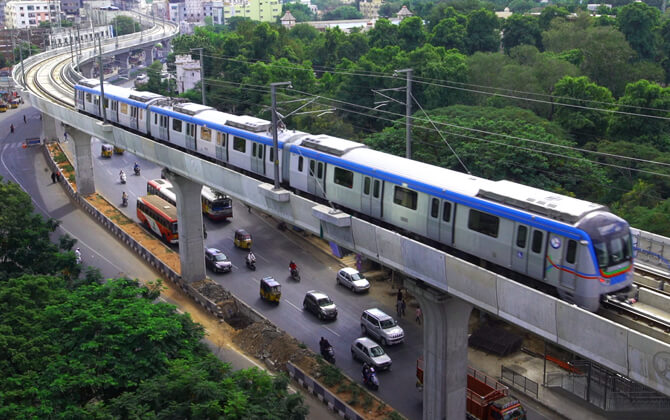
Hyderabad Metro is one of the most practical ways to get around the city. For visitors and daily commuters alike, the metro map is the easiest starting point for understanding how major areas of Hyderabad and Secunderabad connect.
The system links business districts, residential zones, and key interchange points, making it useful for both everyday travel and wider city exploration.
What the network covers
The metro is especially useful for trips between Miyapur, Ameerpet, Nagole, Raidurg, and LB Nagar. It also gives convenient access to central Hyderabad and Secunderabad.
- Red Line connects Miyapur to LB Nagar.
- Blue Line connects Raidurg to Nagole.
- Green Line connects JBS to Falaknuma.
Key interchanges include Ameerpet for the Red and Blue lines, JBS Parade Ground for the Blue and Green lines, and MG Bus Station for the Red and Green lines.
Why the metro is useful for getting around
The metro helps passengers avoid road traffic and offers reliable running time across major corridors. It is built for frequent service, with shorter intervals during peak hours on the main lines.
The system also supports last-mile travel through feeder services and electric auto options at selected stations, which adds to its value as everyday local transport.
If you are new to the city, start with the route map. It makes it much easier to choose the right line, spot the right interchange, and plan a smoother trip.
Passenger experience
Stations are equipped with escalators, elevators, announcement systems, electronic display boards, tactile pathways, and Braille buttons. Signs in Telugu, English, Hindi, and Urdu make navigation easier for a wide range of passengers.
The trains include AC coaches, seating, hand railings, charging points, CCTV, and emergency features. Ticketing is available through smart cards, tokens, QR-based options, and digital payment methods. Smart cards offer discounts, while mobile-based ticketing helps speed things up for regular riders.