Mumbai Metro is a rapid transit system serving Mumbai and the wider Mumbai Metropolitan Region in Maharashtra, India. It was built to ease road congestion and support the heavily used suburban rail network. As of April 2026, it is the second longest operational metro system in India, with 101.43 km (63.03 miles) in service. The network is being developed in phases, with the core system expected to include 16 lines, more than 523 km (324.98 miles) of route length, and 350 stations when complete.
| Key | Information |
|---|---|
| System | Rapid transit system in Mumbai and the Mumbai Metropolitan Region |
| Purpose | Reduce congestion and supplement the suburban railway network |
| Operational length | 101.43 km (63.03 miles) |
| Planned network | 16 lines, over 523 km (324.98 miles), about 350 stations |
| Infrastructure | Mostly elevated, with underground and at-grade sections |
| Main agencies | MMRDA, MMRC, and Mumbai Metro One Private Limited |
| First line opened | 8 June 2014 |
| Completion target | October 2026 for the broader phased buildout |
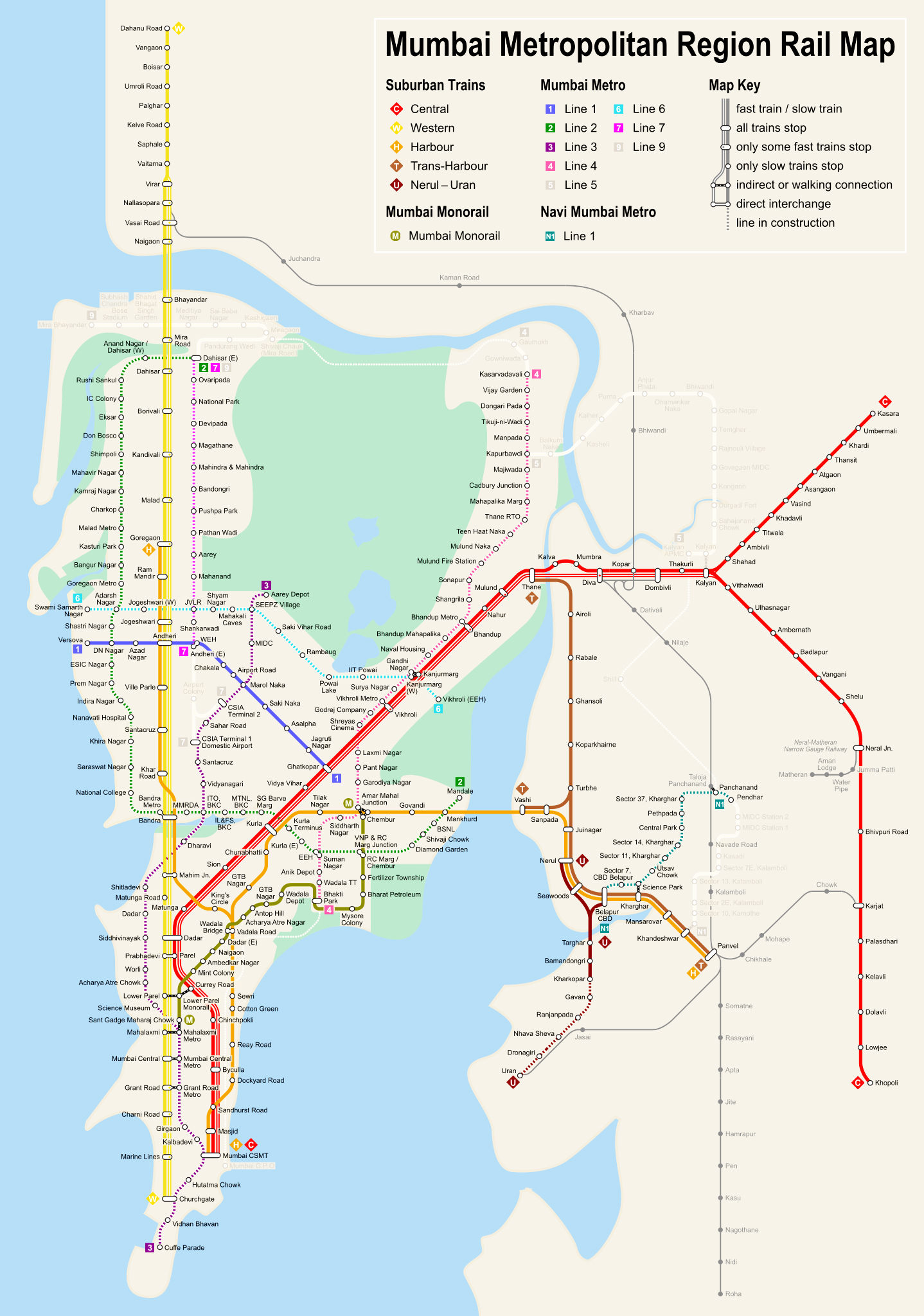
Mumbai Metro Map
Map of Mumbai Metro showing different lines. Click on the map to enlarge it or download the Mumbai Metro map in PDF format.
Lines and Stations
Mumbai Metro is a multi-line city transport system with elevated, underground, and at-grade corridors. The route plan is organized by line number and color, making the stations map easier to follow for daily commuters and visitors. Operational and planned lines connect suburbs, business districts, and key transport interchanges across the metropolitan region.
Operational Lines
| Station | Details |
|---|---|
| Line 1 | Blue line, Versova to Ghatkopar, 12 stations, 11.4 km (7.08 miles), operational |
| Line 2A | Yellow line, Dahisar to DN Nagar, 17 stations, 18.6 km (11.56 miles), operational |
| Line 2B | Yellow line, Diamond Garden to Mandale, 5 stations, 5.4 km (3.36 miles), partially operational |
| Line 3 | Aqua line, Aarey to Cuffe Parade, 27 stations, 33.5 km (20.82 miles), operational |
| Line 7 | Red line, Andheri East to Dahisar East, 16 stations, 16.5 km (10.25 miles), operational |
| Line 9 | Red line, Dahisar East to Kashigaon, 4 stations, 4.97 km (3.09 miles), partially operational |
Lines Under Construction
| Station | Details |
|---|---|
| Line 4 | Green line, Wadala to Kasarvadavali, 32 planned stations, 32.3 km (20.07 miles), under construction |
| Line 5 | Orange line, Thane to Kalyan, 16 planned stations, 25.2 km (15.66 miles), under construction |
| Line 6 | Pink line, Swami Samarth Nagar to Vikhroli, 13 planned stations, 14.5 km (9.01 miles), under construction |
Selected Stations and Interchanges
| Station | Details |
|---|---|
| Versova | Terminus of Line 1 |
| Ghatkopar | Terminus of Line 1 |
| Andheri | Important interchange with suburban rail connections |
| D N Nagar | Connects Line 1 and Line 2A |
| Marol Naka | Interchange between Line 1 and Line 3 |
| Bandra Kurla Complex | Served by Line 3 with a connection to Line 2B |
| Chhatrapati Shivaji Maharaj Terminus | Major Line 3 interchange linked to planned Green Line 11 |
| Dahisar East | Shared station for Lines 2A and 7 |
The Aqua Line is the first fully underground corridor in the system and has 27 stations. As new sections open, the stations list will keep growing across Mumbai, Thane, and Navi Mumbai.
Prices, tickets and discounts
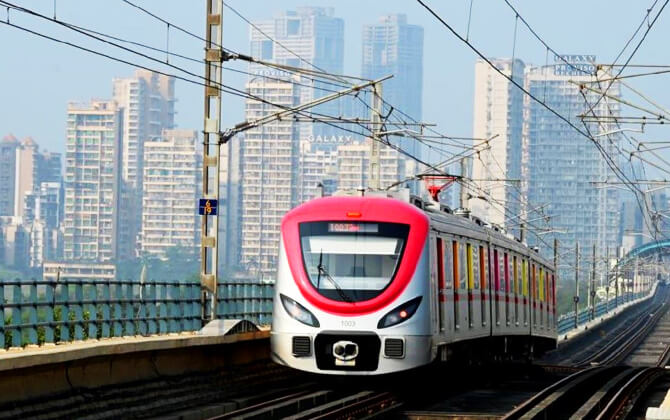
Mumbai Metro uses distance-based fare rules, with several ticket and pass options for different travel needs. You can buy a single ticket for one ride, a return ticket for the same day, or use a card or pass if you travel often. Some purchases are also available through mobile and WhatsApp ticketing.
Ticket types and fares
| Ticket type | Fare | Notes |
|---|---|---|
| Single Journey | ₹10-₹80 ($0.12-$0.96) | One-way ticket based on distance traveled |
| Return Ticket | ₹18-₹144 ($0.22-$1.73) | Same-day return with about 10% savings |
| Smart Card | ₹9-₹76 ($0.11-$0.91) | Prepaid card with a 5% discount |
| Trip Pass | ₹250-₹2000 ($3.00-$24.00) | Designed for frequent travelers |
How fares are calculated
The fare calculator is based on distance slabs. Ticket price starts at ₹10 ($0.12) for short trips and goes up to ₹80 ($0.96) for the longest single journey. Return tickets, Smart Card prices, and pass costs follow the same structure, with lower fare levels or better value depending on the option you choose.
| Distance | Single Journey | Return Ticket | Smart Card | Trip Pass |
|---|---|---|---|---|
| 0-3 km (0-1.86 miles) | ₹10 ($0.12) | ₹18 ($0.22) | ₹9 ($0.11) | ₹250 ($3.00) |
| 3-12 km (1.86-7.46 miles) | ₹20 ($0.24) | ₹36 ($0.43) | ₹19 ($0.23) | ₹500 ($6.00) |
| 12-18 km (7.46-11.18 miles) | ₹30 ($0.36) | ₹54 ($0.65) | ₹29 ($0.35) | ₹750 ($9.00) |
| 18-24 km (11.18-14.91 miles) | ₹40 ($0.48) | ₹72 ($0.86) | ₹38 ($0.46) | ₹1000 ($12.00) |
| 24-30 km (14.91-18.64 miles) | ₹50 ($0.60) | ₹90 ($1.08) | ₹48 ($0.58) | ₹1250 ($15.00) |
| 30-36 km (18.64-22.37 miles) | ₹60 ($0.72) | ₹108 ($1.30) | ₹57 ($0.68) | ₹1500 ($18.00) |
| 36-42 km (22.37-26.10 miles) | ₹70 ($0.84) | ₹126 ($1.51) | ₹67 ($0.80) | ₹1750 ($21.00) |
| More than 42 km (26.10 miles) | ₹80 ($0.96) | ₹144 ($1.73) | ₹76 ($0.91) | ₹2000 ($24.00) |
Smart Card and pass details
The Smart Card is an electronic card available at Customer Care counters and through authorized channels. A refundable security deposit of ₹50 ($0.60) applies under the relevant rules.
The card can work as a Store Value Pass or a Trip Pass. Store Value Pass functions like an e-wallet with a minimum recharge of ₹100 ($1.20) and a maximum stored balance of ₹3000 ($36.00). Trip Pass options include 45 trips or unlimited trips, valid for 30 days from purchase or reload.
For 45 Trip Passes, the source and destination stations cannot be changed after purchase, and the pass is non-refundable. If you commute on the same route often, this option may bring better value than buying separate tickets each time.
Ticket validity and discounts
- Single Journey tickets are valid for 2 hours from issue time.
- Return tickets are valid for two journeys on the same day.
- Paper QR tickets stay valid until the end of operating hours on the same day.
- Mobile QR tickets must be used within 2 hours from issue.
- Children below 3 years travel free.
- Children aged 3 to 12 pay 50% of the adult fare.
- Senior citizens aged 60+, persons with disabilities, and students may be eligible for concessions.
Ways to buy and pay
- Ticket counters at metro stations for ticket purchase and recharge.
- Ticket vending machines with card, UPI, smart card, and contactless payment options.
- Mobile QR tickets through PayTm and PhonePe.
- WhatsApp e-ticketing and Maha Mumbai Metro WhatsApp ticketing.
- Mumbai 1 (NCMC) card and the Mumbai 1 mobile app for supported services.
Unused tickets can be refunded before the journey starts, though a small handling charge may apply.
Mumbai Metro Timings
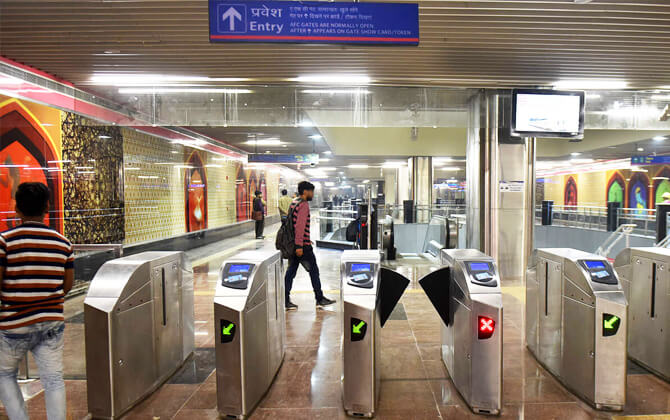
Mumbai Metro operating hours vary by line, day, and service conditions. If you need timings today, schedule today updates, or the latest train schedule, it is best to check the official app or station display boards before travel. The earliest starting time mentioned in the available information is 5:25 AM.
Available source material states that the network currently has 4 operational lines, 69 stations, and 80 km (49.71 miles) of route length in this timetable section. Opening hours, closing time, and frequency can change on holidays and special occasions.
Line 1: Versova – Ghatkopar
Line 1 is the Blue Line, operated by MMOPL. It is an elevated route with 12 stations and a total length of 11.4 km (7.08 miles).
| Service detail | Timings |
|---|---|
| Versova to Ghatkopar first train / last train | 5:30 AM / 11:25 PM |
| Ghatkopar to Versova first train / last train | 5:30 AM / 11:50 PM |
During peak hours, frequency is generally every 3 to 4 minutes. In off-peak weekday periods, trains usually run every 5 to 7 minutes. On weekends and public holidays, intervals are typically 5 to 8 minutes. End-to-end running time is about 40 to 45 minutes.
Timings by Line
| Service detail | Timings |
|---|---|
| Blue Line 1 (Versova-Ghatkopar) | 5:30 AM-11:50 PM |
| Yellow Line 2A (Dahisar East-DN Nagar) | 6:00 AM-10:30 PM |
| Red Line 7 (Dahisar East-Gundavali) | 6:00 AM-10:30 PM |
| Aqua Line 3 (Cuffe Parade-Aarey JVLR) | 6:30 AM-10:30 PM |
According to the available timetable, all lines run on Sundays and public holidays, though schedule changes may depend on commuter demand. Peak-hour frequency is generally 5 to 7 minutes, while off-peak service is around 10 to 15 minutes.
Useful Travel Notes
- Opening times may change on public holidays and special occasions.
- Use the official Mumbai Metro app for real-time schedule updates.
- Check station display boards before boarding.
- Some routes may follow different working hours on weekends and holidays.
Other route timetable references mention approximate journey times of 21 to 25 minutes for an 11-stop trip, around 20 minutes between Andheri and Ghatkopar, and about 45 minutes from Dahisar East to Andheri West. These are route-specific estimates and may vary.
Services
Mumbai Metro services are designed to offer safe, clean, and reliable transportation in Mumbai. Mumbai Metro One operates from 05:30 to 23:50, while the Lost & Found Center is open from 12:00 to 20:00, Monday to Saturday.
Customer Care counters are available at each of the 12 Line 1 stations from the first service in the morning until the last train at night. Passengers can get help with tickets, cards, and general travel support there.
Newer corridors have also seen growing demand. Lines 2A and 7 have recorded strong ridership, and NCMC card use has increased as the broader local transport system develops.
Customer contact
- Call: +91 22 30310900
- WhatsApp Care: +91 9930310900
- Email: [email protected]
Other service channels
- Business Opportunities: [email protected]
- Media: [email protected]
- Career Opportunities: [email protected]
Rules and Tips
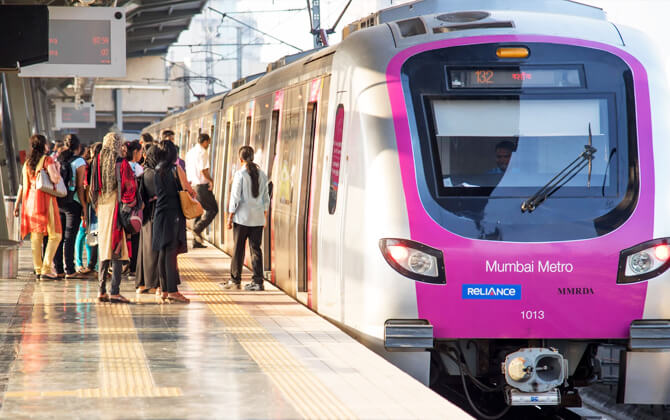
To keep the metro safe and comfortable, passengers are expected to follow station and onboard rules. These guidelines help staff manage crowd flow, cleanliness, and day-to-day transport operations.
Do’s
- Follow queues while waiting for trains and at ticket counters and AFC gates.
- Stand behind the yellow line on platforms.
- Stand on the left side of escalators and keep the right side clear.
- Use elevators and reserved seating when needed.
- Offer seats to elderly passengers, pregnant women, and physically challenged people.
- Use dustbins and keep trains and stations clean.
- Keep luggage in a way that does not inconvenience others.
- Report suspicious objects or activity to staff.
- Follow instructions from metro staff and security personnel.
- Use earphones while listening to music.
Don’ts
- Do not board or get off a moving train.
- Do not lean on train doors or block them from closing.
- Do not cross the yellow line on the platform.
- Do not sit on the floor of trains or stations.
- Do not litter in trains or station areas.
- Do not eat or drink inside the train.
- Do not play loud music inside the train.
- Do not carry inflammable, hazardous, or unauthorized materials.
- Do not smoke in trains or station premises.
- Do not damage metro property.
- Do not enter or exit without a valid ticket.
- Do not cause nuisance to other passengers.
Breaking these rules may lead to fines or legal action, and entry may be denied for non-compliance. Keep your ticket valid, pay attention to announcements, and follow staff directions for a smoother trip.
History
Mumbai Metro grew out of the city’s long-standing need for stronger public transport. As population increased and the suburban rail network became more crowded, a rapid transit system was planned to improve transportation in the city. The end of the tramway era also added pressure to the existing network.
In 2004, MMRDA presented a master plan for 146.5 km (91.03 miles) of track, including 32 km (19.88 miles) underground, to be built in three phases at an estimated cost of ₹19,525 crore. The plan was later revised and expanded in 2011, 2012, 2015, and 2017.
The first phase was launched in June 2006, construction began in February 2008, and the first successful trial run took place in May 2013. The first line opened to the public on 8 June 2014. Progress was slowed at different times by environmental clearances, land acquisition issues, and protests.
After Blue Line 1 opened, the system expanded gradually. Services resumed for the general public in 2020 after the COVID-19 shutdown. Lines 2A and 7 were inaugurated on 2 April 2022. On 5 October 2024, the 12 km (7.46 miles) underground section of Aqua Line 3 from BKC to Aarey Jogeshwari-Vikhroli Link Road opened, followed by its extension to Cuffe Parade on 9 October 2025. The first phase of Line 9 and Line 2B was inaugurated on 7 April 2026.
The history of the project also includes major public debate, especially over tree cutting and construction in the Aarey area. Even so, the metro has become a central part of Mumbai’s city transport system.
Future Extensions
Mumbai Metro expansion continues through lines under construction, approved extensions, and proposed future corridors. The aim is to improve route coverage, reduce congestion, and strengthen connections between suburbs, business districts, and airport areas.
Yellow Line 2B is being developed in stages. Green Line 4 and Line 4A connect Wadala, Thane, Kasarvadavali, and Gaimukh, while Line 10 extends toward Shivaji Chowk in Mira Road. Pink Line 6 links Lokhandwala with Vikhroli, and the Red corridor includes Lines 7, 7A, and 9.
Other routes are at different planning stages. Orange Line 5 and Line 12 connect Thane, Bhiwandi, Kalyan, and Taloja. The Gold Line is proposed between Chhatrapati Shivaji Maharaj International Airport and Navi Mumbai International Airport. Purple and Magenta corridors are also planned toward Virar, Ambarnath, and Badlapur.
The longer-term route plan envisions more than 523 km (324.98 miles) of metro lines in total. Interchange stations such as BKC, Kanjurmarg, Kapurbawdi, SEEPZ, and airport terminals are expected to play a major role as the system grows.
- Approved and under construction: Lines 2B, 4, 4A, 5, 6, 7A, 9, 10, 11, and 12
- Proposed future corridors: Gold Line, Purple Line, and Magenta Line
- Network goal: stronger east-west, north-south, and airport connectivity across the region
Each new section adds more stations, more interchange options, and a wider reach for Mumbai’s public transport network.
Nearby Attractions
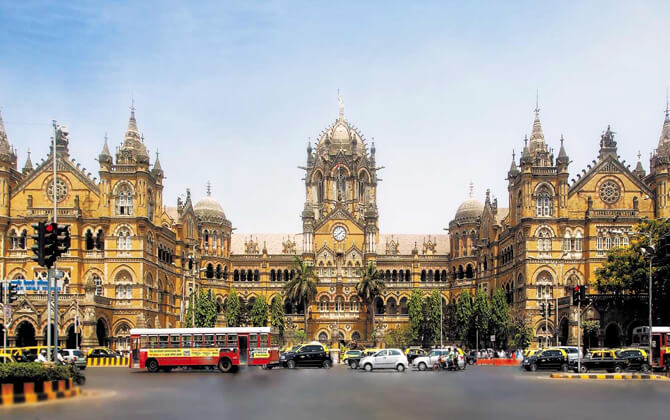
Mumbai Metro makes it easier to reach many of the city’s best-known landmarks, waterfronts, markets, temples, and museums. Depending on your route, you can get closer to places such as Marine Drive, Gateway of India, Siddhivinayak Temple, Juhu Beach, and Chhatrapati Shivaji Maharaj Terminus.
Some stations are especially convenient for sightseeing. Churchgate gives access to Marine Drive, Gateway of India, and heritage areas in South Mumbai. Lower Parel works well for Siddhivinayak Temple and Mahalaxmi attractions. DN Nagar is useful for Juhu Beach and ISKCON Temple Mumbai, while CSMT is a strong starting point for Fort-area sights and markets.
If you want to plan a simple day route, mixing a few different spots usually works best.
- Heritage and architecture: Chhatrapati Shivaji Maharaj Terminus, Flora Fountain, Bombay High Court, and the Victorian Gothic and Art Deco areas near South Mumbai
- Waterfront views: Marine Drive, Chowpatty Beach, Worli Sea Face, and Gateway of India
- Religious sites: Siddhivinayak Temple, Mahalaxmi Temple, Haji Ali Dargah, and Mount Mary Church
- Shopping and markets: Colaba Causeway, Crawford Market, Linking Road, and Chor Bazaar
- Museums and culture: Chhatrapati Shivaji Maharaj Vastu Sangrahalaya, Dr. Bhau Daji Lad Museum, Jehangir Art Gallery, and the National Gallery of Modern Art
Some places are within walking distance of a station, while others need a short taxi, rickshaw, or ferry ride. Elephanta Caves, for example, are reached by ferry from the Gateway area.
Before you go, check opening hours and opening times, especially for museums, temples, and heritage sites. Some locations have specific working hours or may close on certain days.