Lucknow Metro is the mass rapid transit system serving Lucknow, Uttar Pradesh, and it is operated by the Uttar Pradesh Metro Rail Corporation (UPMRC). The system currently runs on the Red Line between CCS International Airport and Munshi Pulia, with trains generally arriving every 5 to 7 minutes. It is a key part of public transport and city transport in Lucknow, linking the airport, rail hubs, bus connections, and major urban districts. Construction of Phase 1A began on 27 September 2014, the first section opened on 5 September 2017, and the full Red Line became operational in March 2019. In January 2024, the state approved the East-West Corridor as Phase 1B, adding to the network’s expansion plans.
| Key | Information |
|---|---|
| Operator | Uttar Pradesh Metro Rail Corporation (UPMRC) |
| Current line | Red Line |
| Route | CCS International Airport to Munshi Pulia |
| Network length in operation | 22.87 km (14.21 miles) |
| Stations in operation | 21 |
| Service frequency | About every 5 to 7 minutes |
| Starting time | 6:00 AM |
| Last train | 10:30 PM |
| End-to-end running time | About 40 minutes |
| Approved expansion | Phase 1B East-West Corridor, 11.165 km (6.94 miles) |
Lucknow Metro Map
Map of Lucknow Metro showing different lines and stations. Click on the map to enlarge it or download the Lucknow Metro map in PDF format.

Lines and Stations
Lucknow Metro currently operates the Red Line, the North-South corridor. This route runs from CCS International Airport to Munshi Pulia and covers 22.87 km (14.21 miles). It has 21 stations across elevated and underground sections, and train frequency is usually every 5 to 7 minutes.
The line opened in stages. The first 8.5 km (5.28 miles) section between Transport Nagar and Charbagh entered commercial service on 5 September 2017. Full operations from CCS International Airport to Munshi Pulia started in March 2019.
Here is the current stations list for the Red Line.
| Station | Details |
|---|---|
| CCS International Airport | Southern terminal and airport connection |
| Amausi | Next station after the airport on the northbound route |
| Transport Nagar | Part of the first section opened in 2017 |
| Krishna Nagar | Red Line station |
| Singar Nagar | Red Line station |
| Alambagh | Useful for access toward Chowk Market and Eco Garden |
| Alambagh ISBT | Connection with the bus station |
| Mawaiya | Red Line station |
| Durgapuri | Access to Lucknow Junction railway station |
| Charbagh | Major interchange with rail and bus services; future link to Blue Line |
| Hussain Ganj | Red Line station |
| Sachivalaya | Red Line station |
| Hazratganj | Close to key attractions and shopping areas |
| KD Singh Babu Stadium | Useful for several heritage attractions |
| Lucknow University | Red Line station |
| IT College | Listed in fare examples as IT Chauraha |
| Badshahnagar | Connection with Badshahnagar railway station |
| Lekhraj Market | Red Line station |
| Bhootnath Market | Red Line station |
| Indira Nagar | Red Line station |
| Munshi Pulia | Northern terminal |
The approved Blue Line, or East-West Corridor, is not operational yet. This future route plan will run between Vasant Kunj and Charbagh, with a total length of 11.165 km (6.94 miles) and 12 planned stations.
| Station | Details |
|---|---|
| Charbagh | Interchange with the operational Red Line |
| Gautam Buddha Marg | Planned Phase 1B station |
| Aminabad | Planned station in a dense city area |
| Pandey Gunj | Planned Phase 1B station |
| Lucknow City | Planned station for City railway station access |
| Medical Chauraha | Planned Phase 1B station |
| Nawajganj | Planned Phase 1B station |
| Thakurganj | Planned Phase 1B station |
| Balaganj | Planned Phase 1B station |
| Sarfarazganj | Planned Phase 1B station |
| Musabagh | Planned Phase 1B station |
| Vasant Kunj | Western terminal of the approved corridor |
As the system expands, the Red Line and Blue Line together form the core of Lucknow Metro’s route map and stations map for the city.
Timetable & Operating Hours
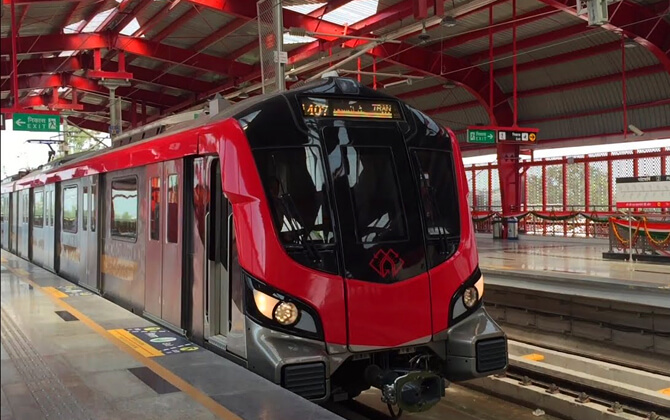
Lucknow Metro operating hours begin daily at 6:00 AM. The current last train leaves at 10:30 PM, which sets the usual closing time for regular passenger service.
Older service information mentioned a 10:00 PM close, so for timings today, schedule today, or holiday changes, it is smart to verify the latest station notices. If you are planning a late trip, check the last train timing before you travel.
Quick timetable overview
| Service detail | Timings |
|---|---|
| First train / starting time | 6:00 AM |
| Last train / closing time | 10:30 PM |
| End-to-end running time | About 40 minutes |
| Peak frequency | About every 5 to 5.5 minutes |
| Off-peak frequency | About every 10 minutes |
The Red Line is the only operating route at present, linking CCS Airport with Munshi Pulia. For route timetable details, train schedule updates, and opening times at specific stations, official announcements remain the best source.
Lucknow Metro Fares
Lucknow Metro fare is based on how many stations you travel. Single-journey tickets are issued as paper tickets with QR codes, and the ticket price rises step by step as the distance increases.
| Stations | Fare |
|---|---|
| 1 station | ₹10 (about $0.12) |
| 2 stations | ₹15 (about $0.18) |
| 3 to 6 stations | ₹20 (about $0.24) |
| 7 to 9 stations | ₹30 (about $0.36) |
| 10 to 13 stations | ₹40 (about $0.48) |
| 14 to 17 stations | ₹50 (about $0.60) |
| 18 stations or more | ₹60 (about $0.72) |
The GoSmart Card is aimed at regular riders and gives a 10% discount on single-journey fares. You can recharge the card at station ticket offices, ticket vending machines, Recharge Card Terminals, the LMRC website, or through netbanking.
For visitors, Tourist Cards work like a day pass or short-stay pass for unlimited travel. The available options are ₹100 (about $1.20) for 1 day and ₹250 (about $3.00) for 3 days, plus a refundable security deposit of ₹100 (about $1.20).
Example fare and price points from the airport route include ₹10 (about $0.12) from CCS International Airport to Amausi, ₹15 (about $0.18) to Transport Nagar, ₹30 (about $0.36) to Charbagh, ₹40 (about $0.48) to Hazratganj, ₹50 (about $0.60) to IT Chauraha, and ₹60 (about $0.72) to Munshipulia.
There is no fare calculator in the source material, but the fare system is straightforward: the more stations you cross, the higher the cost. For frequent travel, a card can save a bit on every trip.
Connections to Other Systems
Lucknow Metro connects with several important parts of the city’s transport network. Charbagh is the main interchange point in the current system and will also link with the approved East-West Corridor, making it central to future transportation in Lucknow.
On the Red Line, CCS International Airport connects the metro directly with air travel. Alambagh ISBT links with bus services, Durgapuri gives access to Lucknow Junction, and Charbagh connects with major rail and bus facilities.
The planned Blue Line will improve local transport links further by connecting Charbagh with Aminabad, Lucknow City, Medical Chauraha, and Vasant Kunj. That should strengthen access across dense parts of Old Lucknow and create better links between key city districts.
Project materials also mention future routes from Munshi Pulia to Jankipuram, Charbagh to SGPGI, and Indira Nagar to Atal Bihari Vajpayee Ekana Stadium. In the wider public transport picture, the metro is part of Uttar Pradesh’s growing rapid transit system, with earlier planning also referring to an elevated BRTS concept.
Airport Connections
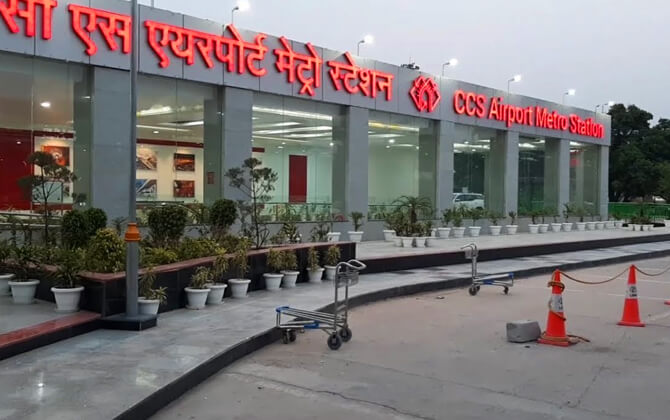
Chaudhary Charan Singh International Airport is the southern terminal of the Lucknow Metro Red Line. It gives travelers a direct path train connection between the airport and the rest of the city, without needing an extra road transfer to reach the metro.
The station opened on 8 March 2019 and is located in front of Terminal 2. From here, northbound trains continue toward Munshi Pulia, with Amausi as the next station.
Station layout
| Station | Details |
|---|---|
| Platform 2 | Southbound platform; trains terminate here |
| Platform 1 | Northbound platform toward Munshi Pulia; next station is Amausi |
The station uses side platforms, and the doors open on the left. It is one of the most practical stations in the system for visitors, especially those looking for a quick airport-to-city transport option.
Parking
Lucknow Metro offers station parking at a few key locations so passengers can drive in, park, and continue by train. This supports multimodal transport and makes daily commuting a little easier.
Parking is available near Transport Nagar Metro Station, where a 200-car facility has operated since launch. There is also a smaller parking area near the Polytechnic College of Krishnanagar, with space for about 60 to 70 cars.
LMRC has also said it is in talks to open parking near Alambagh Bus Stand Station, and another facility is planned for Durgapuri when land becomes available.
The parking charges are ₹3 (about $0.04) for cycles, ₹10 (about $0.12) for two-wheelers, and ₹20 (about $0.24) for cars. The source does not give separate parking charges per day, only these stated rates.
Parking operating hours are listed as 6:00 AM to 10:00 PM. Vehicles left outside authorized station parking areas may be removed.
Lucknow Metro Rules
Lucknow Metro has travel rules and precautions intended to keep journeys safe and smooth. These measures were introduced as services resumed in a graded way after the COVID-19 suspension, and passengers are expected to follow them at stations and on trains.
Key travel rules
- Use a contactless GoSmart Card instead of tokens whenever possible.
- Carry limited luggage and avoid metallic items if possible.
- Stand on the yellow stickers and follow marked queues for social distancing.
- Only 2 passengers may use the lift at one time.
- Follow the alternate seating pattern inside coaches.
- Wear a mask at all times inside metro premises and carry pocket sanitizer.
- Thermal screening is mandatory at station entry points.
- Passengers showing COVID-19 symptoms are not allowed to travel.
Station and coach precautions
High-contact areas such as ticket counters, entry and exit gates, handrails, lifts, escalators, platforms, seats, and vending machines are sanitized regularly. Staff assisting passengers wear masks and gloves, sanitizers are available at entry and exit points, and the air-conditioning and ventilation system follows ISHRAE guidelines. Station temperature is maintained at around 28 degrees Celsius.
Unlock 4 service notes
- Half the gates at Red Line stations remain closed, and passengers use only two gates for entry and exit.
- All passengers must pass thermal screening, mask checking, and Arogya Setu App checking before entering.
- If a passenger does not have a mask, one can be purchased at the station.
- Hand sanitizing is required before entry.
- Metro trains run from 6:00 AM to 10:00 PM under these notes.
- Trains arrive at roughly 5.5-minute intervals, with extra services added as needed.
- Social distancing is monitored at ticket counters and inside trains.
These rules are all about keeping the system safe for everyday travel.
History
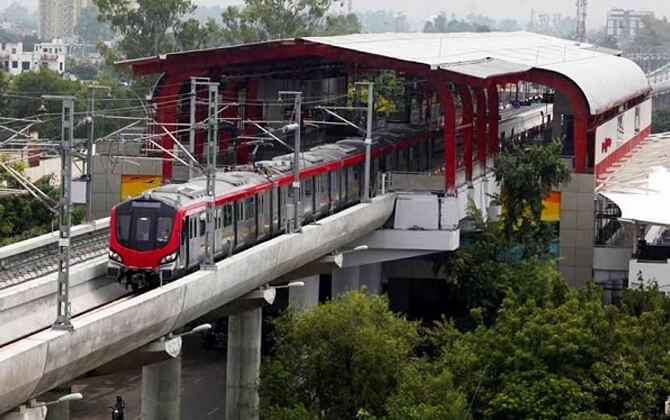
The history of Lucknow Metro begins in September 2008, when the Government of Uttar Pradesh asked DMRC to prepare a concept paper. An agreement between DMRC and the Lucknow Development Authority followed in February 2009, and the original plan included a north-south corridor, an east-west corridor, and an additional link through Gomti Nagar.
The project changed several times in the early years. In 2010, the east-west corridor was revised. Then, in 2013, a report from the Department of Housing and Urban Planning led to a major redesign. The original two-corridor concept was replaced with a denser network, and the layout shifted to a fully elevated route with no underground sections.
Formal progress picked up in 2013. In June, the state cabinet led by Chief Minister Akhilesh Yadav approved the metro rail network and cleared the creation of the Lucknow Metro Rail Corporation. In August 2013, the revised Detailed Project Report from DMRC was approved by the state government. LMRC was formed in October 2013 and incorporated on 25 November 2013. The Government of India gave in-principle approval in December 2013.
Construction began in March 2014 after the foundation stone was laid earlier that month. A budget allocation of ₹100 crore was made in July 2014, and actual construction on Phase 1A started on 27 September 2014 with the 8.5 km (5.28 miles) priority section from Transport Nagar to Charbagh.
The first section opened to the public on 5 September 2017. Later, the full Red Line from CCS International Airport to Munshi Pulia was inaugurated on 8 March 2019, with commercial service starting on 9 March 2019.
In January 2024, the Government of Uttar Pradesh approved Phase 1B, the 11.165 km (6.94 miles) East-West Corridor between Vasant Kunj and Charbagh, at an estimated cost of ₹5,881 crore (about US$700 million). On 1 January 2024, the metro also recorded its highest ridership, reaching 1.30 lakh passengers.
Future Extensions
Lucknow Metro expansion will continue beyond the current Red Line. The next major step is the East-West Corridor, also called Phase 1B, which has already received official approval.
According to UPMRC, physical work is expected to start by February or March 2026, and completion is projected in about five years. Before that, the final technical blueprint, tendering, and procurement still need to be completed. The work is expected to be divided into separate packages for the elevated section, underground section, and depot.
This corridor will be about 11.2 km (6.96 miles) long and will pass through some of Lucknow’s most congested and densely populated areas. It is planned to improve multimodal transport links by connecting Charbagh, City railway station, KGMU, Era, Old Lucknow, Aminabad, and Chowk.
The line is expected to begin with three-coach trains and can later expand to five coaches if needed. That differs from the first phase, where four-coach trains can be extended to six.
Officials have said the project is being designed around commuter needs, while surveys and simulations are being used to prepare traffic diversion and management plans. The longer timeline, despite the shorter route, comes from technical complexity: underground work, utility shifting, tunneling, safety requirements, and seven underground stations all add time.
Planning documents also mention future extensions and new corridors for later phases, including routes toward Jankipuram, SGPGI, Rajajipuram, Indira Nagar, Ekana Stadium, the airport, and Secretariat areas. Those plans still depend on further approvals and detailed project preparation.
Nearby Attractions
Lucknow Metro is a practical way to reach many of the city’s well-known attractions, markets, and heritage sites. Several places of interest sit close to Red Line stations, so it can save time compared with road-based city transport.
- Munshi Pulia is the nearest metro stop for Kukrail Picnic Spot, about 3.1 km (1.93 miles) away.
- IT Chauraha Metro Station is useful for reaching Regional Science City in Aliganj with a short auto ride.
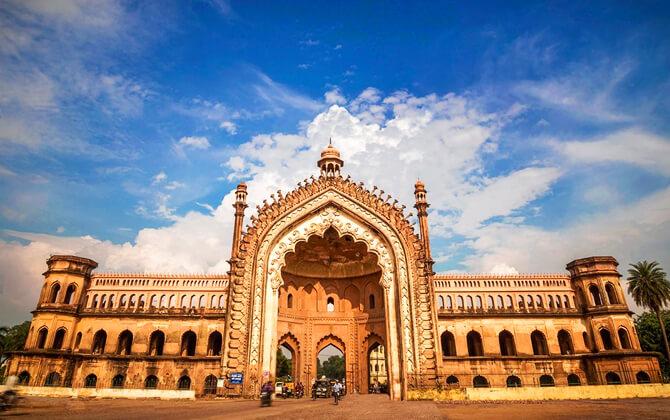
- K D Singh Babu Stadium is a handy station for Husainabad Clock Tower, Rumi Darwaza, Bara Imambara, Chota Imambara, British Residency, and Shaheed Smarak.
- Hazratganj is close to Hazratganj Market, Lucknow Zoo, Indira Gandhi Planetarium, and Botanical Garden.
- Charbagh works well for Aminabad Market, while Alambagh can be used for Chowk Market and Eco Garden.
- Transport Nagar is the nearest station mentioned for Nawabganj Bird Sanctuary and Ekana Cricket Stadium.
From many stations, you can continue by auto-rickshaw, e-rickshaw, cab, or on foot for shorter distances. For sightseeing, shopping, or a quick look at local history, the metro gives you a solid starting point.
| Attraction | Nearest Metro Station |
|---|---|
| Kukrail Picnic Spot | Munshi Pulia |
| Regional Science City | IT Chauraha |
| Husainabad Clock Tower | K D Singh Babu Stadium |
| Rumi Darwaza | K D Singh Babu Stadium |
| Lucknow Zoo | Hazratganj |
| Bara Imambara | K D Singh Babu Stadium |
| Chota Imambara | K D Singh Babu Stadium |
| British Residency | K D Singh Babu Stadium |
| Indira Gandhi Planetarium | Hazratganj |
| Aminabad Market | Charbagh |