Chennai Metro Rail is the rapid transit system serving Chennai, India, operated by Chennai Metro Rail Limited (CMRL), a joint venture between the Government of India and the Government of Tamil Nadu. As of December 2025, the system has two operational lines covering 54.1 km (33.6 miles) with 41 underground and elevated stations. It uses standard gauge tracks with 25 kV 50 Hz AC overhead electrification. Planning began in 2007–08, construction started in February 2009, and passenger service opened in stages from 29 June 2015. Phase II is under construction, and further expansion and integration with other public transport systems remain part of the long-term route plan.
| Key | Information |
|---|---|
| Operator | Chennai Metro Rail Limited (CMRL) |
| System type | Rapid transit |
| Operational lines | 2 |
| Network length | 54.1 km (33.6 miles) |
| Operational stations | 41 |
| Station types | Underground and elevated |
| Electrification | 25 kV 50 Hz AC overhead lines |
| Construction start | February 2009 |
| Passenger service start | 29 June 2015 |
| Expansion | Phase II under construction |
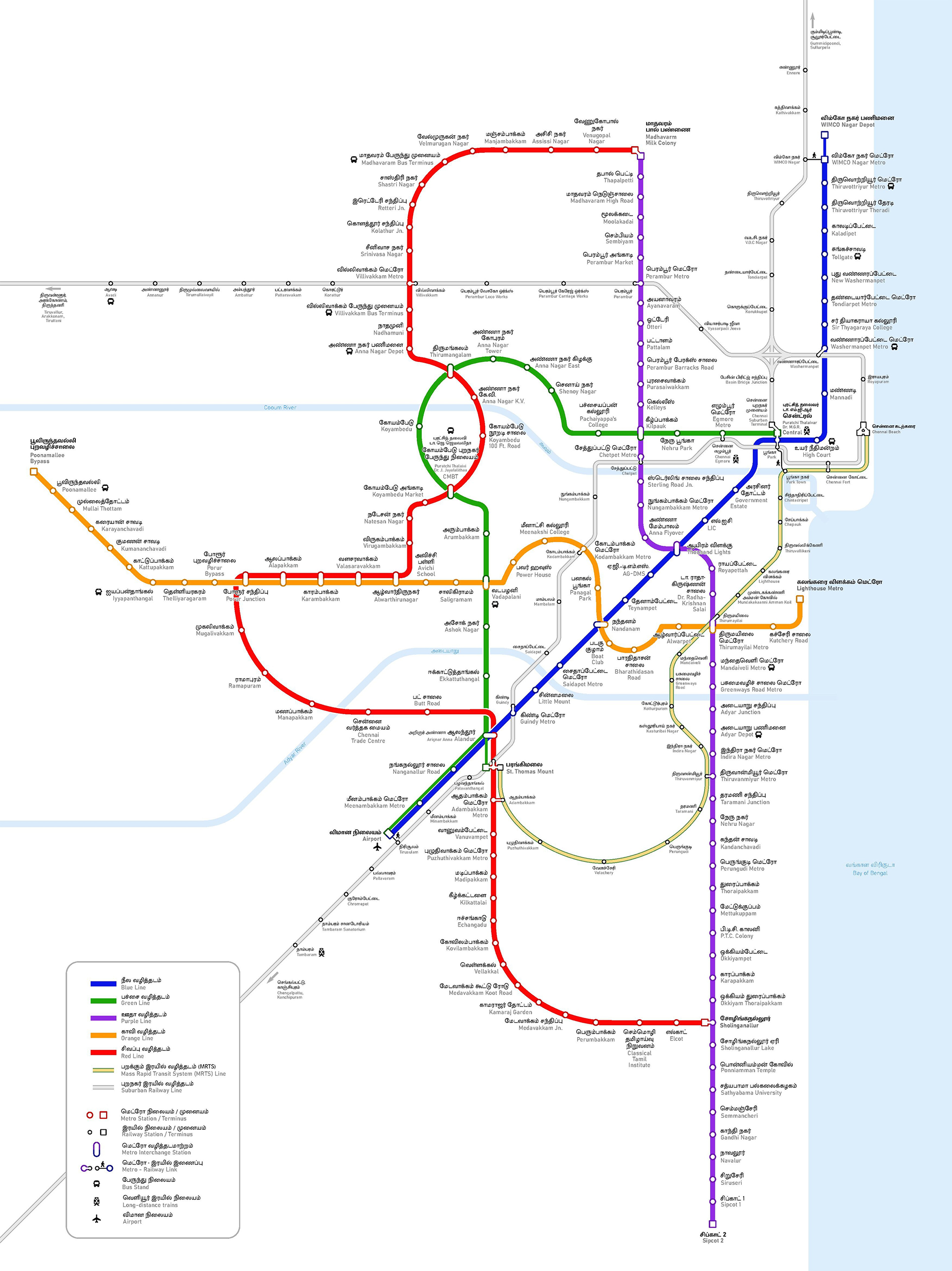
Chennai Metro Rail Map
Map of Chennai Metro showing different lines and stations. Click on the map to enlarge it or download the Yerevan Metro map in PDF format.
Chennai Metro Rail Stations
Chennai Metro stations make up the city’s rapid transit network and include both underground and elevated stops. As of December 2025, the operational system has 41 stations across two lines. The first stations opened on the Green Line between Alandur and Koyambedu on 29 June 2015. The Blue Line started service on 21 September 2016 between Chennai Airport and Little Mount, and the underground stretch from AG-DMS to Washermanpet opened on 10 February 2019, completing Phase I.
Some stations are especially important for transfers and city transport connections, including Arignar Anna Alandur, Egmore, Puratchi Thalaivar Dr. M.G. Ramachandran Central, St. Thomas Mount, and Washermanpet. These help link the metro with Chennai Suburban Railway, Chennai MRTS, and Indian Railways services.
The current network has no at-grade stations in operation. Depot stations are located at Koyambedu and Wimco Nagar. Phase II will add more lines and more stations, and MRTS integration is also planned.
| Station | Details |
|---|---|
| Arignar Anna Alandur | Important interchange and transfer point |
| Egmore | Key connection point with other rail services |
| Puratchi Thalaivar Dr. M.G. Ramachandran Central | Major interchange station |
| St. Thomas Mount | Important transfer point linked with MRTS and suburban rail |
| Washermanpet | Key transfer and network connection station |
| Koyambedu | Depot station |
| Wimco Nagar | Depot station |
| Network summary | 41 operational stations: 19 elevated and 21 underground, with 2 interchange stations listed in the source |
Timings, Frequency and Schedule
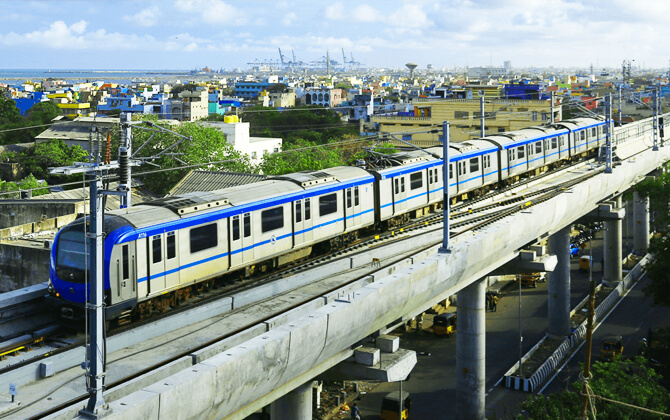
Chennai Metro operating hours vary by day, but the usual opening hours are from 5:00 am to 11:00 pm. Timings, frequency, and train schedule depend on the corridor and time of day. If you are checking schedule today or timings today, weekday, Saturday, and Sunday patterns are different.
Weekdays
On weekdays, the Blue Line runs from Wimco Nagar Depot to Airport, the Green Line runs from Chennai Central to St. Thomas Mount, and the inter-corridor service links Chennai Central and Airport via Egmore, CMBT, and Alandur.
| Service detail | Timings |
|---|---|
| General working hours | 5:00 am to 11:00 pm |
| Blue Line frequency | Every 6 minutes in peak hours, every 9 minutes in non-peak hours, every 15 minutes in extended non-peak hours |
| Green Line frequency | Every 6 minutes in peak hours, every 9 minutes in non-peak hours, every 15 minutes in extended non-peak hours |
| Inter-corridor frequency | Every 6 minutes in peak hours, every 9 minutes in non-peak hours, every 15 minutes in extended non-peak hours |
| Blue Line starting time from Airport | 04:51 hrs |
| Blue Line starting time from Wimco Nagar Depot | 04:56 hrs |
| Blue Line last train | 23:00 hrs from both ends |
| Green Line starting time from Chennai Central | 04:55 hrs |
| Green Line starting time from St. Thomas Mount | 05:01 hrs |
| Green Line last train | 23:17 hrs from Chennai Central and 23:00 hrs from St. Thomas Mount |
| Inter-corridor starting time | 04:51 hrs from Airport and 04:55 hrs from Chennai Central |
| Inter-corridor last train | 23:00 hrs from Airport and 23:17 hrs from Chennai Central |
On weekdays, headway between Central and Alandur via CMBT is 6 minutes during peak hours, 9 minutes in non-peak hours, and 15 minutes in extended non-peak periods. A 3-minute frequency is also maintained between Washermenpet and Alandur via Chennai Central, AGDMS, and Guindy during peak hours.
Saturdays
On Saturdays, there is no short loop service. Blue Line, Green Line, and inter-corridor services follow weekday-style timetable patterns, with first and last train departures generally between 05:00 hrs and 23:00 hrs.
| Service detail | Timings |
|---|---|
| Saturday opening times | Generally from 05:00 hrs |
| Saturday closing time | Generally up to 23:00 hrs |
| Service pattern | Weekday-style schedule, no short loop service |
Sundays and Holidays
On Sundays and holidays, trains run from 05:00 hrs to 23:00 hrs. Peak-hour service does not operate, so the train schedule is lighter than on weekdays.
| Service detail | Timings |
|---|---|
| Sunday and holiday opening hours | 05:00 hrs |
| Sunday and holiday closing time | 23:00 hrs |
| Blue Line frequency | Every 10 to 20 minutes depending on time period |
| Green Line frequency | Every 10 to 20 minutes depending on time period |
| Inter-corridor frequency | Every 10 to 20 minutes depending on time period |
| Central to Alandur via CMBT headway | 10 minutes |
Chennai Metro Rail Fares, Tickets and Cards
Chennai Metro uses a distance-based fare system. Regular fare starts at ₹10 ($0.12) and usually goes up to ₹50 ($0.60) for most trips, though some longer routes may cost up to ₹60 ($0.72). For an exact fare calculator result, passengers need to check the official fare table because it lists fares by station pair and route.
Ticket types available
CMRL offers six main ticket and card options for travel on the system.
- Single journey tokens for one trip, sold at station counters or ticket vending machines.
- Stored Value Cards (SVC), which are prepaid rechargeable cards available against a refundable deposit and offer discounted fares.
- Trip cards for repeated travel between the same two stations, with different validity options and discounts.
- Tourist cards with unlimited rides on the Chennai Metro system for one day.
- QR tickets for single and return journeys bought through the CMRL mobile app.
- National Common Mobility Card, also called the Singara Chennai Card, launched in 2023 and usable across major metro systems and selected bus transport systems in India.
Fare range and discounts
The standard ticket price range is ₹10 to ₹50 ($0.12 to $0.60). CMRL also lists a 20% discount for eligible card-based and QR-based travel, so digital or smart card payments can reduce the cost of the same trip.
The tourist pass options listed by CMRL are:
- 1 Day pass: ₹100 ($1.20) fare plus a ₹50 ($0.60) refundable deposit, with unlimited rides for one day.
- 30 Days pass: ₹2500 ($30.00) fare plus a ₹50 ($0.60) refundable deposit, with unlimited rides for 30 days.
Fare and service notes
The fare table published by Chennai Metro Rail reflects updated distance slabs in 2025. If you need the exact price for a specific route, the official fare table remains the most useful source.
| Ticket type | Main feature |
| Single journey token | Purchased for one trip at stations |
| Stored Value Card | Prepaid rechargeable card with discounted fares |
| Trip card | For travel between the same two stations |
| Tourist card | Unlimited rides for one day |
| QR ticket | Digital ticket bought through the CMRL app |
| Singara Chennai Card | NCMC-based card for metro and selected other transport systems |
Because trains run from early morning to late evening, passengers can choose whichever ticket, pass, or card best fits their travel pattern.
Chennai Metro Rail Parking
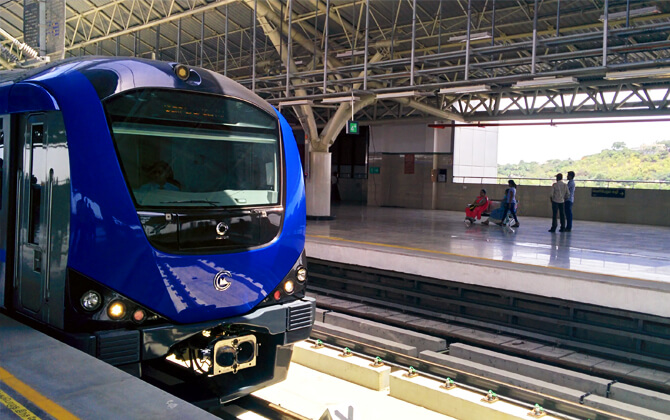
Chennai Metro provides station parking at several locations for passengers who want to park and continue by train. Parking charges depend on the station group, vehicle type, and duration of stay, so it is worth checking the latest tariff before you travel.
Parking is available for two-wheelers and four-wheelers at many stations. Some locations offer only two-wheeler parking, while others also have monthly pass options, night halt charges, and different rates for CMRL card users and non-commuters.
Parking tariff and usage categories
Parking charges are generally based on time slabs such as 0–6 hours, 6–12 hours, more than 12 hours, and beyond service hours. At some stations, commuters using a CMRL or NCMC card on the same day pay different rates from non-commuters.
One tariff group lists two-wheeler parking charges starting from ₹10 to ₹20 ($0.12 to $0.24) for metro travelers using a CMRL or NCMC card, while non-commuters may pay more depending on duration. Four-wheeler parking charges per day and shorter stays vary by station and can rise for longer parking or beyond service hours.
Monthly parking passes are available at selected stations. The source also mentions working hours passes and 24-hour passes for both bikes and cars, with rates depending on station group and commuter category.
Station-specific parking groups
Stations covered under different tariff structures include Egmore, Nehru Park, Arumbakkam, Vadapalani, Ekkattuthangal, Alandur, Washermanpet, High Court, LIC, Thousand Light, Teynampet, Nandanam, Saidapet, Little Mount, Government Estate, Anna Nagar East, Thirumangalam, Ashok Nagar, Guindy, Nanganallur Road, Meenambakkam, and others listed in the source.
Some stations have only two-wheeler parking. The source specifically notes Thiruvotriyur Metro, Thiruvotiyur Theradi, Kaladipet, New Washermenpet, Meenambakkam, AG-DMS, Anna Nagar Tower, Tondiarpet, Kilpauk, and Ekkattuthangal.
Special parking notes
- Differently abled persons’ vehicles are eligible for free parking during revenue hours only. Night halt charges still apply based on commuter or non-commuter tariff.
- e-Vehicles get free parking during revenue hours only for CMRL commuters. Night halt charges still apply as applicable.
- Some stations have premium or special parking arrangements, including Chennai Central and Airport-related parking lots.
Parking flow and practical use
The process is straightforward: park, pay the applicable fee, and enter the station. It is a practical option for riders coming from nearby neighborhoods or needing short-term access to the metro system.
Since parking charges and availability can change, passengers should verify the latest station notice or official CMRL update. The source notes that parking tariffs were last updated on September 24, 2025, with some revisions taking effect on different dates.
Connections to Other Systems
Chennai Metro is closely tied to the city’s wider public transport network, with existing interchanges and more integration planned. The current system already connects with major suburban and rail nodes, and future projects are expected to improve transportation in Chennai across different modes.
Existing and planned rail connections include Chennai Suburban Railway, where the metro already links with key stations for cross-city transport; Chennai Mass Rapid Transit System (MRTS), which is planned to be incorporated into the metro system; and the Tambaram–Velachery link, first proposed as light rail and later planned as a regular metro corridor in 2025.
The MRTS takeover plan is intended to improve integration even more. Once completed, CMRL is expected to upgrade tracks, security, ticketing, and rolling stock so the system works more closely with the metro network.
Important interchange points include Chennai Beach, Chennai Park Town, and St. Thomas Mount, where different rail layers meet. Beyond rail, the wider connectivity strategy also supports future metro extensions linking residential, commercial, and transport hubs across the city.
Airport Connections
Chennai Metro provides direct airport access through the Blue Line. Chennai Airport station is part of the North-South Corridor and connects Chennai International Airport with the city metro network.
The station also serves nearby areas such as Nanganallur, Meenambakkam, Tirusulam, Pallavaram, Pammal, Kundrathur, and Tambaram.
From the station, passengers can access the Chennai International and Domestic Airport terminals, the station concourse, nearby places such as Apollo Pharmacy, Aero Hub Mall, AAI Staff Canteen, the Aero Hub food court and car parking, GST Road access, and Tirusulam Railway Station.
For onward local transport, MTC small bus services are available from Chennai International Airport Metro, including S69 to Kundrathur B.S. and S100 to Tambaram East (MCC).
Platform 1 is towards Wimco Nagar Depot Metro, and Platform 2 is towards Puratchi Thalaivar Dr. M.G.Ramachandran Central Metro. The station also has lifts, escalators, a bicycle facility, parking at the A Entrance, first aid at the station control room, and nearby emergency services.
Chennai Metro Rail Rules and Tips
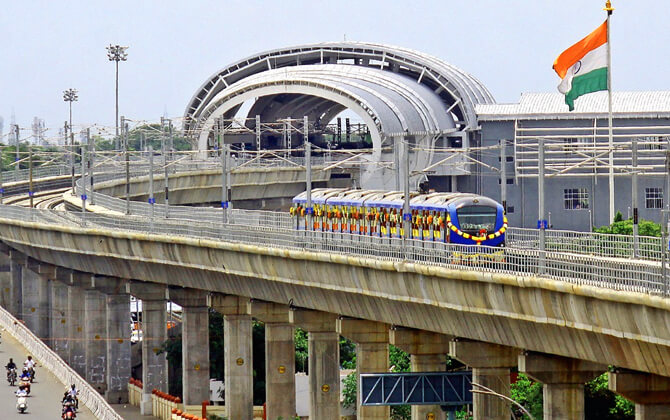
For a smooth and safe trip, follow station instructions and travel rules displayed by Chennai Metro Rail. Passengers are expected to queue properly, keep the left side of escalators clear, move away from escalators after use, show tickets when required, protect their valuables, and make way for passengers with disabilities.
Baggage is limited to 15 kg, with a maximum size of 60 cm by 45 cm by 25 cm, or about 0.6 m by 0.45 m by 0.25 m (2.0 ft by 1.5 ft by 0.8 ft). You should not travel without a valid ticket, and a card or token should not be shared with another passenger on the same journey.
What Not to Carry or Do
For safety and security, passengers must not carry firearms or knives and should not bring pets into metro premises or trains. Smoking is not allowed, and food should not be consumed inside stations or on trains. Do not cross the yellow line, step onto the tracks, jump over ticket barriers, or force train doors open.
Littering and damage to metro property are also not allowed. Parking is at the owner’s risk, and help can be requested from the Station Controller or Customer Care if needed.
Helplines and Passenger Support
Chennai Metro provides a 24/7 helpline at 1860-425-1515. A Women’s Helpline is available at 155370. Passengers can also use official support channels to write in or submit complaints online.
Additional Facilities
The system also offers facilities for women passengers, differently abled passengers, lost and found enquiries, and multimodal integration support. System information is available in English and தமிழ், with WCAG accessibility support mentioned on the official site.
Offences and Penalties
Rules are enforced under the Chennai Metro Railway (Carriage and Ticket) Rules, 2014 and related regulations. Offences listed in the source include drunken travel, nuisance, demonstrations on metro premises, obstruction of duty, ticketless travel, travel beyond the authorised distance, and alteration or defacement of passes. Penalties may include fines, forfeiture of fare, removal from the carriage, and in some cases imprisonment.
History
Plans for Chennai Metro began in 2007–08, and construction started in February 2009 after project approval by the Government of Tamil Nadu in November 2007. Chennai Metro Rail Limited was established in December 2007 as a joint venture between the Government of India and the Government of Tamil Nadu.
Phase I was planned with two corridors covering 45.1 km (28.0 miles), combining underground and elevated sections. Test runs began in 2014. The first segment, between Alandur and Koyambedu on the Green Line, opened on 29 June 2015. Blue Line service began on 21 September 2016 between Chennai Airport and Little Mount. The underground section from Thirumangalam to Nehru Park opened on 14 May 2017, more sections followed in 2018, and the underground stretch from AG-DMS to Washermanpet opened on 10 February 2019, completing Phase I.
A 9 km (5.6 miles) northern extension of the Blue Line from Washermanpet to Wimco Nagar was announced in 2014. Construction began in July 2016, trial runs started in December 2020, passenger service opened on 14 February 2021, and the remaining stations on this extension were commissioned on 13 March 2022.
Phase II was announced in 2016 and later expanded in 2017 to 118.9 km (73.9 miles) across three corridors. Construction began on 20 November 2020. In 2021 and 2022, major contracts were awarded for civil works, rolling stock, tracks, signalling, traction, and monitoring systems. The route plan was revised in May 2023, reducing total length to 116.1 km (72.1 miles).
Trial runs on Phase II began in 2025. The first took place in March 2025 on a 3 km (1.9 miles) stretch between Poonamallee and Mullaithottam on the proposed Yellow Line, followed by another in April 2025 between Poonamallee and Porur Junction. As of December 2025, the railway board had approved signal operations on the line, and after safety checks, the Poonamallee Bypass to Vadapalani stretch is expected to begin operations in March 2026.
Other developments include proposed extensions to existing lines, a Tambaram–Velachery light rail concept proposed in 2020 and studied further in 2023, and plans to integrate the Chennai Mass Rapid Transit System into the metro network.
Future Extensions
Chennai Metro Rail has several expansion projects at different stages of planning, approval, and construction. Phase II is the main ongoing extension, while additional corridors are also being studied to strengthen city transport and wider regional connections.
Phase II and approved extensions
Phase II covers three corridors with a planned length of 118.9 km (73.9 miles) and 128 stations. The project is under construction and is expected to be completed by the end of 2028, though some reports indicate phased openings from 2026 onward.
- Corridor 3: Madhavaram to SIPCOT
- Corridor 4: Lighthouse to Poonamallee Bypass
- Corridor 5: Madhavaram to Sholinganallur
Funding has been arranged in stages. Part is supported by JICA, while remaining sections have been proposed for support from multilateral banks. Civil, track, and system contracts have already been awarded.
Proposed further extensions
Beyond Phase II, several other projects have been discussed or moved into feasibility and approval stages.
- Red Line extension from Koyambedu to Pattabiram
- Yellow Line extension from Poonamallee to Parandur
- Yellow Line extension from Lighthouse to High Court
- Tambaram to Velachery corridor, later studied as a regular metro corridor
- Blue Line extension from Chennai Airport to Kilambakkam, with a DPR prepared
Some proposals have state-level approval or DPR preparation, while others are still awaiting central approval.
Integration and wider network plans
The Chennai MRTS is also proposed for integration into the metro system. In addition, feasibility studies have been commissioned for regional rapid transit corridors and metro development in other Tamil Nadu cities. Taken together, these plans show how the network is expected to grow through both direct expansion and stronger links with other transport systems.
Nearby Attractions
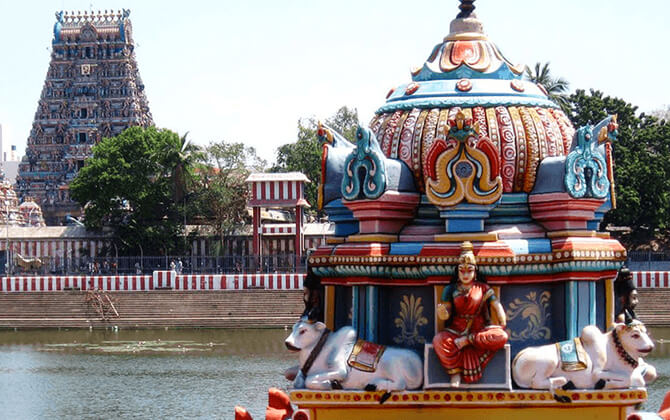
Chennai Metro Rail makes it easier to reach many of the city’s best-known sights. Attractions named in the source include St. Thomas Mount National Shrine, Vadapalani Murugan Temple, Kapaleeshwarar Temple, and Arulmigu Thiruvallikeni Parthasarathy Temple.
The network also gives access to shopping and leisure spots such as Phoenix Market City and Express Avenue Mall, along with cultural and educational places including the Indian Institute Of Technology and The Anna Centenary Library. Other places mentioned near the metro include Shirdi Sai Baba Temple, Mylapore, and Little Mount Shrine.
For a longer outing, the source also lists Flame Le Club, Sohum Spa, Ode Spa, Madras War Cemetery, and Edward Elliot’s Beach. In many cases, a short metro ride is enough to get you closer to these destinations.
- For temples and religious sites: St. Thomas Mount National Shrine, Vadapalani Murugan Temple, Kapaleeshwarar Temple
- For shopping: Phoenix Market City, Express Avenue Mall
- For culture and learning: The Anna Centenary Library, Indian Institute Of Technology
- For leisure: spas, beach visits, and local entertainment venues