The Frankfurt U-Bahn is Frankfurt am Main’s Stadtbahn system and a core part of local transport, alongside the S-Bahn Rhein-Main and the tramway network. It has operated in stages since 1968 and combines inner-city tunnels with above-ground sections farther out. The system has nine lines, 84 stations, and a route length of 64.85 kilometres (40.3 miles). Eight lines serve the city centre, while U9 does not. The network carries heavy daily traffic and remains one of the main pillars of public transport and city transport in Frankfurt.
| Key | Information |
|---|---|
| System | Frankfurt U-Bahn Stadtbahn system |
| Opening | Opened in stages since 1968 |
| Lines | 9 lines, U1 to U9 |
| Stations | 84 stations |
| Route length | 64.85 km (40.3 miles) |
| Underground stations | 27 |
| Above-ground stations | 59 |
| City centre access | 8 of 9 lines enter the city centre; U9 does not |
| Latest expansion | U8 and U9 opened on 12 December 2010 |
| Main role | Key public transport system integrated with S-Bahn, trams, and bus services |
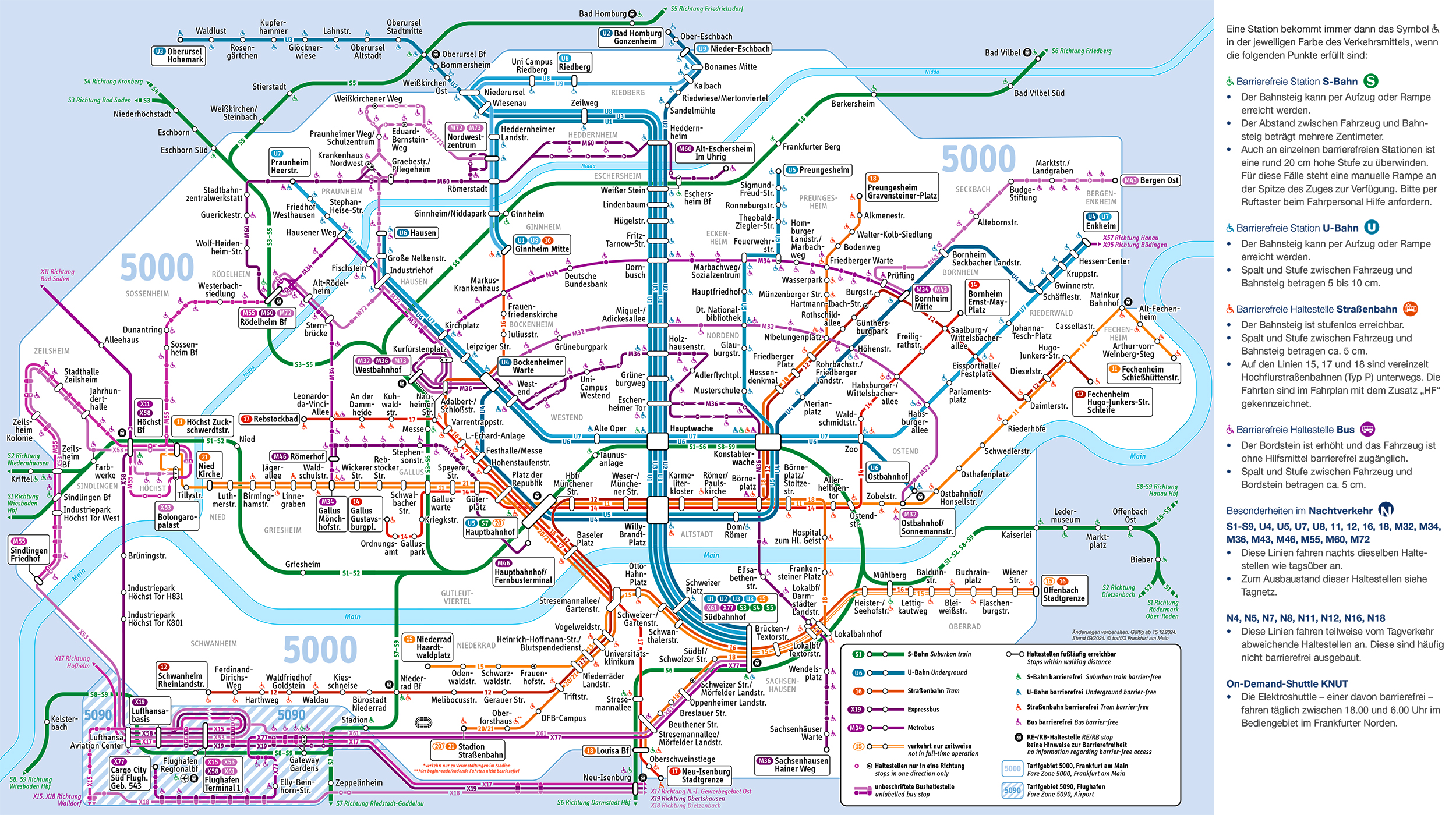
Frankfurt Metro Map
Map of Frankfurt Metro showing different lines. Click on the map to enlarge it or download the Frankfurt Metro map in PDF format.
Lines and Stations
The Frankfurt U-Bahn has nine lines, numbered U1 to U9, and 84 stations across a route network of 64.85 kilometres (40.3 miles). For most passengers, the system route plan is easy to grasp: eight lines run through central Frankfurt, and U9 is the only line that does not enter the city centre.
The network is grouped into four route families: A, B, C, and D. Routes A, B, and C each have their own tunnel through the middle of the city, while Route D is only partly complete. These trunk sections are the backbone of the system, with individual lines branching out beyond them.
Route A is the main north-south route. It carries U1, U2, U3, U8, and U9, linking the centre with northern suburbs. From Heddernheim, branches continue toward Oberursel and Bad Homburg, while another branch heads to Ginnheim.
Route B connects Preungesheim and Enkheim with the inner city and the Hauptbahnhof area. Its central tunnel includes major interchange stations such as Konstablerwache and Willy-Brandt-Platz. It also connects with the partly completed D-route at Bockenheimer Warte.
Route C is the main east-west axis. It runs through the city centre via Hauptwache, Konstablerwache, and Zoo, then continues toward Hausen, Heerstraße, and Enkheim. Route D, for its part, is only partially built. The active sections include the short link between Hauptbahnhof and Bockenheimer Warte and the Riedberg branch used by U8 and U9.
The system mixes underground, elevated, in-trench, reserved-track, and street-running sections. About 59% of the route is underground, which gives Frankfurt a hybrid network rather than a fully separated metro. Major interchange stations include Hauptwache, Konstablerwache, Willy-Brandt-Platz, Bockenheimer Warte, and Hauptbahnhof.
Selected stations and termini
| Station | Details |
|---|---|
| Hauptwache | Southern terminus of the first Frankfurt underground line and a major shared station for Routes A and C. |
| Nordwestzentrum | Underground station on Route A and an important point on the northern part of the network. |
| Südbahnhof | Major southern terminus on Route A. |
| Willy-Brandt-Platz | Central underground interchange station on Routes A and B. |
| Konstablerwache | Shared underground station on Routes B and C. |
| Bockenheimer Warte | Connection point between the C and D routes. |
| Zoo | Branching point of Route C. |
| Enkheim | Eastern terminus of Route C. |
| Riedberg | Northern terminus of the U8 branch. |
| Ginnheim | Terminus of U9 and a shared station with U1. |
| Route | Lines | Main span | Notes |
|---|---|---|---|
| A | U1, U2, U3, U8, U9 | Südbahnhof to the northern branches via Heddernheim | Main north-south axis |
| B | U4, U5 | Preungesheim / Enkheim to Hauptbahnhof / Bockenheimer Warte | Central tunnel through the city centre |
| C | U6, U7 | Hausen / Heerstraße / Enkheim to Zoo and the inner city | Main east-west axis |
| D | U4, U8, U9 | Hauptbahnhof to Bockenheimer Warte; Riedberg branch | Partially completed route |
The latest major expansion came in 2010, when U8 and U9 started running to the university campus area and Riedberg. That addition extended the stations list and added a new branch that changed the network layout in the north of the city.
Schedule and Frequency
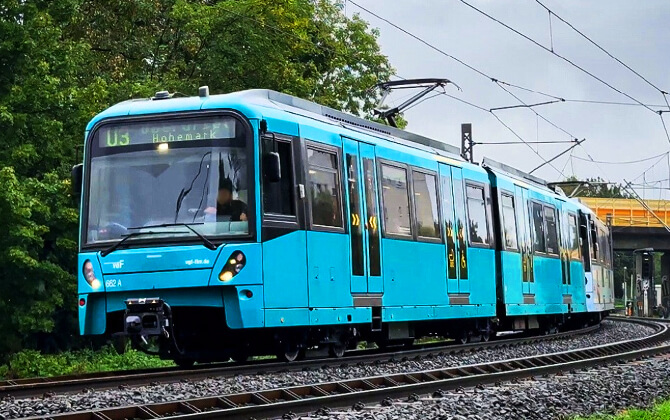
The Frankfurt U-Bahn schedule is built around frequent service in the city centre, where several lines overlap on shared tracks. On the busiest core sections, trains typically run every 2.5 to 3.5 minutes, so waiting times are short during busy periods.
Elsewhere, frequency depends on the line and route segment. The train schedule and route timetable include intervals of 5, 7.5, 10, 15, 20, and 30 minutes. Some inner sections run every 5 minutes, while outer branches may operate every 10, 15, or 20 minutes depending on demand.
During school vacations in Hesse, U4 and U5 run less often, with 7.5-minute intervals. It is a small but useful detail to know if you are checking schedule today or timings today.
As for operating hours, the U-Bahn does not normally run overnight. Trains usually stop between around 1:00 am and around 4:00 am, so the closing time for regular rail service falls in that window. If you travel late, you will usually need the night bus network instead. Plans had called for night service to be gradually extended toward a full 24-hour timetable.
Timetables are available in the digital timetable book and in pocket timetable booklets from VGF TicketCenters and many kiosks. If you need opening hours, working hours, opening times, last train information, or exact timings for a specific branch, checking the current timetable is the best option.
| Service detail | Timings |
|---|---|
| Core city-centre sections | Typically every 2.5 to 3.5 minutes |
| Standard line intervals | 5, 7.5, 10, 15, 20, or 30 minutes depending on route segment |
| U4 and U5 during school vacations in Hesse | Every 7.5 minutes |
| Regular overnight service | Does not usually operate overnight |
| Typical daily closing gap | From around 1:00 am to around 4:00 am |
Rates, Tickets, and Cards
Frankfurt uses an integrated fare system for the U-Bahn and the wider RMV network, so one ticket can also cover other public transport within the relevant fare zones. The fare depends on how many zones you cross. A trip from the city centre to the airport, for example, costs more than a ride within the city fare area.
For short journeys, there is a short-distance ticket valid for trips of up to two kilometres (1.2 miles). Other options include single tickets, day tickets, group tickets for up to five people, weekly tickets, monthly tickets, annual tickets, and reduced tickets for children.
Tickets are sold at VGF sales outlets, including Hauptwache, Konstablerwache, Bornheim Mitte underground station, and Höchst station, as well as from ticket machines, card-o-mat machines, many private sales points, and on the bus. Weekly, monthly, and annual tickets can also be ordered online. Mobile ticket options are available through the RMV app.
The Frankfurt Card is especially handy for visitors. It comes as a 1-day or 2-day pass and includes free travel on all RMV routes within the city, including the airport. It also gives discounts for museums and attractions such as the Zoo and Palm Garden, plus selected city tours and boat tours on the Rhine and Moselle.
One helpful detail: tickets do not need extra validation after purchase. If you buy from a station machine, the ticket is already valid. Print tickets and mobile tickets are valid only when carried with an official photo ID, such as a passport, driving licence, or identity card.
The source material does not provide exact fare, price, ticket price, or cost figures in euros and dollars, and it does not include a fare calculator. So if you need the current price for a specific journey, you will need to check the live RMV fare system.
| Ticket | Notes |
|---|---|
| Single ride | Valid for a direct journey to the destination |
| Short-distance ticket | For journeys up to 2 km (1.2 miles) |
| Day ticket | Available for individual passengers |
| Group ticket | For up to five people |
| Weekly ticket | Can be ordered online |
| Frankfurt Card | 1-day or 2-day pass with visitor discounts and free travel in the city, including the airport |
Interconnection with Other Systems
The Frankfurt U-Bahn is tightly integrated with the city’s wider public transport system. Together with the Rhine-Main S-Bahn and the tram network, it forms the backbone of transportation in Frankfurt. Since 1995, it has been part of the RMV, which means the same fare system works across several transport modes and operators.
In practice, the U-Bahn functions as part of a broader rail and Stadtbahn network rather than as a completely isolated metro. Transfers to the S-Bahn are especially important at hubs such as Hauptwache and Konstablerwache, where passengers can move between systems with relative ease.
The network also connects with trams and with bus services that feed into rail corridors. Some routes run on reserved track or at street level, helping the system link inner-city tunnels with outer districts. That mix is a defining feature of Frankfurt’s transport network and one reason the U-Bahn feels closely tied to everyday local transport and city transport.
- RMV fare integration across Frankfurt public transport
- Connections with the S-Bahn at major central interchanges
- Links with trams in the city network
- Bus feeder connections in some areas
Airport Connections
The U-Bahn itself does not provide the main rail link to Frankfurt Airport. Instead, airport connections rely on the airport’s regional and long-distance train stations, which connect the airport with Frankfurt, the surrounding region, and destinations across Germany and Europe.
The Frankfurt Airport Regional Station offers direct connections to Frankfurt, Offenbach, Hanau, Aschaffenburg, Rüsselsheim, Mainz, and Wiesbaden. S-Bahn lines S8 and S9, along with regional trains RB58, RE59, RE2, and RE3, provide access across the RMV area.
The regional station is located below Terminal 1 on Level 0 and can be reached from terminal areas A, B, and C by following signs for “Train stations S T.” For accessible travel, regional trains arrive at tracks 1 to 3, and tracks 2 and 3 include wheelchair-accessible paths to the elevators.
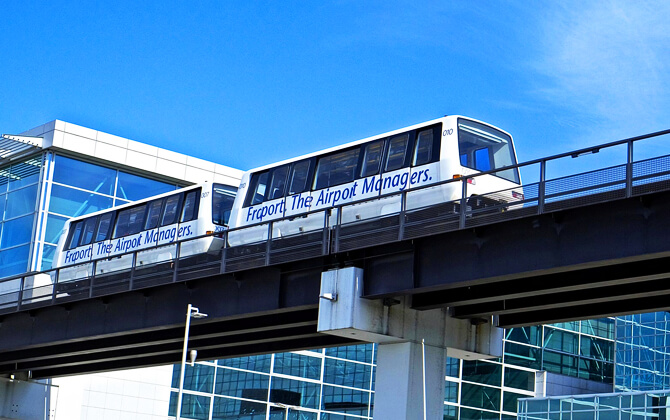
The Frankfurt Airport Long-Distance Station is used for IC and ICE trains to destinations across Germany and Europe. Terminal 1 is about a 10-minute walk away. To reach Terminal 2, use the SkyLine train or the shuttle bus. Terminal 3 is served only by the SkyLine, and the trip takes about 5 to 10 minutes.
Passengers with reduced mobility can arrange support for boarding, alighting, and travel planning through the DB Mobility Service Center. Advance registration at least one working day before travel is recommended.
- Phone: +49 30 65212888
- Email: [email protected]
Lufthansa Express Rail also connects rail travel with flights through timed connections at Frankfurt Airport. Available departure stations include Aachen, Basel, Dortmund, Düsseldorf, Erfurt, Freiburg, Göttingen, Hannover, Kassel, Karlsruhe, Köln, Leipzig, Mannheim, Nürnberg, Stuttgart, Ulm, and Würzburg.
Check-in opens 23 hours before departure and remains available until 15 minutes before the train leaves. Baggage can be checked in at the AiRail Terminal at the long-distance station, with baggage handling also available there on the return journey.
A Glimpse into History
The Frankfurt U-Bahn history begins with postwar planning for a modern rapid transit system. In the early 1950s, Frankfurt’s tramway network was already under pressure, and in 1961 the city chose a U-Bahn system that would initially make use of existing tram infrastructure.
The first construction phase focused on city-centre tunnels, with temporary links to surface routes in suburban areas. Tunnel work started in 1963 under Eschersheimer Landstraße. The system opened on 4 October 1968 with the first route from Hauptwache to Nordweststadt, now part of U1.
From there, the network expanded step by step. Extensions reached Theaterplatz, Römerstadt, Ginnheim, and later Sachsenhausen. In 2010, U8 and U9 opened, adding service to the university campus area and the new development district at Riedberg.
Since 1996, the system has been owned and operated by Stadtwerke Verkehrsgesellschaft Frankfurt am Main (VGF) and has been part of the RMV network. Its development reflects a gradual shift from a tram-based concept to a more independent urban rail system, though it still keeps a mix of underground, elevated, and street-running sections.
Future Expansions
The Frankfurt U-Bahn expansion program includes several planned and ongoing projects, though timelines vary. The current licence contract runs until 31 December 2031 and can be renewed.
Projects on the B Line
The U5 extension to Europaviertel is under construction. From the central railway station, this 2.7-kilometre (1.7-mile) branch will continue in a tunnel to an underground station provisionally called Güterplatz, then run along the centre of Europa-Allee with three more provisional stations: Emser Brücke, Europagarten, and Wohnpark. Opening is expected in 2027, with a later extension to Schmidtstraße and Römerhof planned.
An extension of the Preungesheim branch to Frankfurter Berg is also planned. Intermediate stops are expected at August-Schanz-Straße and Berkersheimer Weg, with entry into service expected in 2028.
Projects on the A Line
At the northern end of the A Line, the extension from Gonzenheim to Bad Homburg station remains planned, although the starting time for construction is still unclear. The project would require Gonzenheim station to be rebuilt underground.
Another planned project is the extension of U5 from Preungesheim to Frankfurter Berg, adding stations for the growing area along Homburger Landstraße.
A longer-discussed extension toward Bergen is considered unlikely because of a low projected cost-benefit factor. A shorter extension to Atzelberg in Seckbach is seen as more realistic, and the turn-back facility on Seckbacher Landstraße has already been prepared for it.
Digital Train Control
A major future project is the digital train control system for Frankfurt. It will replace the existing tunnel control system with a CBTC-based system. Under current plans, all nine lines are to be converted by 2031. U4 and U5, including the Europaviertel extension, are expected to be completed first in 2025.
Advice
The Frankfurt U-Bahn is practical for daily travel across the city and to nearby districts such as Bad Homburg and Oberursel. Most lines run every 10 minutes during the day, with more frequent service in peak periods. U3, U8, and U9 usually run every 15 minutes.
Most stations are barrier-free and can be reached by escalators and lifts. Boarding is level with the platform, while the gap and step between train and platform are about 5 to 10 cm (2 to 4 inches). Door width is 130 cm (51.2 inches). Römerstadt and Niddapark are the only stations listed as not barrier-free.
If you are travelling with a wheelchair or stroller, look for doors marked with wheelchair and stroller symbols and a yellow bar above the door. On U5 trains, each car has a multi-purpose area by the yellow-marked doors. On U4 trains, each car includes a small wheelchair space, and wheelchairs should be positioned across the direction of travel.
There is one special rule on U5 for a barrier-free exit at Glauburgstraße or Musterschule: to leave there without barriers, board at your starting station only at the yellow markings on the platform.
Outside the train, display boards show the line number and destination. Inside, next stops are shown and announced, which makes following the route simple, even if it is your first trip.
On weekend nights, U4, U5, U7, and U8 run continuously every 30 minutes. On weekday nights, nearby rail replacement night buses take over. If you are checking schedule today, timings, or last train details late at night, this matters.
Interesting Facts
The Frankfurt U-Bahn is officially a Stadtbahn, not a fully separate heavy metro system. It works together with the S-Bahn and tramway network as one integrated public transport system.
The name comes from the German word Untergrundbahn, meaning underground railway, even though large parts of the network run above ground.
The system opened in 1968 and has expanded several times since then. Today it has 84 stations on nine lines and a route length of 64.85 kilometres (40.3 miles).
About 59% of the track length is underground. The rest runs on reserved track and street-level sections, which gives the network its distinctive hybrid character.
Eight of the nine lines pass through the city centre. U9 is the only exception.
In 2023, the U-Bahn carried 123.6 million passengers, averaging about 338,600 riders per day.
The most recent expansion opened on 12 December 2010, when U8 and U9 began serving the university campus area and Riedberg.
Since 1996, the system has been owned and operated by VGF and has been part of the RMV transport association.
Sights to See from the Frankfurt Metro
Frankfurt’s U-Bahn is efficient, but it also has some surprisingly memorable stations. If you look up from the platform signs for a moment, you will find public art, unusual architecture, and traces of projects that never happened.
Bockenheimer Warte
This is one of the city’s best-known stations. Its entrance looks like an old London tram bursting out of the ground, so it feels more like a piece of public art than a standard station entrance.
Inside, the station is just as unusual. The distribution level has a ceiling resting on a cushion, and the platform for line 4 has a notably high ceiling. Above the platforms for lines 6 and 7, there was once a repository for the university library. The station also includes underground vaults for the Senckenberg Natural History Museum, still used to protect exhibits.
Miquel-/Adickesallee
On the stations map, Miquel-/Adickesallee stands out for a detail tied to an unrealized plan. During construction, space was left for an autobahn tunnel under the road, but the tunnel was never built. What remains is a practical foot tunnel linking both sides of the route.
The station name reflects its location near the junction of Miquelallee and Adickesallee, close to the police headquarters.
Schweizer Platz
Schweizer Platz is one of only two U-Bahn stations south of the river, and it is the only underground station in Frankfurt not built under a road. Instead, it sits beneath a row of houses, which made construction more complicated.
At the northern end of the platform, there is a statue of St. Barbara, the patron saint of miners and tunnel workers. It is a striking detail, especially in a historically Protestant city.
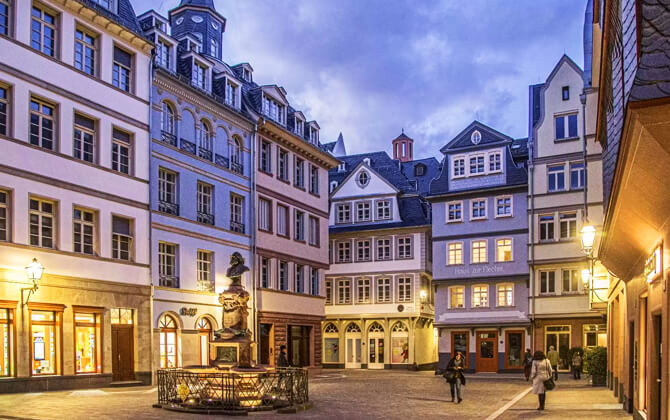
Dom/Römer
Dom/Römer sits in the heart of Frankfurt’s historic district. Above ground, much of the area is reconstructed, but the station itself preserves pieces of the past. On one level, visitors can see remains salvaged from the rubble after the air raids of 1944.
Part of the platform floor is decorated with imperial eagle designs, apparently taken from coins. It is a small touch, but it fits the area well.
Konstablerwache
Konstablerwache is one of the city’s main interchanges, and it also features public art connected to Frankfurt’s partner cities. On the main distribution level, paintings celebrate the city’s twinning with Lyon through scenes from both places and references to figures such as the Lumière brothers and Goethe.
At the other end, a mural marks Frankfurt’s partnership with Granada. It was painted in 2021 for the 30th anniversary of that connection.
Höhenstraße
Höhenstraße lies on a section where the road above is so narrow that the tracks had to be stacked vertically instead of being placed side by side. That alone is unusual.
The station also includes a notable art installation. Created in 1980 by Volker Bussmann, “The Infinity Simulator” uses lights and mirrors to create its effect. It later became known as a dance floor, with rules introduced for hours of use and capacity.
These stations show a different side of the Frankfurt Metro system: not just transport, but architecture, history, and a few surprises along the way.