The Ludwigshafen tram is part of the wider Mannheim/Ludwigshafen/Heidelberg tramway system in Germany’s Rhine-Neckar region. Operated by Rhein-Neckar-Verkehr GmbH since 2005, this public transport network links city centres, railway stations, residential districts, tourist spots, and major interchange points across Ludwigshafen and beyond. It is a metre-gauge system with 10 lines, a total network length of 103.4 km (64.3 miles), and trams reaching speeds of up to 70 km/h (43.5 mph). Weekday operating hours are given as 07:00 to 22:00, and service is not available 24 hours a day.
| Key | Information |
|---|---|
| System | Mannheim/Ludwigshafen/Heidelberg tram network |
| Operator | Rhein-Neckar-Verkehr GmbH |
| Since | 2005 |
| Network length | 103.4 km (64.3 miles) |
| Length in Mannheim | 79.4 km (49.3 miles) |
| Length in Ludwigshafen | 24 km (14.9 miles) |
| Number of lines | 10 |
| Maximum speed | 70 km/h (43.5 mph) |
| Operating hours | Monday to Friday, 07:00 to 22:00 |
| Service type | Not 24 hours, not driverless |
Ludwigshafen Tram Map
Map of Ludwigshafen Tram showing different lines. Click on the map to enlarge it or download the Ludwigshafen Tram map in PDF format.
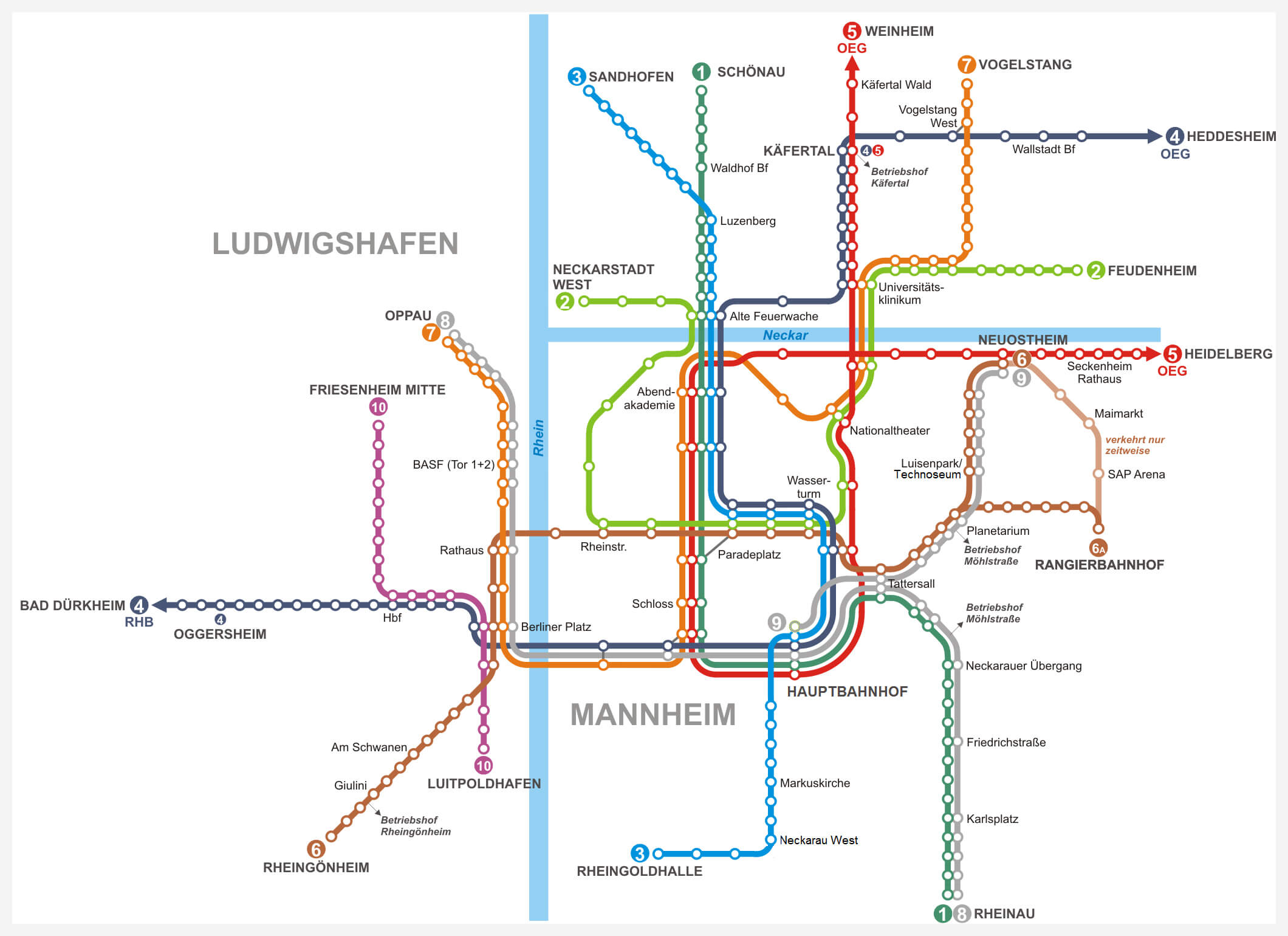
Network Specifications
The Ludwigshafen tramway is part of a larger regional transport system serving Ludwigshafen am Rhein, Mannheim, and Heidelberg. RNV runs the network, and it is integrated with the wider VRN public transport system, which helps with cross-city travel and local transport connections.
The system has 10 lines and a total length of 103.4 km (64.3 miles). Of that, 79.4 km (49.3 miles) lies in Mannheim and 24 km (14.9 miles) in Ludwigshafen. Trams can reach a top speed of 70 km/h (43.5 mph).
The network started with horse trams in 1878, moved into steam operations later on, and was electrified in 1900. Electric trams between Mannheim and Ludwigshafen began running in 1902. Later reforms included route numbering changes in 1985 and the MVG 2000 modernization program, which introduced 50 low-floor trams to replace older articulated vehicles.
Not every system detail is available. Daily ridership figures and exact fare totals are not provided, but the network does not run around the clock, has no platform screen doors, and trams are not driverless. There is also no air conditioning, and passengers cannot walk between platforms.
Accessibility is part of the service. Stops have large displays for routes, connections, transfers, and timetable information, and announcements support visually impaired passengers. Trams are accessible to disabled passengers.
The fare system is zone-based, with ticket price depending on the number of zones traveled. Available ticket options include single tickets, multi-journey tickets, weekend tickets, and selected products for schoolchildren, apprentices, and senior citizens.
Operating Hours
The Ludwigshafen tram does not operate 24 hours a day. Based on the available timetable, weekday operating hours are 07:00 to 22:00, Monday to Friday. If you are checking opening hours, working hours, or timings today, that is the main service window given for regular weekday travel.
Service frequency changes by day and time. On weekdays, trams generally run every 10 minutes. On Sundays and public holidays, the frequency drops to every 20 minutes, and service is also lighter during late hours.
| Service detail | Timings |
|---|---|
| General weekday operating hours | Monday to Friday, 07:00 to 22:00 |
| Regular weekday frequency | Every 10 minutes |
| Sunday and public holiday frequency | Every 20 minutes |
| S6 Monday to Saturday | 06:56 to 20:52 |
| S6 Sunday | 07:46 to 21:48 |
| S44 daily | 05:19 to 18:45 |
Some routes have their own schedule details. The S6 light rail runs from 06:56 to 20:52 on Monday to Saturday, and from 07:46 to 21:48 on Sunday. The S44 runs daily from 05:19 to 18:45.
Not all stops are served at all times, so route timetable details can vary. A few stations are only served in the afternoon or late evening, depending on the line. If you need the last train, closing time, or schedule today for a specific route, it is worth checking line-by-line service information before you travel.
Route and Station Changes
In December 2008, the network went through a major route reorganization. Several lines changed path, some direct links were removed, and one line was withdrawn.
- Lines 3 and 4 changed route between Mannheim Paradeplatz and Ludwigshafen Berliner.
- South of Paradeplatz, lines 3 and 7 switched routes.
- BASF and Mannheim Hauptbahnhof lost their direct connection, so line 8 was redirected for rush hour service on that corridor.
- Lines 14 and 4 were merged.
- Line 12 was withdrawn.
After that, the system operated a revised stations list and route plan as of 12 June 2016.
| Station | Details |
|---|---|
| Line 1 | Schönau, Bahnhof Waldhof, Alte Feuerwache, Paradeplatz, Schloss, Mannheim Hbf, Neckarau, Rheinau Bahnhof |
| Line 2 | Feudenheim, Neckarstadt West, Mannheim Hauptfriedhof, Nationaltheater, Wasserturm, Neckarstadt West |
| Line 3 | Sandhofen, Luzenberg, Alte Feuerwache, Wasserturm, Lindenhof, Mannheim Hbf, Neckarau West |
| Line 4 and 4A | Käfertaler Wald / Waldfriedhof, Hermann-Gutzmann-Schule, Mannheim Hbf, Bonifatiuskirche, Universitätsklinikum, Alte Feuerwache, Ludwigshafen Hauptfriedhof, Berliner Platz, Bad Dürkheim / Ludwigshafen Hbf |
| Line 5 | Nationaltheater, Weinheim, Mannheim Hbf, Schloss, Abendakademie, Edingen, Heidelberg, Universitätsklinikum, Weinheim |
| Line 5A | Abendakademie, Mannheim Hbf, Universität, Universitätsklinikum, Nationaltheater, Bonifatiuskirche, Käfertal, Wallstadt, Heddesheim |
| Line 6 | Mundenheim, Rheingönheim, Ludwigshafen Rathaus, Berliner Platz, Mannheim Rathaus, Wasserturm, Neuostheim. Maimarktgelände, SAP Arena, and SAP Arena S-Bahnhof are served only in the afternoon and late evening. |
| Line 6A | Rheingönheim, Mundenheim, Berliner Platz, Ludwigshafen Rathaus, Mannheim Rathaus, Wasserturm, Neuhermsheim, SAP Arena S-Bahnhof |
| Line 7 | Vogelstang, Mannheim Hauptfriedhof, Nationaltheater, Abendakademie, Schloss, Berliner Platz, Ludwigshafen Rathaus, BASF, Oppau |
| Line 8 | Oppau, BASF, Tattersall, Ludwigshafen Rathaus, Krappmühlstraße, Berliner Platz, Mannheim Hbf (Rheinau Bahnhof) |
| Line 9 | Bad Dürkheim, Maxdorf, Ludwigshafen Hbf, Ludwigshafen Berliner Platz, Mannheim Hbf, Neuostheim, Seckenheim, Heidelberg Hbf, Heidelberg Bismarckplatz, RNV Express |
| Line 10 | Luitpoldhafen, Berliner Platz, Ludwigshafen Hauptbahnhof, Friesenheim Mitte |
| Line 15 | Mannheim Hbf, Schloss, Abendakademie, Alte Feuerwache, Universitätsklinikum, Bonifatiuskirche, Käfertal, Wallstadt West, Wallstadt Ost |
There are also expansion and renovation plans in both Mannheim and Ludwigshafen. Proposed work includes extensions from Feudenheim toward Wallstadt and Ilvesheim, possible changes between Mannheim Hbf and Willy-Brandt-Platz, renovations at Pfalzbau and Kaiser-Wilhelm-Straße, and attention to the Line 10 section between Marienkirche and Friesenheim. Some projects have been delayed by funding issues, and further extensions of Line 4 were approved but postponed.
Fares and Tickets
The Ludwigshafen tram uses a zone-based fare system, so the fare and ticket price depend on how many zones you cross. Available tickets include single journeys, multiple journey tickets, weekend tickets, and selected products for schoolchildren, apprentices, and senior citizens.
For local transport within Ludwigshafen, a city tariff is available. The single ticket is valid for one one-way trip with transfers allowed for 60 minutes after validation. It applies within Ludwigshafen in the area of the main stops triangle and can be used on buses and trams in second class.
Tickets can be bought in several ways:
- At ticket machines with touchscreen payment by cash or debit card
- Online through the RNV website, using print-at-home tickets
- Through the Handy Ticket app
- At customer care centres
- At RNV sales points in shops or newspaper stalls across the network
- At a mobility centre or, for some tickets, on the bus
Customer service centres are available in Mannheim, Ludwigshafen, and Heidelberg. Lost and found services are also offered in these cities.
Passengers must travel with a valid ticket. The fine for riding without one is €60 (about $65). Bikes have lower priority than prams and wheelchairs, and pets must either travel in a carrier or require a child ticket.
No exact fare calculator, pass price, day pass cost, or card details are provided in the available information.
Connections to Other Systems
The Ludwigshafen tram is part of the wider Rhine-Neckar transport system rather than a standalone city transport network. It connects directly with tram and light rail services in Mannheim, Ludwigshafen, and Heidelberg, and it is integrated into the VRN system for easier transportation in the region.
Several lines cross the Rhine and link Ludwigshafen with Mannheim. Some continue onward to Heidelberg and Weinheim, while lines 4, 4A, and 9 provide a cross-country tramway connection to Bad Dürkheim. Berliner Platz is one of the main interchange stations in Ludwigshafen, and Mannheim Hauptbahnhof is another key hub.
The broader network also includes S-Bahn Rhein-Neckar suburban rail and bus services, giving passengers more options for local transport and regional public transport. Together, these links make the tram a central part of everyday travel.
Historically, Mannheim and Ludwigshafen were planned around a shared underground network concept, and the two cities still have closely linked tram operations today.
Airport Connections
Ludwigshafen does not have its own airport, but the city is connected to several airports and airfields in the wider region. Small airfields are located near Speyer, Bad Dürkheim, and Worms, while Mannheim has a regional airport. Frankfurt International Airport can be reached in about an hour by car.
By public transport, the tram provides useful access to rail connections for onward travel. Lines 4, 4A, 6, 6A, 7, 8, 9, and 10 operate in Ludwigshafen and all serve Berliner Platz, next to Ludwigshafen Mitte station. Except for Line 10, these routes cross one of the two Rhine bridges to Mannheim.
Lines 4, 4A, 6, 8, and 9 also serve Mannheim Hauptbahnhof, which is especially useful if you need regional or long-distance train connections. There is also a direct tram link to Bad Dürkheim on lines 4, 4A, and 9.
Historical Perspective
The history of the Ludwigshafen tram network goes back to the late 19th century. In Mannheim, construction of an inner-city horse railway started in July 1877, and service opened in 1878. Steam trams followed in 1884 between Feudenheim and Mannheim, later extending to Weinheim, Heidelberg, and other nearby towns. At one stage, the steam tram system ran six lines with a 10-minute frequency.
In Ludwigshafen, tram development grew alongside this early expansion. Steam trams started in 1890 between Dannstadt and Großkarlbach and were later extended to Meckenheim and Hochdorf. Electric trams between Mannheim and Ludwigshafen began running in 1902, creating a key cross-river route.
The network was electrified in 1900, which marked a major technical step. Later, reforms in 1985 introduced separate numbers for regular and emergency trams, and the MVG 2000 concept replaced older six-axle articulated cars with 50 low-floor trams.
Since 2005, Rhein-Neckar-Verkehr GmbH has operated the system. Another major shift came in December 2008, when route changes affected lines 3, 4, 7, 8, 12, and 14.
Today, the tram remains one of the most important public transport systems in the Rhine-Neckar region, linking city centres, railway stations, universities, and visitor destinations.
Expansion Plans
The Pfalztram project is planned as a major expansion of Ludwigshafen’s tram and light rail system by around 25 km (15.5 miles) along two main corridors. One route would run from Ludwigshafen-Pfingstweide and Edigheim via the existing Oppau-city center-Rheingönheim corridor and continue through Neuhofen to Waldsee. The other would connect the city center with Gartenstadt and Maudach, then continue to Mutterstadt and Dannstadt-Schauernheim.
The project is supported by a positive feasibility study and a political letter of intent. Preliminary planning is scheduled to begin in spring 2026, with public participation expected from an early stage. Later planning and implementation steps will be decided by the relevant municipal bodies.
This is framed as a long-term, phased investment rather than one single build. Full delivery depends on planning, consultation, and approval procedures being completed. The target is to bring Pfalztram into service roughly within 10 years after the start of preliminary planning.
Public funding is expected to cover much of the cost. Under German municipal transport financing law, about 75% of investment costs could be covered, and some sections may qualify for up to 90% if treated as reactivation. Additional co-financing from Rhineland-Palatinate is also being examined.
The route plan also includes a complementary bus network. While the tram would handle the main intermunicipal corridors, buses would play a stronger role in residential areas without rail access. A possible extension toward Speyer was studied but is not being pursued for now because it was found to be economically unviable.
- Two main corridors are planned
- Preliminary planning is scheduled for spring 2026
- Public participation is expected early in the process
- The project depends heavily on public funding and municipal co-financing
- A Speyer extension is not currently included
Facilities and Services
The network includes several practical services for daily travel. RNV operates customer service centres in Mannheim, Ludwigshafen, and Heidelberg. These are open on weekdays from 10:00 to 18:00 and on Saturdays from 10:00 to 15:00.
Lost and found centres are also available in all three cities. At stops, large display boards show routes, transfers, connections, and timetable information. Audio announcements are provided for visually impaired passengers, and the tram system is accessible to disabled users.
There are also a few limits to keep in mind. The system is not driverless, there is no air conditioning, and there are no platform screen doors. Service is not 24 hours, with weekday operating hours listed as 07:00 to 22:00.
No information is provided about station parking, parking charges, or parking charges per day.
Rules
There are a few basic rules to know before you travel on the Ludwigshafen tram.
- Passengers without a valid ticket are fined €60 (about $65).
- Bicycles have lower priority than prams and wheelchairs.
- Pets must travel in a carrier, or a child ticket is required.
Passengers are not allowed to walk between platforms. The system also has no platform screen doors. Service does not run 24 hours a day, and there is no air conditioning.
Tips
A few simple tips can make the trip easier.
- If you have a physical disability, carry your government-issued identification card, as it may help with fare discounts and priority seating.
- When boarding or getting off with a pushchair, press the blue pushchair button near the door so it stays open longer.
- Use the stop displays to check the route, timetable, schedule, and connections.
- If you are visually impaired, listen for station announcements.
- Keep in mind that the service is not 24 hours, and some route timings change in late hours.
Nearby Attractions
The Ludwigshafen tram gives easy access to a number of nearby attractions in the city and the wider Rhine-Neckar area. One notable cultural stop is the German State Philharmonic of Rhineland-Palatinate.
For sports and events, Suedweststadion is another option. Visitors can also use the tram to reach surrounding districts and connect onward to attractions across the area.
In Mitte, you can pair a visit to the German State Philharmonic of Rhineland-Palatinate with Bergstrasse-Odenwald Nature Park. Südliche Innenstadt is a good area for the riverfront and bars, while Oggersheim offers useful access to the wider city and connections toward Mannheim.
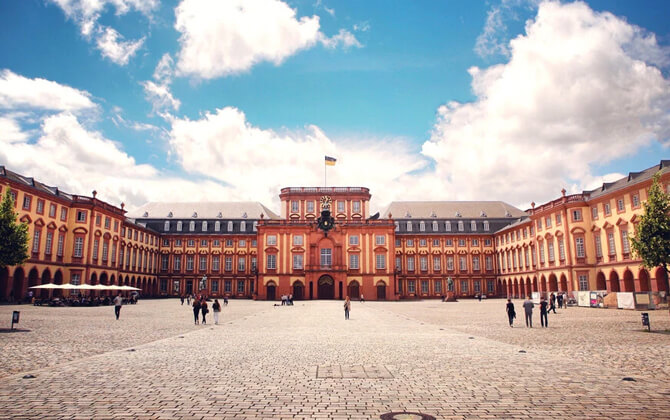
Other nearby sights mentioned in the area include Mannheim Palace, Rosengarten Mannheim, and the Rhine. The tram is also handy for reaching districts such as Ludwigshafen-Friesenheim and Ludwigshafen-Mundenheim.
- German State Philharmonic of Rhineland-Palatinate – performance venue in Ludwigshafen
- Suedweststadion – sports and event venue
- Bergstrasse-Odenwald Nature Park – nearby natural attraction
- Mannheim Palace – reachable via the network
- Rhine – major local riverside landmark