The Blue Line is a Chicago “L” rapid transit route operated by the Chicago Transit Authority. It runs 26.93 miles (43.34 km) between O’Hare International Airport and Forest Park, crossing downtown Chicago through the Milwaukee–Dearborn subway. The line has 33 stations, serves Chicago, Rosemont, Oak Park and Forest Park, and operates 24 hours a day as part of the city transport system.
| Key | Information |
|---|---|
| Status | Operating |
| Owner and operator | Chicago Transit Authority |
| System | Chicago “L” |
| Route | O’Hare International Airport to Forest Park |
| Stations | 33 |
| Line length | 26.93 miles (43.34 km) |
| Average weekday ridership | 72,475 in 2023 |
| Opened | May 6, 1895 |
| Last extension | 1984 |
| Service pattern | 24-hour service between O’Hare and Forest Park |
Blue Line Chicago “L” Map
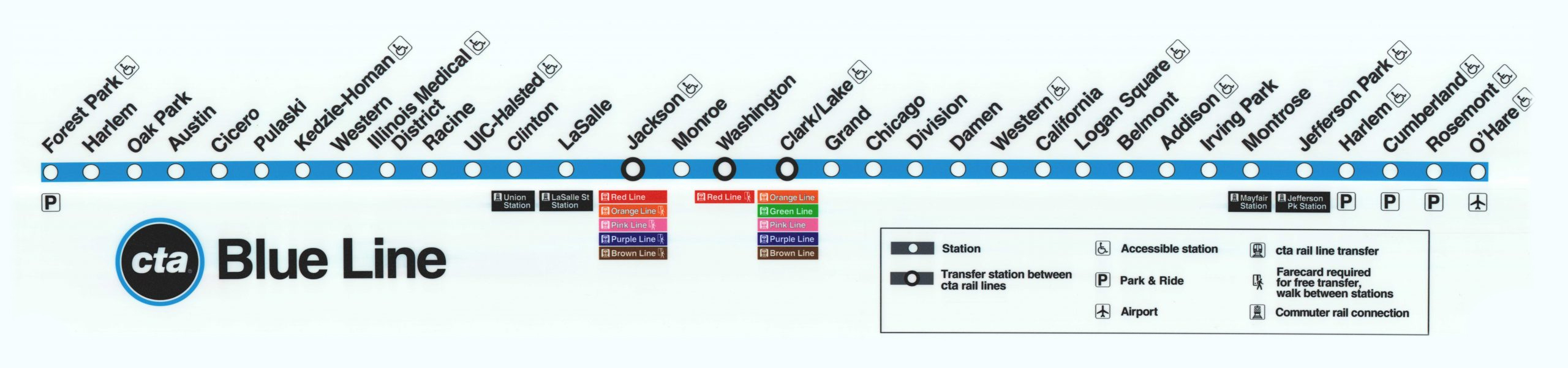
The Blue Line Chicago “L” map shows all available stations. Click on the map to enlarge it or download the Blue Line Chicago “L” map in PDF format.
Route, Branches, and Stations
The Blue Line route links O’Hare with Forest Park through the Northwest Side, downtown Chicago and the West Side. It has 13 stations on the O’Hare branch, 9 stations in the Milwaukee–Dearborn subway and 11 stations on the Forest Park branch. For riders planning a route plan or checking a stations map, the line is simple to follow: airport, Northwest Side, downtown subway, then west toward Forest Park.
Most trains run the full route between O’Hare and Forest Park, although some trips end at intermediate stations such as Jefferson Park, Rosemont or UIC-Halsted. The Blue Line does not share tracks with any other “L” line, and its main in-system transfer points are in downtown Chicago.
Full Station List and Key Stops
The stations list below follows the Blue Line path train from O’Hare toward Forest Park. Key stops include O’Hare, Jefferson Park, Logan Square, Damen, Clark/Lake, UIC-Halsted, Illinois Medical District and Forest Park.
| Station | Details |
|---|---|
| O’Hare | Airport terminal station with direct access to Terminals 1, 2 and 3 |
| Rosemont | Suburban stop on the O’Hare branch |
| Cumberland | Northwest Side stop with Park & Ride access nearby |
| Harlem (O’Hare Branch) | O’Hare branch station; separate from Harlem on the Forest Park branch |
| Jefferson Park | Major transfer point for Metra, Pace and bus connections |
| Montrose | Northwest Side station near Metra Milwaukee District North service at Mayfair |
| Irving Park | Connection area for Metra Union Pacific Northwest service |
| Addison | O’Hare branch station |
| Belmont | Northwest Side subway station |
| Logan Square | Key stop for Logan Square |
| California | One of the Blue Line stations with side platforms |
| Western (O’Hare Branch) | Milwaukee Avenue corridor station with side platforms |
| Damen | Useful for Wicker Park and Bucktown; side platforms |
| Division | West Town and Wicker Park area stop |
| Chicago | Downtown-adjacent station in the Milwaukee–Dearborn subway |
| Grand | Milwaukee–Dearborn subway station |
| Clark/Lake | Major downtown transfer to Loop “L” lines |
| Washington | Downtown station with Red Line connection nearby |
| Monroe | Downtown subway station |
| Jackson | Downtown station with Red Line connection |
| LaSalle | Downtown station near Metra Rock Island service at LaSalle Street |
| Clinton | Downtown station near Union Station for Metra and Amtrak |
| UIC-Halsted | Useful for the University of Illinois at Chicago |
| Racine | Forest Park branch station |
| Illinois Medical District | Serves the Medical District |
| Western (Forest Park Branch) | Separate from Western on the O’Hare branch |
| Kedzie-Homan | Forest Park branch station |
| Pulaski | Forest Park branch station |
| Cicero | Forest Park branch station |
| Austin | West Side station |
| Oak Park | Suburban station in Oak Park |
| Harlem (Forest Park Branch) | Separate from Harlem on the O’Hare branch |
| Forest Park | Western terminal of the Blue Line |
California, Western on the O’Hare branch and Damen use side platforms. Most other Blue Line stations use island platforms.
O’Hare Branch
The O’Hare branch is the longest section of the Blue Line, stretching 14.6 miles (23.5 km). It starts in an underground station below the airport’s main parking garage, then runs through Rosemont and the Kennedy Expressway corridor before reaching Logan Square, Wicker Park and the downtown subway.
This branch combines several eras of the line: the older Milwaukee Elevated, the Milwaukee-Kimball Subway, the Kennedy Extension and the O’Hare Extension. South of Logan Square, the line rises onto the only elevated viaduct section of the Blue Line, which is also part of its oldest infrastructure.
Schedule, Frequency, and Live Arrivals
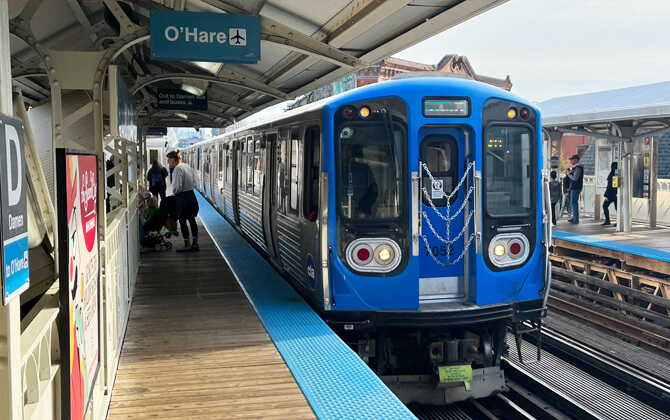
The Blue Line schedule is built around 24-hour service between O’Hare and Forest Park. Opening hours and closing time are easy to remember because the line does not close overnight. Still, frequency and running time vary by time of day, so checking live arrivals is useful before you go.
| Service detail | Timings |
|---|---|
| Daily operating hours | 24 hours a day |
| Starting time | Service runs continuously, so there is no daily first-train start for the full line |
| Closing time | No regular closing time; the Blue Line does not close overnight |
| Last train | No single last train because service is 24 hours |
| Typical O’Hare to downtown running time | About 40–45 minutes |
| Overnight frequency | Approximately every 15 minutes |
| Weekend daytime frequency | Generally every 6–10 minutes, with less frequent overnight service |
| Holiday schedule | Sunday schedules apply on major holidays and observed dates |
For timings today, live arrivals, train schedule updates and the current route timetable, use a real-time transit app or station information before traveling.
24-Hour Service
The Blue Line operates 24 hours a day, every day of the year. Overnight owl service covers the full route between O’Hare and Forest Park, and trains serve all stations during that period.
Most service runs through downtown, but some trips may short-turn at stations such as Jefferson Park, Rosemont or UIC-Halsted depending on the schedule and service management.
Peak, Weekend, and Overnight Service
During weekday rush periods, Blue Line trains run most frequently and can arrive every few minutes. Midday and evening service remains regular, while overnight trains are less frequent.
On weekends, the line still runs all day and all night. Some daytime patterns may not cover the full line, so check the schedule today if you need a specific terminal. Late-night riders can also connect with Owl bus routes near Washington and State, Jefferson Park and other major stations.
Fares, Tickets, and Ventra
CTA uses a flat fare system for rail and bus trips, with one special Blue Line airport fare at O’Hare. The standard CTA rail ticket price is US$2.50, while boarding the Blue Line at O’Hare costs US$5.00 when paying with transit value or buying a Single-Ride Ticket. Bus fare is US$2.25 with Ventra.
Ventra is the payment system for CTA and Pace. Riders can use a Ventra Card, disposable Ventra Ticket, contactless bank card or mobile wallet. A pass can be useful if you plan to ride public transport several times in one day or over several days.
Ventra Card, Ventra Ticket, and Contactless Payment
A Ventra Card can store transit value and passes for CTA and Pace. The classic blue Ventra Card is free when you buy a pass or add at least US$5.00 in transit value, and the one-time US$5.00 purchase fee is refunded as transit value after registration.
Disposable Ventra Tickets are available at CTA rail stations, including Single-Ride and 1-Day options. You can also tap a contactless bank card, Apple Pay or Google Pay at the Ventra reader. To avoid card clash, tap only the card or device you want to use.
Passes, Transfers, and Reduced Fares
CTA and Pace passes allow unlimited rides once activated. Transfers allow up to two additional rides within two hours when using the same Ventra Card, Ventra Ticket, contactless bank card or mobile wallet.
| Pass or fare | Price |
|---|---|
| CTA rail fare | US$2.50 |
| CTA bus fare with Ventra | US$2.25 |
| Reduced CTA rail fare | US$1.25 |
| Single-Ride Ventra Ticket | US$3.00, including up to two transfers within two hours and a limited-use media fee |
| 1-Day CTA/Pace Pass | US$5.00 |
| 3-Day CTA/Pace Pass | US$15.00 |
| 7-Day CTA/Pace Pass | US$20.00 |
| 30-Day CTA/Pace Pass | US$75.00 full fare, US$35.00 reduced fare |
Reduced fares apply to eligible riders, including passengers with RTA-issued Reduced Fare permits and children ages 7 to 11. Children under 7 ride free with a fare-paying customer.
O’Hare Boarding Fare and Airport Ticket Options
The Blue Line fare from O’Hare is higher than at most stations. Boarding at O’Hare costs US$5.00 when paying transit value or buying a Single-Ride Ticket. This special fare does not apply when riding with an unlimited pass.
Ventra vending machines at O’Hare can issue new Ventra Cards, sell tickets and load fare or passes onto existing cards. If you will use CTA more than once, compare the total cost with a day pass before buying single rides.
Transfers and Connections
The Blue Line is one of the most useful local transport routes in Chicago because it connects airport service, downtown CTA rail, regional trains and bus links. It has free in-system CTA rail transfers downtown and regional connections at selected stations.
CTA Rail Transfers in Downtown Chicago
In downtown Chicago, Clark/Lake is the main in-system transfer point from the Blue Line to Loop “L” trains, including Brown, Green, Orange, Pink and Purple Line service. Jackson and Washington connect the Blue Line with the Red Line.
| Station | Details |
|---|---|
| Clark/Lake | Transfer to Brown, Green, Orange, Pink and Purple Line trains |
| Jackson | Connection between Blue Line and Red Line |
| Washington | Connection to the Red Line at Lake |
Metra, Amtrak, and Pace Connections
Jefferson Park is a major connection point for Metra, Pace and CTA bus service. Clinton is useful for Union Station, where Metra and Amtrak services are available. LaSalle connects with Metra Rock Island service, while Montrose and Irving Park provide additional Metra access on the north side.
| Station | Details |
|---|---|
| O’Hare | Airport Transit System access within O’Hare |
| Jefferson Park | Metra, Pace BRT, Pace Pulse and bus connections |
| Montrose | Metra Milwaukee District North service nearby at Mayfair |
| Irving Park | Metra Union Pacific Northwest service |
| LaSalle | Metra Rock Island service at LaSalle Street |
| Clinton | Access to Union Station for Metra and Amtrak |
Pace I-90 Express service, introduced in December 2016, extends the Blue Line travel corridor with rapid service along I-90 to Elgin.
Bus Connections at Major Stations
Several stations have useful bus connections for trips beyond the rail route. Cumberland connects with CTA bus 81W, Pace routes 240, 241, 290 and 331, plus Greyhound service. Jefferson Park is another major bus hub and also has nearby Owl bus connections.
For late-night travel, Owl bus routes near Washington and State include N4, N20, N22, N60, N62 and N66. Additional Owl routes are available near Jefferson Park and Illinois Medical District.
O’Hare Airport Connection
The Blue Line is the direct CTA train connection between O’Hare International Airport and downtown Chicago. It runs 24 hours a day, seven days a week, and all trains from O’Hare travel through downtown before continuing toward Forest Park or, during some hours, UIC-Halsted.
The O’Hare station is accessible and located in the lower-level concourse below the airport’s main parking garage. It connects directly to Terminals 1, 2 and 3. The normal running time from O’Hare to downtown is about 40–45 minutes.
Getting to the Station from Terminals 1, 2, 3, and 5
From Terminals 1, 2 and 3, follow signs for “CTA Trains” or “Trains to City” through the pedestrian tunnels and lower-level walkways. From baggage claim, the walk usually takes under ten minutes.
From Terminal 5, take the free Airport Transit System to Terminal 2 or 3, then follow signs to the CTA station. The route is signed for city trains, so it is fairly straightforward even with luggage.
O’Hare to Downtown Chicago
From O’Hare, board any Blue Line train. Trains run through downtown stations such as Clark/Lake, Washington, Monroe, Jackson, LaSalle and Clinton before continuing west.
The usual travel time to downtown is 40–45 minutes. The line is especially convenient for early flights and late-night arrivals because its working hours are continuous.
Downtown Chicago to O’Hare
From downtown, take an O’Hare-bound Blue Line train from the Milwaukee–Dearborn subway. Downtown stations include Clark/Lake, Washington, Monroe, Jackson, LaSalle and Clinton.
Before boarding, check the destination sign. Most trains run to O’Hare, but some Blue Line trips can end short of the airport depending on service patterns.
Connecting Between O’Hare and Midway
CTA provides rail service to both O’Hare and Midway airports, but the Blue Line itself serves only O’Hare. From O’Hare, take the Blue Line toward downtown; CTA also provides direct service to and from Midway on its own airport route.
Ventra machines at O’Hare can issue cards, sell tickets and load passes before you start the airport-to-airport trip.
Parking near Station
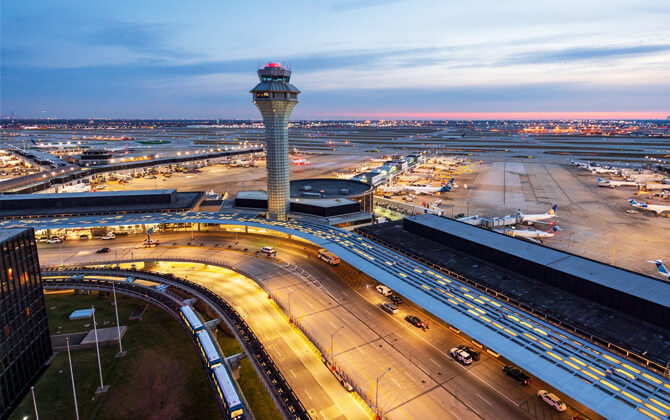
CTA Park & Ride facilities are available at several Blue Line stations, including Rosemont, Cumberland, Harlem on the O’Hare branch and Forest Park. Parking charges, hours and space availability vary by lot, so check the station parking details before driving.
The Harlem (O’Hare branch) lot at 5550 N. Harlem Ave. is closed for construction. Alternative parking is available at Cumberland Station, 5800 N. Cumberland Ave.
The Cumberland garage is open 24/7, allows overnight parking, has direct access to the Cumberland Blue Line station and accepts vehicles up to 6 feet 10 inches high. Parking starts at US$6.00 per hour, with typical rates from US$6.00 to US$11.00 depending on length of stay and day of week. Monthly parking under the “L” is listed at US$95.00 to US$150.00 depending on location.
Parking.com mobile payment is available at selected CTA Park & Ride lots. Daily parking charges per day are not the same at every facility, and spaces may be subject to availability.
Rules, Safety, and Rider Etiquette
Have your Ventra Card, ticket, contactless card or phone ready before you reach the turnstile. Tap once, wait for the confirmation and move through. If you are buying a ticket with cash, use the vending machine before entering.
On the platform, stand behind the safety line and watch the destination signs. Let riders exit before boarding, then move away from the doors. If you are unsure about direction, check whether the train is going toward O’Hare or Forest Park.
Keep bags close, hold the rail if standing and avoid blocking doors. When your stop is next, move toward the doors early. The Blue Line is generally safe to use, but as with any big-city public transport system, stay aware of your surroundings, especially late at night.
Tips for Tourists and Local Riders
For most visitors, the three things to check are line color, direction and payment method. The Blue Line is color-coded and signed clearly, but station names can repeat across Chicago, so always confirm that you are on the correct line and heading toward the right terminal.
Use Ventra, Apple Pay, Google Pay or a contactless bank card for quick entry. A 1-Day CTA/Pace Pass at US$5.00 can be a good value if you plan several rides, while a single CTA rail fare is US$2.50 at most stations.
For route planning, use a transit app to check live arrivals, transfers, fare options and service alerts. The Blue Line is one of the most practical transportation in Chicago options for airport trips, downtown travel and late-night rides.
History and Modernization
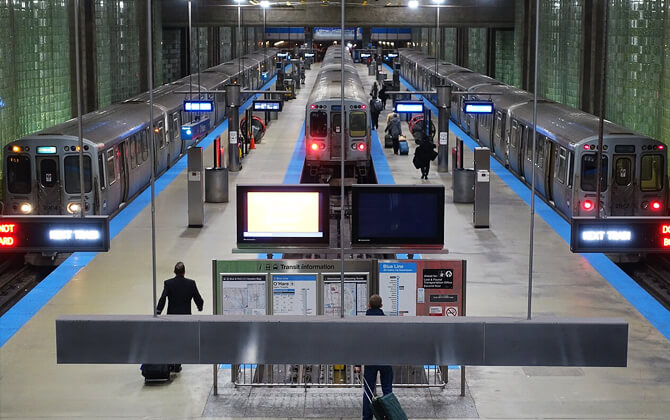
The Blue Line’s history reaches back to the Metropolitan West Side Elevated Railroad, which began serving Chicago’s West Side in 1895. The first section opened on May 6, 1895, and the line to Logan Square was completed later that month.
The modern Blue Line took shape in 1958, when the Milwaukee route was through-routed via the Milwaukee–Dearborn Subway with the new Congress line and the Douglas branch. The route later expanded to Jefferson Park in 1970 and O’Hare International Airport in 1984.
In 1993, CTA adopted color-coded line names, and the West-Northwest Route became the Blue Line. Blue Line service on the Douglas segment ended in April 2008, when that branch became part of the Pink Line.
From Early “L” Segments to the Blue Line
The Blue Line connects early elevated railway infrastructure with modern airport rapid transit. South of Logan Square, the elevated section remains the oldest part of today’s Blue Line and one of the clearest reminders of the line’s origins.
The line is not a tramway and does not use trams; it is part of the Chicago “L” rapid transit system. Its mix of elevated, subway and expressway-median track makes it one of the most varied routes in the network.
O’Hare Branch Modernization
The O’Hare branch has been the focus of major modernization. The Your New Blue program, announced in 2013, covered station renovations, track renewal, signal replacement, traction power upgrades and water mitigation along the branch and part of the Dearborn Subway.
The US$492 million program focused on a 12.5-mile (20.1 km) stretch between Grand and Cumberland. Work included upgrades at stations such as Grand, Chicago, Division, Damen, California, Logan Square, Jefferson Park, Addison, Irving Park, Montrose, Harlem and Cumberland.
Forest Park branch rehabilitation has also continued. Phase 1 of the Forest Park Branch Rebuild was completed in 2023 between LaSalle and Illinois Medical District, and a federal grant supports rebuilding two additional miles (3.2 km) of track between Kedzie and Pulaski in 2027.
Blue Line Neighborhoods and Nearby Attractions
The Blue Line connects O’Hare, the Northwest Side, Logan Square, Wicker Park, downtown Chicago, UIC, the Illinois Medical District, Oak Park and Forest Park. For visitors, it is one of the easiest rail routes to understand because it links the airport directly with major neighborhoods and the Loop.
O’Hare and Northwest Side Stops
Northwest Side stops include O’Hare, Rosemont, Cumberland, Harlem, Jefferson Park, Montrose, Irving Park and Addison. Jefferson Park is especially useful because it brings together CTA rail, bus, Metra and Pace connections.
From O’Hare, the branch follows the expressway corridor before entering the subway and continuing toward Logan Square and downtown.
Logan Square, Wicker Park, and West Town
Logan Square is one of the best-known neighborhood stops on the Blue Line. South of Logan Square, the route follows the historic elevated section through California, Western and Damen.
Damen is a key stop for Wicker Park and Bucktown, while Division is useful for parts of West Town. This stretch is popular with both local riders and tourists because it combines neighborhood access with frequent rail service.
Downtown Chicago and The Loop
Downtown Blue Line stations include Clark/Lake, Washington, Monroe, Jackson, LaSalle and Clinton. These stops provide access to the Loop, City Hall/County Building, Daley Center, Thompson Center, Federal Center and the Board of Trade area.
Clark/Lake is the major transfer point to Loop “L” trains, while Jackson and Washington connect with the Red Line. Because the Blue Line runs 24 hours, downtown access is available at any time.
UIC, Medical District, Oak Park, and Forest Park
West of downtown, the Blue Line serves UIC-Halsted, Racine, Illinois Medical District, Western, Kedzie-Homan, Pulaski, Cicero, Austin, Oak Park, Harlem and Forest Park.
UIC-Halsted is useful for the University of Illinois at Chicago, while Illinois Medical District serves nearby medical facilities. Oak Park and Forest Park extend the line into the western suburbs.
FAQ
These quick answers cover the most common Blue Line questions about the route, fare, schedule, accessibility, transfers and parking.
Is the Blue Line a subway or an elevated train?
It is both, depending on the section. The Blue Line is part of the Chicago “L” rapid transit system, with subway tunnels, elevated structure and expressway-median segments.
The Milwaukee–Dearborn section is underground, while the historic section near Logan Square, California, Western and Damen includes elevated track.
Does the Blue Line run 24 hours?
Yes. The Blue Line runs 24 hours a day between O’Hare and Forest Park. Overnight owl service covers the full route and serves all stations.
Frequency changes by time of day, with the most frequent service during weekday rush periods and less frequent service overnight.
How do I get from O’Hare to downtown on the Blue Line?
From Terminals 1, 2 or 3, follow signs for CTA Trains or Trains to City to reach the O’Hare Blue Line station. From Terminal 5, take the free Airport Transit System to Terminal 2 or 3 first.
Board any Blue Line train from O’Hare toward downtown. The ride usually takes 40–45 minutes.
Which Blue Line stations connect to other CTA lines?
Clark/Lake connects the Blue Line with Brown, Green, Orange, Pink and Purple Line trains. Jackson connects with the Red Line, and Washington also provides a Red Line connection at Lake.
The Blue Line does not share tracks with any other CTA “L” line.
Can I use contactless payment on the Blue Line?
Yes. You can pay with a contactless bank card, Apple Pay, Google Pay or a Ventra Card. Tap the card or device flat against the Ventra reader.
Use only one card or device at the reader to avoid card clash and accidental charges.
Is there parking at Blue Line stations?
Yes. Park & Ride parking is available at selected Blue Line stations, including Rosemont, Cumberland, Harlem on the O’Hare branch and Forest Park.
Rates, hours and availability vary. The Harlem (O’Hare branch) lot is closed for construction, with alternative parking available at Cumberland Station.