The Stuttgart Stadtbahn is Stuttgart’s light rail system, operated by Stuttgarter Straßenbahnen AG, or SSB. It began service on 28 September 1985 and developed from the city’s former tramway into a modern public transport network with underground city-center sections, surface routes, and reserved right-of-way tracks. As of 2024, the system has 14 main lines, one special event line, two temporary construction-related lines, 203 stations, and about 130 km (80.8 mi) of route.
| Key | Information |
|---|---|
| System type | Light rail Stadtbahn serving Stuttgart and nearby municipalities |
| Operator | Stuttgarter Straßenbahnen AG, also known as SSB |
| Opening date | 28 September 1985 |
| Network size | 203 stations on about 130 km (80.8 mi) of route |
| Lines | 14 main lines, one special event line, and two temporary construction lines as of 2024 |
| Main service area | Stuttgart, Remseck am Neckar, Fellbach, Ostfildern, Leinfelden-Echterdingen, and Gerlingen |
| Annual ridership noted | 174.9 million passengers in 2014 |
| Line prefix | U, from unabhängig, meaning independent from road traffic |
Map of Stuttgart Straßenbahnen
Map of Stuttgart Metro showing different lines. Click on the map to enlarge it or download the Stuttgart Metro map in PDF format.
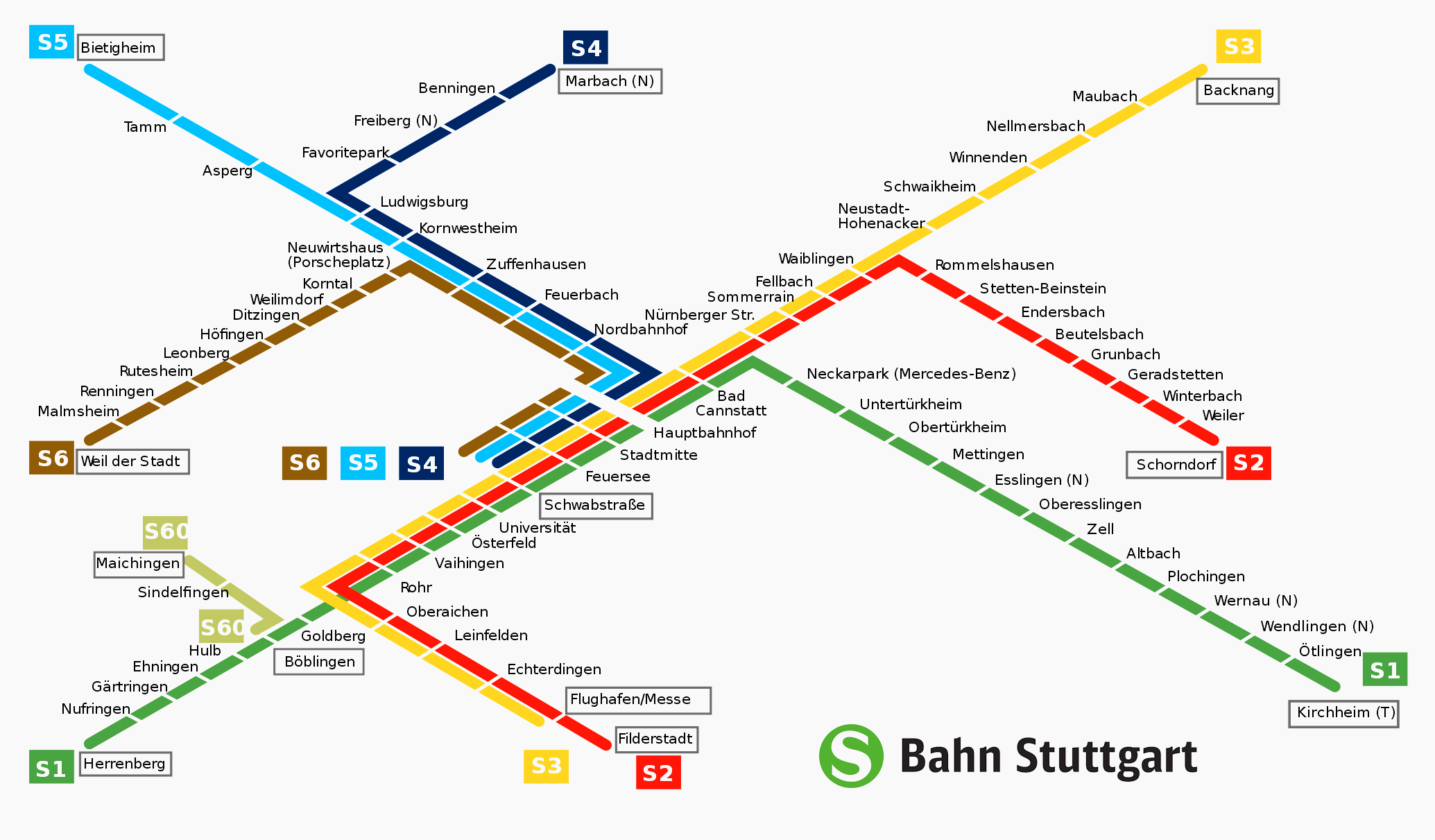
Stuttgart Stadtbahn Lines and Stations
The Stuttgart Stadtbahn route plan covers most of Stuttgart and extends into nearby towns including Fellbach, Gerlingen, Remseck am Neckar, Leinfelden-Echterdingen, and Ostfildern. The network has 16 lines in regular public information: 15 regular lines and the U11 special event line.
For route planning, the lines are often grouped by how they cross Stuttgart’s valley basin:
- Longitudinal lines through the valley basin: U1, U2, U4, U9, U14
- Cross-valley lines: U5, U6, U7, U12, U15
- Tangential lines around the basin: U3, U8, U13, U16, U19
The longitudinal and cross-valley lines meet in the city center at Hauptbahnhof and Charlottenplatz, although there is no track connection between those groups at these stations. Line U11 runs only for selected events. Line number 10 is reserved for the rack railway, and line 20 for the cable car. Since the end of 2025, depot shuttles and other non-standard services outside regular routes have been shown with the neutral line designation U.
| Line | Route | Stations | Length | Running time |
|---|---|---|---|---|
| U1 | Fellbach Lutherkirche – Bad Cannstatt – Mineralbäder – Stöckach – Hauptbahnhof – Rotebühlplatz – Marienplatz – Heslach Vogelrain | 27 stations | 14.9 km (9.3 mi) | About 41 min |
| U2 | Neugereut – Bad Cannstatt – Mineralbäder – Stöckach – Charlottenplatz – Rotebühlplatz – Vogelsang – Botnang | 28 stations | 14.2 km (8.8 mi) | About 36 min |
| U3 | Plieningen – Möhringen Bf – Vaihingen Bf | 11 stations | 8.0 km (5.0 mi) | About 13 min |
| U4 | Untertürkheim Bf – Wangen – Ostheim – Stöckach – Charlottenplatz – Rotebühlplatz – Hölderlinplatz | 22 stations | 9.5 km (5.9 mi) | About 25 min |
| U5 | Killesberg – Hauptbahnhof – Charlottenplatz – Degerloch – Möhringen – Leinfelden Neuer Markt | 23 stations | 16.1 km (10.0 mi) | About 32 min |
| U6 | Gerlingen – Giebel – Weilimdorf – Feuerbach – Pragsattel – Hauptbahnhof – Charlottenplatz – Degerloch – Möhringen – Fasanenhof – Echterdingen – Flughafen/Messe | 43 stations | 29.4 km (18.3 mi) | About 60 min |
| U7 | Mönchfeld – Zuffenhausen – Pragsattel – Hauptbahnhof – Charlottenplatz – Ruhbank/Fernsehturm – Heumaden – Ostfildern-Nellingen | 36 stations | 24.5 km (15.2 mi) | About 50 min |
| U8 | Vaihingen Bf – Möhringen Bf – Degerloch – Ruhbank/Fernsehturm – Heumaden – Ostfildern-Nellingen | 26 stations | 18.4 km (11.4 mi) | About 33 min |
| U9 | Hedelfingen – Wangen – Raitelsberg – Stöckach – Hauptbahnhof – Vogelsang, with some service toward Botnang | 28 or 22 stations | 13.5 km (8.4 mi) or 10.9 km (6.8 mi) | About 35 or 27 min |
| U11 | Hauptbahnhof – Rotebühlplatz – Charlottenplatz – Stöckach – Mineralbäder – Cannstatter Wasen – Neckarpark (Stadion) | 13 or 14 stations | 7.8 km (4.8 mi) | About 18 min |
| U12 | Remseck-Neckargröningen – Mühlhausen – Hallschlag – Löwentor – Nordbahnhof – Hauptbahnhof – Charlottenplatz – Degerloch – Möhringen Bf – Dürrlewang | 36 stations | 25.2 km (15.7 mi) | About 50 min |
| U13 | Feuerbach Pfostenwäldle – Pragsattel – Löwentor – Wilhelma – Bad Cannstatt – Untertürkheim Bf – Wangen – Hedelfingen | 25 stations | 15.1 km (9.4 mi) | About 38 min |
| U14 | Mühlhausen – Hofen – Münster – Wilhelma – Mineralbäder – Stöckach – Charlottenplatz – Marienplatz – Heslach Vogelrain – Vaihingen Bf | 33 stations | 18.1 km (11.2 mi) | About 41 min |
| U15 | Stammheim – Zuffenhausen – Pragsattel – Hauptbahnhof – Charlottenplatz – Eugensplatz – Ruhbank/Fernsehturm, with some service toward Heumaden | 27 or 32 stations | 14.6 km (9.1 mi) or 18.0 km (11.2 mi) | About 37 or 45 min |
| U16 | Giebel – Feuerbach – Pragsattel – Löwentor – Wilhelma – Bad Cannstatt – Fellbach Lutherkirche | 30 stations | 17.4 km (10.8 mi) | About 43 min |
| U19 | Neugereut – Bad Cannstatt – Neckarpark (Stadion) | 9 stations | 6.0 km (3.7 mi) | About 20 min |
On weekdays, U6, U7, and U12 run as 80-meter double-train services during the day. U11 and special U5 event services can also run in double traction when demand is high. For everyday navigation, a stations map and stations list are useful because many central stops are served by several routes.
The current system grew from Stuttgart’s old tram network. Key changes included the 2011 branch swaps on U5, U7, U4, and U2; the introduction of U12; the 2013 changes around Löwentor and Hallschlag; and the temporary lines used during the Stuttgart 21 works. By the December 2023 timetable change, the network returned to its original structure before those restrictions, while U1 and U14 swapped southern and central branches and U8 took over afternoon peak service to Heumaden from U15.
Schedule and Frequency
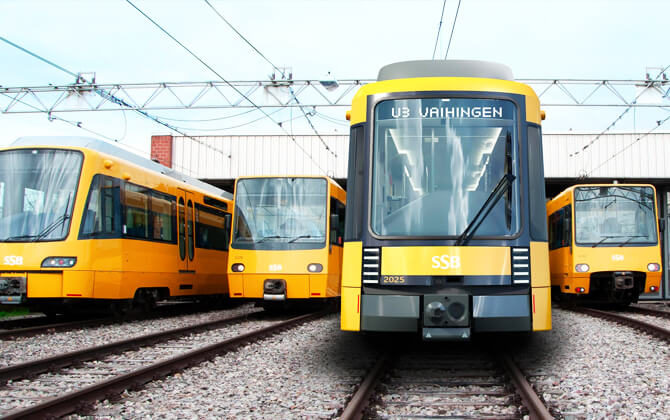
The Stuttgart Stadtbahn normally operates from 04:00 to 01:00. These operating hours make it a practical city transport option for commuting, sightseeing, and evening trips, but always check the schedule today if you are traveling early in the morning, late at night, or during construction work.
| Service detail | Timings |
|---|---|
| General opening hours and working hours | About 04:00 to 01:00 |
| Main daytime frequency | Most lines run every 10 minutes |
| Outside the main daytime pattern | Usually every 15 to 30 minutes, depending on the line and time of day |
| Monday to Friday 10-minute service transition | Starts between 06:00 and 07:00 and ends between 20:00 and 20:30 |
| Saturday 10-minute service transition | Starts between 09:30 and 10:30 and ends between 20:00 and 20:30 |
| Sunday 10-minute service transition | Starts between 10:30 and 11:30 and ends between 17:30 and 18:00 |
| U5 | Every 20 minutes during the day and evening, and every 30 minutes at other times |
| U8 | Monday to Friday from 06:00 to 19:00, every 20 minutes |
In the city center, several lines share the same stations, so trains often arrive every few minutes even when an individual route timetable shows a longer interval. For exact opening times, timings today, closing time, and last train information, use the current train schedule before you travel.
Fares
Stuttgart Stadtbahn fares are part of the VVS tariff system, which covers the Stadtbahn, S-Bahn, regional trains, buses, express buses, the rack railway, and the cable car. The ticket price usually depends on the tariff zones you travel through, with zone 10 covering Stuttgart’s core area and zone 20 extending beyond the city limits.
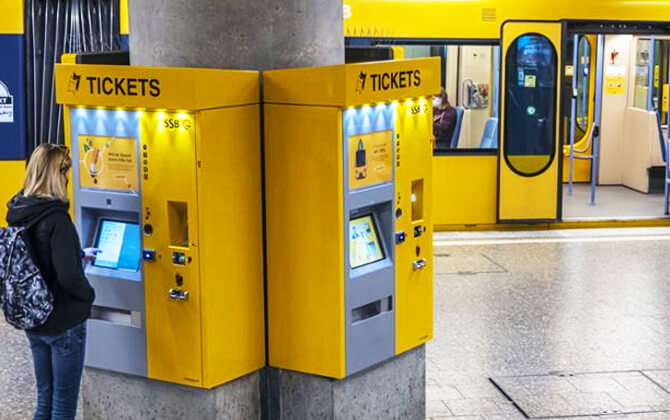
You can buy a ticket at VVS ticket machines, from bus drivers, at VVS ticket offices, or through digital options such as a Mobile Ticket. If you are unsure about the cost, check the current fare information or fare calculator before buying, especially when crossing several zones.
The Short-distance Ticket is for a very short trip without changing or interrupting the journey. It applies to S-Bahn and regional trains for one stop, and to Stadtbahn or bus trips up to the third stop after boarding, with a maximum distance of 5 km (3.1 mi). It is not valid on night buses.
The Single Ticket is valid for one journey toward your destination. Transfers and trip interruptions are allowed, but round trips and return journeys are not. The draft fare information notes validity of up to three hours from purchase or validation.
The 4-trip ticket contains four sections. One section is valid for one journey toward the destination and can also be used by several people if one section is validated per person. It is not available as a mobile ticket.
The day pass options include the EinzelTagesTicket for one person and the GruppenTagesTicket for groups of up to five people, or for one parent traveling with their own children up to 17 years old. Both allow unlimited travel in the selected zones for the valid day. The 10er-TagesTicket is a package of ten single day tickets, with zones chosen separately for each travel day.
Ticket Types and Discounts
Sample fares in the draft information include the following prices. Current fare, pass, and card rules can change, so check the latest VVS ticket price before travel.
- Short Distance Ticket: €1.20, about $1.30, for travel up to three stops in one journey.
- Single Ticket: from €2.07, about $2.25, for a one-way journey with permitted connections.
- Multi Journey Ticket: from €2.08, about $2.27, for several trips, with validation required each time.
- Day Ticket: from €6.50, about $7.09, useful if you plan to travel often in one day.
- Group Day Ticket: from €2.26, about $2.46, designed for groups of up to five people traveling together.
- 3 Day Ticket: from €3.67 per day, about $4.00 per day, intended for visitors staying several days.
Children up to 6 years old travel free under the ticket rules described in the draft. Children aged 6 to 14 can use a reduced child fare with the EinzelTicket Kind. The 3 Day Ticket is valid for three consecutive days for one adult and two children aged 6 to 17, and it must be validated and signed before the first journey.
Tickets bought at a machine or from a driver generally do not need validation, except for the Multi Journey Ticket. Mobile Tickets are available for Short Distance Tickets, Single Tickets, and Day Tickets.
Connections to Other Systems
The Stuttgart Stadtbahn is integrated with wider public transport in the Stuttgart region. The main rail connection is the S-Bahn, operated by Deutsche Bahn, and the shared VVS tariff links Stadtbahn, S-Bahn, regional rail, and bus services in one local transport system.
| Station | Details |
|---|---|
| Stuttgart Hauptbahnhof | Main Stadtbahn transfer hub and a key connection point for regional and long-distance rail |
| Stuttgart Stadtmitte / Rotebühlplatz | Important city-center interchange between S-Bahn and several Stadtbahn lines |
| Stuttgart-Bad Cannstatt | Outer district interchange with useful rail and local transport links |
| Stuttgart-Vaihingen | Major interchange in the south-west of the city |
The Stadtbahn network also includes special rail-based services in the wider SSB system. Line 10 is the rack railway between Marienplatz and Degerloch and has a special bicycle car. Line 20 is the funicular, and line 21 operates as a weekend heritage tram line.
For planning a route across the valley basin, U1, U14, and U2 run along the main valley; U5, U6, U7, and U15 form north-south crossings; U4 and U9 provide west-east crossings; and U3, U13, U19, and the rush-hour U16 work as tangential lines.
Airport Connections
Stuttgart Airport is connected to the city by rail and bus. From Stuttgart Central Station, S-Bahn lines S2 and S3 run directly to the airport every 15 minutes, with a journey time of about 25 to 30 minutes. The U6 Stadtbahn line also serves the airport and stops at Flughafen/Messe, about a 5-minute walk from the terminals; during core times it runs every 10 minutes.
There are line closures on the S-Bahn to the airport on some weekends. During those periods, use U6 or the rail replacement service between Vaihingen and the airport. For transportation in Stuttgart on disruption days, check the current airport train schedule and bus timetable before leaving.
The Stuttgart Airport Bus Terminal, or SAB, is located between Flughafenstraße and Terminal 4, under the P14 car park. It serves local, regional, national, and international buses, including express and night services. Night bus N8 connects Schlossplatz with Stuttgart Airport, departing Schlossplatz at 3:40 a.m. and reaching the airport in around 40 minutes.
The airport S-Bahn station and the SAB are barrier-free. Tickets for S-Bahn, light rail, and regional buses are available from ticket machines in the terminals or through provider apps. Long-distance bus tickets can be bought online or at the airport bus terminal. Local and regional bus lines serving SAB include 122, 806, 812/813, 828, X3, X10, X60, and X82.
Parking near the Metro
Station parking is available at several locations in and around Stuttgart, including options near Stuttgart Hauptbahnhof at Arnulf-Klett-Platz 2. Centrally located paid parking such as Q-Park Galeria Kaufhof is described as being a few minutes’ walk from the station and can be useful for short visits, shopping, or exploring the city.
Park-and-ride is another practical choice in the VVS area. P+R parking is offered at many stations, and some locations use parking decks or garages. Parking cards can be obtained from machines, local sales points, or through the P+R subscription service.
At DB BahnPark GmbH parking facilities without barriers, people with a physical disability, or the person accompanying them, may park free of charge for up to 24 hours. This applies to holders of a blue or orange European parking permit for people with disabilities. The authorized person does not need to drive, but must be transported in the vehicle. The parking card should be placed clearly behind the windshield instead of a parking ticket.
Shared vehicle spaces and station-based car-sharing areas are also available in parts of Stuttgart and the wider region. Some marked spaces are in garages, underpasses, or station parking areas, and access may require a card or app.
Before parking near a station, check current availability, access rules, parking charges, and parking charges per day. Local rules can vary by facility, and some spaces may require online pre-booking.
Tips and Rules
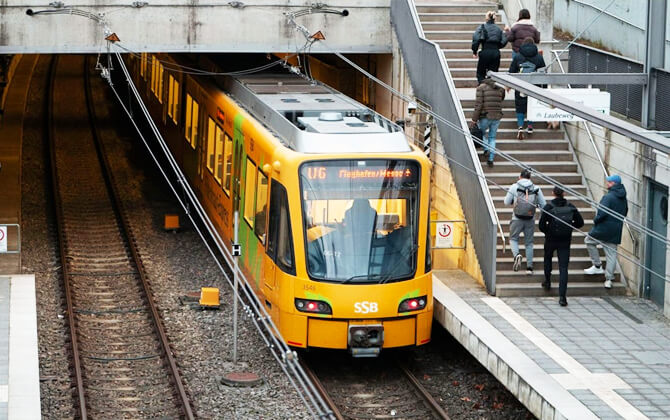
The Stuttgart Stadtbahn is part of the VVS network, so the same tariff rules and travel conditions apply across the cooperating transport companies. The simplest rule is also the most important: make sure your ticket is valid for your route before boarding.
Validation depends on the ticket type. The Multi Journey Ticket must be time-stamped for each trip, while tickets bought from machines or from the driver generally do not need validation, except for the Multi Journey Ticket. If your trip goes beyond the area covered by your ticket, you may need an additional ticket from the start of the journey.
Short Distance Tickets are for travel up to three stops on trams or buses, and to the next stop on S-Bahn trains and the local railway network. Transfers are not permitted, and the ticket is not valid on night buses.
Single Tickets are valid in the selected tariff zone and allow you to change to another connection while continuing toward your destination. Day Tickets allow unlimited trips within one day until the end of operating hours, including night buses, and are not transferable.
Group Day Tickets are valid for up to five people, or for parents traveling with any number of children aged up to and including 17. The 3 Day Ticket is designed for overnight guests and visitors attending conferences or meetings within the VVS network; it is non-transferable and must be validated and signed before the first journey.
For a safe trip, follow staff instructions, do not block doors or entrances, and enter or leave vehicles only at stops unless staff allow an exception. Do not open doors during travel, throw objects from vehicles, use bicycles or roller skates inside vehicles or on premises, beg, or use audio devices in a way that disturbs others.
Seat priority should be given to passengers with limited mobility, older or frail passengers, pregnant passengers, and people traveling with small children. There is no general right to a seat.
Luggage, animals, and bicycles must be carried without endangering safety or disturbing other passengers. Dogs must be supervised and kept on a short leash; dogs that may pose a risk must also wear a muzzle. Guide and assistance dogs follow the applicable rules. If a bicycle is carried when bicycle transport is not permitted, an increased fare of €60.00, about $65.40, applies and the passenger may be excluded from transport.
History
The Stuttgart Stadtbahn replaced the city’s former tram network, which had shaped urban transport for decades. In 1961, the city council decided to move the rail network in the center underground, introduce more powerful vehicles, and separate rail operations from motor traffic in outer areas wherever possible.
The first tunnel stop opened at Charlottenplatz in 1966, followed by the tunnel between Neckartor and Marienplatz in 1972. These early tunnel sections were already prepared for a future standard-gauge system, with the clearance profile and track layout needed for planned Stadtbahn vehicles.
In the mid-1970s, Stuttgart discussed building a full underground railway. In 1976, the city chose a different path: replacing the tram system step by step with a stronger Stadtbahn network. By 1978, Königstrasse, Hauptbahnhof, and sections toward the former Universität and Türlenstrasse stops had been tunnelled. Further works followed by 1984, including Rotebühlplatz and the Siemensstrasse tunnel between Pragsattel and Feuerbach station.
The main technical goals were standard gauge, bidirectional operation to remove turning loops, and step-free access. The DT 8 vehicles were developed for this system. For many years, trams and Stadtbahn trains ran side by side, with dual-gauge tracks used during conversion. Some three-rail sections remain for museum trips by the historic tramway vehicles.
Trial operation with DT 8 pre-series vehicles began on 25 July 1983 on the Plieningen–Möhringen section of line 3. On 28 September 1985, the Plieningen–Vaihingen route became the first line fully converted to Stadtbahn operation. Lines 1 and 14 followed in 1986, bringing Stadtbahn trains through the city center.
More milestones followed: the Volksfest line to Cannstatter Wasen was served by Stadtbahn vehicles in 1988, line 9 was converted in 1989, and U5 and U6 entered service in 1990. U6 reached Giebel in 1992, Gerlingen town limits in 1993, and Gerlingen town center in 1997. U7, introduced for the 1993 World Horticultural Exposition, became the first line to run in double sets.
Line 4 reached Botnang in 1994. Lines 13 and 2 were converted in stages during the late 1990s and early 2000s, and U2 reached Neugereut in 2005 with a tunnel under the main cemetery. The last meter-gauge section, line 15, was converted from September 2005 onward. U15 began service between Ruhbank and Zuffenhausen Kelterplatz in December 2007, and the northern section to Stammheim followed in 2011, ending regular tram operation in Stuttgart.
From 2013, U12 was extensively rebuilt and the network was adapted for Stuttgart 21. The new tunnel between Staatsgalerie and Hauptbahnhof allowed the original Stadtbahn arrangement to return in December 2023 after the Stuttgart 21 restrictions. The system continues to adapt within Stuttgart and into neighboring communities.
Future Extensions
The Stuttgart Stadtbahn has several expansion projects and longer-term ideas that could shape the system in the coming years. The most concrete project in the draft information is the U5 extension from Leinfelden station to Neuer Markt, with commissioning planned for 17 October 2024. The project includes a new above-ground stop, a single-track turning facility behind the terminus, and the option of a later extension toward Echterdingen.
Another major upgrade is the capacity increase on U1. Platform extensions are planned on the Fellbach–Heslach Vogelrain section so that 80-meter double sets can operate there. The less heavily used Heslach Vogelrain–Vaihingen section is expected to continue using 40-meter U14 trains. Construction is being carried out in phases, with work already under way on the northern branch.
Network development is also tied to Stuttgart 21. The completed tunnel connection between Staatsgalerie and Hauptbahnhof made it possible to return to the original Stadtbahn network after the temporary diversion period. At the same time, the U1 and U14 line swap in the city center was introduced to improve vehicle capacity and better connect the Neckar valley with the city center.
Other development areas have shaped the route plan as well. Sections added in 2016 and 2017 were designed to improve access to Hallschlag, the Europaviertel, the planned Rosensteinquartier, and other growth zones. The full route is designed for 80-meter trains, leaving room for later capacity growth.
Further possible extensions have been discussed, including a continuation of U5 toward Echterdingen, a light rail connection to Pattonville, and a planned Stadtbahn line from Markgröningen via Möglingen and Ludwigsburg to Pattonville. These projects show that future expansion remains under consideration both inside Stuttgart and across the wider region.
Nearby Attractions
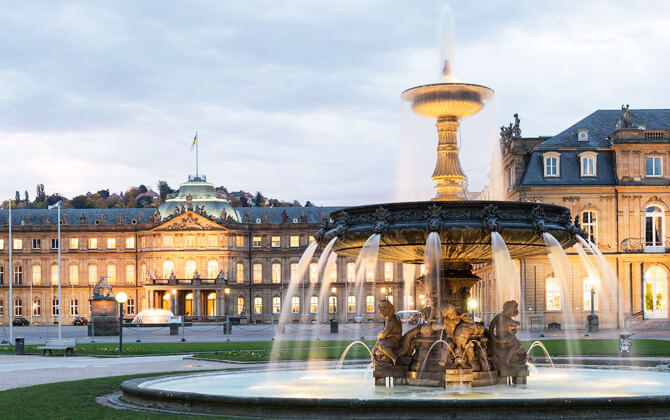
The Stuttgart Stadtbahn is a convenient way to reach many of the city’s best-known sights without a car. Central stops place visitors close to landmarks, museums, shopping streets, parks, and event venues.
| Station | Details |
|---|---|
| Schlossplatz | Useful for central sightseeing, shopping streets, and the main city-center area |
| Charlottenplatz | Major interchange close to central attractions and walking routes |
| Hauptbahnhof (Arnulf-Klett-Platz) | Central station area with rail connections and access to the city center |
| Staatsgalerie | Convenient for museum visits and nearby cultural sites |
| Wilhelma | Direct access to the zoo and botanical garden |
| Ruhbank/Fernsehturm | Practical stop for reaching the Fernsehturm area and city views |
| Cannstatter Wasen | Useful for festivals and large events |
| NeckarPark (Stadion) | Serves sports matches, stadium events, and major gatherings |
For exploring beyond the center, the network also reaches Degerloch, Vaihingen, Bad Cannstatt, and Feuerbach. Because many central stations are served by several lines, it is easy to combine multiple attractions in one day with a simple route plan.