The Mülheim tram and Stadtbahn system is part of the wider Rhine-Ruhr public transport network in western Germany. In the city, the main rail link is the U18, which connects Mülheim with Essen, while the tramway shared with Oberhausen covers many local routes and stations. The key interchange is Mülheim (Ruhr) Hauptbahnhof, where passengers can switch between the U18, tram lines, bus services, and regional rail. A basic short-trip ticket costs €1.60 (about $1.75), and the system runs from early morning to late evening rather than around the clock.
| Key | Information |
|---|---|
| System | Tram and Stadtbahn network in Mülheim an der Ruhr, part of the Rhine-Ruhr public transport system |
| Main Stadtbahn line | U18 |
| Main interchange | Mülheim (Ruhr) Hauptbahnhof |
| Tram network | Shared with Oberhausen |
| Basic fare | €1.60 (about $1.75) for a short journey |
| Operating hours | Early morning to late evening; not 24 hours |
| Weekend opening times | Services usually start later than on weekdays |
Map of Mulheim Tram
Map of Mülheim Tram showing different lines. Click on the map to enlarge it or download the Mülheim Tram map in PDF format.
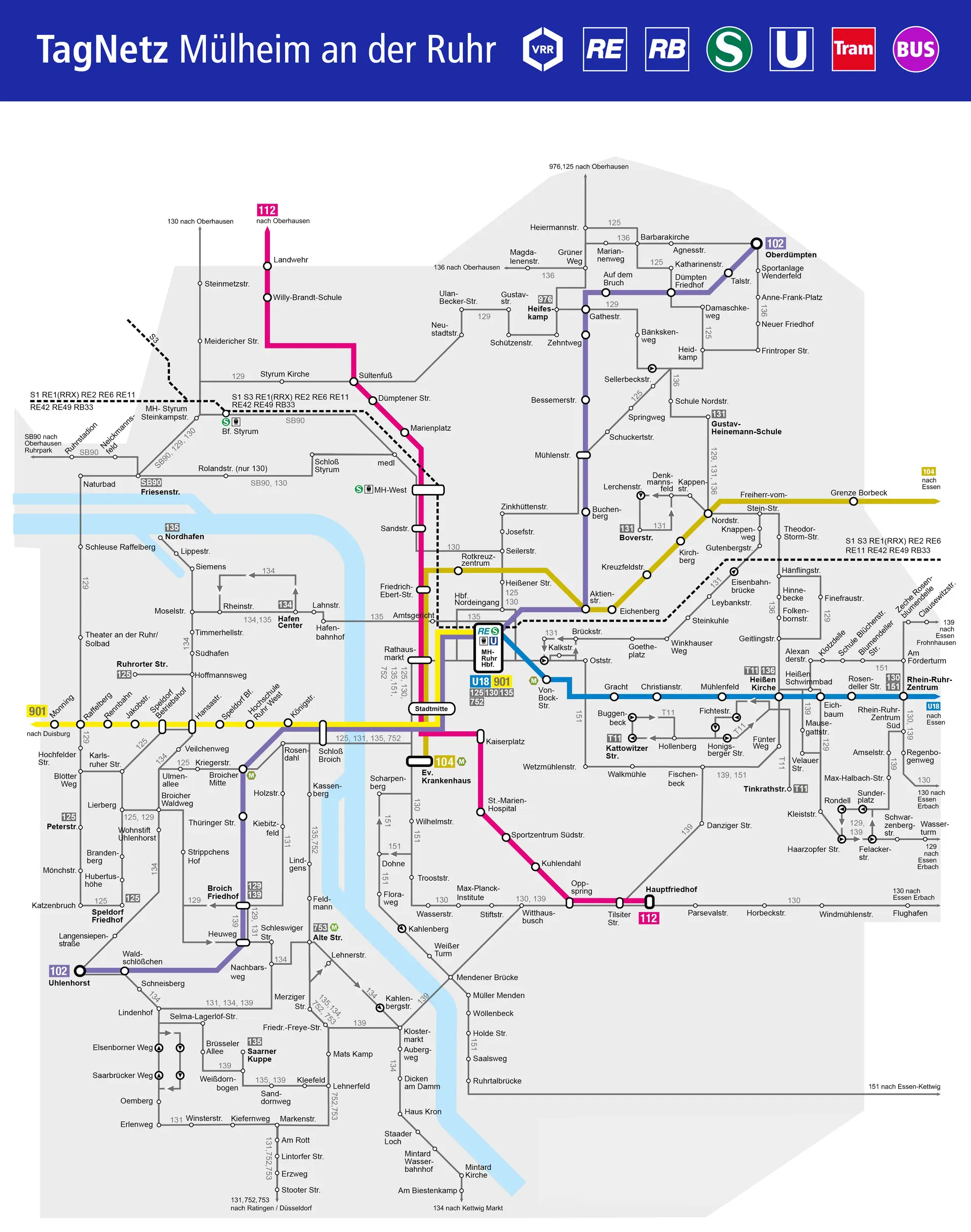
Lines and Stations
The Mülheim/Oberhausen tramway is operated by Ruhrbahn and Stadtwerke Oberhausen (STOAG) and is integrated into the VRR system. It forms an important part of local transport in Mülheim an der Ruhr and nearby Oberhausen.
As of 2015, the tram network included these lines and route details:
| Station | Details |
|---|---|
| Line 102 | Route: Uhlenhorst – Stadtmitte – Mülheim Hbf – Oberdümpten. Rush-hour frequency: 10 minutes. Metre gauge. |
| Line 104 | Route: MH Hauptfriedhof – Max-Planck-Institute – Stadtmitte – Rathausmarkt – Grenze Borbeck – E Abzweig Aktienstraße. Frequency: 20 minutes between Hauptfriedhof and Stadtmitte; 10 minutes between Stadtmitte and Grenze Borbeck; 20 minutes between Grenze Borbeck and E-Abzweig Aktienstraße. Metre gauge. |
| Line 112 / NE12 | Route: MH Hauptfriedhof – Kaiserplatz – Stadtmitte – Landwehr – Oberhausen Hbf – Feuerwache – Neue Mitte – Eisenheim – OB Neumarkt. Frequency: 10 minutes on 112 between Hauptfriedhof and Landwehr; 20 minutes between Landwehr and OLGA-Park, with 10 minutes in morning rush hour; 20 minutes between OLGA-Park and Neumarkt; 60 minutes on NE12 between Kaiserplatz and OB-OLGA-Park, plus occasional trips to OB-Neumarkt. Metre gauge. |
| Line 901 | Route: DU-Obermarxloh – Marxloh – Thyssen Verwaltung – Beeck – Neanderstr. – Laar – Thyssen Tor 30 – Ruhrort – Albertstr. – DU-Stadtmitte – Jakobstr. – Mülheim/Ruhr. Frequency: 15 minutes. Standard gauge Duisburg tramway line. |
The former tram line 110, which ran from Styrum and Friesenstr. to Hauptfriedhof, was replaced by bus line 128 on 4 October 2015.
Besides the tramway, Mülheim is served by the U18 path train line. Within the city, it has nine stations: Rhein-Ruhr-Zentrum, Rosendeller Straße, Eichbaum, Heiße Kirche, Mühlenfeld, Christianstraße, Gracht, Von-Bock-Straße, and Mülheim (Ruhr) Hauptbahnhof.
Mülheim (Ruhr) Hauptbahnhof is the main interchange in the system. It links the U18 with tram lines 102 and 901, as well as bus routes and regional rail. If you are looking for a stations map or stations list, this is the key hub to keep in mind.
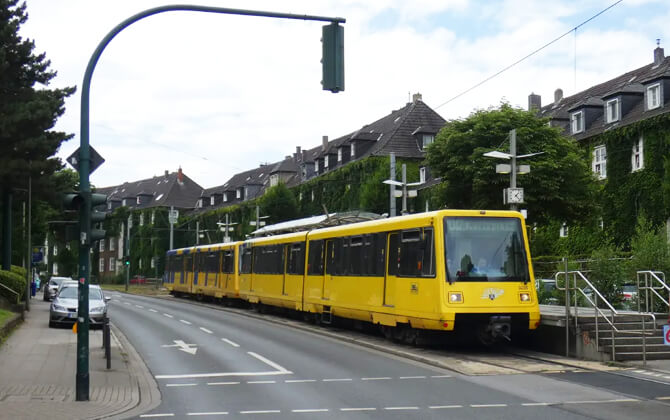
Schedule and Timetables
Mülheim tram and Stadtbahn operating hours vary by line, but services generally run from early morning until late evening. On weekends, opening hours usually begin later. The network does not operate 24 hours, so checking the timetable or schedule today before travel is a smart move.
Available timetable information includes several local routes. Route 102 has a train schedule valid from 7 January 2026 and connects Uhlenhorst, Broicher Mitte, and Mülheim Hbf via Oberdümpten. Route 112, also valid from 7 January 2026, runs between Hauptfriedhof, Oppspring, Kaiserplatz, Stadtmitte, Sültenfuß, and Oberhausen Hbf via OB-Neumarkt. Route 901 runs between Mülheim Hbf, Hochschule Ruhr West, DU-Zoo/Uni, and Duisburg Hbf via DU-Obermarxloh.
For route 112, the source material shows evening and late-evening timings from Oberhausen Neumarkt to Mülheim Stadtmitte. Example arrival times at Mülheim Stadtmitte are 18:04, 19:04, 20:05, 20:15, 23:20, and 00:20. Since schedule today information may change, real-time tools are useful.
| Service detail | Timings |
|---|---|
| General working hours | Early morning to late evening |
| Weekend opening times | Usually later than weekdays |
| Route 102 timetable | Valid from 7 January 2026 |
| Route 112 timetable | Valid from 7 January 2026 |
| Route 901 timetable | Listed in available source material |
| Route 112 arrival timings at Mülheim Stadtmitte | 18:04, 19:04, 20:05, 20:15, 23:20, 00:20 |
Ruhrbahn also provides several timetable and route plan tools:
- Fahrplanauskunft for journey planning and route timetable searches.
- Abfahrtsmonitor for real-time departures and timings today at a stop.
- Linienfahrpläne for valid U-Bahn, tram, and bus PDF timetables.
- Haltestellen und Pläne for stop-area maps and posted timetables.
- ZÄPP, the Ruhrbahn app, for mobile tickets and schedule information.
The customer service numbers listed in the source material are 0208 451-1420 for Kundendialog and 0208 451-1234 for Abo-Service.
Tariffs, Tickets, and Cards
Mülheim fares are integrated into the VRR public transport network, so the same ticket system applies across trams, buses, and Stadtbahn services. The fare depends on distance and is grouped into zones A, B, C, and D. Zone A is split into A1, A2, and A3 in larger cities.
For occasional travel, a short trip of up to three stations within 20 minutes costs €1.60 (about $1.75). Other single-ticket prices are €2.70 (about $2.95) for Zone A, €5.80 (about $6.35) for Zone B, €12.10 (about $13.25) for Zone C, and €15.00 (about $16.40) for Zone D. Children aged 6 to 14 also pay €1.60 (about $1.75).
There are also 4-trip tickets. Prices are €5.90 (about $6.45) for the basic trip, €10.00 (about $10.95) for Zone A, €20.90 (about $22.90) for Zone B, €42.80 (about $46.85) for Zone C, and €52.50 (about $57.45) for Zone D. A children’s 4-trip ticket costs €5.90 (about $6.45). A 10-trip ticket is mentioned as another option, with the price varying by zone.
For longer travel, the 1-Day Unlimited Pass can be used by up to five people at the same time. A 7-day ticket is also available. Frequent riders may prefer Ticket1000 or Ticket2000 monthly cards. Ticket2000 includes extra benefits such as travel for a second person at certain times, free travel for children under 15, and bicycle transport that would otherwise require an extra ticket.
Other passes and cards mentioned in the source material include ShokoTicket for students under 25, YoungTicket for students in general, SemesterTicket through schools and universities, FirmenTicket for employees, MeinTicket as a social fare product, and BärenTicket for passengers over 60.
If you need a fare calculator, route-based cost estimate, or ticket price for a specific trip, Ruhrbahn’s journey tools are the place to check.
Interconnections with Other Systems
Mülheim is closely linked to the wider Rhine-Ruhr transport system. The U18 connects the city with Essen and ties into a much broader network of suburban, regional, and long-distance rail services.
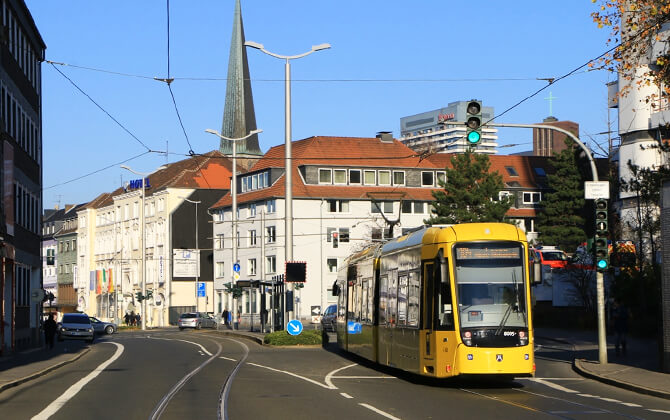
Within the city, trams remain central to everyday transportation in Mülheim. The tramway, known as Straßenbahn Mülheim/Oberhausen, also serves neighbouring Oberhausen. The only direct interchange between the U18 and the tram system is at Mülheim (Ruhr) Hauptbahnhof, where lines 102 and 901 stop.
Buses are fully integrated as well, so transfers between bus, tramway, and Stadtbahn are straightforward under the same VRR ticketing system. Direct bus connections are available at Rhein-Ruhr-Zentrum, Von-Bock-Straße, and Hauptbahnhof.
The city also connects to the regional S-Bahn network. Mülheim (Ruhr) Hauptbahnhof links the Stadtbahn with S-Bahn lines S1 and S3. Two more S-Bahn stations serve the city: Mülheim Styrum with S1 and S3, and Mülheim (Ruhr) West with S3 only.
For longer rail journeys, Mülheim (Ruhr) Hauptbahnhof is again the main interchange. From there, passengers can change to regional or long-distance services.
There is no direct U18 route to Düsseldorf Airport. Travelers need to go to Hauptbahnhof and transfer to the S1 S-Bahn line.
Connections to the Airport
Mülheim does not have its own international airport. The main option for most travelers is Düsseldorf Airport, around 29 km (18 miles) south of the city. Other nearby airports are Dortmund Airport, about 61 km (38 miles) away, and Weeze Airport, about 71 km (44 miles) away.
There is no direct U18 connection to Düsseldorf Airport. To get there by public transport, passengers should travel to Mülheim (Ruhr) Hauptbahnhof and change to the S1 S-Bahn line, which serves the airport.
Rules and regulations
Passengers are expected to follow a few simple rules to keep travel safe and comfortable.
- Smoking is strictly forbidden, and eating or drinking on trains is not allowed.
- Please give up your seat when asked by elderly passengers, people with severe physical disabilities, pregnant women, or adults traveling with small children.
- Always follow staff instructions, especially during emergencies.
Because the network is integrated across tram, bus, and Stadtbahn services, passengers should keep their ticket with them throughout the trip. Inspections may take place at any time.
A Glimpse into the History
Mülheim an der Ruhr was included in a master plan for a rail network connecting the major cities and suburbs of the densely populated Rhine-Ruhr region. After the Second World War, planning moved ahead more quickly, with trams introduced first and an express bus network added soon after.
In 1961, plans were proposed for a tunnel in Essen to create a direct link to Mülheim. After discussion over whether to build a larger underground system or a tram-based solution, the tram option was chosen. The first phase opened on 28 May 1977, linking Essen and Mülheim via Heiße Kirche station.
On 3 November 1979, the line was extended with five additional stations in Mülheim and the connection to the main railway station was completed. Later expansion continued mainly in the surrounding area, especially in Essen and nearby Gelsenkirchen.
In 2010, the system was restructured to improve efficiency, and the U18 was renamed the Shopping Line because of its strong commercial role.
Advice
Public transport in Germany works on a trust-based system, so there are no physical barriers before boarding. Still, keep your ticket with you at all times. Inspectors may ask to see it during the trip.
It also helps to plan ahead. Knowing your route and distance in advance makes it easier to choose the right fare, avoid overpaying, and use the network more smoothly.
For everyday travel, the free ZÄPP Ruhrbahn app for iOS and Android can be very handy. It includes journey planning, live departures, timetable information, network maps, stop plans, service notices, and mobile ticket buying.
If you need help or service information, these contact numbers are available:
- Kundendialog: 0208 451-1420
- Abo-Service: 0208 451-1234
Useful online tools include the journey planner, departure monitor, line network maps, route timetable pages, and stop maps. Simple, practical, and worth checking before you head out.
Fun facts
- The Mülheim system is only a small part of the larger Essen Stadtbahn network in the Rhine-Ruhr region.
- It is integrated with the regional S-Bahn network, giving passengers wider transport connections across the area.
- Although often described as a metro, much of the system is closer to a hybrid of tram and light rail than to a fully separate underground.
- In Mülheim an der Ruhr, trams still play a major role in city transport and are shared with neighbouring Oberhausen.
- Mülheim (Ruhr) Hauptbahnhof is the key interchange where Stadtbahn, trams, buses, and other rail services come together.
- Basic single fares start at €1.60 (about $1.75) for short journeys.
- Passengers who need assistance can be accompanied by staff to their destination at no extra cost.
Tourism and sightseeing
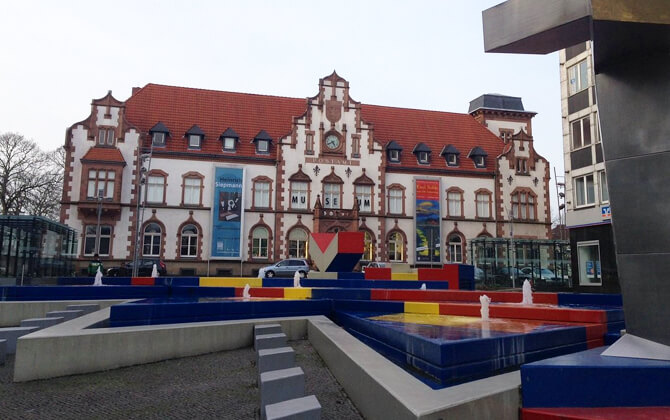
Mülheim an der Ruhr has shifted from its industrial and coal-mining past toward a greener image focused more on leisure and sustainable business. Many attractions are easy to reach by city transport, so the tram and Stadtbahn network works well for sightseeing.
One well-known stop is Rhein-Ruhr-Zentrum, one of Germany’s first major shopping centres. It sits just outside the metro station of the same name and offers designer shops, chains, smaller stores, and a large food court.
Another interesting route is the KulturRing Mülheim, which links 55 cultural highlights along bus lines 129 and 139 and tram line 112. It works as a flexible sightseeing route rather than a fixed tour, letting visitors choose their own stops.
Places connected to the KulturRing include Schloß Broich, Kloster Saarn, Theater an der Ruhr, and the Kunstmuseum. The route combines historic buildings, industrial heritage, and modern cultural landmarks, giving visitors a good sense of the city’s history and present-day identity.
For planning, the KulturRing is supported by a website with photos, detailed information, and icon-based guidance for featured sites. A printed culture timetable is also available, and signs at stops point the way to nearby attractions.
If you prefer to explore on foot, themed walks are also available and focus on architecture, historical figures, and green spaces.