The Wuppertal Suspension Railway, known in German as the Wuppertaler Schwebebahn, is a suspended electric rapid transit system in Wuppertal, Germany. It is the world’s oldest electric elevated railway with hanging cars and still works as everyday public transport. The single route links Oberbarmen and Vohwinkel, serves 20 stations, and runs above the River Wupper for much of its path.
| Key | Information |
|---|---|
| System | Wuppertal Suspension Railway, or Wuppertaler Schwebebahn |
| City | Wuppertal, Germany |
| Type | Suspended electric elevated railway and grade-separated rapid transit |
| Route | Oberbarmen to Vohwinkel |
| Route length | 13.3 km (8.3 miles) |
| Stations | 20 stations |
| Running time | About 30 minutes for the full trip |
| Opening | First section opened in 1901; the full line was completed in 1903 |
| Fare network | Verkehrsverbund Rhein-Ruhr (VRR), including acceptance of the Deutschlandticket |
Map of Wuppertal Railway
Map of Wuppertal Metro showing different lines. Click on the map to enlarge it or download the Wuppertal Metro map in PDF format.
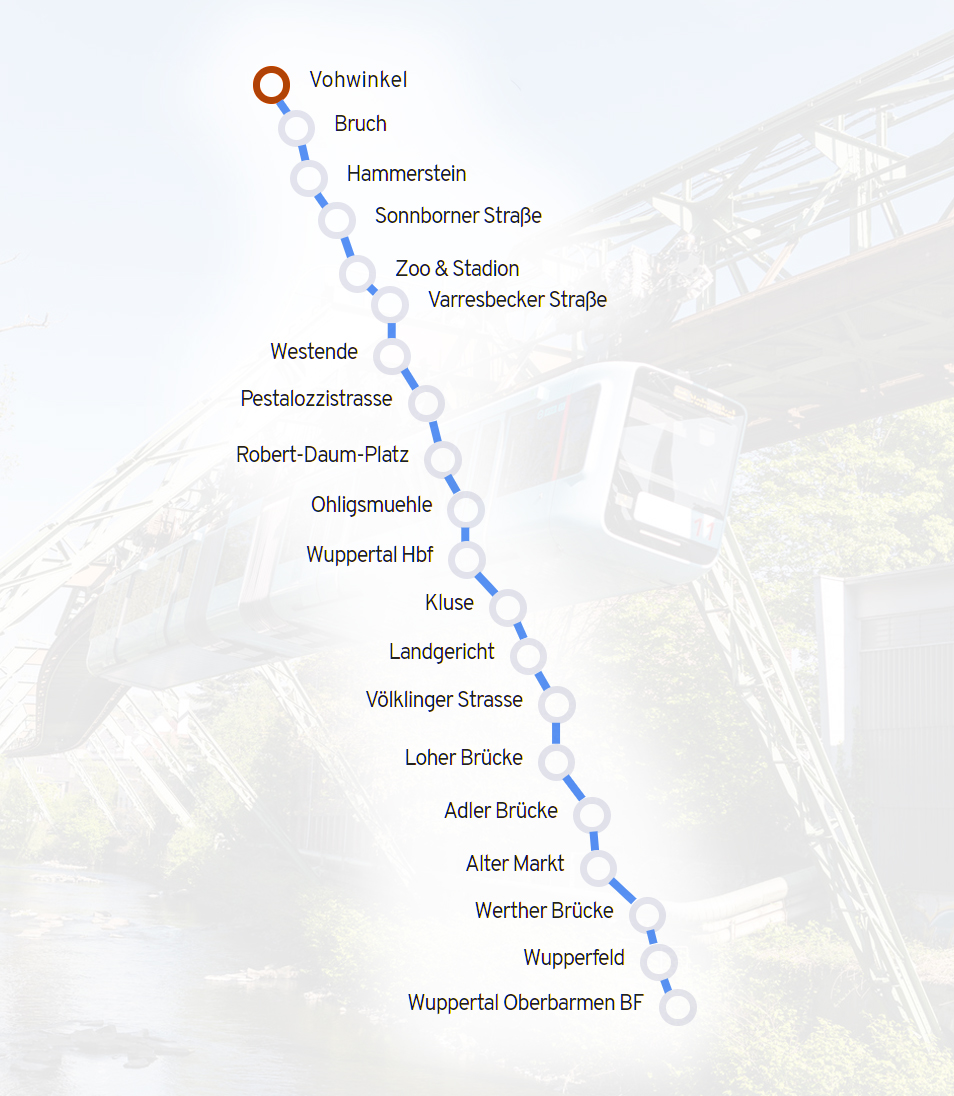
Wuppertal Railway Lines and Stations
The Wuppertal Suspension Railway runs on one line across the Vohwinkel-Oberbarmen route. The 13.3 km (8.3 miles) line is grade-separated, so it avoids road traffic and keeps a steady path through the valley.
The route starts at Oberbarmen in the east and ends at Vohwinkel in the west. For much of the journey, the train hangs above the River Wupper; between Sonnborner Straße and Vohwinkel, it runs above the valley road. It also crosses the A46 motorway at one point.
| Station | Details |
|---|---|
| Oberbarmen | Eastern terminus of the route |
| Wupperfeld | Station on the eastern section of the line |
| Werther Brücke | Near the Schwebodrom attraction |
| Alter Markt | Station on the central-eastern part of the route |
| Adlerbrücke (Opernhaus) | Serves the Opernhaus area |
| Loher Brücke (Junior-Uni) | Station serving the Junior-Uni area |
| Völklinger Straße | Station along the River Wupper section |
| Landgericht | Near the Regional Court area |
| Kluse | One of the stations on the first section opened in 1901 |
| Hauptbahnhof (Döppersberg) | Central station area and key city access point |
| Ohligsmühle | Known for modern station architecture |
| Robert-Daum-Platz | Central-western station on the route |
| Pestalozzistraße | Station between Robert-Daum-Platz and Westende |
| Westende | Station on the western half of the line |
| Varresbecker Straße | Station before the Zoo/Stadion area when traveling west |
| Zoo/Stadion | Useful for Wuppertal Zoo and the stadium area |
| Sonnborner Straße | Near the section where the line leaves the river alignment |
| Hammerstein | Western section station |
| Bruch | Station before Vohwinkel when traveling west |
| Vohwinkel | Western terminus; the depot is located here |
Service opened in stages: Kluse to Zoo/Stadion on 1 March 1901, the western extension to Vohwinkel on 24 May 1901, and the eastern section to Oberbarmen on 27 June 1903. Many stations have since been rebuilt or technically modernized, keeping the system useful for local transport as well as visitors following the stations map or stations list.
Prices, Tickets, and Fares
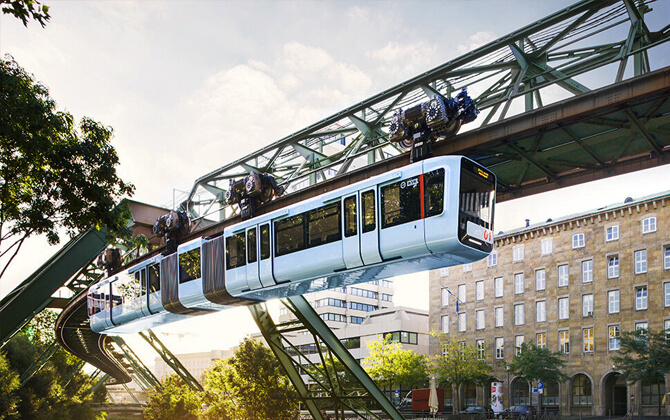
The Schwebebahn is part of the Verkehrsverbund Rhein-Ruhr fare system, so VRR tickets and the Deutschlandticket are accepted. In practice, that makes it easy to combine the suspension railway with bus and other city transport in Wuppertal.
For a typical journey, the fare is listed as €2.70, about $2.90. Other fare references mention adult single ticket prices of €2.50 to €2.90, about $2.70 to $3.10, and child fares of €1.50 to €1.70, about $1.60 to $1.80. Check the current ticket price before traveling, especially if you are comparing a single ticket with a day pass.
| Key | Information |
|---|---|
| Typical single fare | €2.70, about $2.90 |
| Adult single fare references | €2.50 to €2.90, about $2.70 to $3.10 |
| Child fare references | €1.50 to €1.70, about $1.60 to $1.80 |
| 24-hour ticket reference | €7.20, about $7.80 |
| 48-hour ticket reference | €13.70, about $14.80 |
Day tickets are useful if you plan several trips or want a simple sightseeing pass for railway and bus travel in Wuppertal.
| Key | Information |
|---|---|
| 1 person day ticket | €6.80, about $7.30 |
| 2 people day ticket | €10.00, about $10.80 |
| 3 people day ticket | €13.20, about $14.30 |
| 4 people day ticket | €16.40, about $17.70 |
| 5 people day ticket | €19.60, about $21.20 |
A Kombi Ticket Zoo is also available for visitors heading to Wuppertal Zoo. It combines Schwebebahn travel with zoo admission, which can be convenient if the zoo is part of your route plan.
| Key | Information |
|---|---|
| Adult Kombi Ticket Zoo | €14.50, about $15.70 |
| Child Kombi Ticket Zoo | €7.00, about $7.60 |
| Small group: 1 adult and 3 children | €28.50, about $30.80 |
| Group: 2 adults and 3 children | €37.00, about $40.00 |
| Alternative adult zoo ticket reference | €15.00, about $16.20 |
| Alternative child zoo ticket reference | €8.00, about $8.60 |
There is no separate fare calculator described here, so use the current VRR fare information when you need the exact cost for your ticket type.
Schedule, Calendar, and Timetables
The Wuppertal Suspension Railway runs daily, with operating hours from about 5:30 a.m. to 11:00 p.m. These opening hours cover most local transport needs, but late-evening travelers should pay attention to the closing time and the last train.
Typical frequency is every 8 to 10 minutes. During weekday rush hours, trains can run about every 4 minutes; on Saturdays, peak timings are around every 6 minutes. Sunday service is steadier, with trains every 8 to 10 minutes throughout the day.
| Service detail | Timings |
|---|---|
| Operating hours and opening times | About 5:30 a.m. to 11:00 p.m. |
| Typical train schedule | Every 8 to 10 minutes |
| Weekday rush-hour frequency | About every 4 minutes |
| Saturday peak frequency | About every 6 minutes |
| Sunday schedule | Every 8 to 10 minutes |
| Full route running time | About 30 minutes |
If you are checking the schedule today or planning a transfer, look at the current timetable before you go. The route timetable is especially helpful for time-sensitive trips across the 20 stations.
Connections to Other Systems
The Schwebebahn is integrated into the VRR network and accepts tickets issued by VRR companies, including the Deutschlandticket. That means it works as part of regional public transport, not as an isolated attraction with its own separate fare system.
The line also has an international connection. Since 2018, Wuppertal’s Schwebebahn has been paired with the Shonan Monorail in Kanagawa, Japan, and the two systems have marked the relationship through joint campaign activities.
Vohwinkel is notable because the depot is located there. The line’s terminus stations and central stops also help connect the suspension railway to Wuppertal’s wider transport pattern.
Connection to the Airport
Wuppertal does not have its own airport. The nearest airport mentioned for this route is Düsseldorf Airport.
By public transport, the trip can take up to about one hour. From Vohwinkel, walk around 500 meters (0.5 km / 0.3 miles) to Wuppertal-Vohwinkel station, continue via Sonnborn, and transfer toward the central station of the Düsseldorf Metro. From there, the ride to Düsseldorf Airport station takes about four minutes, followed by a short walk to the terminal.
If you are traveling from Düsseldorf Airport to Wuppertal, follow the same route in reverse. It is a manageable connection, but give yourself extra time if you have luggage or a flight deadline.
Tips and Rules
Riding the Schwebebahn is simple, but a few small choices make the trip better. If you want the classic view of the train floating through the city, sit at the back when you can.
- Sit at the back for the best views and photo opportunities.
- Use your valid public transport ticket if you already have one for the VRR network.
- Stand behind the white line on the platform while waiting for the train.
- Keep your ticket ready, since validation may be required in some cases.
- Expect a gentle sway as the train hangs above the river and city streets.
The line is 13.3 km (8.3 miles) long, and a full round trip takes around one hour. It is an easy way to see Wuppertal, especially if you combine the ride with stops at the zoo, city center, or Werther Brücke.
The end stations also provide access to Deutsche Bahn services, making the Schwebebahn useful for both sightseeing and everyday transportation in Wuppertal.
History
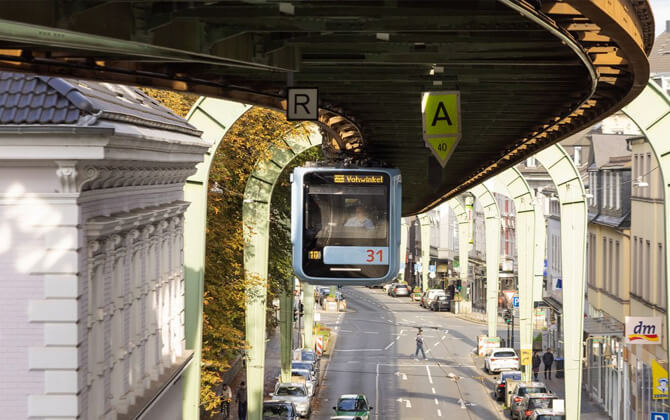
The idea behind the Schwebebahn goes back well before its opening. In 1824, British engineer Henry Robinson Palmer presented a single-rail suspension railway with horse-drawn carriages. Friedrich Harkort, a Prussian industrial entrepreneur and politician, saw potential in the concept for moving coal through the Wupper valley.
Harkort built a demonstration section in Elberfeld in 1826, but the plan stalled after protests from the transport sector and mill owners whose businesses were not on the proposed route. Interest returned in the late 19th century, when Elberfeld and Barmen formed a commission in 1887 to study an elevated railway.
In 1894, the cities chose the system developed by Eugen Langen of Cologne. The project was licensed by the City of Düsseldorf in 1896, and construction began in 1898 under government master builder Wilhelm Feldmann.
The railway opened in stages. Emperor Wilhelm II joined a trial run on 24 October 1900, and the first public section opened in 1901. The full line was completed on 27 June 1903. Around 19,200 tonnes of steel were used for the supporting frame and stations, and construction cost 16 million gold marks.
The Schwebebahn became part of daily city life almost immediately. It connected the communities along the Wupper and helped support the growth that later led to the formation of Wuppertal. After heavy bombing during World War II, the railway reopened in 1946 and returned to full operation less than a year after the fighting in Europe ended.
Modernization continued in the 21st century. Stations and structures were rebuilt in the early 2000s, the system was temporarily shut down in 2009 because of safety concerns, and older support structures were renewed in 2010. Generation 15 trains began entering service in 2016, gradually replacing the older GTW 72 cars. A museum devoted to the Schwebebahn also opened in 2016.
Future Extensions
The future of the Wuppertal Suspension Railway is mainly about modernization, reliability, and maintenance rather than a new route expansion. A renovation program that began in the 1990s and continued through 2014 renewed major parts of the system while keeping the railway’s role in local transport intact.
Recent work has focused on safety, comfort, and dependable service. This includes a new digital control system introduced in 2019, retrofit work on vehicles, and the gradual integration of the current fleet into regular operation.
The railway’s operating speed has been planned at up to 60 km/h (37 mph), supporting efficient service along the 13.3 km (8.3 miles) route. Station upgrades are part of the same long-term effort, including the renovation of the historic Döppersberg station and other modernization projects.
The line’s future also includes preserving its character. The Kaiserwagen’s return for guest test runs and anniversary events shows how historic elements remain visible alongside the modern trains used every day.
Fun Facts
- The Wuppertaler Schwebebahn is the oldest electric elevated railway with hanging cars in the world.
- Its original German name was Einschienige Hängebahn System Eugen Langen, but it was too long for everyday use.
- Eugen Langen first offered the technology to Berlin, Munich, and Breslau, but all three cities rejected it.
- Barmen, Elberfeld, and Vohwinkel supported the idea because it could connect communities along the River Wupper.
- The line is 13.3 km (8.3 miles) long and runs about 12 meters (39 feet) above the River Wupper in one section and about 8 meters (26 feet) above the valley road in another.
- It carries about 25 million passengers a year, and more recent reports describe daily use of roughly 80,000 passengers.
- Emperor Wilhelm II rode the Schwebebahn during a test run on 24 October 1900.
- The Kaiserwagen from that era is still associated with excursions, special occasions, and charter trips.
- The line’s first and only fatal accident happened in 1999 near Robert-Daum-Platz during maintenance work.
- A baby elephant named Tuffi became famous after a 1950 publicity stunt ended with a fall into the River Wupper.
- In 2018, the Schwebebahn formed a sister-railway relationship with the Shonan Monorail in Japan.
Nearby Attractions
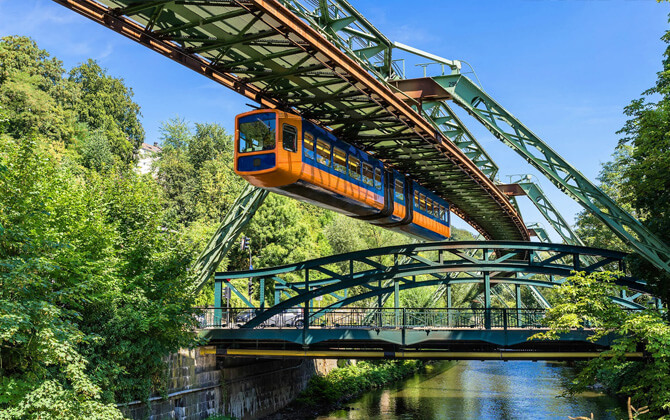
The Wuppertal Suspension Railway is easy to combine with several city attractions. At Werther Brücke station, the Schwebodrom offers a museum experience and a virtual-reality trip back to Wuppertal in 1929.
Wuppertal Zoo is another strong stop, especially for its hilly setting, large lion enclosure, and penguin enclosure with an underground glass tunnel. Near Zoo/Stadion, the train also passes Support 100, one of the line’s engineering highlights.
In the city center, the route gives convenient access to shopping areas, the Von der Heydt Museum, the Historic City Hall, and the Luisenviertel district. Ohligsmühle and Kluse stand out for modern station architecture, while the nearby Regional Court building is one of the oldest in Germany.
On the north side of the Wupper, the Hardt local recreation area and Botanical Garden offer green space and wide views. South of the river, the Waldfrieden sculpture park by Tony Cragg adds an artistic stop to the ride.
Other sights along the line include Kaiserstraße in Vohwinkel, the Bayer plant grounds, the Briller neighborhood with its historic villas, and the Schwebodrom at Werther Brücke.
Weddings on the Nostalgic Kaiserwagen
From 2024 onward, visitors can once again experience the nostalgic Kaiserwagen, often described as Wuppertal’s floating parlour. It gives passengers a taste of the railway’s early years while still feeling like a living part of the system.
The carriage is a replica of the original car that took Emperor Wilhelm II and Augusta Victoria on a test ride in 1900. The original Kaiserwagen has also been carefully preserved and is used for special events and celebrations, including weddings.
Today, the replica can be used for private charters such as weddings, meetings, and ceremonies. It is also used for tourist rides and promotional purposes by the railway operators.
For couples looking for an unusual venue, the Kaiserwagen offers a memorable setting on one of Germany’s most iconic transport systems.