Public transportation in Munich is easy to use and well connected, so getting around without a car is straightforward. The city transport system combines U-Bahn, S-Bahn, tram, and bus services, with airport links, night routes, and app-based ticket options that make local transport simple for visitors and residents alike.
| Key | Information |
|---|---|
| Main public transport modes | U-Bahn, S-Bahn, tram, and bus |
| Ticket coverage | MVV and MVG tickets are valid across all four modes of transport |
| Digital ticket option | MVV Swipe in the MVV app and MVGO app |
| Useful passes | Zone M day ticket, Airport City Day Ticket, Munich Card, Munich City Pass |
| Airport rail links | S1 and S8 |
| Best for planning | MVGO app with real-time connection information and navigation |
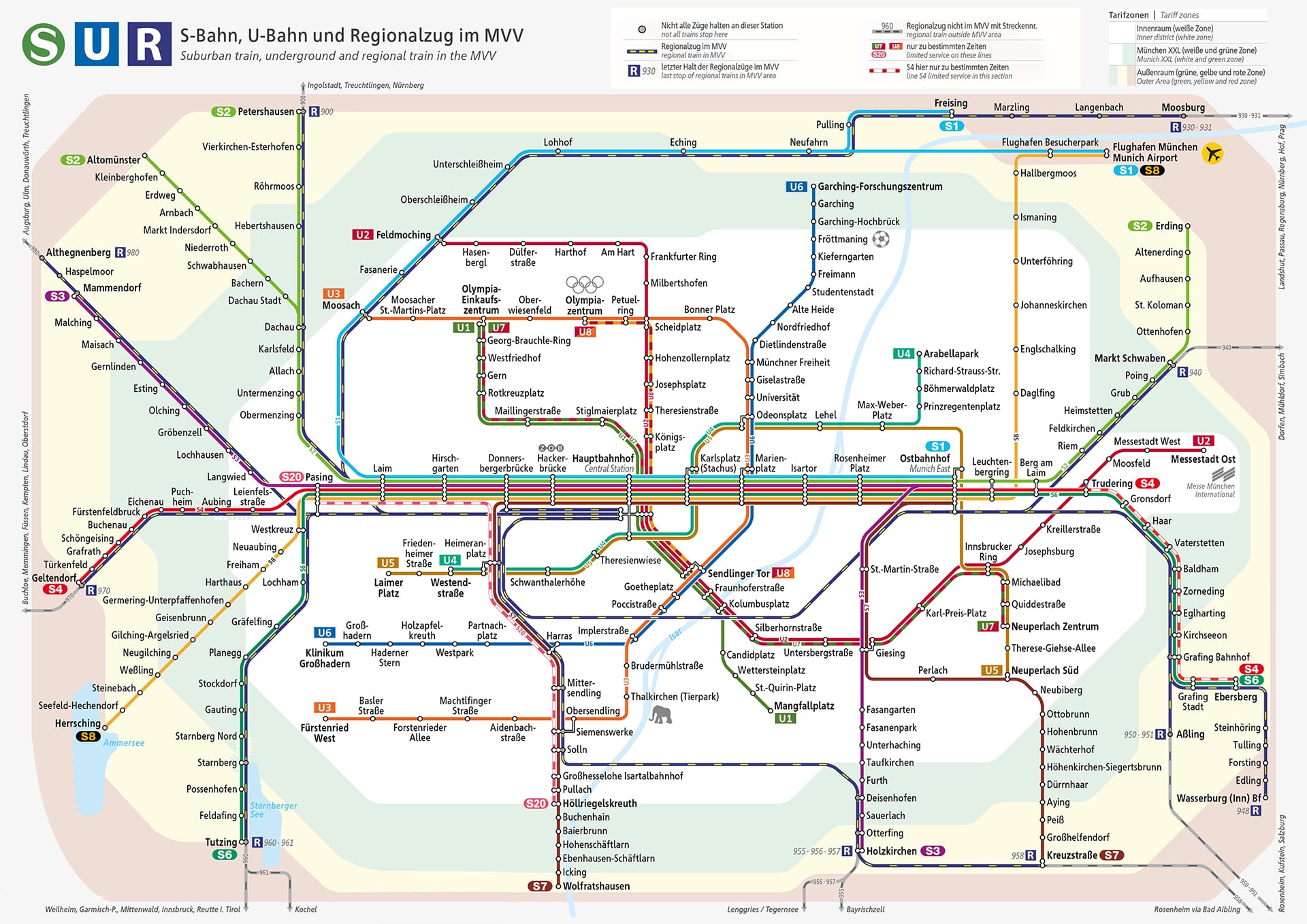
Munich Public Transportation Map
Map of Munich Public Transportation showing different lines. Click on the map to enlarge it or download the Public Transportation map in PDF format.
Getting around in Munich
Getting around Munich is simple even without a car. You can combine public transport with walking, bike hire, e-scooters, or taxis depending on your plans and pace.
For most visitors, the main options are the U-Bahn, S-Bahn, buses, and trams. The U-Bahn is best for fast city travel, while the S-Bahn also reaches the surrounding area. Buses and trams fill in the gaps and are especially useful in outer districts. Selected lines also run at night.
If you want simpler ticketing, the MVV Swipe function in the MVV app or MVGO app lets you swipe in and out and pay for the route you actually traveled. If you expect to make more than two trips in a day, a Zone M day ticket or Airport City Day Ticket may cost less.
For sightseeing, the Munich Card and Munich City Pass combine transport with free or discounted entry to many attractions. You can also choose bike hire, hop-on hop-off buses, car-sharing, or e-scooters.
Public transport in Munich
Munich public transport is built around four main modes: U-Bahn, S-Bahn, tram, and bus. The U-Bahn and S-Bahn are the backbone of the system. Since January 2025, subway trains have also been running at night on weekends and before public holidays.
MVG buses and trams are a practical option for both daily travel and sightseeing. They cover areas beyond the city center, and the night network helps with late travel throughout the week.
Two tram routes stand out for visitors. Tram 19 passes Karlsplatz-Stachus, the National Theatre, and the Maximilianeum. Tram 16 runs from Effnerplatz to Stachus and passes the Bayerisches Nationalmuseum, Haus der Kunst, Isartor, and Sendlinger Tor.
Fare zones and tickets
Munich uses fare zones. Zone M covers the entire city area and some neighboring municipalities, while zones 1 to 12 surround Munich. Munich Airport is in zone 5, so travel between the airport and the city center requires a ticket for zone M-5.
Available ticket types include single tickets, stripe cards, day tickets, and tourist tickets. MVV Swipe in the MVV app or MVGO app is an easy option for occasional users. A single ticket fits a one-way trip, while a day pass is usually better if you make more than two journeys in one day.
Useful ticket options include the Single Day Ticket, Children’s Day Ticket, Group Day Ticket, and Airport-City-Day-Ticket. The Munich Card includes an MVV day ticket in the selected validity area and offers discounts at many attractions, shops, and dining partners. The Deutschlandticket is also available for broader travel.
Mobility apps, bike hire, and other ways to travel
The best-known apps are the MVV app and MVGO app, both free to use. They show bus, tram, U-Bahn, and S-Bahn connections, live departure timings, and MVV Swipe. DB Navigator is also useful for regional journeys and trips beyond the city.
Munich is bike-friendly and has many cycle paths. Bike hire is a popular way to explore, and if you bring your own bike on the U-Bahn or S-Bahn, you can use a bicycle day ticket. Just keep rush-hour restrictions in mind.
Other options include hop-on hop-off buses, taxis, transport services, car-sharing, e-scooters, and walking.
Tram and bus networks in Munich
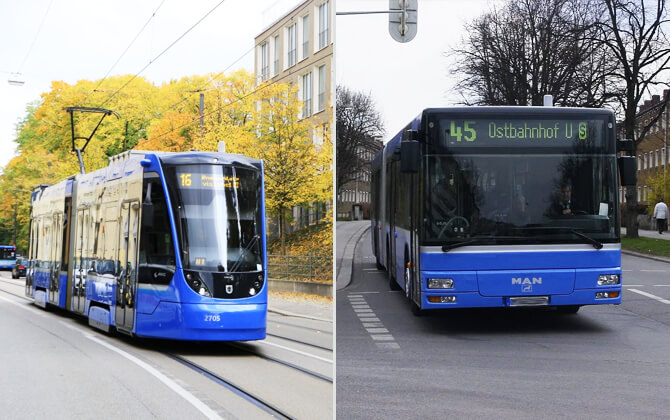
Munich’s tramway and bus network is part of a well-developed public transport system run by MVG in partnership with MVV. Along with the U-Bahn and S-Bahn, they form the core of city transport in Munich.
The tram network covers more than 80 kilometers, or about 50 miles, and connects smoothly with bus, U-Bahn, and S-Bahn services. Buses reach districts beyond the center, so they are especially useful for less central trips. Both trams and buses also have night lines marked with an “N” before the route number.
One ticket works across the whole MVV and MVG system, so you do not need a new ticket when changing between tram, bus, U-Bahn, or S-Bahn. You can buy a ticket at machines, on buses and trams, or in the MVGO app.
For visitors, trams and buses are a practical way to explore the city. They are handy for sightseeing, everyday transport, and late journeys during the week.
- Tram lines connect with the MVG bus network, the U-Bahn, and the S-Bahn.
- Night services run on both trams and buses.
- Tickets are valid across the full public transport system.
- Tickets are available from machines, on board, and in the MVGO app.
| Station | Details |
|---|---|
| Tram 19 | Passes Karlsplatz-Stachus, the Nationaltheater, and the Maximilianeum. |
| Tram 16 | Runs from Effnerplatz to Stachus and passes the Bayerisches Nationalmuseum, Haus der Kunst, Isartor, and Sendlinger Tor. |
For route planning, the MVV search tools and the MVGO app help with connections, route timetable checks, and ticket choice.
Taxi cab service in Munich
Taxis are the most individual transport option in Munich, especially if you are short on time or carrying luggage. They are a flexible alternative to public transport for trips around the city and the surrounding area.
Since September 2023, fixed prices can be agreed for taxi rides in Munich, but only if you book in advance by phone or app. If you take a cab from a taxi stand or hail one in the street, the fixed fare option does not apply.
How to call a taxi in Munich
There are three main ways to get a taxi in Munich. You can hail one on the street if the yellow roof sign is lit, go to a taxi stand, or book by phone or app for pickup at your location. In central areas such as the main station or Odeonsplatz, taxi stands usually have several cars waiting.
Taxi centers in Munich
The two main taxi centers are generally available around the clock.
| Station | Details |
|---|---|
| Taxi-München eG | Phone: 089-21 610 or 089-19 410; E-Mail: [email protected] |
| IsarFunk Taxizentrale GmbH & Co. KG | Phone: 089-450 540; E-Mail: [email protected] |
Taxi fares in Munich
Taxi fare rules in Munich are regulated. For spontaneous rides, the total price depends on distance traveled, and there is also a minimum fare. Waiting time is charged as well when the taxi is idle.
Munich has the highest taxi density in Germany, with 2.5 taxis per 1,000 inhabitants.
Fixed prices for taxi rides
For pre-booked rides, passengers can agree on a fixed ticket price for the trip. That agreed cost still applies if there are traffic jams or detours. The city sets limits for these fares and monitors them.
Taxis at Munich Airport
Taxi ranks are available in the departure and arrival areas of Terminal 1 and Terminal 2. The taxi service point is on level 03 in Terminal 2. Taxis are a straightforward option for airport transfers between Munich Airport and the city.
SIXT ride taxi service in Munich
You can also book licensed local taxis through the SIXT app in cooperation with Taxi München eG and Isarfunk. The app allows advance booking or immediate pickup, driver tracking, and cashless payment by linked card.
The service operates 24/7 within about 45 kilometers, or 28 miles, of central Munich.
Munich S-Bahn system
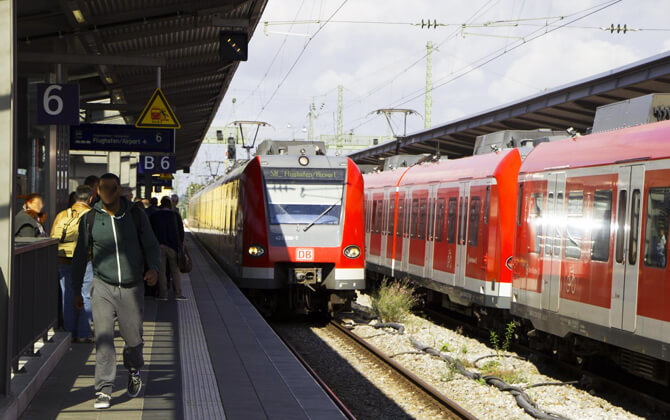
Munich’s S-Bahn is one of the four pillars of the public transport system. It opened in 1972 as part of the modernization linked to the Olympic Games and now connects the city, the wider region, and Munich Airport.
The network has eight lines and almost 150 stations. Its core route through the city center offers frequent service and flexible travel options. S1 and S8 both connect the airport with central Munich. The running time to the city center is about 35 minutes, and trains leave alternately every 10 minutes.
S-Bahn stations are marked with a white S on a green background, so they are easy to spot. The system is fully integrated with the rest of Munich public transport, which means passengers can transfer between S-Bahn, U-Bahn, tram, and bus using the same valid ticket.
| Service detail | Timings |
|---|---|
| Operating hours | Approximately 4:15 am to 1:00 am daily |
| Rush hour frequency | Every 10 minutes |
| Daytime frequency outside rush hour | Every 20 minutes |
| Night frequency | Every 20 to 40 minutes |
| Friday, Saturday, and nights before public holidays | Service runs through the night |
| Airport route timetable | S1 and S8 depart alternately every 10 minutes; about 35 minutes to the city center |
With a network length of 530 kilometers, or about 329 miles, Munich’s S-Bahn is one of the largest in Germany. It carries up to 840,000 passengers a day and reaches places beyond the city, including Dachau and Starnberg. Expansion and modernization continue, with new trains, upgraded infrastructure, and a second trunk line under construction.
Munich U-Bahn train service
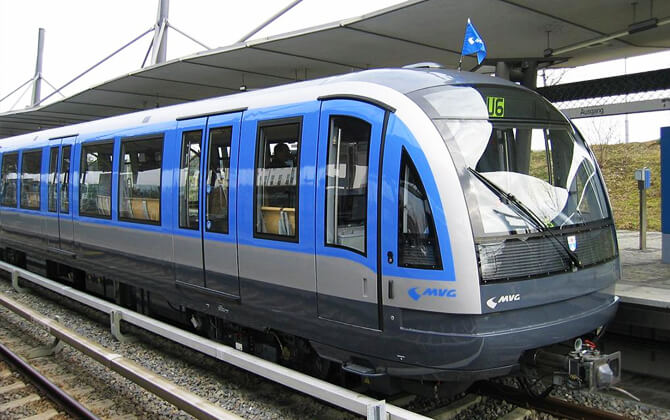
The Munich U-Bahn is an electric rapid transit system operated by MVG and integrated into the MVV network. It opened on 19 October 1971 and works closely with the S-Bahn as a key part of local transport.
Today, the system has eight lines, 96 stations, and about 95 kilometers, or 59 miles, of track. In 2024 it carried 452 million passengers. Trains reach speeds of up to 80 km/h, or about 50 mph, making it the fastest German U-Bahn.
Service pattern and night operation
The U-Bahn runs frequently throughout the day. During peak periods, frequency is generally every 5 minutes and can be as short as 2 minutes on shared sections. Off-peak service is usually every 10 minutes. Early morning and late evening service is less frequent.
| Service detail | Timings |
|---|---|
| Peak frequency | Generally every 5 minutes; as short as 2 minutes on shared sections |
| Off-peak frequency | Usually every 10 minutes |
| Weekday closing time | Service stops between 1:00 am and 4:00 am |
| Weekend closing time | Service stops between 2:00 am and 4:00 am |
| Night service on Fridays, Saturdays, and nights before public holidays | Since 2025, all six main lines run every 30 minutes |
These opening hours and working hours can vary on special occasions such as New Year’s Eve.
Line structure and shared sections
Three line pairs share tracks in the city center with coordinated train schedule planning:
- U1 and U2
- U3 and U6
- U4 and U5
Most stations have two tracks with an island platform. Some use side platforms, including Olympia-Einkaufszentrum on U1, Richard-Strauss-Straße on U4, Neuperlach Süd on U5, and Garching-Hochbrück and Nordfriedhof on U6.
Major interchange stations have more complex layouts. Scheidplatz and Innsbrucker Ring have four tracks with two island platforms for cross-platform interchange. Hauptbahnhof and Münchner Freiheit each have four tracks on one level, while Implerstraße, Max-Weber-Platz, and Kolumbusplatz use three-track layouts. Hauptbahnhof also has a separate higher-level station for U4 and U5, bringing the total to six tracks.
Sendlinger Tor, Odeonsplatz, and Olympia-Einkaufszentrum have two levels connected by escalators and lifts.
U6 is the only line that leaves Munich, continuing north to Garching. All other lines stay underground within the city, except U5 at Neuperlach Süd and U6 between Studentenstadt and Garching, where parts of the route run above ground.
Operating notes
MVG uses two main train formations: Langzug, a long train made up of three Class A/B units or one Class C1/C2 set, and Kurzzug, a short train made up of one or two Class A/B units. Kurzzug services were temporarily suspended during the COVID-19 pandemic in 2020.
The U3/U6 corridor is especially prone to interruptions because of high passenger volumes, technical issues, and maintenance work. This is one reason behind plans for the future U9 line.
Basic network facts
| Key | Information |
|---|---|
| Opening date | 19 October 1971 |
| Operator | MVG |
| Lines | 8 |
| Stations | 96, or 100 when interchange stations with separate levels are counted twice |
| Track length | About 95 km (59 miles) |
| Passengers in 2024 | 452 million |
Airport Connections
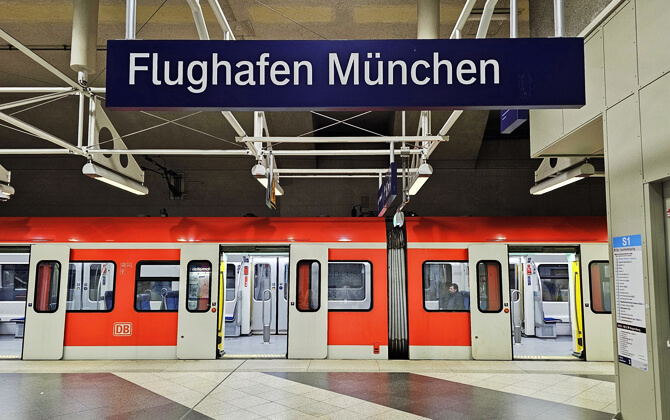
Munich Airport is linked to the city center by S-Bahn, airport buses, regional trains, and transfer services. For most travelers, the main public transport connection is the S1 or S8. Both lines run through central Munich with stops including Marienplatz and the main station.
The trip to the main railway station takes about 40 minutes. Because S1 and S8 run in alternating intervals, there is usually a connection every 10 minutes between the airport and the city.
Inside the airport, walking distances can be longer than expected. Depending on your terminal area or gate, you may also need a shuttle bus or shuttle train, so leaving extra time is a smart move.
| Station | Details |
|---|---|
| Visitors Park | Serves administration, cargo, and parking areas including P41, P43, P44, P50, P51, P90, P91, and P92. |
| Flughafen München | Serves Terminal 1 and Terminal 2. |
If you are making several trips in one day, a day pass may be the better-value ticket. Depending on your route plan, the Zone M day ticket or the Airport City Day Ticket can be useful. Tickets are sold at machines and in the MVGO app, which also shows live timetable and schedule information.
Other airport transport options include the Lufthansa airport bus, transfer buses, parking-area shuttle services, and regional train connections from eastern Bavaria.
Tips and Rules
Munich’s transport system is reliable and fairly easy to use once you know the basics. MVV and MVG tickets are valid across U-Bahn, S-Bahn, tram, and bus, so changing between modes is simple.
- Children under 6 travel free.
- Single tickets, stripe tickets, and day tickets must be validated before the journey starts.
- Paper tickets are still common, so keep your ticket safe and ready for inspection.
- Ticket checks can happen without warning, and fines for traveling without a valid ticket can be high.
- A regular single ticket is one-way only and cannot be used for a return trip.
If you are staying mainly in the city, Zone M is usually the key fare area to know. Trips across more zones cost more. If you are unsure, the MVV search can help with fare calculator-style route checks and ticket choice.
For airport travel, S1 and S8 are the main train schedule options. Both connect Munich Airport with the city center in about 35 minutes and leave alternately every 10 minutes.
If you plan several trips in one day, a day ticket is often the best-value pass. For groups, the Group Day Ticket is especially practical because it allows up to five adults to travel together within the selected area.
You can buy tickets at machines in U-Bahn and S-Bahn stations, on buses and trams, or online in the MVGO app. The app is also helpful for route planning, timetable checks, and live schedule today information.
One useful tip: watch for short underground trains on quieter routes. They stop only along part of the platform, so check the departure screens carefully.
Nearby Attractions
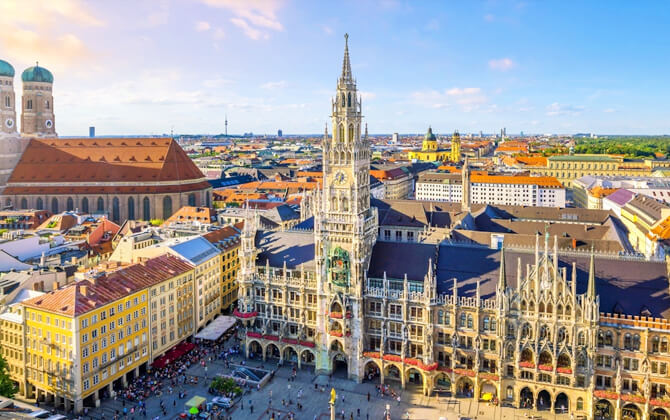
Many of Munich’s best-known sights are easy to reach by public transport. The city’s U-Bahn, S-Bahn, tram, and bus stations put major attractions within simple walking distance or a short connecting ride.
| Station | Details |
|---|---|
| Marienplatz | Close to the Neues Rathaus, the Glockenspiel, Viktualienmarkt, and St. Peter’s Church. |
| Hauptbahnhof | A convenient stop for the Kunstareal, including the Alte Pinakothek and Pinakothek der Moderne. |
| Odeonsplatz | Near the Residenz, the Feldherrnhalle, and the Hofgarten. |
| Theresienwiese | Known for Oktoberfest and the Bavaria statue. |
| Sendlinger Tor | Useful for the historic gate and a lively shopping area. |
| Olympiazentrum | Serves the Olympic Park, BMW Museum, and BMW Welt. |
| Schwabing-Freimann | Useful for the English Garden and the Monopteros viewpoint. |
| Karlsplatz/Stachus | A central hub for shopping, dining, and historic Karlsplatz. |
| Dachau | Connects to the Dachau Concentration Camp Memorial Site with a short bus ride. |
For visitors who want to combine transport with sightseeing, the Munich Card and Munich City Pass can be especially useful.