The Gelsenkirchen tram is part of the wider BOGESTRA public transport system in the Ruhr region of western Germany. Although it is sometimes described as a metro or Stadtbahn, it is mainly a tramway and light rail network, with underground stations in the city centre and direct links to places such as Bochum and Essen. For most visitors, the key tram lines are 107, 301, and 302, all serving Gelsenkirchen Hauptbahnhof and connecting major stations, city districts, and regional transport.
| Key | Information |
|---|---|
| Operator | BOGESTRA |
| System type | Tramway and light rail style public transport system |
| Main lines in Gelsenkirchen | 107, 301, 302 |
| Main hub | Gelsenkirchen Hauptbahnhof |
| Network links | Bochum, Essen, buses, regional rail, and S-Bahn |
| General operating hours | From around 4:00 AM until after midnight, depending on the line |
| Ticket rule | A valid ticket is required before entering trams in underground stations |
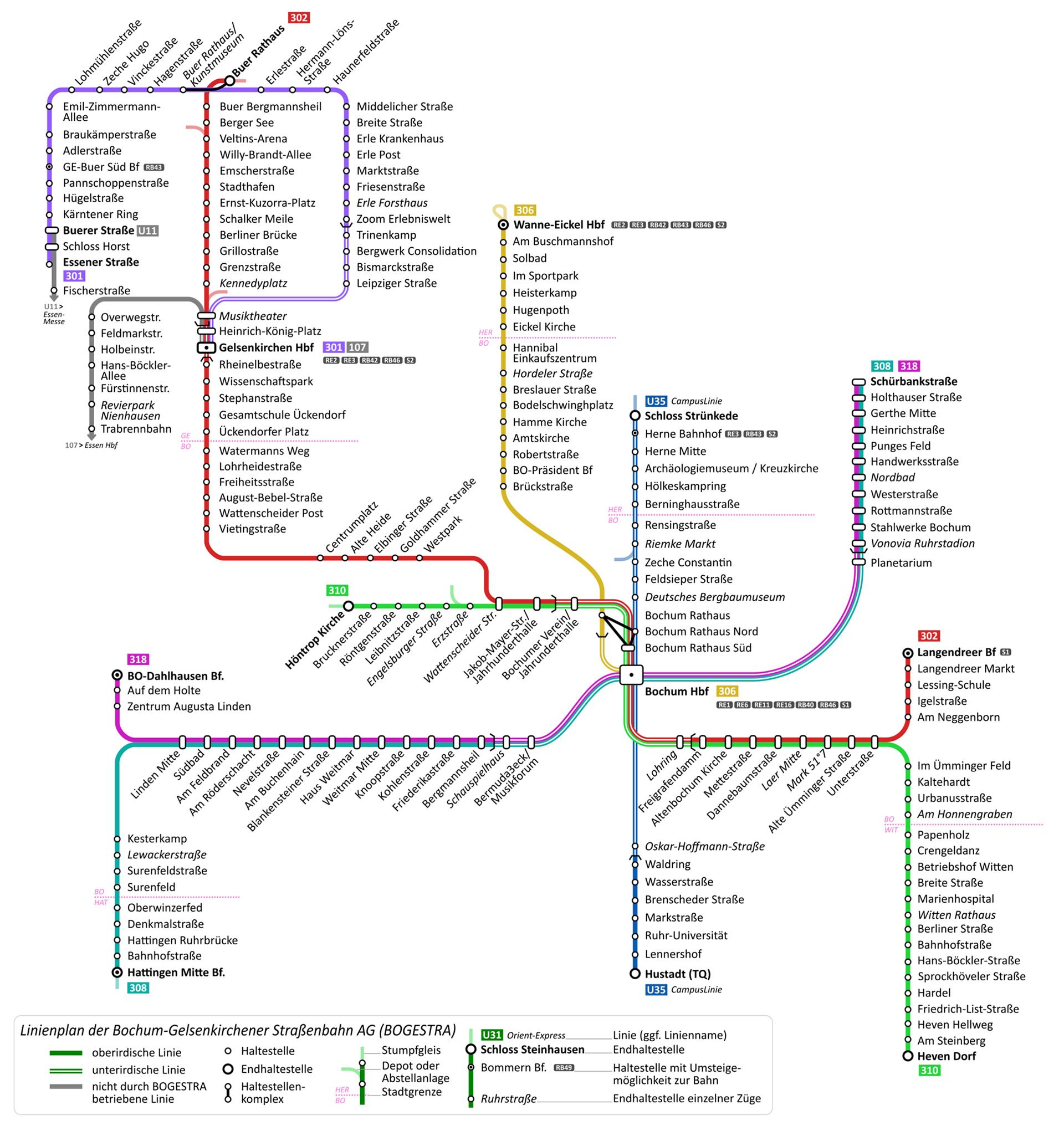
Gelsenkirchen Tram Map
Map of Gelsenkirchen tram showing different lines. Click on the map to enlarge it or download the Gelsenkirchen tram map in PDF format.
Lines and Stations
The Bochum-Gelsenkirchen tram system has seven lines in total, but three lines serve Gelsenkirchen directly. These are the core routes most passengers use for city transport and wider Ruhr connections.
| Station | Details |
|---|---|
| Line 107 | One of the longest routes in the system. It has 34 stations, including 11 in the BOGESTRA area, and runs between Gelsenkirchen Hbf and Bredney with a stop at Essen city station. In 2010, it was named the Culture Line because it passes historic and cultural sites. |
| Line 301 | The only line used exclusively in Gelsenkirchen. It has 34 stations and more than 7.4 million annual passengers. Starting at Gelsenkirchen Hbf, the route passes through seven underground stations, then continues via Bismarck and Buer to Horst. |
| Line 302 | This route has 44 stations, including seven underground stations, and creates a direct path train connection between Gelsenkirchen Hbf and Bochum Hbf. In Gelsenkirchen, it runs to Gelsenkirchen-Buer Rathaus; in Bochum, to Laer Mitte. |
| Gelsenkirchen Hbf | The main interchange for tram lines 107, 301, and 302, with rail and S-Bahn connections. |
| Gelsenkirchen-Buer Nord | Provides indirect access to the S-Bahn network. |
| Gelsenkirchen-Hassel | Another point for indirect S-Bahn access. |
If you are looking for a stations map or stations list, Gelsenkirchen Hbf is the easiest place to start. It connects the main tram route network with regional rail and local transport across the city.
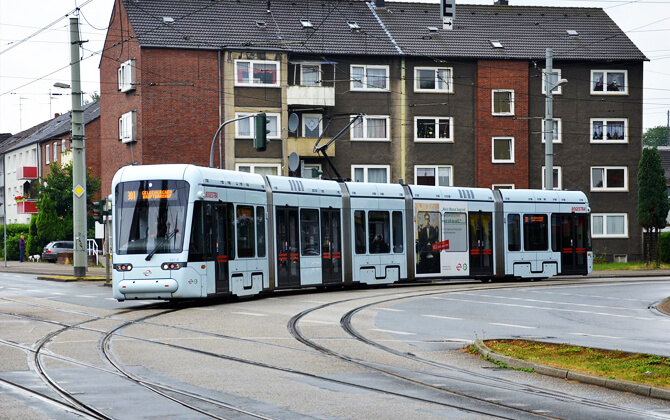
Opening hours and working hours vary by line, but service usually starts around 4:00 AM and continues until after midnight. Line 107 has a starting time of 4:28 AM and a closing time of 11:21 PM, with a frequency of about 20 minutes. Line 301 starts at 3:58 AM and has the latest last train in the system at 1:08 AM, with trains about every 10 minutes. Line 302 starts at 3:55 AM and runs until 12:15 AM, also with a 10-minute frequency.
Schedule, Timetables, and Calendar
The Gelsenkirchen tram does not run 24 hours a day. In general, operating hours begin in the early morning and continue until late evening or shortly after midnight, depending on the line.
If you need the timetable, schedule today, or timings today, it is worth checking station displays before you travel. Timetables are posted at station entrances and exits, and live updates help with route planning during the day.
| Service detail | Timings |
|---|---|
| General opening times | Service usually begins around 4:00 AM |
| General closing time | Usually after midnight, depending on the line |
| Line 107 | First train 4:28 AM; last train 11:21 PM; frequency about every 20 minutes |
| Line 301 | First train 3:58 AM; last train 1:08 AM; frequency about every 10 minutes |
| Line 302 | First train 3:55 AM; last train 12:15 AM; frequency about every 10 minutes |
For route timetable planning, line 107 has the longest interval between trams. Lines 301 and 302 run more often and are usually the main choice for quick travel through the city. If you are traveling late, check the running time and last train carefully, since services become more limited after midnight.
Tickets, Prices, and Cards
Gelsenkirchen tram tickets are based on distance, so the fare and ticket price depend on how far you travel and which VRR fare zone applies. The system uses four fare zones: A, B, C, and D. Zone A is split into A1, A2, and A3.
For short trips of fewer than three stops, a single ticket costs €1.60 ($1.73) for both adults and children. Adult single-ticket prices then rise by zone: €2.70 ($2.92) in Zone A, €5.80 ($6.26) in Zone B, €12.10 ($13.07) in Zone C, and €15.00 ($16.20) in Zone D.
| Ticket type | What to know |
| Single tickets | Best for one-way travel. Short trips under three stops cost €1.60 ($1.73). |
| Four-trip tickets | A multi-ride option with different prices for children and adults. |
| Ten-ride tickets | Useful if you expect to travel often. |
| Daily passes | Unlimited travel for one day within the chosen fare zone. |
| Seven-day passes | Unlimited rides for seven days. |
| Monthly cards | Available as calendar-month or 30-day passes, with optional extras such as dogs, luggage, or children. |
If you are comparing fare options, there is no fare calculator included here, but the basic rule is simple: the longer the trip, the higher the price. A day pass or pass for several days can make more sense than buying single tickets again and again.
German public transport often works on a proof-of-payment basis, so inspections may happen during the ride rather than at the platform. Make sure your ticket is valid or that your card has the right credit. For stays longer than a week, the Deutschland-Ticket at €49.00 per month ($52.92) can be a convenient option for local transport, though it does not cover long-distance trains.
Connections

Gelsenkirchen is well integrated into the Bochum-Gelsenkirchen tramway network and the wider VRR system. That means easy transfers between trams, bus services, S-Bahn, and rail, with connections to nearby towns such as Hattingen, Herne, and Witten.
From Gelsenkirchen Hauptbahnhof, you can use line 301 for the city centre, Buer, and Horst. Line 302 links Gelsenkirchen Hbf with Bochum Hbf and continues toward Buer Rathaus and Laer Mitte. Line 107 connects Gelsenkirchen Hbf with Essen, passing Feldmark, Trabrennbahn, Essen-Katernberg, Zeche Zollverein, and Essen Hbf.
Rail connections are available at Gelsenkirchen Hbf, including regional and long-distance trains. The S2 line of the S-Bahn Rhein-Ruhr also passes through the station, while Gelsenkirchen-Buer Nord and Gelsenkirchen-Hassel offer additional access via local transport and bus links.
Bus services are fully integrated with the tram system, including night buses. For travel toward Essen, passengers can also use the U11 Stadtbahn from Buerer Straße on line 301.
For transportation in Gelsenkirchen and the surrounding Ruhr area, the tram and bus network works as one connected system. That makes route changes fairly straightforward, even if your trip includes several forms of public transport.
Airport Connection
Gelsenkirchen does not have its own airport, so Düsseldorf Airport is the main air gateway for the city. The airport connection is not direct by tram, but it is easy enough by combining tram and rail.
From Gelsenkirchen VELTINS-Arena, the usual route is line 302 to Gelsenkirchen Hbf, then a train to D-Flughafen Bf, followed by the onward airport connection to the terminal. The full journey takes about 1 hour 19 minutes.
The draft fare for this airport trip is listed as ₴665–1,333, which is about $16.89–$33.85. Tram 302 from VELTINS-Arena to Gelsenkirchen Hbf takes around 16 minutes and runs every 15 minutes. By car, the trip takes about 36 minutes.
For airport travel, check the timetable and schedule in advance, especially for late departures or arrivals. After midnight, opening hours for public transport services become more limited.
Tips for Riding
For trips from Gelsenkirchen Hauptbahnhof to VELTINS-Arena, line 302 is the key route. It takes about 16 minutes and is the main public transport option for the stadium.
On match days and major events, trains can get crowded fast. Leave some extra time, stay patient, and follow staff instructions at stations.
If you use an underground station, buy your ticket before boarding and validate it if needed. Ticket machines are available at major stations.
If you already have a VRR ticket, a NRW-wide ticket such as the SchönerTagTicketNRW, or a DeutschlandTicket, these are accepted on Gelsenkirchen public transport. Match tickets may also include travel rights in the Ruhr area or across NRW, so it is worth checking before you go.
For accessibility, buses are low-floor and all trams are low-floor as well. The station directly at the arena is not wheelchair-accessible, so passengers with reduced mobility should use Willy-Brandt-Allee and allow about 10 minutes to walk. That is roughly 0.8 km or 0.5 miles, based on a typical walking pace.
Stops are announced on board and shown on screens, which makes the system easy to follow. If you are traveling late, check the last train and timetable in advance.
History
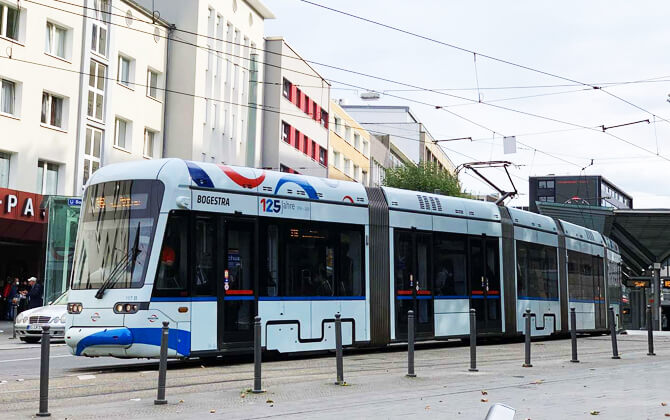
The Bochum-Gelsenkirchen tramway history goes back to the 1890s. Bochum opened its tram system in 1894, and Gelsenkirchen followed in 1895. Since then, the network has linked the two cities and served nearby towns including Hattingen, Herne, and Witten.
From the 1960s onward, rising road traffic pushed cities in the Rhine-Ruhr area to rethink urban transport. The long-term plan was to move key tram routes underground in central areas and develop them into Stadtbahn lines, while some less important routes would be replaced by bus services.
In 1969, several Ruhr cities founded Stadtbahngesellschaft Ruhr to coordinate this development. Düsseldorf and Hattingen joined in 1972, after which the organization became Stadtbahngesellschaft Rhein-Ruhr. Witten joined in 1981, while Recklinghausen left in 1982.
The original idea was ambitious, with plans to convert up to 300 km (186.4 miles) of tram lines. In practice, financial constraints and the regional economic downturn meant many sections were never built. The result was a mixed system of tramway and Stadtbahn infrastructure.
Modernization continued over time, especially through new rolling stock. The NF6D and type M high-floor articulated trams were retired by 2021 and replaced by Variobahn vehicles.
Future Extensions
BOGESTRA has planned major network changes under the Netz 2020 concept. The idea is to simplify the system, improve the route plan, and create mostly 15- and 30-minute headways, with overlapping routes producing a 7.5-minute frequency on many sections.
The main expansion plans include these revised or new tram lines:
- 305: Höntrop – Langendreer Bahnhof
- 309: Langendreer Bahnhof – Witten – Heven Dorf
- 310: New routing via Langendreer, with the Unterstraße – Papenholz section closed for revenue service and a new section from Langendreer Markt to Papenholz
- 316: Bochum-Gerthe, Heinrichstraße – Bochum-Hamme, with rush-hour service to Wanne-Eickel
The official start of Netz 2020 was scheduled for 15 December 2019. However, because the section between Langendreer Markt and Papenholz was not expected to be completed before the end of the following year, regular service was planned between Witten Crengeldanz and Heven Dorf using the remaining Düwag M6S trams.
The old track from Crengeldanz via Papenholz to Unterstraße will remain usable for depot and workshop access in Witten. Broader city transport planning for Bochum and Gelsenkirchen also points to future infrastructure work, including new low-floor platforms on selected corridors.
Fun Facts
Gelsenkirchen sits in the Rhine-Ruhr region, where cities are tightly linked by S-Bahn, Stadtbahn, and tramway networks. In practical terms, that means easy tram connections to both Bochum and Essen.
Even though parts of the system still feel like a traditional tram, some busy sections have been upgraded to light rail standard. Another distinctive feature is the 1000 mm gauge, rather than the standard 1,435 mm used by many other systems.
The network also has a punctuality policy: if a train arrives more than 10 minutes late, passengers can request a refund.
Advertising inside the system is allowed, with a minimum fee of €510 ($599.11).
Nearby Attractions
Gelsenkirchen has a strong industrial past, but today it also offers culture, parks, and major visitor attractions that are easy to reach by tram. The network makes it simple to combine sightseeing with short rides across the city and into the wider Ruhr area.
- Musiktheater im Revier – A major cultural landmark near the Musiktheater stop on line 301.
- Hans Sachs House – A modernist building from the 1920s, reachable from Heinrich-König-Platz on lines 107 or 302, followed by a short walk.
- Revierpark Nienhausen – A large park with spa facilities, massage centers, and an outdoor swimming pool, served by Nienhausen station on line 107.
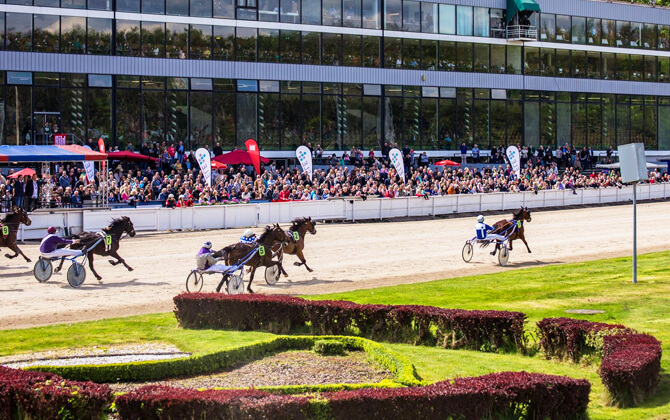
- Gelsenkirchen Racecourse – Also known as GelsenTrabPark, accessible from the Trabrennbahn stop on line 107.
- Zeche Zollverein – A famous industrial heritage site in Essen, reachable by the wider public transport network.
- ZOOM Erlebniswelt – A popular zoo in Gelsenkirchen, easy to reach by local transport.
With the tram system linking central districts, major stations, and nearby cities, getting around is straightforward. For visitors, that is one of the best things about public transport in Gelsenkirchen.