The Toulouse Metro, or Métro de Toulouse, is the rapid transit system serving Toulouse Métropole in France and the only metro system in Occitania. Managed by Tisséo Voyageurs under Tisséo Collectivités since 2003, the system uses automated VAL technology and forms a central part of public transport in Toulouse. The network has two mainly underground lines, Line A and Line B, 37 stations, and a total route length of 28.2 kilometres (17.5 miles). It connects with buses, trams, suburban rail, and Téléo, the urban tricable gondola line in the south of the city.
| Key | Information |
|---|---|
| System | Automated metro serving Toulouse Métropole |
| Lines | Line A and Line B |
| Stations | 37 stations |
| Route length | 28.2 kilometres (17.5 miles) |
| Technology | VAL driverless metro technology with rubber-tyred trains |
| Operator | Tisséo Voyageurs under Tisséo Collectivités |
| Ridership | 110.3 million passengers in 2018 |
| Operating hours | Service is extended until 3:00 AM on Friday and Saturday nights |
| Connections | Bus, tramway, suburban rail, and Téléo connections across the city transport network |
Toulouse Metro Map
Map of Toulouse Metro showing different lines and stations. Click on the map to enlarge it or download the Toulouse Metro map in PDF format.
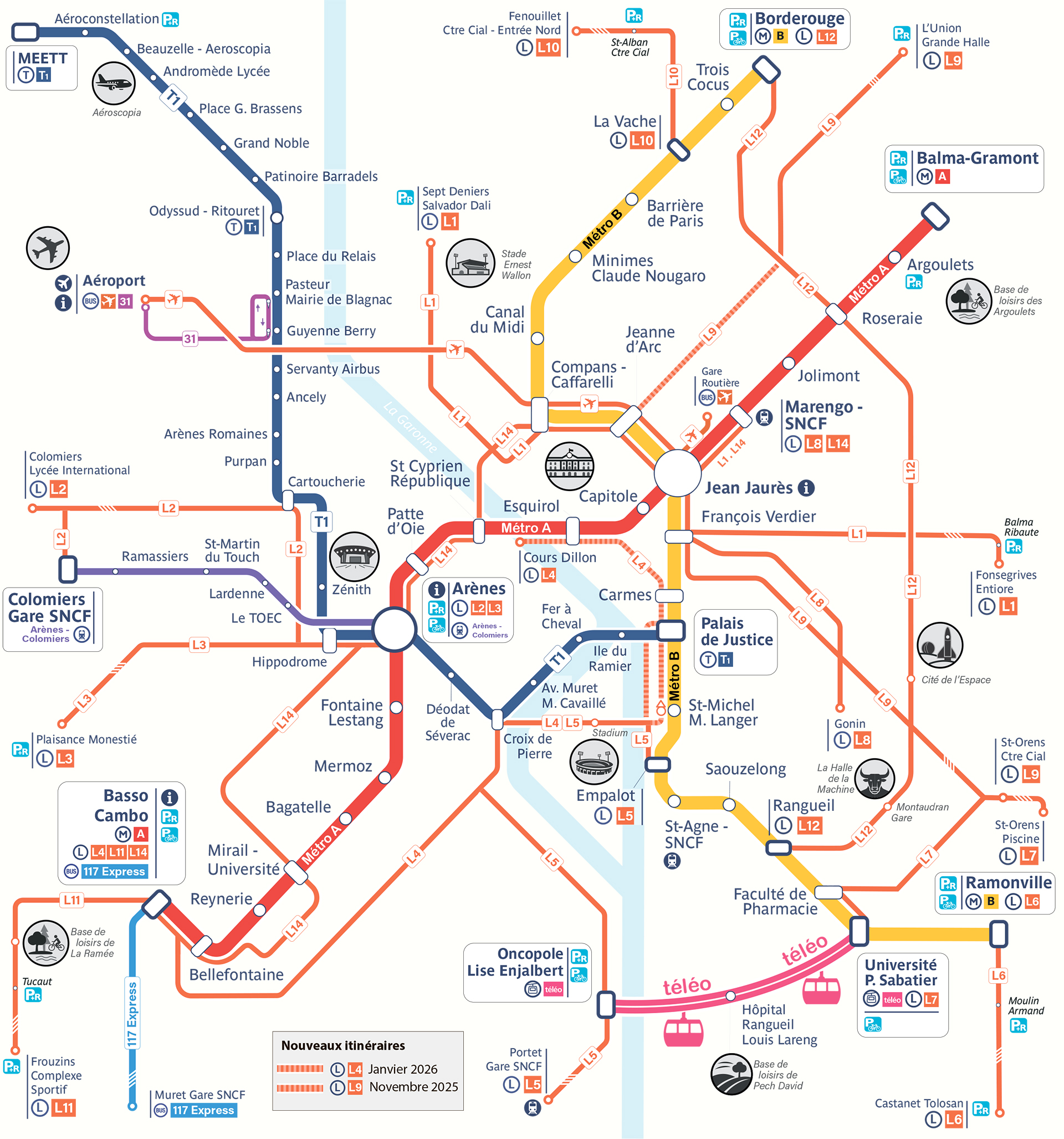
Toulouse Metro Lines and Stations
The Toulouse Metro has 2 lines:
Line A
Route: Basso-Cambo ↔ Balma-Gramont
Stations:
- Basso-Cambo
- Mirail-Université
- Reynerie
- Bellefontaine
- Bagatelle
- Mermoz
- Fontaine-Lestang
- Arènes
- Patte d’Oie
- Saint-Cyprien – République
- Esquirol
- Capitole
- Jean-Jaurès
- Marengo – SNCF
- Jolimont
- Roseraie
- Argoulets
- Balma-Gramont
Line B
Route: Borderouge ↔ Ramonville
Stations:
- Borderouge
- Trois Cocus
- La Vache
- Barrière de Paris
- Minimes – Claude Nougaro
- Canal du Midi
- Compans-Caffarelli
- Jeanne d’Arc
- Jean-Jaurès
- François-Verdier
- Carmes
- Palais de Justice
- Saint-Michel – Marcel Langer
- Empalot
- Université Paul Sabatier
- Faculté de Pharmacie
- Rangueil
- Saouzelong
- Saint-Agne SNCF
- Ramonville
Prices, Tickets, and Subscriptions
For subscriptions and season tickets, passengers need a Pastel Card. The card is used for pass-based fares, including weekly, monthly, and annual travel. Reduced fare categories are available for under-26 passengers, students aged 26–35, seniors aged 65 and over, families, job seekers, RSA recipients, and passengers with disabilities.
| Type of ticket | Price | Description |
|---|---|---|
| Single Ticket | €1.60, about $1.73 | Access to one journey. |
| Double Journey Ticket, Single User | €3.10, about $3.35 | Two journeys for the purchaser only. |
| Evening Ticket | €3.10, about $3.35 | Unlimited journeys on the Tisséo urban network from 7:00 PM until stations close. |
| Day Ticket | €5.50, about $5.94 | Unlimited travel for one day; it can be shared by several people. |
| Group Ticket | €5.50, about $5.94 | 12 journeys during the day, shareable between several people. |
| 2-Day Ticket | €8.50, about $9.18 | Unlimited journeys over two days, valid until stations close on the second day. |
| 3-Day Ticket | €10.50, about $11.34 | Unlimited travel over three days, valid until stations close on the third day. |
| 10 Journey Pass | €13.40, about $14.47 | 10 individual journeys. |
Pastel Card subscription prices listed for the network include:
| Subscription type | Price | Description |
|---|---|---|
| Annual | €39 per month, about $42.12, or €468 per year, about $505.44 | Unlimited travel all year. Payment can be made in cash or by monthly direct debit. |
| 31-day subscription | €46.80, about $50.54 | Unlimited travel for 31 days. |
| 7-day subscription | €14.20, about $15.34 | Unlimited travel for 7 days. |
Ticket prices without a Pastel Card are also listed for several products:
| Type of ticket | Price |
|---|---|
| 3 days | €13.50, about $14.58 |
| Day ticket | €6.80, about $7.34 |
| Planet Ticket | €3.00, about $3.24 |
| Tribe Ticket | €8.90, about $9.61 |
| 10 Journeys | €15.10, about $16.31 |
| 1 Journey | €1.80, about $1.94 |
| 1 Last-minute journey | €2.00, about $2.16 |
| Return Téléo ticket | €3.50, about $3.78 |
Use the listed ticket price and fare conditions to choose the right option. If you need a fare calculator-style comparison, the simplest approach is to compare your expected number of trips with the single ticket cost and the available pass prices.
Toulouse Metro Hours and Shedule
The Toulouse Metro operates every day.
Operating Hours
- Sunday–Wednesday: 5:15 AM – 12:00 AM
- Thursday–Saturday: 5:15 AM – 3:00 AM
Frequency
Line A
- Every 2–6 minutes on weekdays
- Every 3–8 minutes on Saturdays
- Every 4–9 minutes on Sundays
Line B
- Every 1 min 15 sec – 2 min 30 sec on weekdays
- Every 3 minutes on Saturdays
- Every 4–7 minutes on Sundays and evenings
Notes
- Both metro lines are fully automatic.
- Extended night service is available on weekends.
- On New Year’s Eve, the metro operates all night.
Connections to Other Systems
The Toulouse Metro is integrated with the Tisséo public transport network and works alongside suburban rail, the tramway, Téléo, and local bus services. For many trips, the route plan is simple: take the metro across the core of the city, then connect to a tram, train, or bus for the final leg.
| Station | Details |
|---|---|
| Jean-Jaurès | Main interchange between Metro Lines A and B. |
| Marengo-SNCF | Connection with the main SNCF railway station. |
| Arènes | Serves Metro Line A, the Arènes-Colomiers suburban rail line, and Tram Line T1. |
| Palais de Justice | Connects Metro Line B with Tram Line T1. |
The tram network includes Lines T1 and T2 in the northwestern suburbs. T2 opened as a branch of T1, later closed in 2023, and is planned to return in 2026 as the Aéroport Express line using existing infrastructure.
Téléo opened in 2022 and adds a southern connection to the city transport system. Tisséo bus services, including local bus lines, Noctambus, Transport on Demand, and the City Centre Shuttle, fill in areas not directly served by the metro stations map.
Several major stations also connect with park-and-ride facilities, making it easier to combine car travel with local transport. The metro itself does not run directly to Toulouse–Blagnac Airport, but airport access is available through shuttle, tram, and bus links.
Airport Connections
Toulouse–Blagnac Airport is connected to the city centre by public transport options linked to the Tisséo network. Your best choice depends on your destination, budget, and timings today.
The former T2 tram connection linked the city centre with the airport, with a typical frequency of every 20 minutes, a running time of about 35 minutes, and a ticket price from €1.70, about $1.84. It connected with Metro Line A at Arènes, Metro Line B at Palais de Justice, rail services at Arènes, and wider bus services. The same network information notes that Tram Line T2 closed in June 2023, with Toulouse Aéroport Express planned for 2026.
The airport shuttle connects Toulouse–Blagnac Airport with Toulouse Matabiau station. It serves Pierre Baudis Palais des Congrès, central boulevards near Jeanne d’Arc, and Matabiau station. At the airport, the shuttle stop is on the ground floor, Gate C2, on the arrivals level.
| Service detail | Timings |
|---|---|
| Airport shuttle frequency | Every 15 minutes, 7 days a week |
| Airport shuttle running time | 25 to 45 minutes, depending on traffic |
| Airport to Toulouse city centre | First departure at 5:40 AM; last train-style late shuttle departure at 0:10 AM |
| Toulouse city centre to Airport | First departure at 5:05 AM; last departure at 9:40 PM |
| Tisséo airport office opening hours | Monday to Friday, 7:30 AM to 2:00 PM; Sunday, 1:00 PM to 7:30 PM |
The shuttle fare is €9.00, about $9.72, and the ticket also works across the Tisséo metro, tram, and bus network. Bus line 30 connects the airport with the MEETT area, while bus line 388 serves Toulouse and nearby towns including Blagnac and Beauzelle.
Fun facts
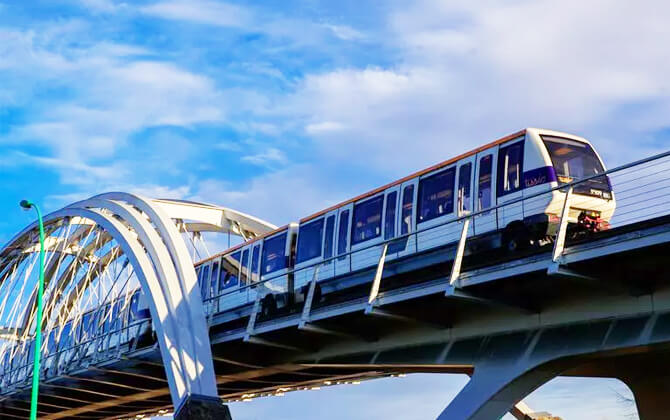
Toulouse was the fourth city in France to get a metro system. The network is fully automated, so there are no drivers on the trains, and it runs on VAL technology developed by Matra and Siemens.
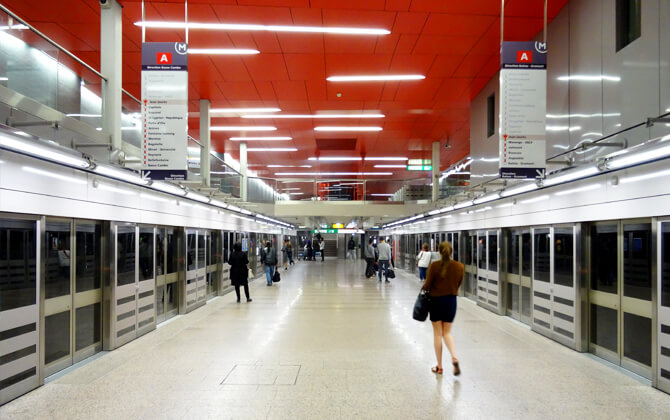
The trains use rubber tyres and a 750 V direct current power supply. They can climb slopes of up to 7% and reach about 60 km/h, or 37 mph. Platform screen doors are synchronized with train doors, which is why platform edges must be perfectly straight.
Line A was upgraded so that all 18 stations could handle four-car trains. When the longer trains entered service in early 2020, the line’s capacity was essentially doubled.
At Basso-Cambo, the end of Line A, the carriage shed-workshop handles storage, maintenance, and testing for the whole system. The Central Control Centre is also located there.
Jean-Jaurès is the only station where Lines A and B connect directly. The network also links with the tramway, suburban rail, and Téléo, so it functions as part of a wider transportation system rather than a standalone metro.
Tips
With only two metro lines, A and B, the Toulouse Metro is easy to understand and quick to use. For most city-centre trips, it is faster than surface transport, especially when you are moving between major stations, museums, shopping areas, and railway connections.
Check the Tisséo app before you travel for the train schedule, schedule today, real-time timetable updates, and service alerts. It is also useful for checking route timetable information and finding the best path train connections through the network.
- Use one ticket across the metro, bus, and tram when making transfers.
- Keep coins with you, as some ticket machines may not accept notes.
- Look at the network map before you travel, especially if you need to transfer at Jean-Jaurès.
- For accessibility, check lift availability and wheelchair-accessible station information before setting out.
- If you arrive by car, look for P+R signs at station parking areas. Some facilities offer free parking under certain conditions.
For travellers with reduced mobility or special needs, assistance services are available by prior arrangement. The metro is designed to support accessible travel, and the platform-door system also helps keep stations safe.
Rules and Accessibility
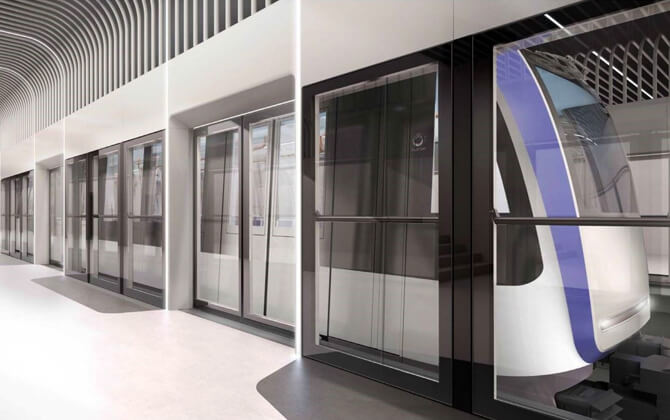
The Toulouse metro lines are 100% accessible for people with reduced mobility. All stations have one or more lifts between the platform and station areas, and trains include designated spaces for wheelchair users.
- Lowered validation gates make access to platforms easier.
- Dynamic platform displays show upcoming trains and service information.
- Displays can be made audible with a universal remote control.
- Tactile warning strips are placed at the top of stairs and in front of doors.
- Some stations have orientation strips, and lift controls include braille with raised lettering.
A spoken announcement indicates the lift destination inside the cabin just before the doors open. Visual and audio information is also provided in stations and on trains.
The universal remote control is available on request at an approved distribution point. Passengers need proof of address in one of the communes of Toulouse Métropole, a national identity card, and a Carte Mobilité Inclusion.
Tisséo also has an accessibility commission for the urban network, working with associations representing people with disabilities. The wider accessible network includes buses and Linéo services; Tisséo states that all buses are accessible for people with reduced mobility, all Linéo bus stops are accessible, and 70% of other bus stops are accessible.
Fun Facts
The Toulouse Metro is the only metro system in Occitania. It is fully automated, with driverless trains running on VAL technology developed by Matra and now part of Siemens Transportation Systems.
Line A and Line B together serve 37 stations across 28.2 kilometres, or 17.5 miles, of route. Line A is mainly underground, while Line B is entirely underground.
The network carried 110.3 million passengers in 2018, and later figures list annual ridership at 112.9 million in 2023. At peak performance, trains can operate at intervals as short as 65 seconds.
Platform screen doors are installed at stations, and Line A platforms were lengthened so four-car trains could replace two-car sets. That upgrade gave the line a major capacity boost without changing the basic route.
In the transport history of Toulouse, the system has been managed by Tisséo Voyageurs under Tisséo Collectivités since 2003.
History
The Toulouse Metro grew through several planning, construction, and expansion phases before becoming the two-line system used today.
- 1983: the City Council decided to create a metro line on a south-western to north-eastern axis.
- 1985: the municipality chose VAL technology.
- 1987: the project received planning and environmental approvals.
- 1989: construction began on Line A.
- 1993: Line A opened between Basso Cambo and Jolimont.
- 1997: preliminary studies began for the Line A extension and the construction of Line B.
- 2001: work began on the Line A extension and Line B.
- December 2003: the Line A extension to Balma-Gramont opened.
- 30 June 2007: Line B opened between Borderouge and Ramonville.
- 2010: Tram Line T1 opened from Arènes to Aéroconstellation.
- 2013: the T1 extension to Palais de Justice opened.
- 2015: Line T2 opened from Palais de Justice to Aéroport Toulouse-Blagnac.
- May 2022: Téléo opened.
- December 2022: construction work began on Line C.
- June 2023: Tram Line T2 closed due to construction works.
- 2026: Toulouse Aéroport Express tramway is planned to begin operations, effectively replacing Line T2.
- 2028: Line C is planned to begin operations as the third metro line.
Line A later received an important capacity upgrade. Five of the original 18 stations had shorter platforms, which initially limited the line to two-car trains. Between 2015 and 2019, the shorter platforms were lengthened, allowing four-car trains to run across the whole line from early 2020.
Plans for Line B also changed. A southern extension was proposed in 2006, but the project was shortened in favour of a third metro line. The shortened extension is planned to open in 2027.
Some earlier tram and metro ideas were cancelled or left unstudied, including a tram extension to Grand Rond, extensions to Saint-Orens and Plaisance-du-Touch, and a northern Line A extension to L’Union.
Future Expansions
The main expansion project is Line C, the third metro line. It was renamed in 2022 from Toulouse Aerospace Express to fit the existing naming system. Construction began in December 2022, and the opening is planned for 2028.
Line C is expected to run for 27 kilometres, or 16.8 miles, and serve 21 stations. The route will link Colomiers in the west with Labège in the southeast via the city centre, with interchanges planned for Lines A and B and the tramway network.
Another major project is the Line B extension, known as Connexion Ligne B. It is being built to connect Line B with Line C and is expected to be completed in 2027.
Tram line T2 is scheduled to reopen in 2026 as Toulouse Aéroport Express, using existing infrastructure to provide a shuttle-style link between the future Blagnac Line C station and Toulouse–Blagnac Airport.
The network is also receiving new rolling stock. Fifteen new trains were ordered in 2020 and are expected to enter service in 2025.
Nearby Attractions
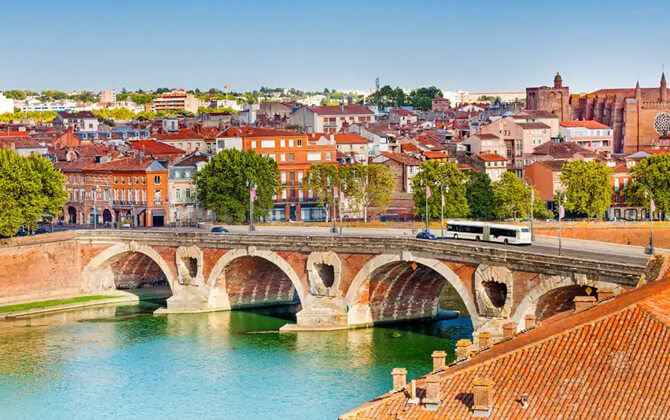
Line A is especially useful for sightseeing because it crosses Toulouse from Basso-Cambo in the southwest to Balma-Gramont in the northeast. Along the route, you can reach central districts, shopping areas, cultural spots, nightlife, and major transport links.
| Station | Details |
|---|---|
| Basso-Cambo | Southwestern end of Line A, useful as a starting point for the route. |
| Balma-Gramont | Northeastern terminus with shops, cafés, and modern surroundings. |
| Esquirol | Central stop for theatres, restaurants, and nightlife areas. |
| Marengo-SNCF | Major transport hub connected with the main SNCF railway station. |
| Capitole | Key central stop for exploring the historic core of Toulouse. |
| Jean-Jaurès | Main interchange station and a practical starting point for onward travel. |
Other places mentioned around the network include the Musée des Augustins, Canal du Midi, Fondation Bemberg, Les Abattoirs, and Musée Paul-Dupuy. Central stations such as Jean-Jaurès, Esquirol, Saint-Cyprien-République, and Carmes are useful for reaching these areas.