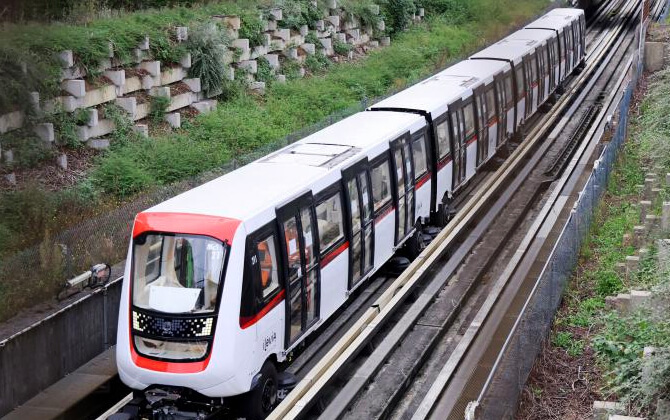
The Lille Metro is a driverless light metro system in Lille, France. It opened on 25 April 1983 and became the first network to use VAL technology. Today, it has two lines, 60 stations, and a total network length of about 45 kilometres (28 miles). The metro is a key part of public transport in Lille, working together with the tramway and bus network under the Ilévia brand.
| Key | Information |
|---|---|
| System | Driverless light metro in Lille, France |
| Opening date | 25 April 1983 |
| Technology | First metro system to use VAL technology |
| Lines | 2 |
| Stations | 60 |
| Network length | About 45 kilometres (28 miles) |
| Operator | Ilévia |
| Other transport connections | Tramway and bus |
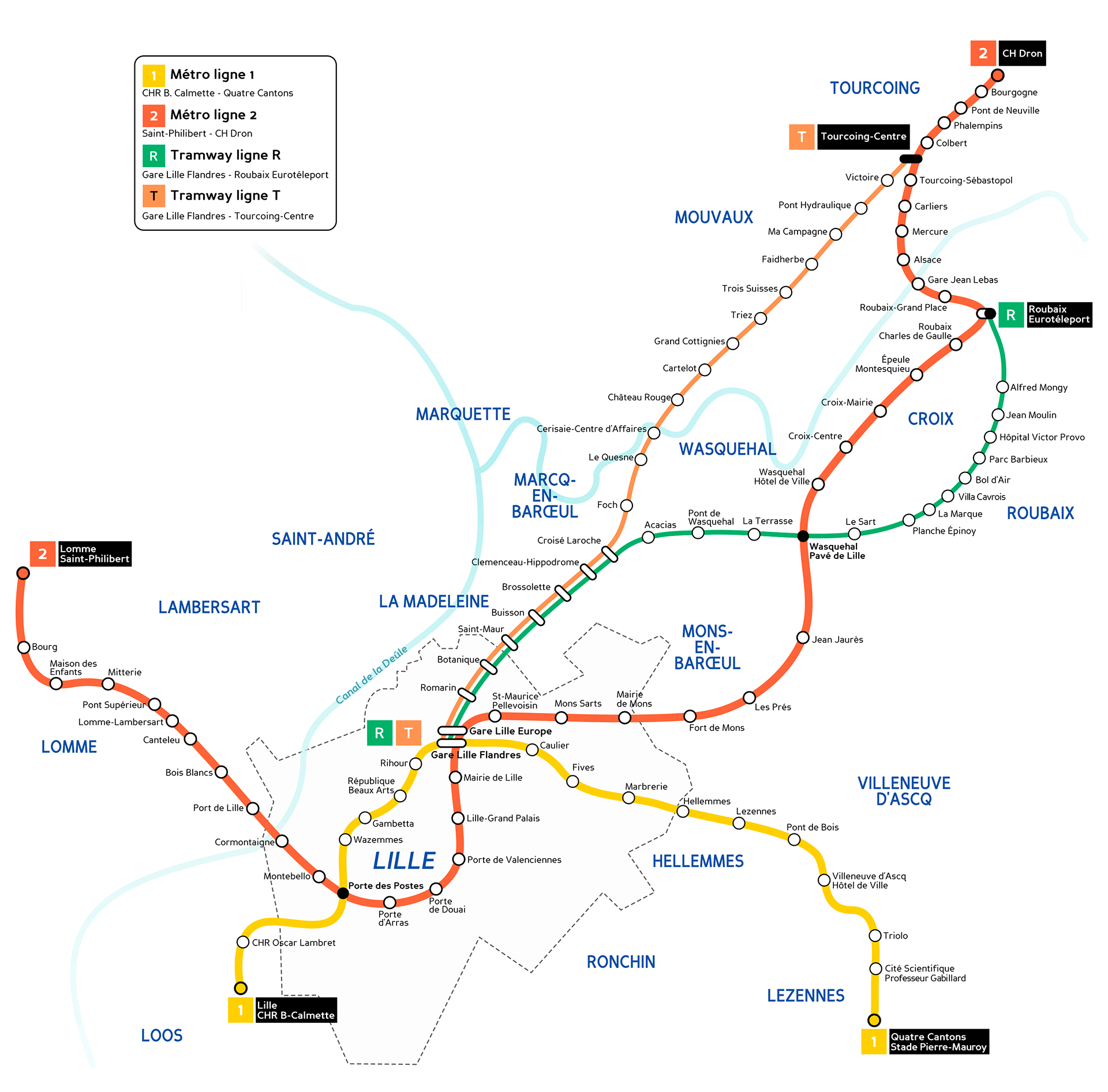
Lille Metro Map
Map of Lille Metro showing different lines. Click on the map to enlarge it or download the Lille Metro map in PDF format.
Lines and Stations
The Lille Metro has two automated lines and 60 stations across a network of about 45 kilometres (28 miles). Together, they form the core of local transport in Lille and connect the city with Roubaix, Tourcoing, Villeneuve-d’Ascq, and nearby municipalities.
Line 1
Line 1 runs from Quatre Cantons – Stade Pierre-Mauroy to CHU – Eurasanté. It opened on 25 April 1983, was extended on 2 May 1984, and serves 18 stations over 12.5 kilometres (7.8 miles). This was the first line in the world to use VAL technology.
| Station | Details |
|---|---|
| Quatre Cantons – Stade Pierre-Mauroy | Eastern terminus of Line 1 |
| Cité Scientifique – Professeur Gabillard | Line 1 station |
| Triolo | Line 1 station |
| Villeneuve-d’Ascq – Hôtel de Ville | Line 1 station |
| Pont de Bois | Line 1 station |
| Square Flandres | Line 1 station |
| Mairie d’Hellemmes | Line 1 station |
| Marbrerie | Line 1 station |
| Fives | Line 1 station |
| Madeleine Caulier | Line 1 station |
| Gare Lille-Flandres | Connection to SNCF rail services |
| Rihour | Line 1 station |
| République – Beaux-Arts | Line 1 station |
| Gambetta | Line 1 station |
| Wazemmes | Line 1 station |
| Porte des Postes | Connection with Line 2 |
| CHU – Centre Oscar-Lambret | Line 1 station |
| CHU – Eurasanté | Western terminus of Line 1 |
Line 1 also connects with Line 2 and with SNCF rail services at Gare Lille-Flandres.
Line 2
Line 2 runs from Saint-Philibert to CH Dron. It opened on 3 April 1989 and stretches for 31.1 kilometres (19.3 miles) with 44 stations. The route links Lille with Roubaix, Tourcoing, and several suburban areas. It is also the longest metro line in France.
| Station | Details |
|---|---|
| Saint-Philibert | Western terminus of Line 2 |
| Bourg | Line 2 station |
| Maison des Enfants | Line 2 station |
| Mitterie | Line 2 station |
| Pont Supérieur | Line 2 station |
| Lomme – Lambersart – Arthur-Notebart | Line 2 station |
| Canteleu – Euratechnologies | Line 2 station |
| Bois Blancs | Line 2 station |
| Port de Lille | Line 2 station |
| Cormontaigne | Line 2 station |
| Montebello | Line 2 station |
| Porte des Postes | Connection with Line 1 |
| Porte d’Arras | Line 2 station |
| Porte de Douai – Jardin des Plantes | Line 2 station |
| Porte de Valenciennes | Line 2 station |
| Lille Grand Palais | Line 2 station |
| Mairie de Lille | Line 2 station |
| Gare Lille-Flandres | Rail connection station |
| Gare Lille-Europe | Rail connection station |
| Saint-Maurice Pellevoisin | Line 2 station |
| Mons Sarts | Line 2 station |
| Mairie de Mons | Line 2 station |
| Fort de Mons | Line 2 station |
| Les Prés – Edgard-Pisani | Line 2 station |
| Jean-Jaurès | Line 2 station |
| Wasquehal – Pavé de Lille | Line 2 station |
| Wasquehal – Hôtel de Ville | Line 2 station |
| Croix – Centre | Line 2 station |
| Mairie de Croix | Line 2 station |
| Épeule – Montesquieu | Line 2 station |
| Roubaix – Charles-de-Gaulle | Line 2 station |
| Eurotéléport | Line 2 station |
| Roubaix – Grand-Place | Line 2 station |
| Gare Jean-Lebas Roubaix | Line 2 station |
| Alsace – Plaine Images | Line 2 station |
| Mercure | Line 2 station |
| Carliers | Line 2 station |
| Gare de Tourcoing | Rail connection station |
| Tourcoing – Centre | Line 2 station |
| Colbert | Line 2 station |
| Phalempins | Line 2 station |
| Pont de Neuville | Line 2 station |
| CH Dron | Eastern terminus of Line 2 |
Both lines have platform screen doors at every station.
| Line | Details |
|---|---|
| Line 1 | Quatre Cantons – Stade Pierre-Mauroy to CHU – Eurasanté, opened in 1983, 12.5 kilometres (7.8 miles), 18 stations |
| Line 2 | Saint-Philibert to CH Dron, opened in 1989, 31.1 kilometres (19.3 miles), 44 stations |
Schedule, Timetables, and Operating Hours
The Lille Metro schedule is managed by Ilévia, with real-time updates available in the app. For daily route planning, timetable checks, and live station timings today, passengers can also use Moovit. The system runs every day of the year except May 1, so opening hours are generally reliable, but checking the latest train schedule before travel is still a smart move.
The metro serves Lille as well as nearby cities including Roubaix, Villeneuve-d’Ascq, Tourcoing, Mons-en-Barœul, and Wasquehal. If you need schedule today details, station departures, or route timetable information, the app is the easiest place to look.
Line 1 operating hours
Line 1 starts service at 5:12 on weekdays and Saturdays, and at 6:24 on Sundays and public holidays. The last train leaves at 0:21 from C.H.R. B-Calmette and at 0:17 from 4 Cantons Stade Pierre Mauroy.
During weekday peak periods, trains run every 1 minute. Frequency drops slightly outside those times: every 2 minutes on weekday off-peak periods, every 1 to 3 minutes on Saturdays, and every 2 to 6 minutes on Sundays and public holidays. Before 6:00 and after 22:00, trains run every 6 to 8 minutes.
| Service detail | Timings |
|---|---|
| Starting time on weekdays and Saturdays | 5:12 |
| Starting time on Sundays and public holidays | 6:24 |
| Last train from C.H.R. B-Calmette | 0:21 |
| Last train from 4 Cantons Stade Pierre Mauroy | 0:17 |
| Weekday peak frequency | Every 1 minute |
| Weekday off-peak frequency | Every 2 minutes |
| Saturday frequency | Every 1 to 3 minutes |
| Sunday and public holiday frequency | Every 2 to 6 minutes |
| Before 6:00 and after 22:00 | Every 6 to 8 minutes |
Line 2 operating hours
Line 2 starts at 5:08 from C.H. Dron and at 5:12 from Saint-Philibert on weekdays and Saturdays. On Sundays and public holidays, service begins at 6:20 from C.H. Dron and at 6:24 from Saint-Philibert. The closing time is earlier than on Line 1, with the last train leaving at 23:56 from C.H. Dron and at 23:40 from Saint-Philibert.
On weekday peak hours, Line 2 runs every 1 minute 30 seconds. At other times, trains run every 2 to 3 minutes on weekdays during off-peak periods, every 2 to 4 minutes on Saturdays, and every 4 to 6 minutes on Sundays and public holidays. Before 6:00 and after 22:00, service runs every 6 to 8 minutes.
| Service detail | Timings |
|---|---|
| Starting time from C.H. Dron on weekdays and Saturdays | 5:08 |
| Starting time from Saint-Philibert on weekdays and Saturdays | 5:12 |
| Starting time from C.H. Dron on Sundays and public holidays | 6:20 |
| Starting time from Saint-Philibert on Sundays and public holidays | 6:24 |
| Last train from C.H. Dron | 23:56 |
| Last train from Saint-Philibert | 23:40 |
| Weekday peak frequency | Every 1 minute 30 seconds |
| Weekday off-peak frequency | Every 2 to 3 minutes |
| Saturday frequency | Every 2 to 4 minutes |
| Sunday and public holiday frequency | Every 4 to 6 minutes |
| Before 6:00 and after 22:00 | Every 6 to 8 minutes |
Useful travel tips
- Check live departure and arrival timings in the Ilévia app before you travel.
- Use Moovit for service alerts, delays, route changes, and station updates.
- If you need a route timetable or train schedule, both line and station information are available in the app.
Price, Tickets, and Cards
The Lille Metro is part of the Ilévia network, so one ticket works across the metro, tramway, and bus system. Tickets and cards are sold at metro stations, tram stops, information points, and from bus drivers. Public transport runs every day except May 1.
A single ticket costs €1.80 (about $1.96). A ZAP ticket for 3 stations costs €1.15 (about $1.25), while a book of 10 tickets costs €15.40 (about $16.79). Other fare options include unlimited travel after 7 p.m. for €2.45 (about $2.67), a day pass for €5.30 (about $5.78), a 7-day pass for €18.10 (about $19.73), and a monthly pass for €62 (about $67.58).
For longer stays, you need a Pass Pass card, which costs €4 (about $4.36), before loading a package onto it. The card can be topped up in the Pass Pass Easy Card app, online through an Ilévia account, or at a sales point such as a station, agency, or tobacconist.
Youth and adult packages
- For ages 4 to 25: monthly package €31 (about $33.79); 10-month package €27 per month or €270 total (about $29.43 per month or $294.30 total); permanent package €27 per month with a yearly total of €324 (about $29.43 per month or $353.16 per year).
- For ages 26 to 64: monthly package €62 (about $67.58); permanent package €55 per month with a yearly total of €660 (about $59.95 per month or $719.40 per year).
Children under 18 travel free on public transport in Lille. Tickets must be validated before travel and kept until the end of the journey.
V’lille bike sharing is also available. A 24-hour pass costs €1.80 (about $1.96), the first 30 minutes of each ride are free, and each additional half-hour started costs €1.15 (about $1.25).
Connections
The Lille Metro is fully integrated into the wider Ilévia public transport system, which also includes tramway and bus services. That makes it easy to combine metro trips with other local transport options across the metropolitan area.
Rail connections are available at major central stations. Lille-Flandres and Lille-Europe link the metro with national and international train services, including TGV, Eurostar, and Thalys.
The network also has a few especially useful transfer points:
- Line 1 connects with Line 2 at Porte des Postes.
- Gare Lille-Flandres connects with the Grand Boulevard Tramway.
Several stations also serve shopping districts, cultural venues, universities, and the Lille University Hospital complex. In day-to-day transportation in Lille, the metro works as the backbone of city transport for Lille, Roubaix, Tourcoing, and surrounding municipalities.
Station parking and park-and-ride facilities are available across the metropolitan area, helping passengers switch from car to metro, tram, or bus near key interchanges. Specific parking charges and parking charges per day are not listed in the source material.
Airport Connection
Lille–Lesquin Airport is about 10 to 15 minutes from Lille city centre and the main rail stations. For the most direct airport transfer, the Lille Airport Shuttle runs every day, including Sundays and public holidays, with a running time of around 20 to 25 minutes.
The shuttle leaves from Gate A in the airport departures area. In the city centre, it stops near Lille-Flandres Station and Lille-Europe Station, close to Euralille. A single ticket costs around €8 (about $8.72). Return fares are available on some services.
A cheaper route is Ilévia bus line 68, which connects the airport with 4 Cantons Grand Stade in Villeneuve-d’Ascq. From there, you can switch to the metro and continue to the city centre. It takes longer, but the cost is lower than the direct shuttle.
Taxis are also available if you want a direct ride or need extra assistance. Lille is also well connected by rail, with Lille-Flandres and Lille-Europe offering TGV, Eurostar, and Thalys services.
- Direct shuttle running time: around 20 to 25 minutes
- Airport stop: Gate A, departures area
- City centre stop: near Lille-Flandres and Lille-Europe stations
- Budget option: bus line 68 to 4 Cantons Grand Stade, then metro
Rules
The Lille Metro has a few basic rules to keep the system safe and comfortable for everyone. Some items are not allowed on board, and standard passenger etiquette also applies across the metro and tramway.
Forbidden items
- Large packages are not allowed in the metro or tramway. Any item with one dimension over 0.75 metres (0.47 miles) is prohibited.
- Scooters, shopping trolleys, and empty strollers should not be brought on board.
- Bicycles are not allowed during rush hours, and boarding or getting off with a bike at Lille Flandres Station is strictly forbidden.
- Dangerous materials, weapons, and infectious substances are not allowed.
Etiquette in the metro
- Do not take extra seats with your belongings.
- Eating and drinking are not allowed, except for water.
- Do not use false alarm signals.
- Spitting is prohibited.
- Sound devices may only be used with permission.
Tips
For an easy start, use the Ilévia app or buy a Pass Pass card at a station machine. Machines are available in metro stations and major tram stops, and they usually offer several language options.
Validate your ticket before entering the platform area and keep it until you leave the station. Ticket checks can happen inside the network, so it is better not to put it away too soon.
If you plan to make several trips in one day, a day pass is often better value than buying single tickets. For short rides, a regular ticket is fine, but passes are more convenient if you are using the metro, tramway, and bus across the day.
Check digital screens for real-time arrival information, especially when changing lines or traveling later in the evening. The metro is frequent, but it is still worth confirming the last train and closing time before a late trip.
If you need help, staff are often available at the main hubs. And if your route takes you to northern suburbs or museums, the tram can sometimes be a useful alternative.
- Use the English language option on ticket machines.
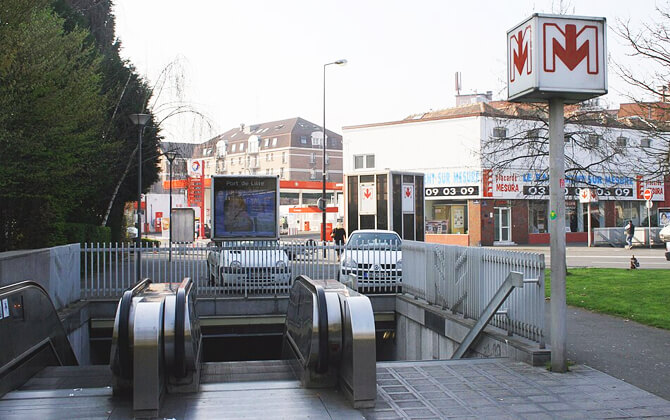
- Look for the yellow M signs at station entrances.
- Check stations map displays to choose the right exit.
- Save the Ilévia app for quick route plan checks.
- Carry a contactless card for faster payment at machines.
History
In the 1960s, decentralisation of Lille was considered because parts of the region were poorly served by public transport while the city centre was congested with traffic and buses. This led to the creation of the Public Establishment of Lille East development in 1968. In the 1970s, a four-line light metro plan was developed, and the VAL system was chosen over conventional rail.
Construction of Line 1
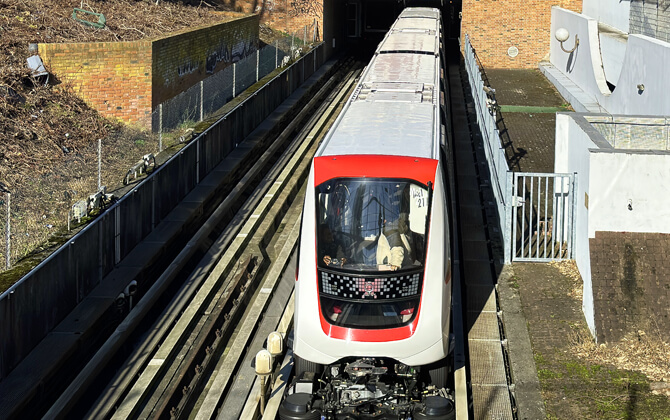
Construction began in 1978, and the first section opened on 25 April 1983 between Quatre Cantons and République. Line 1 was completed on 2 May 1984, reaching 13.5 kilometres (8.4 miles) and linking CHR B Calmette to Quatre Cantons via Gare de Lille Flandres. It was the first metro line to use VAL technology.
Line 1 extension and the creation of Line 2
The first line opened in two phases, and the full opening cost about 2 billion Francs. Construction of Line 2 began in April 1985, with a depot opened at Villeneuve d’Ascq beyond the Saint Philibert terminus in Lomme. Line 1 became fully operational in late 1988 after four months of testing. In 1989, COMELI merged with COTRALI to create a unified public transport body.
Line 2 opened on 3 April 1989, connecting Lille with Roubaix and Tourcoing, and was later extended to CH Dron on 27 October 2000. The line is 32 kilometres (19.9 miles) long and has 44 stations. Both lines have platform screen doors at every station, making Lille Metro the second metro to use platform doors after the Saint Petersburg Metro.
The route to Roubaix and Tourcoing was built and opened in four stages. The first extension opened on 5 May 1994 and added a 500-metre (0.5-kilometre, 0.3-mile) underground section linking the Euralille business area to the rest of Lille. The third section, about 13 kilometres (8.1 miles) long, became operational in March 1999 and was commissioned on 18 August that year. It crosses Villeneuve d’Ascq, Wasquehal, Croix, Roubaix, and Tourcoing, including a 1.3-kilometre (0.8-mile) viaduct between Fort Mons and Jean-Jaures. The final section was inaugurated on 27 October 2000 by Prime Minister Lionel Jospin.
Plans for third and fourth lines
A four-line system had originally been planned in the 1970s, but only two lines were built. In June 2000, Lille Métropole Urban Community stated in its urban transport plan that the cost of subway construction did not allow new projects. In 2003, a third line was estimated to cost €810 million (about $882.90 million), which was considered too expensive, so the city shifted its focus to bus, tram, and tram-train development. In 2010, Eric Quiquet confirmed that no new metro lines were planned.
Future Expansions
Lille Metro Line 1 has gone through a major modernization phase and now operates exclusively with VAL 208 trains and the Urbalis Fluence system. The current priority is to complete the rolling stock renewal program and finish the platform works needed for full 52-metre (0.05-kilometre, 0.03-mile) train operation.
The planned fleet expansion includes 15 additional BOA trains, bringing the total to 42 units by 2028. These trains are being introduced progressively after trials and testing, and they are intended to fully replace older equipment on Line 1.
Station upgrades are also part of the project. Platform modifications and door installations began in 2025 at selected stations, with full deployment of the longer trains expected once the works are completed.
For Line 2, the strategy is different. Instead of a new extension, the line is expected to benefit from refurbished VAL 208 trains, the transfer of trains released from Line 1, and planned procurement of new-generation VAL 208 rolling stock. The aim is to maintain service quality while preparing the system for longer-term renewal.
A possible extension of Line 2 from Saint-Philibert to Pérenchies station was proposed in public consultations, but no construction project has been confirmed.
More broadly, Lille’s transport planning is now focused on capacity, reliability, accessibility, and stronger links with other public transport services rather than building new metro lines.
Fun Facts
- The Lille Metro is a driverless light metro system and was the first to use VAL technology.
- Service began on 25 April 1983.
- The network has two lines, 60 stations, and a total length of about 45 kilometres (28 miles).
- Both lines have platform screen doors at all stations.
- Most of the metro runs underground, but part of Line 2 runs on a 1.3-kilometre (0.8-mile) viaduct between Fort Mons and Jean-Jaures.
- Station design varies widely, with tiles, stainless steel, stone, brick, and wood used across the system.
- Many stations feature artwork, including murals, sculptures, and a reflecting pool. Montebello station even has an aquarium.
- A female voice announces the next station just before arrival.
Some sources describe the Lille Metro as the longest automatic metro network in the world, though the Port Island Line in Kobe, Japan, opened earlier as a fully automated driverless metro.
Nearby Attractions
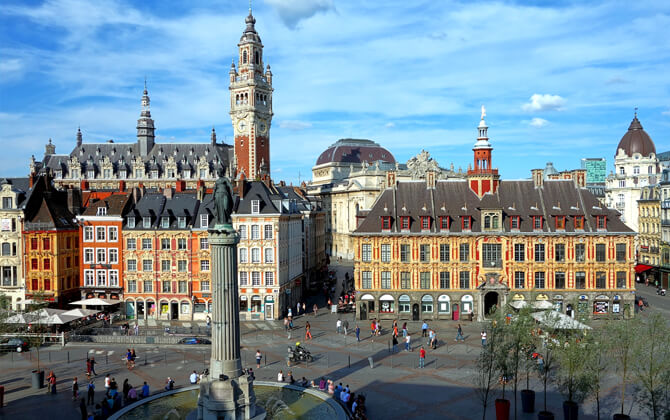
Lille Metro Line 1 provides easy access to many of the city’s best-known sights, especially in central Lille and nearby districts. A City Pass can also be useful, as it includes free entry to 20 tourist and cultural attractions in Lille and its metropolitan area, with public transport included if needed.
Central Lille highlights
- Grand Place is a short walk from Lille-Flandres and Lille-Europe stations and is known for its colorful facades and varied architecture.
- La Vieille Bourse, built in 1653, sits between Place du Théâtre and Grand Place. When the doors are open, you can step inside and explore the courtyard and booksellers’ stalls.
- Old Lille is directly accessible from Grand Place, with cobbled streets, independent shops, and traditional estaminets.
- Rihour Palace is one of the few medieval buildings in Lille and now houses the Lille Tourist Office at Place Rihour.
- Palace of Fine Arts is one of France’s richest museums, with a large and carefully preserved collection.
- Town Hall and belfry offer the highest view over the city and its surroundings, with 415 steps to the top or an elevator for the first 100 steps.
Museums and cultural stops
- Hospice Comtesse Museum, in rue de la Monnaie in Old Lille, presents the history of the city and includes reconstructed 17th-century interiors.
- République – Beaux-Arts provides access to the Palais des Beaux-Arts de Lille and nearby cultural landmarks.
- Gare Lille-Flandres also connects to Euralille, L’Aéronef, and the Tri Postal cultural space.
Green spaces and lively districts
- The Citadel Park is Lille’s largest green space and a good spot for a walk along the Deûle and near the citadel ramparts.
- Wazemmes Market can be reached via Gambetta station, while Wazemmes station also serves the Maison Folie Wazemmes cultural venue.
- Stade Pierre-Mauroy, accessible from Quatre Cantons – Stade Pierre-Mauroy and Cité Scientifique – Professeur Gabillard, is a major venue for sports and concerts.
If you are interested in history, museums, shopping, or open-air walks, Line 1 puts many of Lille’s top attractions within easy reach.