The Rennes Metro is a rubber-tired light metro system serving Rennes in Brittany, France. It forms a core part of STAR public transport and transportation in Rennes, with two automated lines, 28 stations, and 23.5 km (14.6 mi) of route across the city. Most of the network is underground, and the main interchange stations are Sainte-Anne and Gares.
| Key | Information |
|---|---|
| System | Rubber-tired light metro in Rennes, France |
| Network | 2 lines: Line A and Line B |
| Stations | 28 stations across the system |
| Route length | 23.5 km (14.6 mi) |
| Opening | Line A opened in March 2002; Line B opened on 20 September 2022 |
| Operator network | Part of the STAR city transport network |
| Main interchanges | Sainte-Anne and Gares |
| Technology | Line A uses Siemens VAL technology; Line B uses Siemens CityVal technology based on NeoVal |
Rennes Metro Map
Map of Rennes Metro showing its lines and stations. Click on the map to enlarge it or download the Rennes Metro map in PDF format.
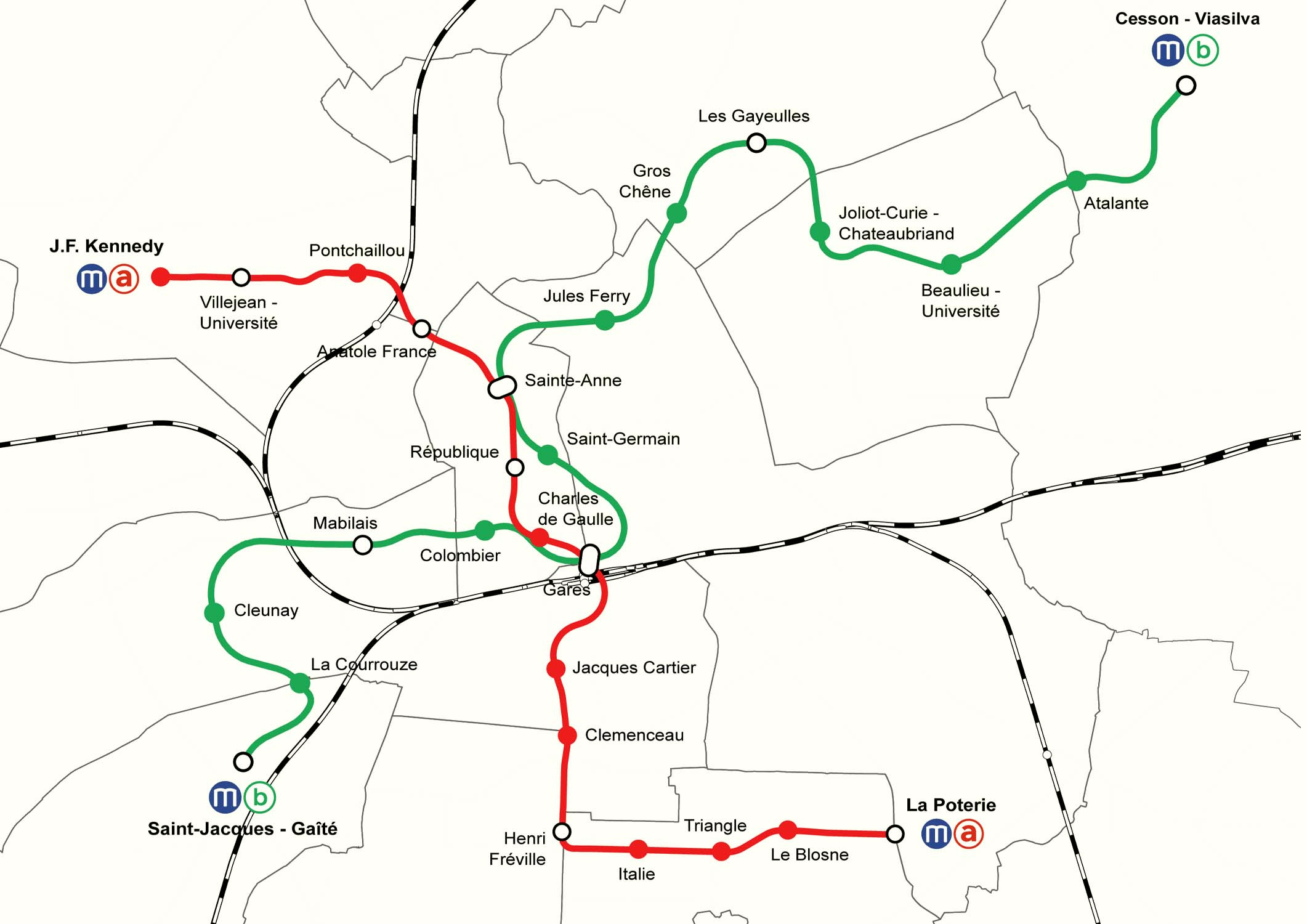
Rennes Metro Lines and Stations
The Rennes Metro has two automated lines that cross the city center and connect outer districts with key urban areas. For anyone checking a stations map or planning a route timetable, Sainte-Anne and Gares are the main transfer points between Line A and Line B.
Line A
Line A connects J.F. Kennedy and La Poterie through central Rennes. It uses Siemens VAL technology and was the first line in the system. In 2023, it carried about 145,000 trips per day. The route is mostly underground, with some above-ground sections.
| Station | Details |
|---|---|
| J.F. Kennedy | Line A terminus |
| Villejean-Université | Listed Line A station |
| Pontchaillou | Listed Line A station |
| Anatole France | Listed Line A station |
| Sainte-Anne | Interchange with Line B |
| République | Central station and useful bus connection point |
| Gares | Interchange with Line B and SNCF rail services |
| Charles de Gaulle | Listed Line A station |
| Clemenceau | Listed Line A station |
| Le Blosne | Listed Line A station |
| La Poterie | Line A terminus |
Line B
Line B opened on 20 September 2022 and runs between Saint-Jacques – Gaîté and Cesson – Viasilva. It passes through the city center and shares the Sainte-Anne and Gares interchanges with Line A. In 2023, Line B carried about 80,000 trips per day.
| Station | Details |
|---|---|
| Saint-Jacques – Gaîté | Line B terminus |
| La Courrouze | Listed Line B station |
| Cleunay | Listed Line B station |
| Mabilais | Listed Line B station |
| Colombier | Within walking distance of Line A |
| Saint-Germain | Within walking distance of Line A |
| Sainte-Anne | Interchange with Line A |
| Jules Ferry | Listed Line B station |
| Gros-Chêne | Listed Line B station |
| Les Gayeulles | Listed Line B station |
| Joliot-Curie – Chateaubriand | Listed Line B station |
| Beaulieu – Université | Listed Line B station |
| Atalante | Listed Line B station |
| Cesson – Viasilva | Line B terminus |
Together, the two lines form the backbone of local transport in Rennes and give the city a simple route plan for everyday travel.
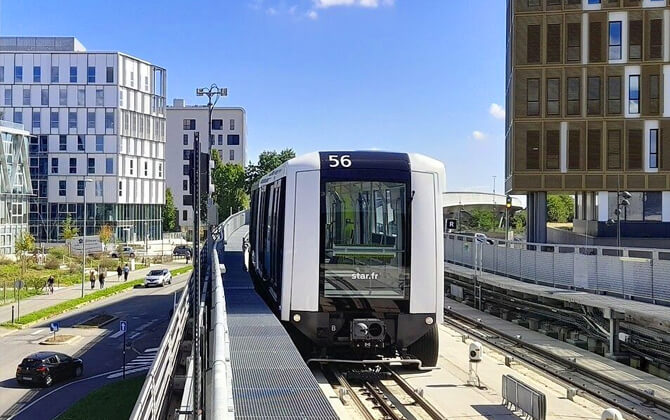
Operating Hours
The Rennes Metro runs every day of the year except 1 May, when the system is closed. Opening hours, closing time, and frequency vary slightly by day, so check the schedule today if you are traveling early in the morning or near the last train.
| Service detail | Timings |
|---|---|
| Weekday starting time | Usually 5:00 a.m. |
| Saturday opening times | Usually 5:15 a.m. |
| Sunday and public holiday opening hours | Usually 7:30 a.m. |
| Monday to Thursday closing time | Service runs until 12:45 a.m. |
| Friday and Saturday closing time | Service runs until 1:45 a.m. |
| Normal train schedule frequency | Every 2 to 4 minutes |
| Weekday rush-hour frequency | About every 90 seconds |
| Average running time | About 16 minutes for a typical line journey |
| Special event service | Overnight service may operate during major city festivals or events |
Stations close after the last train, and working hours can be extended when major events require extra public transport.
Ticket Pricing
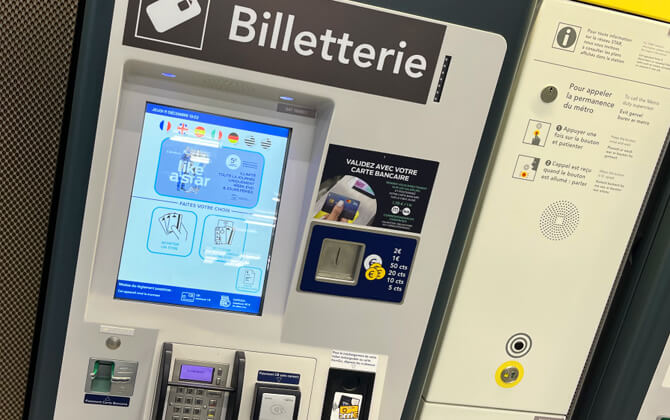
Rennes Metro fare options cover short trips, day pass travel, group travel, and longer subscriptions. The same ticket system also works with STAR bus services, making it practical for combined metro and bus journeys. Dollar amounts below are approximate and are included only as a quick price reference.
| Key | Information |
|---|---|
| One Heure ticket | €1.50, about US$1.60, for unlimited metro and bus travel for one hour |
| Pass 1 Jour | €4.10, about US$4.40, for 1 day |
| Pass 2 Jours | €8.20, about US$8.90, for 2 days |
| Pass 3 Jours | €11.40, about US$12.30, for 3 days |
| Pass 4 Jours | €13.60, about US$14.70, for 4 days |
| Pass 5 Jours | €15.70, about US$17.00, for 5 days |
| Pass 7 Jours | €17.90, about US$19.30, for 7 days |
| Pluriel Pass | €5.00, about US$5.40, for 2 to 5 people with unlimited metro and local bus travel for one day |
| KorriGo card | Can be used with selected passes and subscriptions |
The ticket price depends on how long you need the pass and how many people are traveling. If you use a fare calculator while planning, compare the result with the current ticket and pass options before buying.
| Key | Information |
|---|---|
| 1-month subscription | €51.30, about US$55.40 |
| 2-month subscription | €102.60, about US$110.80 |
| 3-month subscription | €153.90, about US$166.20 |
| 4-month subscription | €205.20, about US$221.60 |
| 5-month subscription | €256.50, about US$277.00 |
| 6-month subscription | €294.98, about US$318.60, including a free week |
| 7-month subscription | €333.45, about US$360.10, including 2 free weeks |
| 8-month subscription | €371.93, about US$401.70, including 3 free weeks |
| 9-month subscription | €410.40, about US$443.20, including a free month |
| 10-month subscription | €448.88, about US$484.80, including 5 free weeks |
| 12-month subscription | €513.00, about US$554.00, including 2 free months |
Monthly subscription cost can vary by passenger age, and subscriptions longer than six months may be bought with a 50 percent discount.
Interconnections with Other Systems
The Rennes Metro is integrated with the wider STAR public transport network, so it works as part of daily city transport rather than a stand-alone metro. Bus connections are especially important, and the bus network was adjusted around the opening of Line B to improve transfers.
The KorriGo card, introduced in 2006, supports travel across the metro and bus network. Park-and-ride facilities also help commuters who arrive by car, adding station parking near parts of the network. Parking charges and parking charges per day are not detailed here.
Gares station provides an SNCF rail interchange, which is useful for passengers transferring between the metro and regional or long-distance trains. Sainte-Anne and Gares are also the two direct interchange stations between Line A and Line B.
Saint-Germain and Colombier are within walking distance of Line A, giving passengers more transfer options in the city center. The system also connects areas such as the university district, the hospital area, and central Rennes, making it a strong connector for transport across the metropolis.
Connection to the Airport
There is no direct metro route to Rennes Saint-Jacques Airport, but the trip is still straightforward with a metro and bus connection.
From the city center, take the metro to République station, then continue on STAR bus 57 toward the airport. The bus journey usually takes 20 to 30 minutes.
| Service detail | Timings |
|---|---|
| Bus 57 weekday schedule | 5:20 a.m. to 1:50 a.m. |
| Bus 57 Saturday schedule | 6:00 a.m. to 1:50 a.m. |
| Bus 57 Sunday schedule | 8:15 a.m. to 12:50 a.m. |
If you are traveling from the airport to the city center, use the same bus line in reverse. The bus stop is about 300 m, or 0.3 km (0.2 mi), from the terminal. A ticket can be bought on board for €1.50, about US$1.60.
Taxis are also available near the airport if you prefer a direct transfer.
Regulations
Passengers using the Rennes Metro must follow the rules of the city public transport network. These rules help keep the system safe and comfortable, especially during busy periods.
- Pets are not allowed on Rennes public transport, including the metro and buses. Guide dogs are the exception.
- Do not try to open train doors. Wait until the vehicle has stopped completely.
- Doors should only be opened manually in extreme situations where personal safety is at risk.
- Smoking is prohibited on trains, buses, and stations across the Rennes public transport network.
- Reserved seats are for disabled passengers, senior citizens, and pregnant women.
- Let passengers get off before you board.
- Oversized luggage is not allowed on the metro or other public transport in Rennes, and staff may deny access if a bag is too large.
- Prams should be placed in wheelchair areas. If those spaces are occupied, you may need to wait for the next vehicle.
- Bicycles are allowed on the metro as long as they do not inconvenience other passengers. During crowding, you may not be able to bring a bike on board.
- Drinking alcoholic beverages is prohibited on public transport in Rennes.
Fun Facts
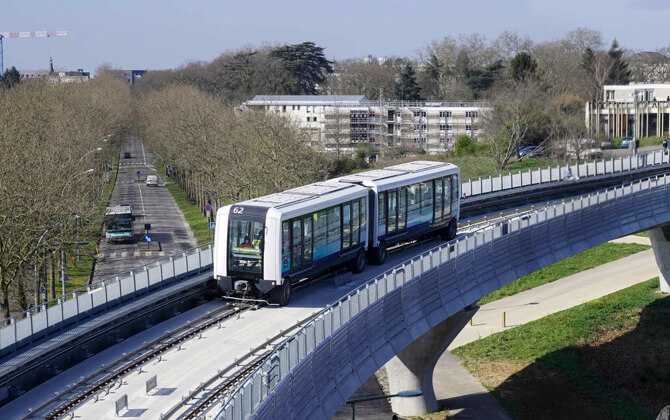
When the Rennes Metro opened in 2002, Rennes became the smallest city in the world to have a metro system. It kept that distinction until 2008.
Line A is a rubber-tired, driverless light metro based on Siemens VAL technology. It runs 9.4 km (5.8 mi) from J.F. Kennedy to La Poterie and has 15 stations.
Line B opened on 20 September 2022 and became the first metro line in the world to use NeoVal technology. With Line B, Rennes became the smallest city in the world with two metro lines.
The network has 28 stations across two lines, and the two main transfer stations are Sainte-Anne and Gares. On a route plan, the lines create an X-shaped network.
Several station names are linked to notable people. J.F. Kennedy refers to the former U.S. President, Charles de Gaulle to the former French President, and Anatole France to the French poet and journalist.
Some station signage is multilingual. Charles de Gaulle station uses French and Gallo, while Gares station uses French and Breton.
La Poterie station and the viaducts on the line were designed by Foster + Partners.
In 2023, Line A carried about 145,000 trips per day, while Line B carried about 80,000.
The system is also known for accessibility and automated operation. All Line A stations have platform screen doors and lifts, and trains run at an average speed of 32 km/h (20 mph).
History
In the 1960s, Rennes Mayor Henri Fréville discussed restoring the city tramway system, which had been dismantled by his predecessor, Yves Milon. The idea of bringing back trams was unpopular at the time because it did not fit the city car-oriented mindset. During a visit to Rennes on 31 March 1969, Charles de Gaulle reportedly told Fréville that the city could have a metro when it had a million inhabitants.
In September 1984, the urban transport planning document for Rennes was redesigned under Mayor Edmond Hervé. The aim was to ease congestion and reduce future traffic problems by remapping the city center. Between June and September 1986, SITCAR studied public transport separated from road traffic, including tramway and light railway options.
- 1986: the City Council decided to create a transport line on a northwestern-southeastern axis.
- 1989: the municipality chose VAL technology.
- 1992: the Line A project received planning and environmental approvals.
- 1997: work on Line A began.
- 2002: Line A opened.
- 2005: three park-and-ride lots were established.
- 2006: the KorriGo card was created.
- 2007: the City Council decided to create Line B.
- 2010: the municipality chose CityVal technology.
- 2011: the Line B project received planning and environmental approvals.
- 2014: work on Line B began.
- 2022: Line B opened.
Line A runs from J.F. Kennedy to La Poterie via the city center and Gare de Rennes. It made Rennes the smallest city in the world to have a metro system until 2008.
On 1 March 2006, the KorriGo card was introduced as a supplement to the ticket system and to support metro and bus travel. The line is maintained by STAR and managed by Keolis. Operations are controlled from a central control center in Chantepie, and 120 cameras monitor the stations.
Line B opened on 20 September 2022 after several delays, mainly linked to the COVID-19 pandemic. It connects Cesson-Sévigné and Saint-Jacques-de-la-Lande, with interchanges to Line A at Sainte-Anne and Gares.
The Rennes Metro has shaped urban development by improving access to outer districts. With the first line, one in two Rennes residents lived within 600 m, or 0.6 km (0.4 mi), of a station, roughly a 10-minute walk. With the second line, that rose to three in four.
Future Expansions
The main expansion project now under way is a capacity upgrade on Line A. The work is designed to improve passenger flow and increase service frequency at the J.F. Kennedy terminus.
The works include extending the underground rear depot by about 200 m, or 0.2 km (0.12 mi), creating a second platform at Kennedy, relocating the turnout in the turnaround area, and adding a new auxiliary structure for ventilation, smoke extraction, and emergency access.
The project is expected to increase Line A transport capacity by 25 percent and allow trains to run every minute instead of every 1 minute 20 seconds by the end of 2028. Rennes Métropole also plans to acquire 7 additional VAL 208 NG3 trains, increasing the fleet from 30 to 37 units, with delivery expected from autumn 2026.
J.F. Kennedy station is due to be fully transformed by the end of 2028, with two platforms, extra equipment, and a new glass slab at surface level. During the works, local traffic adjustments and temporary service interruptions are planned, including a full Line A shutdown with replacement buses between mid-July and late August 2028.
Long-term plans to expand the network further exist, but no detailed timetable has been set for additional lines or extensions.
Nearby Attractions
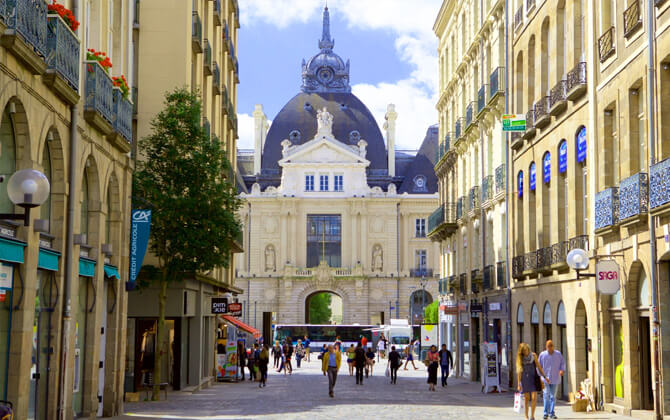
Rennes has a historic center, a lively cultural scene, and plenty of places that are easy to combine with a metro trip. In the Old Town, cobbled streets, timber-framed buildings, and the Parliament of Brittany make a relaxed walk feel worthwhile.
Parc du Thabor is one of the city highlights, offering a calm green space near the center. Culture stops include the Musée des Beaux-Arts and the Musée de Bretagne, while the city center has bars, performance venues, and a strong festival scene.
Popular places to visit include Place des Lices, Rennes Cathedral, Parc du Thabor, Place du Parlement de Bretagne, and Le Couvent des Jacobins. For a longer outing, Mont-Saint-Michel is one of the best-known day trips from Rennes.
If you want more outdoor time, Parc des Gayeulles has trails, a small farm, a skate park, an ice rink, and deer in the woods. Ecomusée de la Bintinais is another option, with exhibits on traditional Breton farming and farm animals.
The Rennes Metro makes many of these sights easy to reach, with two lines connecting central attractions and neighborhoods across the city.