The Lyon Metro is a rapid transit system in Lyon, France, and a core part of the TCL public transport network. Opened in 1974, it has four lines, 42 stations, and 34.4 km (21.4 miles) of route. The system also connects with funiculars, trams, and bus services, making it central to transportation in Lyon and the wider metropolitan area.
| Key | Information |
|---|---|
| System | Lyon Metro |
| Opening | 1974 |
| Lines | 4 |
| Stations | 42 |
| Route length | 34.4 km (21.4 miles) |
| Network | TCL public transport |
| Notable feature | Trains run on the left |
| Other connected modes | Funiculars and tramway |
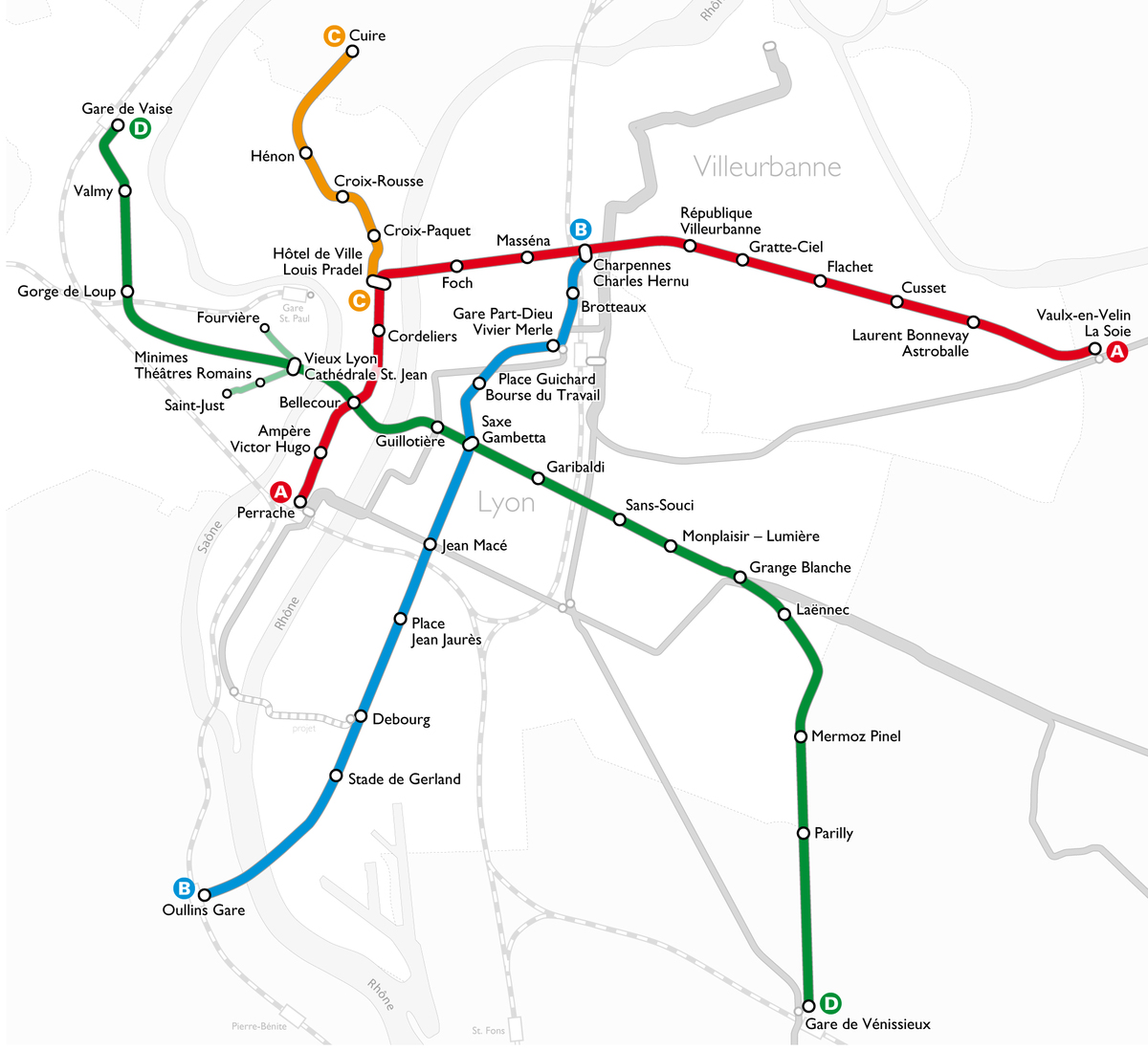
Lyon Metro Map
Map of Lyon Metro showing different lines. Click on the map to enlarge it or download the Lyon Metro map in PDF format.
Lines and Stations
The Lyon Metro has four lines: A, B, C, and D. Together they cover 34.4 km (21.4 miles) and serve 42 stations. All metro stations are wheelchair accessible, and most have turnstiles or automated gates. The source notes one exception: Croix-Paquet on Line C.
| Station | Details |
|---|---|
| Line A | Opened in 1978, 9.2 km (5.7 miles), 14 stations, Perrache to Vaulx-en-Velin–La Soie |
| Line B | Opened in 1978, 10.1 km (6.3 miles), 12 stations, Charpennes–Charles Hernu to Saint-Genis-Laval–Hôpital Lyon Sud |
| Line C | Opened in 1974, 2.5 km (1.6 miles), 5 stations, Hôtel de Ville–Louis Pradel to Cuire |
| Line D | Opened in 1991, 12.6 km (7.8 miles), 15 stations, Gare de Vaise to Gare de Vénissieux |
Lines A and B opened in 1978 and both use rubber tyres. Line C has a different background: it began as the Croix-Rousse-Croix-Paquet rack railway and became part of the metro in 1978. It uses overhead wires and steel wheels, and includes the steep Croix-Paquet station with a 17% incline.
Line D opened in 1991. It is the longest route in the system and was the first fully automatic metro line in France. Like Lines A and B, it uses rubber tyres.
Line A stations
| Station | Details |
|---|---|
| Perrache | Line A station |
| Ampère–Victor Hugo | Line A station |
| Bellecour | Line A station |
| Cordeliers | Line A station |
| Hôtel de Ville–Louis Pradel | Line A station |
| Foch | Line A station |
| Masséna | Line A station |
| Charpennes–Charles Hernu | Line A station |
| République–Villeurbanne | Line A station |
| Gratte-Ciel | Line A station |
| Flachet–Alain Gilles | Line A station |
| Cusset | Line A station |
| Laurent Bonnevay–Astroballe | Line A station |
| Vaulx-en-Velin–La Soie | Line A station |
Line B stations
| Station | Details |
|---|---|
| Charpennes–Charles Hernu | Line B station |
| Brotteaux | Line B station |
| Gare Part-Dieu–Vivier Merle | Line B station |
| Place Guichard–Bourse du Travail | Line B station |
| Saxe–Gambetta | Line B station |
| Jean Macé | Line B station |
| Place Jean Jaurès | Line B station |
| Debourg | Line B station |
| Stade de Gerland–Le LOU | Line B station |
| Gare d’Oullins | Line B station |
| Oullins Centre | Line B station |
| Saint-Genis-Laval–Hôpital Lyon Sud | Line B station |
Line C stations
| Station | Details |
|---|---|
| Hôtel de Ville–Louis Pradel | Line C station |
| Croix-Paquet | Line C station |
| Croix-Rousse | Line C station |
| Hénon | Line C station |
| Cuire | Line C station |
Line D stations
| Station | Details |
|---|---|
| Gare de Vaise | Line D station |
| Valmy | Line D station |
| Gorge de Loup | Line D station |
| Vieux Lyon–Cathédrale Saint-Jean | Line D station |
| Bellecour | Line D station |
| Guillotière–Gabriel Péri | Line D station |
| Saxe–Gambetta | Line D station |
| Garibaldi | Line D station |
| Sans Souci | Line D station |
| Monplaisir–Lumière | Line D station |
| Grange Blanche | Line D station |
| Laënnec | Line D station |
| Mermoz–Pinel | Line D station |
| Parilly | Line D station |
| Gare de Vénissieux | Line D station |
Schedule, Timetables, and Hours of Operations
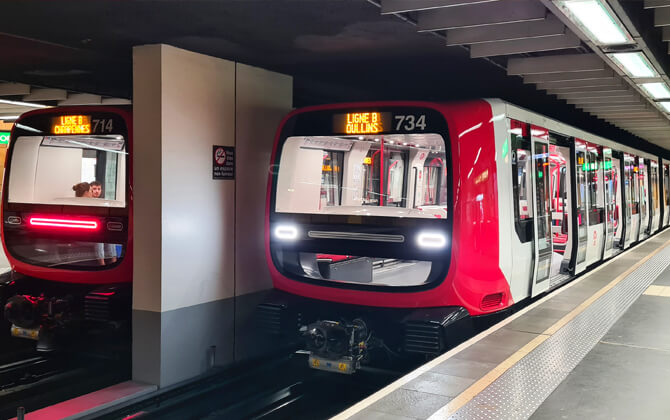
The Lyon Metro operating hours generally run from around 4:00 am to 12:30 am daily, with longer opening hours on Fridays and Saturdays. Since timings, closing time, and last train departures vary by line and day, checking the latest timetable or train schedule before travel is a smart move.
| Service detail | Timings |
|---|---|
| General metro opening times | Around 4:00 am to 12:30 am every day |
| Line A frequency | Every 4 minutes from 7:00 am to 9:00 pm |
| Line A last train, weekdays | Between 12:00 am and 12:20 am |
| Line A last train, Fridays and Saturdays | Between 1:40 am and 1:58 am |
| Line B frequency | Every 3 minutes between 6:00 am and 10:00 pm |
| Line B last train, weekdays | Between 9:15 pm and 9:25 pm on Mondays and Tuesdays; between 12:12 am and 12:18 am on Sundays, Wednesdays, and Thursdays |
| Line B last train, Fridays and Saturdays | Between 1:50 am and 1:55 am |
| Line C frequency | Every 5 to 10 minutes between 7:00 am and 12:00 am |
| Line C last train, weekdays | Between 12:10 am and 12:25 am |
| Line C last train, Fridays and Saturdays | Between 1:48 am and 2:05 am |
| Line D frequency | Every 3 to 5 minutes between 7:00 am and 12:00 am |
| Line D last train, weekdays | Between 12:15 am and 12:20 am |
| Line D last train, Fridays and Saturdays | Between 1:55 am and 2:00 am |
TCL also operates trams, buses, cable cars, and the Rhônexpress airport link, each with its own schedule. Tram line 1 usually runs every 5 to 10 minutes, with the last tram between 12:26 am and 12:35 am. Tram line 2 also runs every 5 to 10 minutes, with the last service between 11:50 pm and 12:52 am.
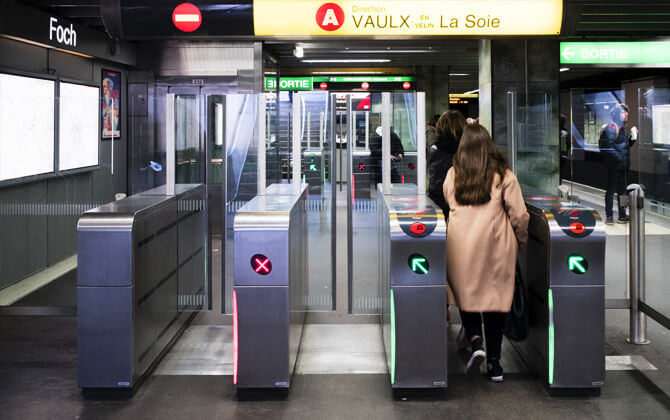
If you use TCL tickets, validate the ticket at the start of the trip and again when boarding another vehicle after a transfer. That includes switching between metro, bus, tram, and other local transport services.
The Rhônexpress route timetable starts early: the first tram leaves Lyon-Part-Dieu at 4:25 am and reaches the airport at 4:54 am. The last departure from the airport is at 12:00 am, arriving at Lyon-Part-Dieu at 12:29 am. Running time is up to 30 minutes.
Prices, Tickets, and Cards
Lyon’s TCL network covers metro, tramway, bus, cable car, and other public transport services. A standard ticket price in the draft is listed as €2 ($2.18), while later fare details in the same source show updated prices for several ticket types. Because the source contains both sets of figures, it is worth checking the latest fare calculator or official ticket machine before buying.
Tickets can be bought with coins or card at metro stations and most tram stops. On buses and trams, a single ticket may also be purchased on board using Apple Pay or a contactless card.
- 10-ticket pack or pre-loaded card with 10 tickets: €19 ($20.71)
- 10-ticket pack for under-26 passengers and students aged 26 to 27: €16.30 ($17.77)
- Long-duration ticket valid from 2 to 72 hours: €3.50 to €17 ($3.82 to $18.53)
- One-day family ticket for 2 to 5 people: €6.50 ($7.09)
- 10 family tickets for families with at least 3 children under 18: €14.10 ($15.37)
- Cable car ticket valid for a same-day round trip: €3.50 ($3.82)
- 7-day pass: €22 ($23.98)
Every ticket must be validated when used. If you change from one form of transport to another, validate again when boarding the next vehicle.
The Lyon City Card is another option for visitors. It includes unlimited access to TCL public transport for the validity period of the card, plus museum entry, guided tours, cruises, and other benefits. Cards are available for 24, 48, 72, or 96 hours, including versions with Rhônexpress.
- Adult 24h: €29 ($31.61)
- Adult 48h: €39 ($42.51)
- Adult 72h: €49 ($53.41)
- Adult 96h: €59 ($64.31)
- Adult 24h with Rhônexpress: €49 ($53.41)
- Adult 48h with Rhônexpress: €58 ($63.22)
- Adult 72h with Rhônexpress: €67 ($73.03)
- Adult 96h with Rhônexpress: €75 ($81.75)
- Junior 24h: €21 ($22.89)
- Junior 48h: €27 ($29.43)
- Junior 72h: €35 ($38.15)
- Junior 96h: €42 ($45.78)
- Student or discounted 24h: €25 ($27.25)
- Student or discounted 48h: €34 ($37.06)
- Student or discounted 72h: €43 ($46.87)
- Student or discounted 96h: €52 ($56.68)
| Station | Details |
|---|---|
| Metro ticket | €2 ($2.18) |
| 10-ticket pack | €19 ($20.71) |
| Long-duration ticket | €3.50 to €17 ($3.82 to $18.53) |
| 7-day pass | €22 ($23.98) |
| Lyon City Card | 24h to 96h validity |
Single tickets
A single ticket is valid across the TCL system, including metro, tramway, bus, trolleybus, shuttle, and funicular. It allows a free transfer and a return trip within one hour.
You still need to validate it each time you start a trip on the metro or funicular, and every time you board a bus or tram. If you change vehicles, validate again.
Tickets are sold at vending machines in metro stations and most tram stops, at TCL agencies and service points, on the TCL mobile app, and on board buses and trams for single trips. Buying on the bus costs more.
The contactless ticket replaced the old paper ticket. The first card costs €0.20 ($0.22), and it can be reloaded up to 10 times.
- Single ticket: €1.90 ($2.07)
- Single ticket bought on board: €2.20 ($2.40)
- 10-ticket booklet: €18.00 ($19.62)
- 10-ticket booklet for under 26s and students up to 28: €15.40 ($16.79)
- 2-hour ticket: €3.30 ($3.60)
- 7-day pass: €22.00 ($23.98)
Children under 11 travel free on the network, but a free ticket is still required for children aged 4 to 11.
Specific Tickets
The TCL fare system covers metro, tram, bus, and funicular services with the same ticket structure across the network. That makes day-to-day travel fairly straightforward.
Single ticket: valid for one journey with a free transfer and return trip within one hour. Price: €1.90 ($2.07), or €2.20 ($2.40) if bought on the bus.
10-ticket booklet: €18 ($19.62), or €15.40 ($16.79) for people under 26 and students aged 28 or younger.
Time-based tickets: 2-hour ticket €3.30 ($3.60), night ticket valid from 7 pm €3.30 ($3.60), 24-hour ticket €6 ($6.54), 48-hour ticket €12 ($13.08), and 72-hour ticket €16.50 ($17.99).
Monthly subscriptions: €25 ($27.25) for ages 18 to 25, and €25 ($27.25) for students aged 26 to 27.
Tickets can be bought at metro or tram stations, at TCL agencies, at service points, on the TCL mobile app, and on the bus. If you buy on board, the single ticket costs more.
As always, validate every time you begin a trip or make a transfer. Children under 11 travel free, though children aged 4 to 11 still need a free ticket.
The Lyon City Card also gives unlimited access to public transport in zones 1 and 2 for 24, 48, 72, or 96 hours, depending on the version.
Student Subscription
The Lyon City Card is available at a student rate. It is a contactless card that combines public transport access with museums, guided tours, cruises, and other activities during the validity period.
Student cards are sold for 24h, 48h, 72h, and 96h. A valid student card is required.
- Lyon City Card Student or discounted 24h: €25 ($27.25)
- Lyon City Card Student or discounted 48h: €34 ($37.06)
- Lyon City Card Student or discounted 72h: €43 ($46.87)
- Lyon City Card Student or discounted 96h: €52 ($56.68)
The pass includes unlimited use of buses, metro, trams, and cable cars for its duration. It also includes access to museums, temporary exhibitions, guided tours, and selected attractions.
Discounted and student cards bought online must be picked up at the Tourist Office on Place Bellecour, at the Part-Dieu Shopping Centre, or at Confluence Shopping and Leisure Centre, with valid supporting documents.
The card is activated on first use, either on public transport or for the first tourist activity. When using transport, validate it at each connection.
Connecting Rail Services
The Lyon Metro is closely integrated with the wider TCL system, so changing between metro, tramway, funicular, and rail services is simple enough. Several stations work as major interchange points.
| Station | Details |
|---|---|
| Charpennes–Charles Hernu | Lines A and B, transfers to Tramways 1 and 4 |
| Debourg | Line B, transfer to Tramway 1 |
| Part-Dieu | Line B, transfers to Tramways 1, 3, and 4, Rhonexpress, Intercités, and TGV services |
| Perrache | Line A, transfer to Rhonexpress |
| Jean Macé | Line B, transfer to Rhonexpress |
| Grange Blanche | Line D, transfers to Tramways 2 and 5 |
| Guillotière-Gabriel Péri | Line D, transfer to Tramway 1 |
| Sans Souci | Line D, transfer to Tramway 4 |
| Place Guichard–Bourse du Travail | Line B, transfer to Tramway 1 |
| Vieux Lyon–Cathédrale Saint-Jean | Line D, transfers to Funiculars 1 and 2 |
| Vaulx-en-Velin–La Soie | Line A, transfer to Tramway 3 |
| Gorge de Loup | Line D, connection with western Lyon tram services |
For airport access, Lyon-Saint Exupéry Airport is served by Rhonexpress. The nearest metro connection mentioned here is Part-Dieu on Line B, and the journey from Part-Dieu to the airport takes about 30 minutes.
Funiculars
The Funiculars of Lyon are part of the same broader transport system as the metro and tramway. Of the five historic lines, two remain in operation today, both starting from Saint-Jean.
F1 runs between Saint-Jean and Saint-Just, while F2 runs between Saint-Jean and Fourvière.
| Station | Details |
|---|---|
| F1 | Saint-Jean to Saint-Just, 791 metres (0.8 km / 0.5 miles), height 91.2 metres, 3 stops |
| F2 | Saint-Jean to Fourvière, 404 metres (0.4 km / 0.3 miles), height 116 metres, 2 stops |
| Service detail | Timings |
|---|---|
| F1 running time | 3 minutes 20 seconds |
| F1 frequency | Every 5 to 10 minutes |
| F1 opening hours | 05:00 to 24:00 |
| F2 running time | 2 minutes |
| F2 frequency | Every 5 to 10 minutes |
| F2 opening hours | 06:00 to 22:00 |
The funiculars have a long history in Lyon. The first one opened in 1862, and the old Croix-Paquet line was later converted into a rack railway before becoming Metro Line C. So yes, the link between the metro and funicular network runs deep.
Airport Connection
Lyon Saint-Exupéry Airport is about 25 km (15.5 miles) from the city centre. The main public transport link is the Rhônexpress tramway, which connects central Lyon to Lyon Saint-Exupéry TGV station in about 30 minutes.
The airport station is around 2 minutes on foot from Terminals 1 and 2. Rhônexpress runs 7 days a week, with departures every 15 minutes from 4:25 am to midnight, and every 30 minutes during part of the day and late evening.
The route serves Lyon Part-Dieu, Vaulx-en-Velin La Soie, and Meyzieu ZI. Part-Dieu connects with Metro Line B, while Vaulx-en-Velin La Soie links with Metro Line A. Tickets can be bought at stations or online, and no seat reservation is required.
Bus line 47 serves the airport in the direction of Saint-Laurent-de-Mure Maréchal Juin and also goes toward Meyzieu Zi, where you can connect with Tram T3 and then continue to Part-Dieu and Metro Line B. Bus line 48 also connects Genas with the airport.
Because road traffic can affect the bus schedule, extra time is a good idea during peak hours. If you want the simplest route, Rhônexpress is the most direct option.
Parking at Metro
Park-and-ride can be a practical option if you want to avoid driving all the way into central Lyon. TCL offers 23 park-and-ride lots connected to metro, tramway, or bus lines.
The idea is simple: park, continue by public transport, and use your TCL ticket or travel card when leaving the lot. These station parking facilities are reserved for TCL customers, and parking is prohibited at night.
Lyon also has 20 public car parks managed by Q-Park, Indigo, and LPA, with pricing regulated by the Metropole. Residents can get subscription rates in some cases.
Street parking is divided into two paid zones, Presto and Tempo. Presto is the more expensive one. Payment is also available through the Flowbird app.
- Parking charges for a weekend in some car parks: €40 to €50 ($43.60 to $54.50)
- Example parking charges: République €50 ($54.50), Fosse aux Ours €40 ($43.60)
- Parking charges per day are not fully detailed in the source
- Tempo zone street parking is free from 1 to 31 August, with more than 38,000 spaces available
Rules and Tips
One ticket can be used across the TCL network, including metro, tramway, bus, trolleybus, shuttle, and funicular services. But a valid ticket or pass alone is not enough: you must validate it every time you start a trip on the metro or funicular, and every time you board a bus or tram.
If you change vehicles, validate again. That matters during inspections, so keep your ticket or contactless card until the end of the trip.
Ticket basics
The contactless ticket has replaced paper tickets. You can load single tickets, day pass products, funicular tickets, passes, and ticket books onto it. The first purchase costs €0.20 ($0.22), and the card can be reloaded up to 10 times.
There are options for different travel needs, including 24h, 48h, and 72h tickets, a 7-day pass, family tickets, group tickets, and ticket books. Children under 11 travel free, but a free ticket is still required for children aged 4 to 11.
Good to know before you travel
The TCL network covers 4 metro lines, 7 tramway lines, around 150 bus, trolleybus, and shuttle lines, 2 funicular lines, 1 river shuttle, and about 3,000 stops. It serves 262 towns, including the 58 towns of the Metropolitan Area.
The source also states that from 1 September 2025, TCL merged with the Cars du Rhône and Libellule networks to cover the whole Rhône department. It further notes that the network is divided into six fare zones with four fare categories, and that line C200 connects Vaulx-en-Velin to Lyon Airport in 40 minutes.
Useful travel tips
- Always keep your ticket until the end of the trip.
- Use the TCL app or station maps to plan your route and check schedule today information.
- Avoid peak hours if you want a more comfortable ride.
- Keep belongings close in crowded stations and trains.
- Let passengers off first, keep noise down, and respect reserved seating.
The draft also mentions Pleine Lune night lines, alighting on request after 10 pm, accessibility improvements for passengers with reduced mobility, and park-and-ride facilities that can be used with a transport ticket.
A Lyon City Card includes unlimited access to TCL zones 1 and 2 for 1, 2, 3, or 4 days, depending on the card validity.
A Brief History of Lyon Metro
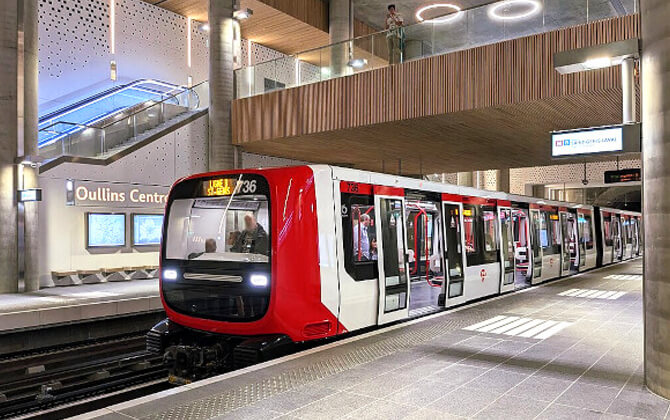
The history of Lyon Metro starts in 1974, when the system first opened. It is part of the TCL public transport network and today has four lines, 42 stations, and 34.4 km (21.4 miles) of route.
Lines A and B entered service on 2 May 1978. Both were built using the cut-and-cover method. Line A originally ran from Perrache to Laurent Bonnevay–Astroballe, while Line B linked Charpennes to Part-Dieu before later extensions.
Line C followed a different path. It was integrated into the metro in 1978 from the refurbished Croix-Rousse–Croix-Paquet rack railway, then extended to Cuire on 8 December 1984. It remains the only line in the system to use overhead wires and steel wheels.
Line D opened on 4 September 1991 and became the first fully automatic metro line in France. At first it ran with operators on board, then switched to driverless service on 11 December 1992.
Trains run on the left, unlike most other French metro systems. The source says this reflects an earlier plan to extend the metro along existing railway lines into the suburbs. In 2025, daily average ridership was 810,000.
- 1974: Lyon Metro first opened
- 1978: Lines A and B entered service
- 1978: Line C was integrated into the metro
- 1991: Line D opened
- 2025: Daily average ridership reached 810,000
Future Expansions
Lyon Metro expansion plans focus on modernization, automation, and capacity upgrades rather than building a new metro line right now.
Line A is planned to be modernized and automated by 2035. The project includes a new control system, new-generation trains with longer four-car formations, platform screen doors, upgrades to fixed installations, and redevelopment of the Poudrette depot.
Line D is planned for modernization by 2030. The works include renewed driving automation, 18 additional trains, upgrades to the platform-track protection system, depot adaptations, and wider system renewal.
Egis has been awarded project management contracts for both schemes and will oversee delivery, costs, timelines, performance, and integration while service continues on these busy routes.
Plans for a new Line E were studied in the past as a route between the western suburbs and the city centre, but these proposals were cancelled in 2022 in favor of new express tramway projects, partly underground.
Curious Facts
The Lyon Metro has a few details that make it stand out. Trains run on the left, which is unusual in France, and the system uses different operating technologies across its lines.
Lines A, B, and D use rubber tyres and a third rail, while Line C uses steel wheels and overhead wires. The loading gauge is 2.90 m, wider than the average for metro systems in Europe.
Line D was the first fully automatic metro line in France. It started in 1991 with staff on board, switched to driverless operation in 1992, and still has no platform screen doors.
Line C has perhaps the most unusual story in the system. It began as a funicular in 1891, later became a rack railway, and joined the metro in 1978. Croix-Paquet station is said to be the steepest metro station in Europe, with a 17% incline.
The source also notes that Line D is the deepest line in Lyon and passes under both the Rhône and Saône rivers. Daily ridership reached 810,000 in 2025.
Nearby Attractions
The Lyon Metro is a handy way to reach many of the city’s major sights, from museums and historic districts to large public squares. If you are planning a route through central Lyon, the metro and funicular network make sightseeing much easier.
With daily service starting around 4:00 am and a closing time around 12:30 am on most days, there is usually enough flexibility to fit visits into your schedule.
- Museum of Fine Arts in Lyon: major museum with collections ranging from Egyptian artefacts to contemporary art.
- Place des Terreaux: central square near City Hall, the Opera House, and the Museum of Fine Arts.
- Old town of Quartier Saint-Jean and Saint Georges: historic areas with cobbled streets, restaurants, and local museums.
- Croix-Rousse: hill district known for traboules, silk heritage, and local character.
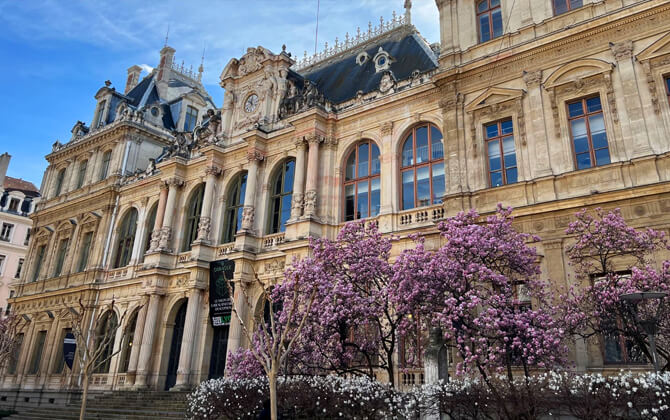
- Presqu’ile district: lively central area with notable architecture, including the Palais de la Bourse et du Commerce.
- Basilique Notre-Dame de Fourvière: landmark church with city views.
- Musée des Tissus and Musée des Arts Décoratifs: museums linked to Lyon’s silk trade and decorative arts.
- Mini World Lyon Park: attraction reachable by metro.
- Parc de Parilly: another area connected by the network.
The draft mentions around 22 museums within reach of the metro. For airport travel, the metro also connects with Rhonexpress via Part-Dieu, linking the city transport system with Lyon-Saint Exupéry Airport.