The Rouen tramway, officially branded as the Rouen Metro, is a light rail system serving Rouen in Normandy, France. Operated as part of the city’s public transport network, it opened on 17 December 1994 after construction began in 1991. The route includes a 1.7 km (1.1 mi) underground section through the city centre, then splits into two southern branches toward Le Grand-Quevilly and Saint-Étienne-du-Rouvray. Although locals often call it the metro, it remains technically a modern tramway.
| Key | Information |
|---|---|
| System name | Rouen tramway, branded as Rouen Metro |
| Location | Rouen, Normandy, France |
| Opened | 17 December 1994 |
| Network length | 18.2 km (11.3 mi) |
| Commercial route length | 15.1 km (9.4 mi) |
| Underground section | 1.7 km (1.1 mi) through central Rouen |
| Stations | 31 stops |
| Lines and branches | Two southern branches after a shared central route |
| Daily traffic | 65,000 journeys |
| Opening hours | 5:00am to 11:30pm |
| Peak frequency | Every 3 minutes |
| Off-peak frequency | Every 20 minutes |
| Single fare | €1.80, about $1.95 |
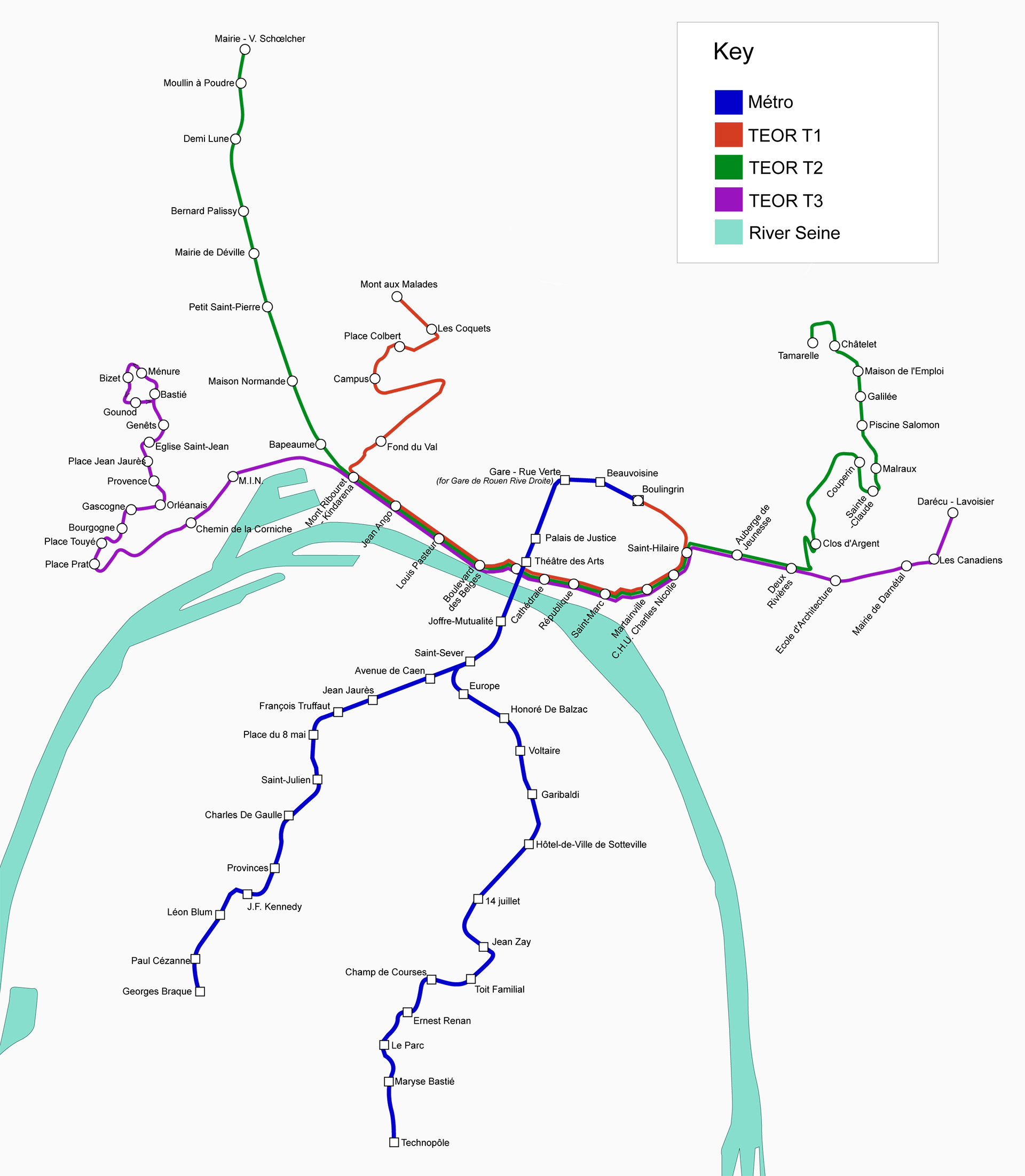
Map of Rouen Tramway
Map of Rouen Metro showing different lines. Click on the map to enlarge it or download the Rouen Metro map in PDF format.
Line and Stations
The Rouen tramway route covers 18.2 km (11.3 mi), including extensions to car parks, with a 15.1 km (9.4 mi) commercial section. Trains follow a shared path through central Rouen before the line divides south of the Seine River. This simple route plan makes the system easy to understand, even for first-time visitors.
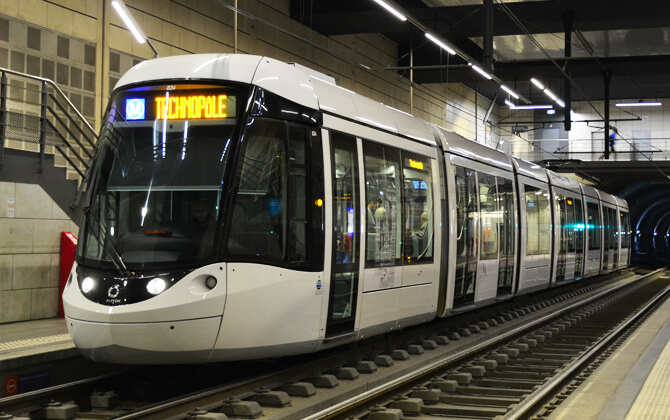
In the city centre, the tram runs underground for 1.7 km (1.1 mi), from Joffre–Mutualité through the central stations. After leaving the tunnel, the route continues at street level, mostly on reserved track. The underground stretch is the main reason the system is widely known as the Rouen Metro.
South of Saint-Sever, the line splits into two branches. One branch serves Le Grand-Quevilly and ends at Georges Braque. The other serves Saint-Étienne-du-Rouvray and ends at Technopôle. Both remain part of the same tramway system and share the central section.
| Station | Details |
|---|---|
| Boulingrin | Northern terminal and a key access point to the line. |
| Beauvoisine | Central underground station on the shared route. |
| Gare–Rue Verte | Interchange with the SNCF railway line. |
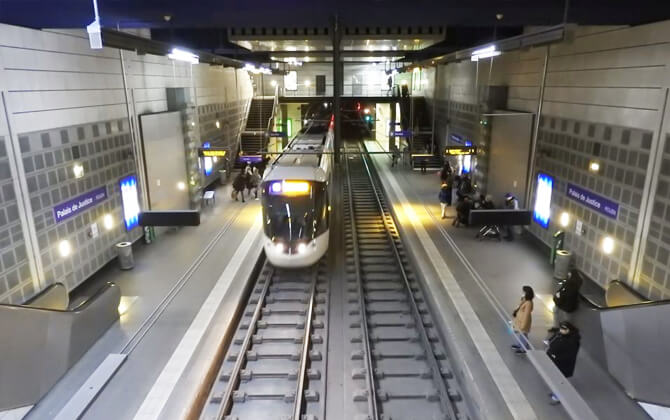
| Palais de Justice | Central station opened in 1997, useful for city-centre trips. |
| Théâtre des Arts | Major interchange with bus rapid transit lines T1, T2, and T3. |
| Joffre–Mutualité | Underground station in the city-centre section. |
| Saint-Sever | Station where the line divides into the two southern branches. |
| Georges Braque | Terminus of the Le Grand-Quevilly branch. |
| Technopôle | Terminus of the Saint-Étienne-du-Rouvray branch. |
Platforms were designed for 60-metre trains, and all stations are accessible for passengers with reduced mobility. Main stations also have platform validators, installed from 2009 onward to speed up boarding. Station parking is linked in the route information to car-park extensions, but parking charges and parking charges per day are not listed in the available tramway details.
Key Stations
The main stations are concentrated in the city centre and along the shared northern section. Several are underground, while others work as important transfer points in the local transport network.
| Station | Details |
|---|---|
| Boulingrin | Northern terminus at Place Boulingrin, inaugurated on 16 December 1994. It serves the Jouvenet district. |
| Gare–Rue Verte | One of the main interchange stations, with direct access to the SNCF railway station. |
| Palais de Justice | Busy central stop near the Palais de Justice and Avenue Jeanne d’Arc, opened in 1997. |
| Théâtre des Arts | Central hub opened in 1994, located between the Vieux-Marché and Cathédrale districts. |
| Joffre–Mutualité | Underground station opened on 16 December 1994 in the Saint-Sever district. |
| Saint-Sever | Major transfer station on Avenue de la Bretagne, serving both southern branches. |
| Europe | Important stop on the southern part of the network. |
| Hôtel de Ville de Sotteville | Serves Sotteville-lès-Rouen. |
| Ernest Renan | Important southern-branch stop. |
| Technopôle | Terminus for the Saint-Étienne-du-Rouvray branch. |
| Georges Braque | Terminus for the Le Grand-Quevilly branch. |
Together, the stations list connects central Rouen with Sotteville-lès-Rouen, Le Petit-Quevilly, Le Grand-Quevilly, and Saint-Étienne-du-Rouvray. For visitors comparing a stations map with the route timetable, the shared central section is the part to watch first.
Fare Structure
The Rouen tramway uses the same fare system as the bus and TEOR lines in the Astuce network. The same ticket, card, or pass can be used across the network, and fares are set by Métropole Rouen Normandie.
A single ticket is valid for one hour from first validation. Within that period, it can be used for a round trip and allows 1 to 6 transfers with bus and tram lines.
| Offer | Value | Price |
|---|---|---|
| Single trip | 1 ride | €1.80, about $1.95 |
| 10-trip ticket | 10 rides | €15.30, about $16.55 |
| Moderato | 10 rides | €3.30, about $3.55 |
| Jeune | 10 rides | €9.00, about $9.75 |
| Senior | 20 units | €12.00, about $13.00 |
| Découverte | 24 hours | €5.70, about $6.15 |
| Groupe | Up to 10 people | €6.30, about $6.80 |
| In’Cité | Network fare product | €4.00, about $4.30 |
For a quick fare calculator, compare the single ticket price with the 10-trip ticket or the 24-hour day pass, depending on how many journeys you expect to make. Fare updates generally follow inflation and help fund network development, new vehicles, maintenance, dedicated right-of-way sections, and station upgrades.
Single and Multi-Trip Tickets
Occasional riders can use a single ticket, while frequent passengers can save with multi-trip options. The 24-hour Découverte pass works well for visitors planning several journeys in one day.
- Single trip: €1.80, about $1.95.
- 10-trip ticket: €15.30, about $16.55.
- Moderato 10 trips: €3.30, about $3.55.
- Jeune 10 trips: €9.00, about $9.75.
- Senior 20 units: €12.00, about $13.00.
- Découverte 24-hour day pass: €5.70, about $6.15.
Tickets can be bought at station sales offices or from automatic ticket machines. They must be validated before travel, including when transferring from Metrobús services.
Subscriptions
Rouen Tramway subscriptions follow the Astuce network system and also cover bus and TEOR services. A valid travel ticket allows connections with bus and tram services for one hour after first validation.
The fare policy is set by Rouen Normandy Metropolis. Prices are adjusted broadly in line with inflation and support network development, including new vehicles, maintenance, and modernization works.
| Offer | Validity | Price |
|---|---|---|
| 1 trip | 1 trip | €1.80, about $1.95 |
| 10 trips | 10 trips | €15.30, about $16.55 |
| Moderato | 10 trips | €3.30, about $3.55 |
| Youth | 10 trips | €9.00, about $9.75 |
| Senior | 20 units | €12.00, about $13.00 |
| Discovery | 24 hours | €5.70, about $6.15 |
| Group | Up to 10 people | €6.30, about $6.80 |
| In’Cité | Network fare product | €4.00, about $4.30 |
Subscriptions and passes are issued through the same network ticketing system, using travel cards or magnetic tickets that must be validated when boarding.
Operating Hours
The Rouen Tramway operates daily from 5:00am to 11:30pm. These are the listed operating hours, opening hours, and working hours for the system, so they are the best starting point when checking timings today.
| Service detail | Timings |
|---|---|
| Starting time | 5:00am |
| Closing time | 11:30pm |
| Daily opening times | 5:00am to 11:30pm |
| Peak service frequency | Every 3 minutes |
| Off-peak service frequency | Every 20 minutes |
For evening travel, plan the last train around the listed closing time. The line does close late enough for many evening trips, but the exact schedule today can vary by time of day, so allow extra time outside peak periods.
Train Frequencies
The train schedule is strongest during busy periods, when trams run every 3 minutes. Off peak, the frequency drops to every 20 minutes. That difference matters if you are planning a connection or trying to match the tramway timetable with a bus or SNCF service.
| Service detail | Timings |
|---|---|
| Peak running time between trains | Every 3 minutes |
| Off-peak running time between trains | Every 20 minutes |
| Daily service window | 5:00am to 11:30pm |
During quieter hours, the wait can feel longer, especially in the evening. If your trip depends on a transfer, check the route timetable before setting out.
Transit Connections
The Rouen tramway is closely tied into city transport and local transport across Rouen. The most useful interchange is Théâtre des Arts, where passengers can connect with bus rapid transit lines T1, T2, and T3. Gare–Rue Verte is another key point, offering a connection to the SNCF railway line.
Several stations also connect the tramway with bus services, including Boulingrin, Beauvoisine, Palais de Justice, Europe, Hôtel de Ville de Sotteville, Ernest Renan, Technopôle, François Truffaut, Place du 8-Mai, Saint-Julien, Charles de Gaulle, J.F. Kennedy, Paul Cézanne, and Georges Braque.
As part of public transport in Rouen, the tramway is useful for more than city-centre trips. It also links the centre with both southern branches and supports onward travel across the wider transport system.
Service frequency is especially strong at peak times, which helps with transfers. Outside peak hours, leave more time between connections.
Underground Connections
The Rouen tramway includes a 1.7 km (1.1 mi) underground section through the city centre. This tunnel carries the central route before trains continue south and divide into the two branches.
Underground stations in the central section include Joffre–Mutualité, Théâtre des Arts, Palais de Justice, Gare–Rue Verte, and Beauvoisine. South of the tunnel, the tramway runs mainly at street level and on reserved track.
For onward travel, Théâtre des Arts connects with bus rapid transit lines T1, T2, and T3. Gare–Rue Verte connects with the SNCF railway line, making it one of the most practical stations for regional rail transfers.
This underground section gives the system its metro identity, even though it is a tramway rather than a full underground metro.
Connections to the Airport
The Rouen Metro does not have a direct connection to Rouen Vallée Seine Airport, and there are no dedicated bus lines to the airport. Most travellers use a taxi for the final part of the journey.
To reduce the cost, you can combine public transport with a short taxi ride. Take the tramway to Gare–Rue Verte, then board bus number 13 from the stop outside the station. Get off at La Claire Voie, near the Centre Commercial du Canivet, and take a taxi from there to the airport.
From the airport to Rouen city centre, use the same route in reverse. Taxis are available outside the airport for the ride to Centre Commercial du Canivet, where bus number 13 runs back toward the city.
Guidelines and Rules
These rules help keep the Rouen tramway safe, accessible, and comfortable for everyone using the network.
- Validate your ticket every time you board a tram, including after a Metrobús transfer.
- Only guide dogs and small pets in special carriers are allowed on board.
- Smoking and electronic cigarettes are not allowed on tram or bus services.
- Do not open the windows, as this affects the air conditioning.
- Respect seats reserved for disabled passengers, elderly passengers, and pregnant women.
- Let passengers get off before you board.
- Keep wheelchair spaces clear at all times.
- Large items that take up excessive space are not allowed.
- Pyrotechnic products are prohibited.
- Prams are allowed, but they must not block other passengers. Only three prams are allowed per carriage.
- Vandalism, graffiti, sabotage, and deliberate damage to stations or vehicles are prohibited.
- Bicycles are allowed, but they should not take up too much space in the carriage.
- Roller skates are not allowed in the metro.
A Brief History of Rouen
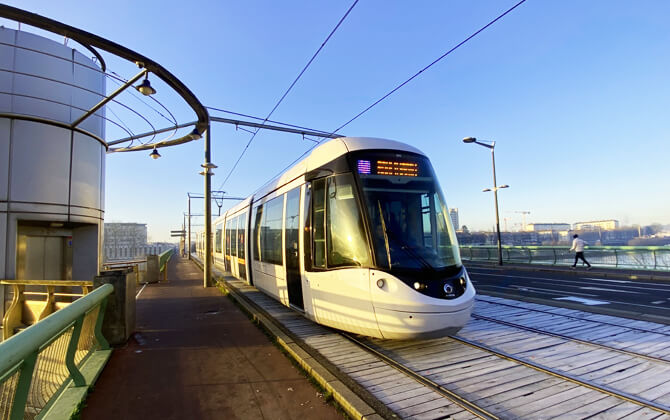
Rouen’s tramway history has two main periods: the first-generation network, which operated from 1877 to 1953, and the modern light rail system, which opened in 1994. Before electric trams, the city had horse-drawn carriages and omnibuses, but they were no longer enough for a growing urban area.
The first tramway began with horse-drawn services, then added steam traction from Maromme on 29 December 1877. Full electrification followed in 1896 by Thomson Houston. The network expanded quickly through Rouen and its suburbs, reaching 70 km (43.5 mi) by 1915, the longest electric tram network in France at the time.
Traffic rose again in 1928 to more than 30 million journeys, but private cars, buses, trolleybuses, the Great Depression, and World War II pushed the old tramway into decline. The municipality decided to close it in March 1950, and the last trams ran in 1953.
Rouen then spent more than 40 years without trams. Construction of the modern network began in 1991, and the new system opened on 17 December 1994 under the Rouen Metro brand. It combined underground operation in the centre with surface tramway running on the outer sections.
The modern network was extended to Technopôle du Madrillet in September 1997. Today, it remains a major part of transportation in Rouen, with 31 stops and strong links to other local transport lines.
Future Expansions
Future expansion of the Rouen tramway is tied to wider changes in the metropolitan transport network. Current studies look at the tramway, TEOR, and Fast services, along with possible urban tram-train sections within the Metropolitan Regional Express Service project and service to the future Saint-Sever station.
These plans could lead to new tramway or TEOR lines over the next 15 years. Options mentioned in the available material include a fourth tram branch, a new tram line, or the conversion of one TEOR line into tramway service. The Saint-Sever station connection and the replacement of a TEOR line by tramway are among the options considered.
The future Saint-Sever station is one of the main drivers for expansion. As part of the Paris–Normandy new line project, a new mainline station is planned for around 2030 on the left bank. Tramway extensions are being studied to provide direct access and create a new north-south axis serving the future station and the eco-district near the Gustave-Flaubert bridge.
Another long-discussed idea is a tram-train link between Rouen and Elbeuf. The wider railway network is also under study, including the reopening to passengers of the 365-370 line toward Elbeuf and the creation or reopening of several railway stops.
The future T5 line, scheduled for 2025, is described as the first building block of this updated structuring network. By the 2035 horizon, the role of the current TEOR lines and the possible creation of additional tramway sections are expected to be clearer.
Tourist Attractions
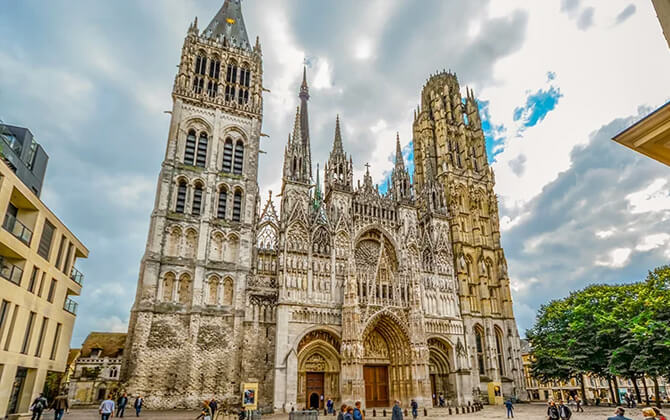
Rouen’s main sightseeing area is concentrated around the historic centre, and several attractions are easy to reach from Gare–Rue Verte. A short walk brings you to the Musée des Beaux-Arts de Rouen, which has paintings from the 15th century onward, including works by Monet, Pissarro, and Gauguin. It also hosts art appreciation events during the year.
Nearby, the Cathédrale Notre-Dame de Rouen stands as one of the city’s signature Gothic landmarks. If you are exploring Rouen by tramway and on foot, this area is a practical place to start.
- Musée des Beaux-Arts de Rouen: known for its painting collection and Impressionist works.
- Cathédrale Notre-Dame de Rouen: a major Gothic monument and one of Rouen’s best-known landmarks.
- Place du Vieux Marché: linked to the memory of Joan of Arc and included on guided routes through the historic centre.
- Le Gros-Horloge: Rouen’s famous astronomical clock and one of the city’s iconic monuments.
- Historial Jeanne d’Arc: an immersive museum dedicated to Joan of Arc.
Guided tours and the Rouen Pass include access to major attractions, museum visits, and free public transport. That makes it easier to combine the main landmarks with a relaxed day around the Seine Valley and Rouen’s historic streets.