The Tashkent Metro is the rapid transit system serving Tashkent, the capital of Uzbekistan. Opened in 1977, it was the first metro in Central Asia and the seventh built in the former USSR. Today, the system has four lines, 50 stations, and 70.4 km (43.7 miles) of route, making it one of the key parts of public transport and city transport in Tashkent.
| Key | Information |
|---|---|
| System name | Tashkent Metro, also known as Toshkent metropoliteni |
| Opened | 1977 |
| Lines | 4 |
| Stations | 50 |
| Route length | 70.4 km (43.7 miles) |
| Daily ridership | About 785,000 passengers per day in 2025 |
| Annual ridership | 286.8 million passengers in 2025 |
| Notable feature | Many stations have themed architecture, original art, and distinctive decorative styles |
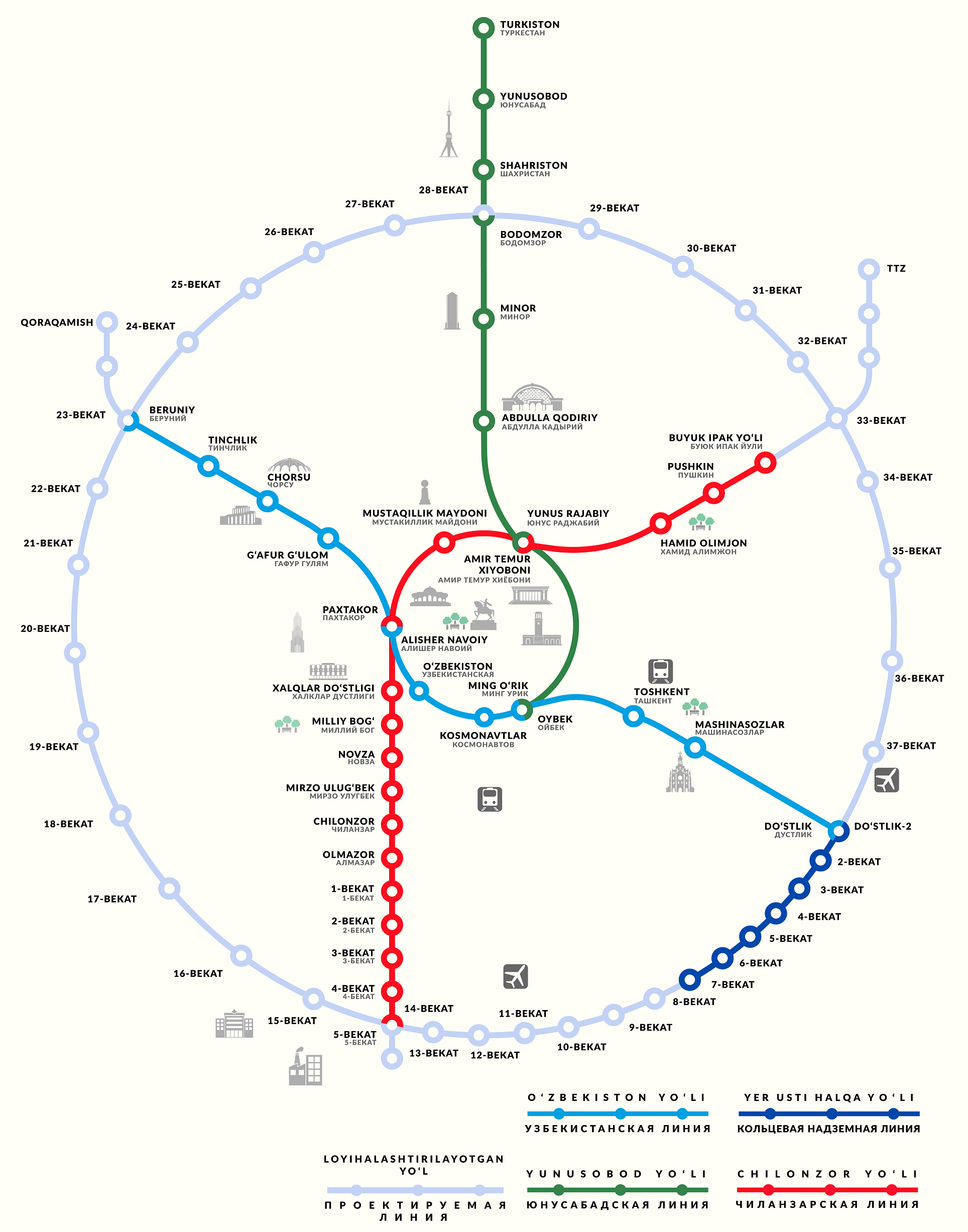
Tashkent Metro Map
Map of Tashkent Metro showing different lines and stations. Click on the map to enlarge it or download the Tashkent Metro map in PDF format.
Tashkent Metro Lines and Stations
The Tashkent Metro currently operates four lines: the Chilonzor Line, the Oʻzbekiston Line, the Yunusobod Line, and the Circle, or Halqa, Line. Together, they form the main metro route plan across the city and serve 50 stations over 70.4 km (43.7 miles).
| Line | Opened | Length | Stations |
|---|---|---|---|
| Chilonzor Line | 1977 | 23.7 km (14.7 miles) | 17 |
| Oʻzbekiston Line | 1984 | 14.3 km (8.9 miles) | 11 |
| Yunusobod Line | 2001 | 10.5 km (6.5 miles) | 8 |
| Circle (Halqa) Line | 2020 | 21.9 km (13.6 miles) | 14 |
| Total | — | 70.4 km (43.7 miles) | 50 |
The Chilonzor Line was the first route to open and remains one of the core lines of the system. The Oʻzbekiston Line runs diagonally across the city from northwest to southeast via Toshkent Railway station. The Yunusobod Line links northern districts with the city center, while the Circle Line is the newest line and continues to expand.
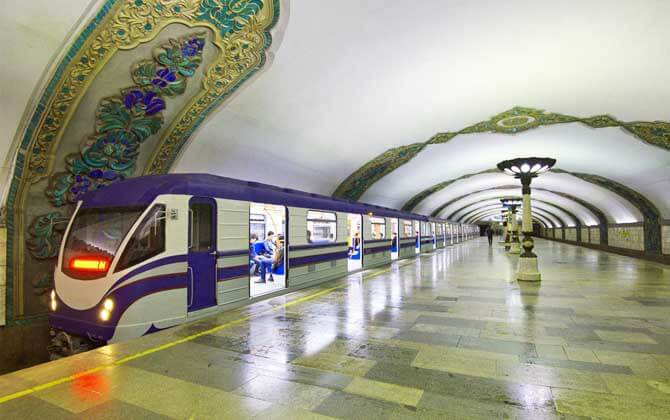
Station design is a major part of the Tashkent Metro experience. Each station is built around a specific theme, often reflected in its name, and many use marble, granite, ceramics, glass, metal, and carved alabaster. Some stations were renamed after 1991, so older names may still appear in historical materials or on an older stations map.
Timetable & Operating Hours
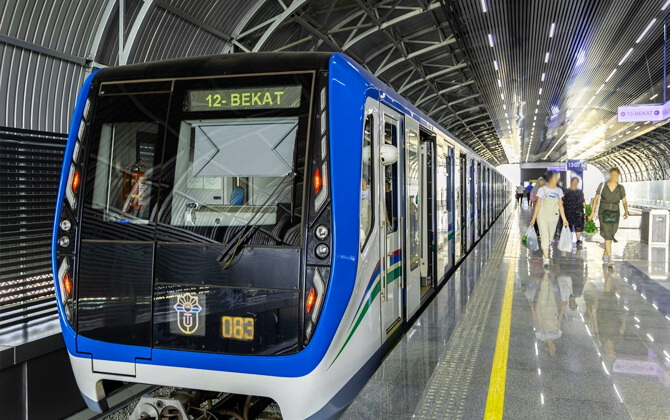
The Tashkent Metro runs daily, with operating hours generally from 5:00 AM to 12:00 AM. Some information lists the closing time at around 11:30 PM, so checking the latest schedule today is a smart move before late-night travel, holidays, or maintenance periods.
Train frequency is usually about every 5 minutes on weekdays. During peak hours, trains may arrive every 2 to 3 minutes. After 9:00 PM, the gap can increase to around 10 minutes, while weekend and holiday timings are generally every 5 to 10 minutes.
| Service detail | Timings |
|---|---|
| General opening hours | About 5:00 AM to 12:00 AM daily |
| Possible earlier closing time | Some sources list service ending around 11:30 PM |
| Weekday frequency | Usually every 5 minutes |
| Peak-hour frequency | Every 2 to 3 minutes |
| Evening frequency after 9:00 PM | About every 10 minutes |
| Weekend and holiday frequency | Every 5 to 10 minutes |
| Peak hours | 7:30 AM to 9:30 AM and 5:00 PM to 7:30 PM |
| Best time to ride | Early afternoon, roughly 1:00 PM to 4:00 PM |
Sample first train and last train timings are listed below. These opening times can vary slightly by station and direction, so use them as a route timetable reference rather than a final guarantee.
| Service detail | Timings |
|---|---|
| Chilanzar Line, Beruni | First train 05:00; last train 00:00 |
| Chilanzar Line, Pakhtakor | First train 05:09; last train 00:09 |
| Chilanzar Line, Chilanzar | First train 05:33; last train 00:33 |
| Uzbekistan Line, Tashkent International | First train 05:00; last train 00:00 |
| Uzbekistan Line, Oybek | First train 05:18; last train 00:18 |
| Uzbekistan Line, Parkent | First train 05:24; last train 00:24 |
| Yunusabad Line, Shahristan | First train 05:00; last train 00:00 |
| Yunusabad Line, Hazrati Imam | First train 05:15; last train 00:15 |
| Yunusabad Line, Turkistan | First train 05:21; last train 00:21 |
Prices, tickets and discounts
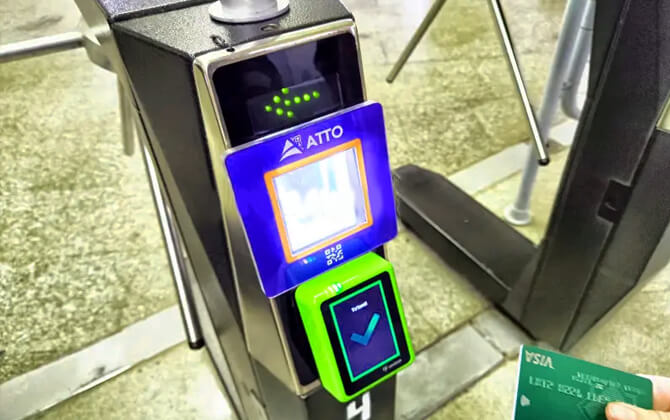
Tashkent Metro fares are paid in Uzbek soums. The standard single-ride ticket price is 3,000 UZS, about $0.24. With an electronic payment method, the fare is reduced to 1,700 UZS, about $0.14. Because the fare is simple, most riders do not need a separate fare calculator for regular metro trips.
Since 1 November 2020, the metro has used the ATTO card system instead of tokens. ATTO cards can be topped up at metro ticket offices and UZPost offices, and a virtual ATTO card is available through the mobile application.
There are three preferential ATTO card types for eligible passengers:
- Green ATTO for school pupils
- Yellow ATTO for university students
- Red ATTO for elderly people
These cards allow eligible passengers to buy daily or monthly tariffs with a 50% discount. Monthly and longer-period pass options are available only with an ATTO card. The published bus plus metro tariffs are:
| Period | General public | Pupils | Elderly people | Students |
|---|---|---|---|---|
| 1 day | 8,500 UZS (about $0.68) | 4,250 UZS (about $0.34) | 4,250 UZS (about $0.34) | 4,250 UZS (about $0.34) |
| 5 days | 36,000 UZS (about $2.88) | 18,000 UZS (about $1.44) | 18,000 UZS (about $1.44) | 18,000 UZS (about $1.44) |
| 7 days | 46,000 UZS (about $3.68) | 23,000 UZS (about $1.84) | 23,000 UZS (about $1.84) | 23,000 UZS (about $1.84) |
| 10 days | 73,000 UZS (about $5.84) | 36,500 UZS (about $2.92) | 36,500 UZS (about $2.92) | 36,500 UZS (about $2.92) |
| 15 days | 110,000 UZS (about $8.80) | 55,000 UZS (about $4.40) | 55,000 UZS (about $4.40) | 55,000 UZS (about $4.40) |
| 20 days | 147,000 UZS (about $11.76) | 73,500 UZS (about $5.88) | 73,500 UZS (about $5.88) | 73,500 UZS (about $5.88) |
| 30 days | 221,000 UZS (about $17.68) | 110,500 UZS (about $8.84) | 110,500 UZS (about $8.84) | 110,500 UZS (about $8.84) |
| 90 days | 604,000 UZS (about $48.32) | 302,000 UZS (about $24.16) | 302,000 UZS (about $24.16) | 302,000 UZS (about $24.16) |
| 180 days | 1,123,000 UZS (about $89.84) | 561,500 UZS (about $44.92) | 561,500 UZS (about $44.92) | 561,500 UZS (about $44.92) |
| 1 year | 2,073,000 UZS (about $165.84) | 1,036,500 UZS (about $82.92) | 1,036,500 UZS (about $82.92) | 1,036,500 UZS (about $82.92) |
Fare control takes place at station entrances. Once inside the metro system, passengers can travel and transfer within the network without extra checks, except for the joint station connection between the Sergeli line terminus and Qipchoq station, where an additional charge applies.
Payment options include cash, mobile applications, ATTO cards, and certain credit or debit cards. Some electronic systems may offer cashback or discounts, and discounted transfers within one hour are available for some bus and metro journeys paid electronically.
From 1 January 2025, new public transport tariffs were announced for Tashkent. The standard fare remains 3,000 UZS, about $0.24, while the electronic fare stays at 1,700 UZS, about $0.14. Preferential passenger tariffs remain unchanged.
Connections
The Tashkent Metro connects with buses, microbuses, trams, and the local transport network at several stations. Not every station has a transfer option, but the main interchange points are useful for planning transportation in Tashkent.
| Station | Details |
|---|---|
| Pushkin | Buses 17, 24, 58, 95, and 155; microbus 97M |
| Olmazar | Buses 32, 41, 74, 86, 98, 100, 103, 105, 116, and 118; tram line 17 |
| Beruniy | Buses 10, 11, 14, 28, 31, 34, 78, 87, 88, 92, 116, and 188 |
| Tinchlik | Buses 11, 28, 29, 64, 65, 76, 92, 147, and 188 |
| Gafur Gulom | Buses 9, 17, 43, 65, 100, 109, 111, and 150 |
| Alisher Navoiy | Buses 35, 36, 53, 64, 65, 100, and 126 |
| Ozbekiston | Buses 13, 42, and 51 |
| Kosmonavtlar | Buses 57, 67, 90, and 140 |
| Oybek | Buses 18, 33, 38, 57, 58, 67, 90, and 98 |
| Toshkent | Buses 12, 16, 22, 26, 37, 40, 46, 55, 60, 62, 68, 69, 70, 76, 78, 81, 93, and 127; tram lines 9, 13, and 26; bus 40 can be used for airport access |
| Mashinasozlar | Buses 10, 28, 72, 148, and 155; microbuses 43M and 137M |
| Do‘stlik | Buses 10, 15, 22, 28, 49, 54, 72, 148, and 155; microbuses 72M, 115M, 137M, and 166M |
| Shahriston | Buses 9, 24, 26, 50, 51, 60, 63, 67, 71, 72, 91, 93, 95, 97, 140, and 150; microbuses 62M, 102M, and 134M |
The metro does not directly serve Tashkent International Airport. The most practical connection listed here is Toshkent Station, where bus line 40 continues toward the airport. Shared taxis and private taxis are also available for other routes across the city.
Connection to the Airport
The Tashkent Metro has no direct station at Tashkent International Airport, but you can combine metro and bus for a straightforward airport route.
The most convenient option is Toshkent Station on the Oʻzbekiston Line, which is also connected to the Tashkent Railway Terminal. From there, bus line 40 goes to the airport. The running time is about 20 to 30 minutes depending on traffic, and the bus fare is about 1,250 UZS ($0.10).
These buses are regular city buses, not express airport services. They run every 10 to 20 minutes and do not have large luggage compartments, so heavy bags can be awkward at busy times.
Shared cabs are available outside the airport and follow fixed routes for about 5,000 UZS ($0.40). Private taxi services are also available for trips to other parts of Tashkent, with prices from about 50,000 to 125,000 UZS ($4 to $10).
Rules
The Tashkent Metro rules are designed to keep the system safe, orderly, and easy to use. Before entering, passengers and luggage may be inspected at the lawful request of metro staff or police officers. If a passenger refuses inspection, entry may be denied.
Smoking, open fire, pyrotechnics, flammable or explosive substances, and parking vehicles loaded with flammable materials in restricted areas are prohibited. Passengers must not climb fences or parapets, enter while intoxicated, or use unmanned aerial vehicles near stations and underground passages.
Inside stations and trains, passengers should not run, cross restricted lines without permission, or stand too close to the platform edge. Damaging metro property, trading in stations or carriages, begging, handing out flyers, and disrupting service are also forbidden.
Photography and video recording are allowed in public metro areas, but not in service, technical, or special facilities. Professional shoots, performances, cultural events, and sports events require written permission from metro management.
Rules also apply to carried items. Firearms, toxic substances, compressed gases, and other hazardous materials require proper permission or may be banned. Free carriage is available for children under 7, strollers, wheelchairs, and some other belongings listed in the regulations.
Passengers are expected to keep the metro clean and respect others. Large luggage should not block passageways, backpacks should be kept in front when seated, pets are not allowed, and music should not be played without headphones.
Fun Facts
The Tashkent Metro opened in 1977 as the first metro in Central Asia and the seventh metro built in the former USSR.
Its stations are known for themed architecture, and each station has its own visual character. For many visitors, the stations list reads almost like a design itinerary.
The tunnels were built to withstand earthquakes of magnitude 9.0 on the Richter scale, an important feature in a city shaped by seismic history.
The metro uses a 1,520 mm gauge and a third rail power supply at 825 V DC.
Stations are relatively shallow, with tunnel depths from 8 to 25 meters. The average distance between stations is 1.40 km (0.87 miles).
Photography and video recording were banned until 31 May 2018 because the metro was treated as a military facility and also served as a nuclear bomb shelter.
By 2025, the network had reached four lines, 50 stations, and 70.4 km (43.7 miles) of route, carrying 286.8 million passengers that year.
History
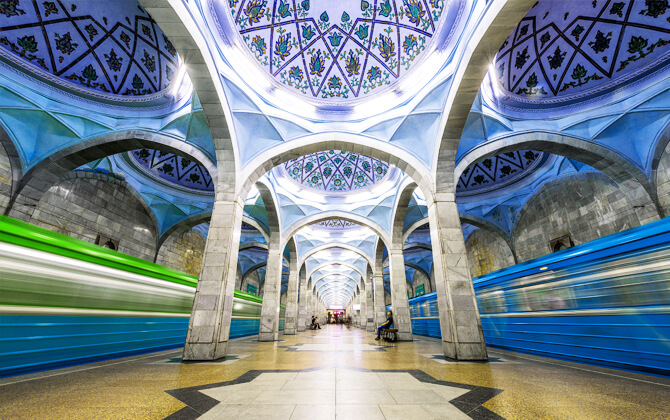
Planning for the Tashkent Metro began in 1968, after the major earthquake that struck the city in 1966. Construction of the first line, the Chilanzar Line, started in 1972. The first section opened on 6 November 1977 with nine stations.
The Chilanzar Line was extended in 1980. The second line, later known as the Oʻzbekiston Line, opened in 1984, followed by the Yunusobod Line in 2001. Work later continued on the Yunusobod Line, with Turkiston and Yunusobod stations opening on 29 August 2020.
The newest route is the Circle, or Halqa, Line. Construction began in October 2017, and the first section opened on 30 August 2020 with seven stations. A five-station extension from Qoʻyliq to Quruvchilar opened on 25 April 2023, followed by a two-station extension completed on 11 March 2025.
After Uzbekistan gained independence in 1991, several stations were renamed to reflect new national priorities and move away from some Soviet-era symbols. The system still carries that layered history in its names, architecture, and decorative details.
Future Expansions
Tashkent Metro expansion continues as the city grows. Recent projects include the southern Chilonzor Line extension to Quipchoq, the northern Yunusobod Line extension to Turkiston and Yunusobod, and new sections of the Circle Line.
Circle Line development remains one of the main priorities. The line first opened in 2020, and further stages are planned to add more stations and extend the route across the city. Earlier plans described a full Circle Line with 35 stations and a length of 52.1 km (32.4 miles), while newer updates indicate that additional sections are still being built in phases.
Other planned projects include extensions of existing lines to serve growing districts:
- 2 stations from Beruniy station to the Karakamysh district
- 4 underground stations from Buyuk Ipak Yoli to the TTZ area
- 5 to 6 stations from Ming O‘rik to Tashkent Janubiy railway station
An eastward extension from Buyuk Ipak Yoli to TTZ remains under consideration. A new metro line to New Tashkent is also planned as part of the city’s wider transport strategy.
For New Tashkent, reports mention an 8 km (5.0 miles) section with three stations planned for completion by the end of 2026, as part of a longer line from Dustlik to New Tashkent. The full connection is projected to be 21 km (13.0 miles) long with nine stations and could carry up to 230,000 passengers per day.
The broader aim is to expand access, reduce congestion, and strengthen the metro’s long-term role in Tashkent’s public transport system.
Tourist Attractions
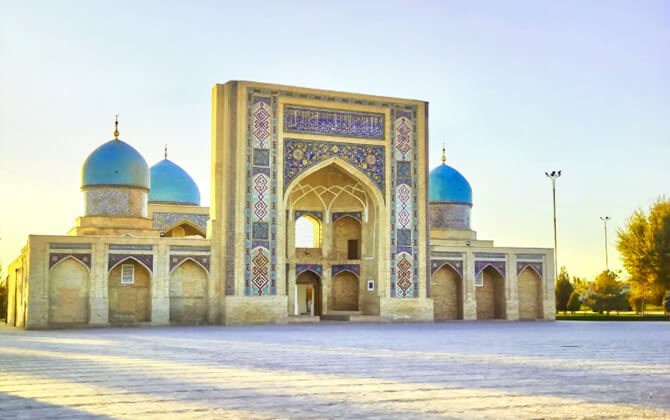
The Tashkent Metro is not just transportation; it is one of the city’s standout tourist attractions. Many stations are decorated with marble columns, chandeliers, mosaics, stained glass, and themed architectural details, so riding the metro can feel a bit like moving through an underground museum.
For sightseeing, the best time is usually early afternoon, between 1:00 PM and 4:00 PM, when trains and platforms are less crowded. Rush hours are from 7:30 AM to 9:30 AM and from 5:00 PM to 7:30 PM. Photography has been allowed since June 1, 2018.
| Station | Details |
|---|---|
| Kosmonavtlar | Known for its space theme and portraits of Soviet cosmonauts |
| Alisher Navoi | Recognized for blue domes and ceramic murals inspired by the poet’s work |
| Mustaqillik Maydoni | A grand marble station with chandeliers and an elegant hall |
| Paxtakor | Decorated with mosaics of cotton plants |
| Bodomzor | A newer station with a futuristic look and geometric details |
The metro reflects layers of Uzbekistan’s history, from Silk Road influences to Soviet-era design. Practical details help too: single rides are inexpensive, and passengers can buy tickets at the Kassa counter or pay by bank card, ATTO card, or phone at many stations.
For visitors with limited time, pairing a metro ride with nearby landmarks is an easy way to see both the city and its underground architecture.
Media