The Essen Stadtbahn is a 19.6-kilometer (12.2-mile) light rail system serving Essen and nearby Mülheim an der Ruhr and Gelsenkirchen in North Rhine-Westphalia. Operated by Ruhrbahn, it is part of the wider Rhine-Ruhr Stadtbahn network and plays a central role in local transport and city transport across the area. The system mixes underground sections with tramway-style surface running: U18 is fully separated from road traffic, while U11 and U17 combine tunnel sections with above-ground stretches. Essen Hauptbahnhof is the main interchange, where all three lines connect with other public transport services including trams, bus routes, and rail links.
| Key | Information |
|---|---|
| System | Light rail / Stadtbahn |
| Operator | Ruhrbahn |
| Network length | 19.6 kilometers (12.2 miles) |
| Lines | 3: U11, U17, U18 |
| Stations | 45 |
| Main interchange | Essen Hauptbahnhof |
| Core route | Underground trunk line between Berliner Platz and Essen Hauptbahnhof |
| Service pattern | Regular timetable with higher frequency at peak times and lower frequency in the evening and on weekends |
Essen Metro Map
Map of Essen Metro showing different lines. Click on the map to enlarge it or download the Essen Metro map in PDF format.
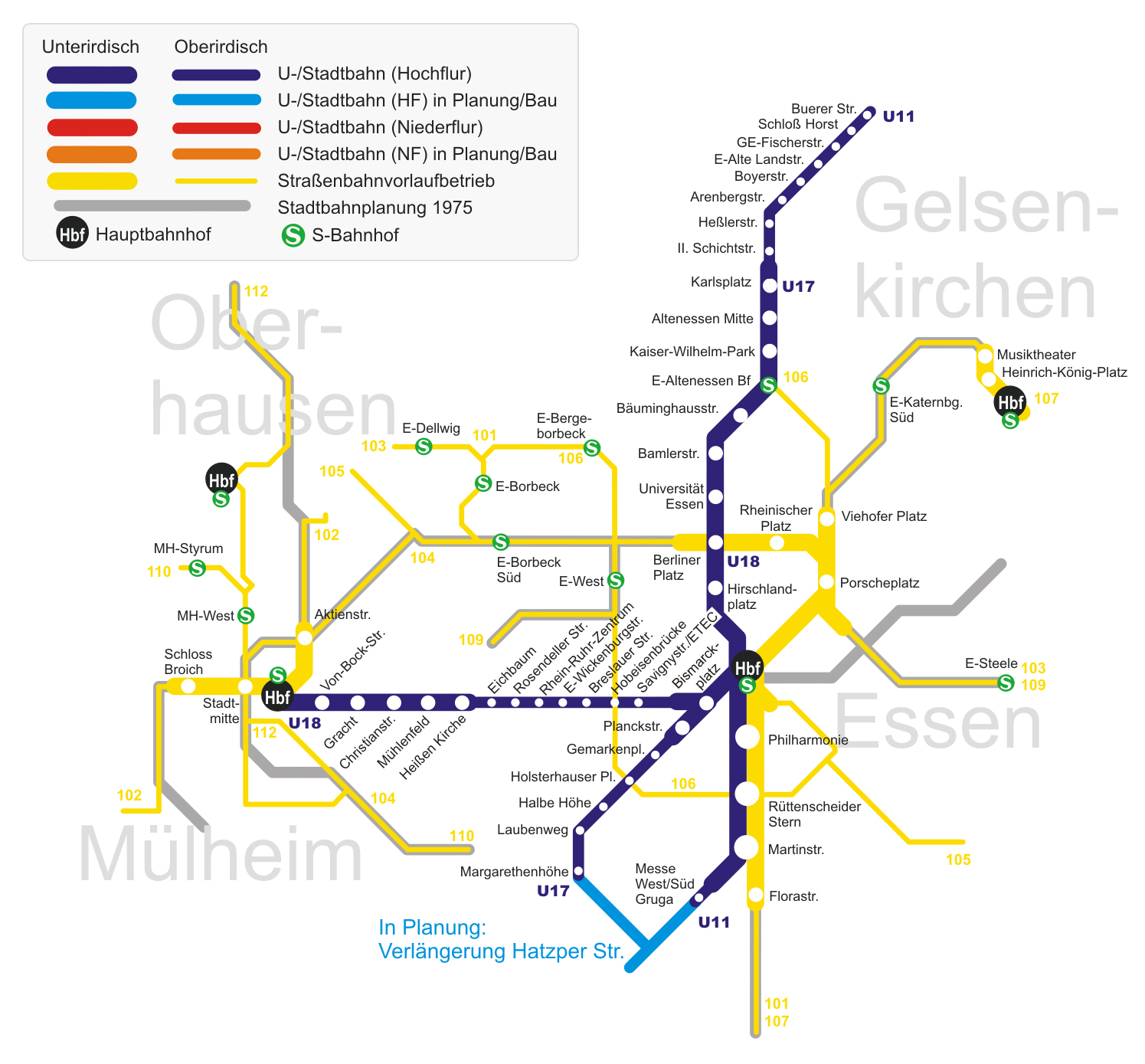
Lines and Stations of Essen Stadtbahn Metro
The Essen Stadtbahn route covers 19.6 kilometers (12.2 miles) and includes 45 stations. At the heart of the system is a 9.8-kilometer (6.1-mile) underground trunk line through central Essen. All three lines share the section between Berliner Platz and Essen Hauptbahnhof, then split into outer branches.
For anyone checking the stations map or planning a route, this shared central section is the key part of the network. It keeps transfers simple and makes the Stadtbahn an integrated part of transportation in Essen.
The three lines
- U11 runs between Gelsenkirchen Buerer Straße and Messe West-Süd/Gruga, with 23 stations.
- U17 runs between Karlsplatz and Margarethenhöhe, with 17 stations.
- U18 runs between Berliner Platz and Mülheim Hauptbahnhof, with 17 stations and is the only fully grade-separated path train in the system.
The section between Berliner Platz and Essen Hauptbahnhof is used by all three lines. Berliner Platz to Karlsplatz is shared by U11 and U17, while Essen Hauptbahnhof to Bismarckplatz is shared by U17 and U18.
Line details
| Station | Details |
|---|---|
| U11 | GE-Buerer Str. – E-Karnap – Altenessen – Essen Hbf – Rüttenscheid – Messe; 23 stations |
| U17 | Karlsplatz – Berliner Platz – Essen Hbf – Holsterhausen – Margarethenhöhe; 17 stations |
| U18 | Berliner Platz – Essen Hbf – MH-Rhein-Ruhr-Zentrum – Mülheim Hbf; 17 stations |
The line numbering follows the VRR system. The letter U marks a Stadtbahn line that is largely or completely separated from other traffic.
U11
U11 starts in Gelsenkirchen-Horst and heads toward central Essen, giving Altenessen a direct connection to the Messe and Gruga area in the south. Since the timetable change in January 2010, it has no longer been fully separated from other traffic, though it still runs underground through the city center.
U11 serves 23 stations in total.
U17
U17 is the shortest line. It runs from Karlsplatz in Altenessen to Margarethenhöhe in the south. From Karlsplatz to the Planckstraße ramp, the line is underground; after that, it continues above ground and crosses traffic at several points.
Near Margarethenhöhe, parts of the route are single track. In 2002, the above-ground stations received high platforms, helping make the full system accessible.
U18
U18 links Essen with Mülheim an der Ruhr and is the only line fully separated from road traffic. It has nine stations in Mülheim and connects with the tram network at Mülheim Hauptbahnhof.
Even though it was built to a full rapid-transit standard, much of U18 runs above ground. It also passes major shopping destinations including Allee-Center Altenessen, Limbecker Platz, RheinRuhrZentrum, and Forum Mülheim.
Main stations and interchange points
Essen Hauptbahnhof is the main interchange in the network. It connects all three Stadtbahn lines with tram and rail services, and in some areas transfers are cross-platform.
Berliner Platz is another major transfer station, while Bismarckplatz links U17 and U18. Shared Stadtbahn and tram stations include Philharmonie, Rüttenscheider Stern, Martinstraße, Hobeisenbrücke, and Holsterhauser Platz.
Selected stations by branch
| Station | Details |
|---|---|
| Northern branch | Gelsenkirchen Buerer Straße, Gelsenkirchen Schloss Horst, Gelsenkirchen Fischerstraße, Alte Landstraße, Boyer Straße, Arenbergstraße, Heßlerstraße, II. Schichtstraße, Karlsplatz, Altenessen Mitte, Kaiser-Wilhelm-Park, Altenessen Bahnhof, Bäuminghausstraße, Bamlerstraße, Universität Essen |
| Trunk line | Berliner Platz, Hirschlandplatz, Essen Hauptbahnhof |
| Southern branch | Philharmonie, Rüttenscheider Stern, Martinstraße, Messe Ost/Gruga, Messe West-Süd/Gruga |
| Essen-Mülheim line | Bismarckplatz, Savignystraße / ETEC, Hobeisenbrücke, Breslauer Straße, Wickenburgstraße, RheinRuhrZentrum, Rosendeller Straße, Eichbaum, Heißen Kirche, Mühlenfeld, Christianstraße, Gracht, Von-Bock-Straße, Mülheim (Ruhr) Hauptbahnhof |
| Branch to Margarethenhöhe | Planckstraße, Gemarkenplatz, Holsterhauser Platz, Halbe Höhe, Laubenweg, Margarethenhöhe |
The stations list shows how the network combines underground running, surface sections, and shared tram infrastructure. That mix is a defining feature of public transport in Essen.
Ticket Types and Discounts
Essen Stadtbahn fare rules are based on distance. The network uses four fare zones: Zone A, Zone B, Zone C, and Zone D. There is also a Short Distance ticket for trips of up to four stations, valid for 20 minutes.
The lowest ticket price mentioned in the available information is the Short Distance ticket at €1.60 (about $1.73). For longer trips, there are single tickets by zone, as well as 4-trip tickets that are also valid on bus and trams.
- Single tickets: Short Distance, Zone A, Zone B, Zone C, and Zone D.
- 4-trip tickets: valid for four journeys on the Stadtbahn, bus, and tramway network.
- 24-hour and 48-hour tickets: unlimited travel for the selected period across metro, bus, and trams.
- YoungTicket: a personalized monthly pass for students, valid for 30 consecutive days.
- Ticket1000: a monthly subscription priced by zone and valid on metro, bus, and tram.
- BärenTicket: a monthly pass for adults aged 60 and over, including those still working.
If you travel often, a 4-trip ticket or monthly pass may cost less than buying singles. The source material does not include a fare calculator, exact zone-by-zone price table, or day pass details beyond the 24-hour and 48-hour tickets.
Operating Hours
The Essen Stadtbahn does not run 24 hours a day. On weekdays, operating hours usually start at 4:30 a.m. and continue until 11:30 p.m. Some sources note that certain stations may close earlier, at 11:00 p.m.
On Saturdays, opening hours are generally from 7:00 a.m. until 11:00 p.m. or 11:30 p.m. On Sundays and public holidays, opening times usually begin at 8:00 a.m. and continue until 11:00 p.m. or 11:30 p.m.
During the day, trains usually run every 10 minutes. At peak periods, frequency increases to every 5 minutes. On Saturdays, Sundays, and public holidays, trains generally run every 15 minutes.
| Service detail | Timings |
|---|---|
| Weekday starting time | Usually 4:30 a.m. |
| Weekday closing time | Usually 11:30 p.m.; some stations may close at 11:00 p.m. |
| Saturday working hours | Usually 7:00 a.m. to 11:00 p.m. or 11:30 p.m. |
| Sunday and public holiday working hours | Usually 8:00 a.m. to 11:00 p.m. or 11:30 p.m. |
| Regular frequency | Every 10 minutes |
| Peak frequency | Every 5 minutes |
| Weekend and holiday frequency | Every 15 minutes |
The available material does not give line-by-line timetable, route timetable, last train times, or timings today and schedule today details. For exact train schedule information, passengers need to check current Ruhrbahn updates.
Connections
The Essen Stadtbahn is closely tied to the wider public transport system. At key stations, you can transfer to suburban rail, regional and long-distance trains, bus routes, and trams.
Essen Hauptbahnhof is the main interchange, where all three Stadtbahn lines meet rail, tram, and bus services. Other important connection points include Berliner Platz, Altenessen Bahnhof, Bismarckplatz, and Mülheim (Ruhr) Hauptbahnhof.
- Berliner Platz: tram routes 101/106, 103, 105 and 109; bus routes 145, 166 and SB16.
- Essen Hauptbahnhof: S-Bahn lines S1, S2, S3, S6 and S9; regional services RE1, RE2, RE6, RE11, RE14, RE16, RE42, RE49, RB33 and RB40; tram routes 101/106, 105, 107 and 108; bus routes 145, 146, 147, 154, 155, 166, 193, 196, SB14, SB15, SB16 and SB19.
- Altenessen Bahnhof: S-Bahn line S2, RE3, bus routes 140, 162, 172 and 183, and tram route 108.
- Altenessen Mitte: bus routes 162, 170 and 172.
- Kaiser-Wilhelm-Park: bus routes 162 and 172.
- Universität Essen: bus routes SB16 and 166.
- Philharmonie: tram routes 107 and 108.
- Rüttenscheider Stern: tram routes 101/106, 107 and 108.
- Martinstraße: tram routes 107 and 108, plus bus routes 142, 160 and 161.
- Messe Ost/Gruga and Messe West/Süd/Gruga: bus route 142.
- Bismarckplatz: bus route 196.
- Hobeisenbrücke: tram route 101/106.
- Breslauer Straße: bus routes 160 and 161.
- Wickenburgstraße: bus routes 145 and 196.
- RheinRuhrZentrum: bus routes 129, 130 and 138.
- Eichbaum: bus route 136.
- Heißen Kirche: bus routes 129, 132, 136, 138 and 753.
- Von-Bock-Straße: bus route 131.
- Mülheim (Ruhr) Hauptbahnhof: S-Bahn lines S1 and S2; regional services RE1, RE2, RE6 and RE11; bus routes 122, 124, 128, 131, 132, 133, 135, 151 and 752.
- Holsterhauser Platz: tram route 101/106.
- Margarethenhöhe: bus route 169.
The planned CITYBAHN will add direct links between ESSEN 51, the city center, Essen Hauptbahnhof, and southeastern districts including Huttrop and Steele. According to the plans, it is also meant to reduce pressure on the central tunnels and improve east-west local transport.
Lines 101, 105, and 108 are expected to play the main role in those future connections, with a new surface route linking the station forecourt and the inner city.
Airport Connections
Essen does not have its own commercial airport. There is a smaller air facility for private use, independent pilots, and charter flights.
For most travelers, the main airport connection is Düsseldorf International Airport. It is about 30 minutes from central Essen. A typical route is to take the Stadtbahn to Essen Hauptbahnhof, then board the RE 10162 express train to the airport. The full running time is usually around 35 to 40 minutes, and the train stops right in front of the terminal.
Düsseldorf International Airport also has strong rail connections to other cities, which makes it a practical regional option for passengers using the Essen Stadtbahn as part of a longer trip.
Accessibility
The Essen Stadtbahn was developed with accessibility in mind. Based on the available information, all entries and exits across the system became fully accessible after the last above-ground U17 stations received high platforms in 2002.
The network includes both high-platform Stadtbahn stations and low-platform tram stops, so details vary by location. Underground stations have a wide, bright warning strip along the platform edge, and many stops include tactile guidance systems that can be detected with a cane or underfoot.
At Essen Hauptbahnhof, transfers support barrier-free movement. Ramps connect the two platform levels, and a bridge across the underground station can be reached by lifts, making changes between directions easier for passengers with reduced mobility.
Other features include audible announcements on vehicles, acoustic passenger information at many stops, and lifts with tactile controls. On the southern route to Bredeney, stations have also been adapted for mixed rolling stock with both high-floor and low-floor vehicles.
On U18, the fully grade-separated route further reduces conflicts with road traffic.
Regulations
Travel on the Essen Stadtbahn follows the fare and conduct rules of Verkehrsverbund Rhein-Ruhr (VRR), just like other public transport services in the city.
The system has a clear code of conduct designed to keep travel safe and comfortable. These rules apply across trains and stations.
- Intentional damage to vehicles or facilities may lead to a fine, and repeat offenders can be excluded from the system.
- Luggage must not block other passengers.
- Objects or behavior that disturb other passengers are not allowed, including strong-smelling or potentially toxic materials and irritating noise.
- Emergency equipment may only be used in a real emergency. Misuse can result in a fine.
- Skates, skateboards, scooters, and similar items are not permitted.
- Aggressive behavior, insults, and intimidation are forbidden.
- Smoking is not allowed on trains or in stations.
- Eating is not allowed in the metro.
- Alcohol consumption and being under the influence of alcohol are not permitted in metro facilities.
- Unauthorized distribution of propaganda is prohibited in stations and on trains.
- Passengers must stay behind the yellow line.
- Begging is not allowed on trains or in stations.
- Firearms are not allowed unless carried by a clearly identified official.
- Music on portable devices must be listened to through headphones.
- Access to the tracks is prohibited. If something falls onto the tracks, passengers should ask staff for help.
These regulations are intended to protect passengers, staff, and equipment while keeping service reliable.
History
The history of the Essen Stadtbahn goes back to 1893, when the city’s first tram line was being built. A partly underground railway, however, did not become reality until long after the Second World War.
The first precursor to the modern system appeared in the early 1960s, when tram tracks were laid partly in the median of the Ruhrschnellweg, now used by U18. At that point, a full underground Stadtbahn was not yet planned. The work was tied to the upgrade of the expressway, which then had only three lanes and level crossings and could no longer handle growing traffic.
In 1961, planning began for tunnels under Essen’s compact city center. Several ideas were discussed, from keeping trams on the surface with a new central interchange to building a pure metro system. The chosen solution was an underground tram that could later be converted to a full U-Bahn. A metro-only system was rejected because Essen needed to remain connected with tram networks in neighboring Ruhr cities.
Detailed tunnel planning continued alongside construction of a highway tunnel for the Ruhr Expressway. The final concept became the so-called Y solution, with Essen Hauptbahnhof as a central four-track junction and branches to the northeast and northwest.
The first construction project was the shell of Planckstraße station in 1964, intended for a future link to the surface tram line to Margarethenhöhe. The first section to open was instead the 552-meter (0.34-mile) tunnel through Saalbau station on 5 October 1967. This was the first underground railway station in North Rhine-Westphalia and the first part of the Rhine-Ruhr underground tram network.
The next major stage was the continuous Essen-Mülheim route along the Ruhr Expressway, seen as a model for later projects. On 28 May 1977, a nearly 8-kilometer (5.0-mile) link between Mülheim-Heißen and Essen city center opened, including Heißen Kirche, Bismarckplatz, Essen Hauptbahnhof, and Wiener Platz, now Hirschlandplatz. It was the first line in the network fully independent of the tram system. On the same day, Porscheplatz, now Rathaus Essen, also opened as a tram station. The remaining five underground stations in Mülheim followed on 3 November 1979.
In 1981, U17 to Margarethenhöhe entered service, including Planckstraße station and its ramp, both prepared in shell form in the 1960s. At the same time, Berliner Platz and Universität Essen opened. The next phase extended the southern line from Saalbau toward Messe/Gruga and Bredeney. This section was built for mixed operation with three rails for both Stadtbahn and tram services up to Martinstraße, where the lines split. Four underground U11 stations were added together with the underground tram station Florastraße, and service began in 1986.
The most recent major construction phase was the northern extension, built in two stages. In 1998, the tunnel from Universität Essen to Altenessen was completed, and three years later the line opened to Karlsplatz and the ramp at II. Schichtstraße. U11 terminated at Karlsplatz, while U17 continued to Gelsenkirchen. The section north of Karlsplatz was upgraded by 2001 for standard-gauge Stadtbahn operation.
The network changed again in September 2011: U11 was extended to Gelsenkirchen Buerer Straße, U17 returned to Karlsplatz, and U18 was shortened to the section between Mülheim Hauptbahnhof and Berliner Platz.
Today, the Stadtbahn remains closely linked with Essen’s tram system, especially at Essen Hauptbahnhof, the main interchange between the two networks.
Future Expansions
The main expansion project mentioned in the source material is the CITYBAHN Essen, which is scheduled to bring the surface tram back to the city center in 2026. It is planned as a new tram line introduced step by step, with the first stops expected to open in 2026.
The route plan runs from the Ruhrbahn depot in Stadtmitte to the new ESSEN 51 district and the area around Essen Central Station. The project is intended to improve east-west connections and create a direct link from Huttrop, the Südostviertel, and Steele to the main station.
Construction began in January 2024 with the official groundbreaking near Essen Central Station. Since then, work has continued on the core section, known as the Bahnhofstangente, and the first tracks have already been laid.
By 2028, three lines are expected to use the new route. In total, the CITYBAHN is planned to have eleven stops, supporting more environmentally friendly transport and responding to rising passenger demand.
The first stops planned for commissioning in 2026 are Betriebshof Stadtmitte, Hollestraße, Essen Hbf, and Hindenburgstraße.
Attractions
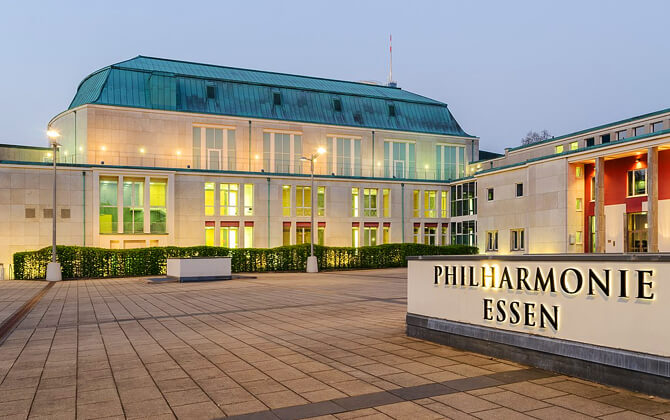
Essen has plenty of places that are easy to combine with a Stadtbahn trip. Around Essen Hauptbahnhof, you can reach the Essener Dom, Alte Synagoge – Haus Jüdischer Kultur, Aalto-Theater, Philharmonie Essen, and GOP Varieté-Theater Essen. Museum visitors can also use the network to get closer to Museum Folkwang, Ruhr Museum, and Red Dot Design Museum.
For a longer outing, well-known attractions include Zeche Zollverein Essen, Grugapark Essen, Villa Hügel, Kettwiger Altstadt, Siedlung Margarethenhohe, and Werdener Altstadt. Limbecker Platz is also useful for shopping and central city visits.
One standout destination is the Zollverein Coal Mine Industrial Complex, a UNESCO World Heritage Site with guided tours and a restaurant. Another is GOP Varieté Essen, about 500 meters (0.31 miles) from Berliner Platz station, where performances change monthly.
The Stadtbahn makes it easy to move between central Essen, cultural venues, parks, historic districts, and major industrial heritage sites without needing a car or worrying about parking charges or station parking.