The Manila Metro Rail Transit System, usually called the MRT, is part of Metro Manila public transport in the Philippines. Together with the Manila Light Rail Transit system and the Philippine National Railways commuter line, it forms a key part of city transport and transportation in Metro Manila. At present, the system has one operating route, MRT Line 3, which runs 16.9 km (10.5 miles) across 13 stations between North Avenue and Taft Avenue. Line 3 opened in December 1999 and became fully operational in July 2000. Daily operating hours are generally from 4:40 a.m. to 10:10 p.m., with shorter opening times during the Christmas and year-end holidays, and the system closes during Holy Week for annual maintenance.
| Key | Information |
|---|---|
| System | Manila Metro Rail Transit System |
| Operational line | MRT Line 3 |
| Route length | 16.9 km (10.5 miles) |
| Stations | 13 |
| Route | North Avenue to Taft Avenue |
| Opening | December 1999 |
| Full operation | July 2000 |
| Operating hours | Daily from 4:40 a.m. to 10:10 p.m. |
| Holiday changes | Shorter hours at Christmas and year-end; closed during Holy Week maintenance |
| Owner | Department of Transportation (DOTr) |
Manila Metro Rail Transit System Map
Map of Manila Metro Rail Transit System showing different lines and stations. Click on the map to enlarge it or download the Manila Metro map in PDF format.
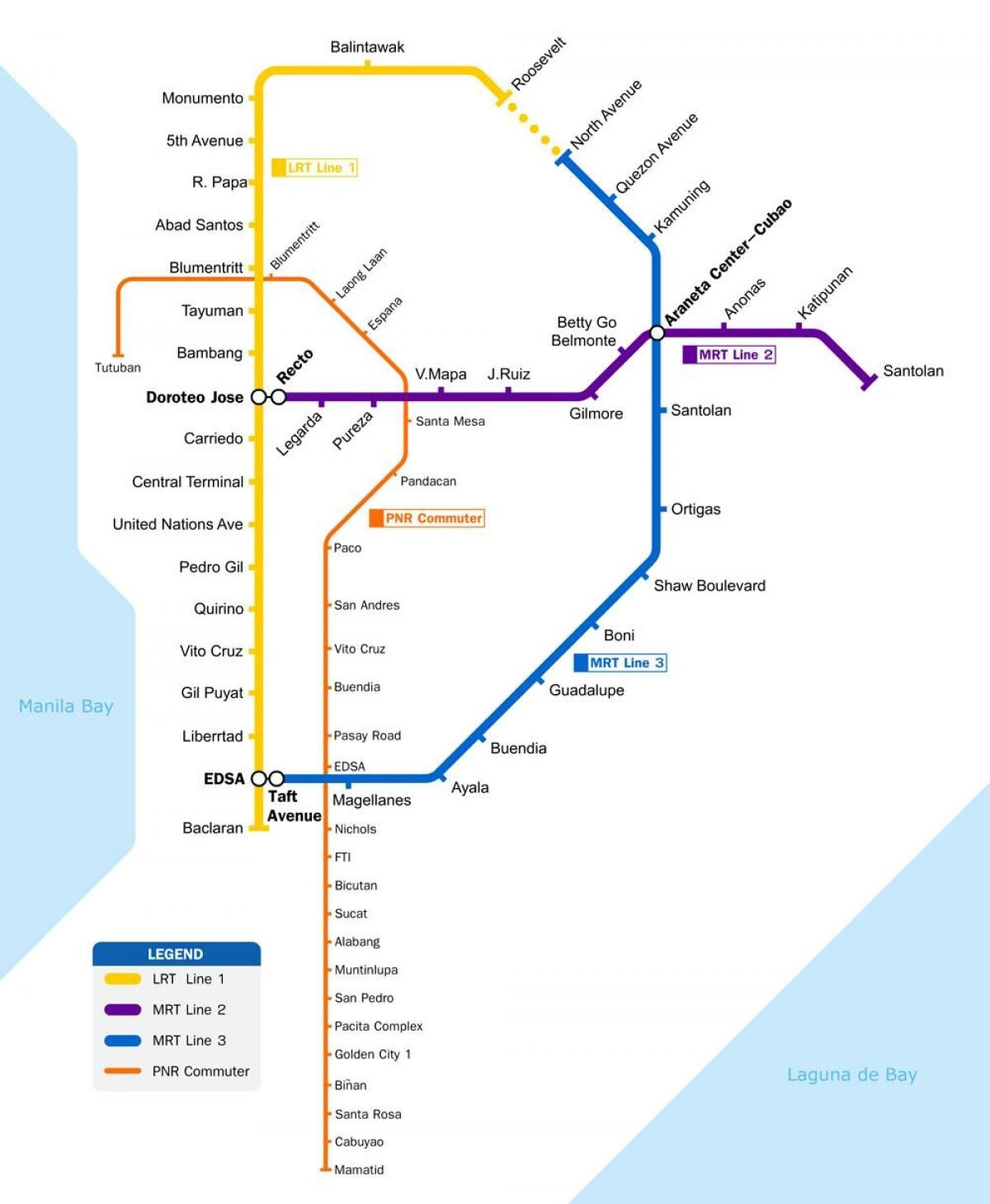
Manila MRT System Lines and Stations
The Manila Metro Rail system currently has one line in service: MRT Line 3. This is the only active path train route in the network today, covering 16.9 km (10.5 miles) and serving 13 stations. For now, any Manila MRT stations map or stations list is focused on this single line.
MRT Line 3 links North Avenue and Taft Avenue. Most stations are elevated, while a few are at-grade or underground. Stations generally have a concourse level and a platform level, and most use side platforms. Standard platform length is 130 meters, planned for four-car operations, although the line currently runs with three-car trains.
The current stations list is shown below.
| Station | Details |
|---|---|
| North Avenue | Northern terminus of MRT Line 3 |
| Quezon Avenue | Operating station on MRT Line 3 |
| Kamuning | Operating station on MRT Line 3 |
| Araneta Center-Cubao | Operating station on MRT Line 3 |
| Santolan | Operating station on MRT Line 3 |
| Ortigas | Operating station on MRT Line 3 |
| Shaw Boulevard | Operating station on MRT Line 3 |
| Boni | Operating station on MRT Line 3 |
| Guadalupe | Operating station on MRT Line 3 |
| Buendia | Operating station on MRT Line 3 |
| Ayala | Operating station on MRT Line 3 |
| Magallanes | Operating station on MRT Line 3 |
| Taft Avenue | Southern terminus of MRT Line 3 |
Future expansion is tied to several projects associated with the MRT brand, including MRT Line 4, MRT Line 7, and the Metro Manila Subway. These routes are expected to add many more stations once completed, but only Line 3 is operating at the moment.
So if you are planning a trip today, keep the route plan simple: one line, 13 stations, and a direct north-south route along EDSA.
Timetable & Operating Hours
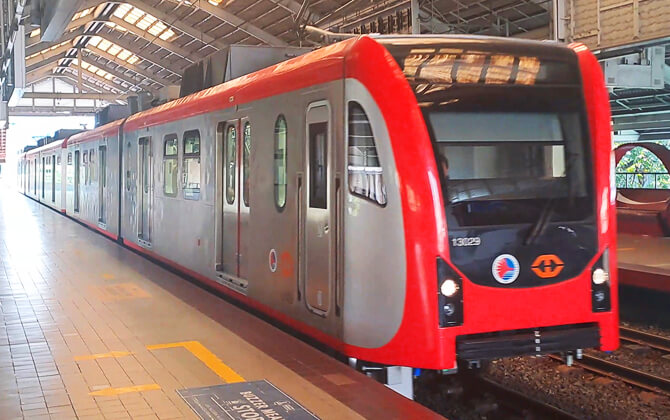
The Manila Metro Rail timetable currently centers on MRT Line 3. Daily service usually starts at 4:40 a.m. and runs until 10:10 p.m., though station-specific opening hours, timings, and closing time can vary slightly by day and by station.
Because the train schedule is not always identical across the full line, it is smart to check the timetable or schedule today before you travel, especially for an early starting time or a late return. Last train departures may differ slightly depending on the station, so the running time of your trip can also depend on where you board.
Here are the main service details.
| Service detail | Timings |
|---|---|
| Regular daily operating hours | 4:40 a.m. to 10:10 p.m. |
| Opening times by station | May vary slightly by day and station |
| Last train | Can differ slightly from one station to another |
| Holy Week | System closed for annual maintenance |
| Christmas and year-end holidays | Working hours are shortened |
| Weekdays and weekends | Frequency and departure timings may differ |
A few service changes are worth keeping in mind:
- During Holy Week, the system is closed for annual maintenance.
- At Christmas and around the end of the year, opening hours are shorter because demand is lower.
- On regular weekdays and weekends, frequency and route timetable details are not always the same.
If you are checking timings today, allow extra time at the station. Entrance gates may close a little earlier than the final departure, and the last train is not always the same at every stop.
Prices, tickets and discounts
The Manila rail system uses an Automated Fare Collection System with contactless smart cards. Passengers can buy a ticket at station ticket booths or ticket machines, then enter the paid area with either a single journey ticket or a stored value card. For regular riders, a card is usually the more convenient option and can help cut queue time.
For LRT Line 2, a Standard Stored Value Card costs Php 30.00 (about $0.52), plus a minimum load of Php 14.00 (about $0.24). It is reloadable, valid until the printed expiry date, and accepted at LRT and MRT Lines 1, 2, and 3 stations, as well as other facilities using the DoTr Transpo system.
| Line | Boarding fare | Distance fare | Minimum | Maximum |
|---|---|---|---|---|
| Line 1 | ₱16.25 (about $0.28) | ₱1.47/km (about $0.03/km) | ₱20.00 (about $0.35) | ₱55.00 (about $0.96) |
| Line 2 | ₱13.29 (about $0.23) | ₱1.21/km (about $0.02/km) | ₱15.00 (about $0.26) | ₱35.00 (about $0.61) |
Fare levels are lower when you use a stored value card. On Line 2, stored value fare can range from Php 6.50 to Php 16.50 (about $0.11 to $0.29), while single journey ticket price runs from Php 8.00 to Php 18.00 (about $0.14 to $0.31), based on the updated fare matrix.
Discounts are available for eligible passengers:
- Senior citizens: 20% discount
- Persons with disabilities: 20% discount
- Students: 50% fare discount
Transfers between lines may require a new fare, since the rail lines do not share one common paid area in the way some other systems do. There is no fare calculator provided in the source material, so it is best to check station information in advance if you want to estimate total cost and ticket price for a multi-line trip.
Interconnections with Other Systems
The Manila MRT is part of a wider transport system that includes the Light Rail Transit network and the Metro Commuter Line of Philippine National Railways. Even with only one operational MRT line today, it already sits within a much larger public transport and local transport network.
One of the most important future interchanges is North Triangle Common Station, planned as a transfer point for LRT Line 1, MRT Line 3, and MRT Line 7. This station is still under construction and is expected to become a major hub for city transport.
The Metro Manila Subway is also planned to connect with other rail services. Based on the available material, riders will be able to transfer to LRT Line 1, MRT Line 3, and MRT Line 7 at North Triangle Common Station. Other planned or existing links mentioned include LRT Line 2, the North-South Commuter Railway, MRT Line 4, and MRT Line 8.
Beyond rail, the network also works with road-based transport. Bus services and jeepneys help passengers reach stations and continue beyond the rail route where tracks do not go.
Integration is still fairly loose. In many cases, passengers need to exit one line, enter another, and pay a separate fare. Even so, the Beep card helps make travel across major rail lines more practical.
The source material also mentions a proposed physical connection between the Metro Manila Subway and the North-South Commuter Railway near the FTI area, allowing through operations toward Calamba and back.
| North Triangle Common Station | Planned interchange for LRT Line 1, MRT Line 3, and MRT Line 7 |
| Metro Manila Subway | Planned links with LRT Line 1, MRT Line 3, MRT Line 7, LRT Line 2, NSCR, MRT Line 4, and MRT Line 8 |
| FTI area | Proposed physical connection and interoperability with the NSCR-South line |
Airport Connections
The Metro Manila Subway Project, also known as MRT-9, is planned to become the Philippines’ second direct airport rail link after the North-South Commuter Railway. A branch line is planned to serve Ninoy Aquino International Airport, with a proposed station beside Terminal 3.
The project is also designed to connect with other major urban rail services. Planned transfers include LRT Line 1, MRT Line 3, and MRT Line 7 at North Triangle Common Station. Other connections mentioned in the source material include LRT Line 2, the North-South Commuter Railway, and the planned MRT Line 4 and MRT Line 8.
Published station plans also show an NAIA extension spur with a station at NAIA Terminal 3 in Pasay. Future phases mention a possible extension from NAIA Terminal 3 to PITX as well.
For now, there is no direct MRT airport connection in operation. The airport rail link remains under construction as part of the wider subway project.
Parking near the Metro
If you are driving before switching to Manila rail transport, station parking can be useful, though availability is often limited. One nearby option mentioned in the source material is the SM Manila Parking Lot at SM City Manila. It is about 110 metres (0.11 km / 0.07 miles) southeast of SM City Manila and around 480 metres (0.48 km / 0.30 miles) southeast of Central Terminal, making it a practical choice for passengers using LRT Line 1.
Parking demand is often high around malls, major attractions, and transport hubs. Many drivers prefer mall parking because it usually offers better shelter and a more secure setting. Some facilities may allow longer stays, though overnight parking can require advance approval.
When comparing options, try to choose a facility close to the station you plan to use. That can cut walking time and make transfers easier, especially during peak periods or when carrying bags.
If you are heading into central Manila or places such as Intramuros, park-and-ride can simplify the trip: park once, take the train, then continue on foot or by local transport.
- Check opening hours before leaving your vehicle.
- Confirm whether overnight parking is allowed.
- Pick a facility close to your intended station exit.
- Expect heavier demand near malls and central business districts.
The source material does not provide parking charges or parking charges per day, so those details should be confirmed directly with the facility.
Tips and Rules
If it is your first time using Manila public transport by rail, a few simple habits can make the trip smoother and safer.
- Use a Beep card if you can. It is usually faster and slightly cheaper than buying a single journey ticket every time.
- Do not depend on single journey tickets unless necessary. Lines at ticket counters can be long.
- Plan your route before you travel. This helps if your destination is not directly on the line.
- Use the most direct station or transfer option available instead of adding extra trips.
- Stand behind the yellow line or platform marking.
- Do not remain inside the train after it terminates. Trains are moved for checking and sanitizing.
- If you are unsure, ask station staff, guards, or another passenger for help.
- Do not press the Open Door button. Doors open automatically.
- Keep your ticket or card ready when exiting.
- Do not eat or drink inside the train or on the platform.
For a more safe and comfortable ride, follow station signs, let passengers get off first, and keep your belongings secure.
History
The history of the Manila Metro Rail system goes back to long-term planning for rapid transit in Metro Manila. During construction of the first Manila Light Rail Transit line in the early 1980s, Electrowatt Engineering Services of Zürich prepared a comprehensive metro plan that remained a basis for future rail planning. That study outlined a 150-kilometer (93.2-mile) network for the region’s main corridors, building on studies from the 1970s.
The first and only line now in operation, MRT Line 3, began construction in October 1996 after the Metro Rail Transit Corporation won a build-lease-transfer contract. The project involved Sumitomo Corporation and Mitsubishi Heavy Industries in a turnkey partnership, with EEI Corporation handling civil works and ČKD Tatra supplying the rolling stock. The line opened partially on December 15, 1999, and became fully operational on July 20, 2000.
After Line 3 opened, the MRT name was increasingly applied to new rail projects outside the Light Rail Transit Authority’s jurisdiction. These included MRT Line 7, MRT Line 4, and the Metro Manila Subway, also identified as MRT Line 9. Line 7 was first proposed in 2001, approved in 2004, re-approved in 2013, and construction began in 2017. Line 4 was first approved in 2015 and again in 2019 as a monorail line. The Metro Manila Subway was first planned in 2000, revived in 2014, funded by a Japanese loan, and broke ground on February 27, 2019.
Subway construction moved forward in stages. Clearing works started in Valenzuela in December 2019, and underground tunnel work began in January 2023 after the first tunnel boring machine was ceremonially lowered in June 2022. The project has faced delays, including those linked to the COVID-19 pandemic and right-of-way issues. As of June 2024, completion stood at 14%, and full opening is now scheduled for 2029.
The system has also changed on the ownership side. Line 3 had operated under a 25-year build-lease-transfer agreement with the Metro Rail Transit Corporation, and ownership shifted to the Department of Transportation after that agreement expired in July 2025.
| Line | Opened | Status |
|---|---|---|
| Line 3 | December 15, 1999 | In operation |
| Line 7 | 2027 (projected) | Under construction |
| Line 4 | 2031 (projected) | Planned / under development |
| Metro Manila Subway | 2029 (projected) | Under construction |
Future Extensions
Future expansion is focused mainly on the Metro Manila Subway. In the 2023 plan, later phases would extend the line north to Bulacan and south to Cavite, covering roughly 40 km (24.9 miles) in total. A separate 4 km (2.5 miles) extension to Asia World is also included, with direct links to PITX and its LRT-1 station.
Phase 2 is being studied as three separate projects: a north extension from East Valenzuela to Langit Road in Caloocan, a south extension from FTI to Governor’s Drive in Dasmariñas, Cavite, and an airport spur from NAIA Terminal 3 to PITX.
Phase 3, described as Closing the Loop, would continue from Phase 2 and create new northern and southern termini with interchanges to the NSCR in both Bulacan and Laguna.
These plans are still subject to study and approval. The source material notes possible financing support from the Asian Development Bank under the Infrastructure Preparation and Innovation Facility, and it also mentions a later comprehensive study for the Greater Capital Railway master plan awarded in January 2026 that includes both Phase 2 and Phase 3.
If completed, this expansion would tie the subway more closely to other rail lines and major transport hubs across Metro Manila and nearby provinces.
Nearby Attractions
Several Manila attractions can be reached using the MRT-3, especially from Araneta Center-Cubao station. For sightseeing by public transport, this station works well as a starting point.
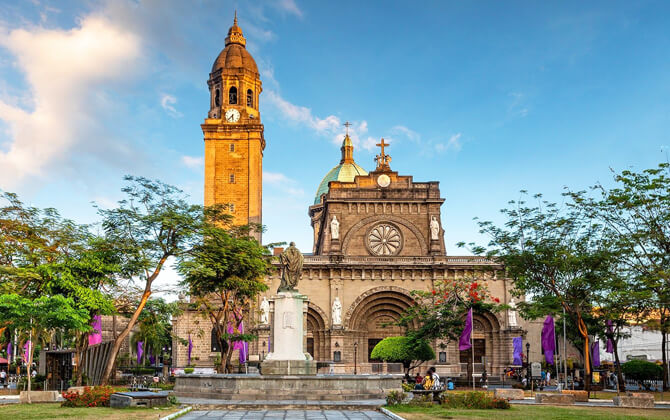
From Araneta Center-Cubao, you can continue to a number of cultural and historic sites. Manila Cathedral can be reached via Taft Avenue and then LRT Line 1 to Central Terminal Station. Plaza San Luis is another Intramuros destination, reached by taking the metro to Taft Avenue and then a bus to Ayala Boulevard. If museums are more your thing, the Metropolitan Museum of Manila can be reached by transferring from Buendia, while Mehan Garden is accessible through a similar trip toward Manila City Hall.
The MRT-3 also gives access to areas linked with Intramuros and the Cultural Center of the Philippines Complex, both among the better-known places to explore in the city.
- Manila Cathedral – historic church in Intramuros
- Plaza San Luis – heritage complex in Intramuros
- Metropolitan Museum of Manila – museum in the Malate area
- Mehan Garden – garden in Ermita
- Cultural Center of the Philippines Complex – cultural hub along Roxas Boulevard
If you want a simple sightseeing route, Araneta Center-Cubao is one of the most practical stations to start from.