Chongqing Rail Transit (CRT), also called the Chongqing Metro, is the city’s rapid transit system in Chongqing, China. Open since 2005, it links major business districts, entertainment areas, railway hubs, suburbs, and the airport through a mix of heavy-rail metro and high-capacity monorail lines. As of February 2026, the system has 12 lines stretching 574.12 km (357 mi), built for a dense mountain city with steep grades, deep valleys, and complex urban transport needs.
| Key | Information |
|---|---|
| System name | Chongqing Rail Transit (CRT) |
| Also known as | Chongqing Metro |
| City | Chongqing, China |
| Opened | 2005 |
| Network size | 12 lines |
| Total length | 574.12 km (357 mi) |
| Line types | Heavy-rail metro and monorail |
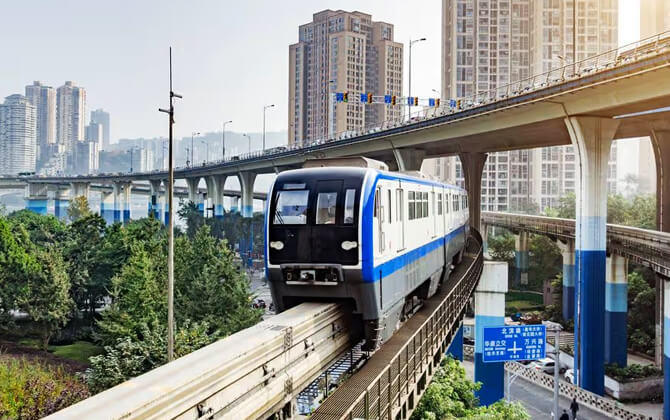
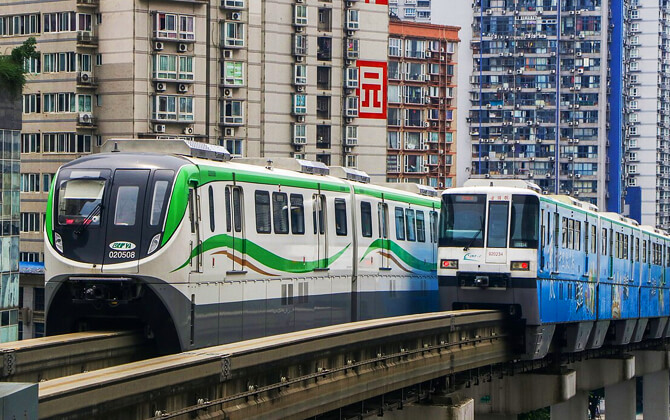
| Monorail lines | Lines 2 and 3 |
| Main role | City transport and public transport across central districts, suburbs, rail hubs, and the airport |
| Notable feature | Built for a mountainous city with major bridges, deep stations, and steep alignments |
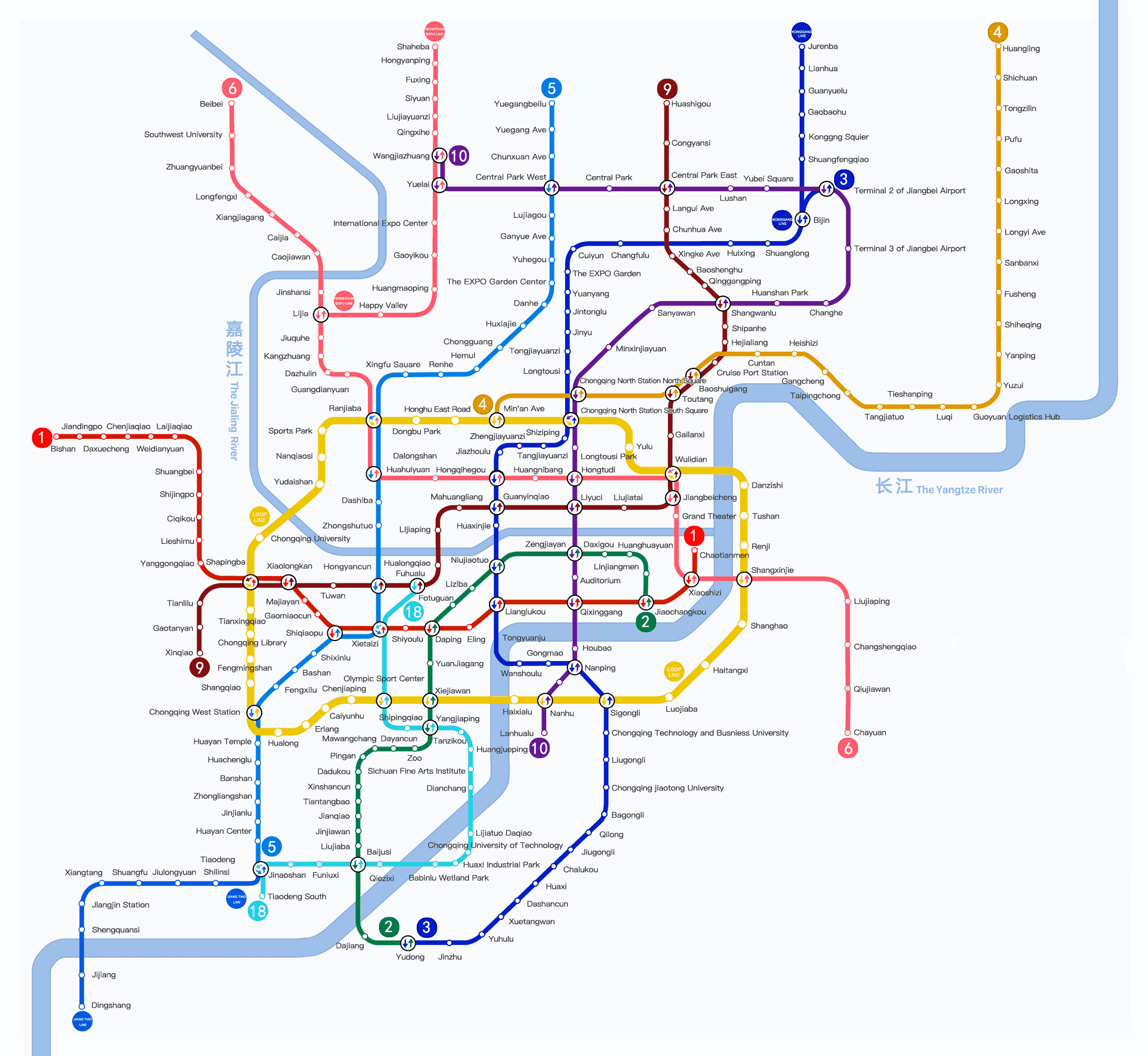
Chongqing Metro Map
Map of Chongqing Metro showing different lines. Click on the map to enlarge it or download the Chongqing Metro map in PDF format.
Lines and Stations
As of February 2026, Chongqing Rail Transit includes 12 lines and 324 stations across 574.12 km (357 mi) of route. The system combines conventional metro lines with monorail infrastructure, a practical fit for Chongqing’s hilly terrain, dense urban form, and day-to-day transportation in one of China’s most unusual major cities.
The current network includes the Loop line, Lines 1, 4, 5, 6, 9, 10, 18, the Jiangtiao line, the Bitong line, and monorail Lines 2 and 3. Several more routes are under construction as the system expands.
Network overview
| Station | Details |
|---|---|
| Loop line | Loop route; opened 2018; newest extension 2021; 51 km (31.7 mi); 33 stations |
| Line 1 | Chaotianmen – Bishan; opened 2011; newest extension 2020; 43.7 km (27.2 mi); 25 stations |
| Line 2 | Jiaochangkou – Yudong; opened 2005; newest extension 2014; 31.4 km (19.5 mi); 25 stations |
| Line 3 | Yudong – Terminal 2 of Jiangbei Airport; opened 2011; newest extension 2016; 56.1 km (34.9 mi); 45 stations |
| Line 4 | Shimahelijiao – Huangling; opened 2018; newest extension 2026; 58 km (36 mi); 32 stations |
| Line 5 | Yuegangbeilu – Tiaodeng; opened 2017; newest extension 2023; 48.66 km (30.2 mi); 32 stations |
| Line 6 | Chayuan – Beibei; opened 2012; newest extension 2025; 70.1 km (43.6 mi); 43 stations |
| Line 9 | Gaotanyan – Huashigou; opened 2022; newest extension 2023; 40.1 km (24.9 mi); 29 stations |
| Line 10 | Wangjiazhuang – Lanhualu; opened 2017; newest extension 2023; 43.3 km (26.9 mi); 26 stations |
| Line 18 | Fuhualu – Tiaodengnan; opened 2023; no extension listed; 28.96 km (18 mi); 19 stations |
| Jiangtiao line | Tiaodeng – Shengquansi; opened 2022; no extension listed; 28.2 km (17.5 mi); 7 stations |
| Bitong line | Bishan – Tongliangxi; opened 2025; no extension listed; 37.5 km (23.3 mi); 8 stations |
| Total | 574.12 km (357 mi); 324 stations |
Some stations and structures are especially notable. Hongyancun, Hongtudi, and Liyuchi are the three deepest metro stations in China, while Hualongqiao is the world’s tallest metro station, with Line 9 platforms 48 m (157.5 ft) above the surface.
CRT also includes major engineering landmarks. The Caijia Rail Transit Bridge on Line 6 is the world’s highest metro-only bridge, with its deck about 100 m (0.1 km / 0.06 mi) above the Jialing River valley. The Nanjimen Bridge on Line 10 is the world’s longest metro-only cable-stayed bridge by main span.
Selected station highlights
| Station | Details |
|---|---|
| Line 1 | Runs from Chaotianmen to Bishan and serves Xiaoshizi, Jiaochangkou, Lianglukou, Shapingba, and Ciqikou |
| Line 2 | Connects Jiaochangkou with Yudong and serves Jiefangbei CBD, Daping, Yangjiaping, and Chongqing Zoo |
| Line 3 | Links Yudong with Jiangbei Airport; key interchange stations include Lianglukou and Niujiaotuo |
| Line 6 | Serves Chongqing East Railway Station, Xiaoshizi, Grand Theater, Hongtudi, Ranjiaba, and Beibei |
| Loop line | Connects Chongqing North railway station, Shapingba railway station, and Chongqing West railway station |
Some routes also use through service. The Jiangtiao line, for example, has through service with Line 5 from 2023.
Fares
CRT uses a distance-based fare system. The standard ticket price for a single trip ranges from CNY 2 (about $0.28) to CNY 10 (about $1.40), depending on travel distance. In simple terms, the farther you go, the more the ticket costs.
The standard fare scale is CNY 2 ($0.28) for 0-6 km (0-3.7 mi), CNY 3 ($0.42) for 6-11 km (3.7-6.8 mi), CNY 4 ($0.56) for 11-17 km (6.8-10.6 mi), CNY 5 ($0.70) for 17-24 km (10.6-14.9 mi), CNY 6 ($0.84) for 24-32 km (14.9-19.9 mi), CNY 7 ($0.98) for 32-41 km (19.9-25.5 mi), CNY 8 ($1.12) for 41-51 km (25.5-31.7 mi), CNY 9 ($1.26) for 51-63 km (31.7-39.1 mi), and CNY 10 ($1.40) for 63 km (39.1 mi) or more.
Passengers using the IC Transportation Card or the e-wallet feature get a 10% discount on one-way fares. This card can also give free or discounted transfers between rail transit and city bus services within one hour, which is handy if you use local transport a lot.
If you are staying in Chongqing for more than a few days, the card is usually the most practical option. There is no fare calculator provided here, but the price is easy to estimate from the distance bands above.
Ticket and Card Types
CRT offers several ticket and pass options for different travel needs. Single Journey Tickets are valid on the day of purchase and can be used once. Souvenir Tickets are issued for holidays and special events, come with special designs, and are not recycled after use. Fixed Journey Tickets allow a set number of rides within their validity period.
For short stays, the One-day Travel Pass costs CNY 18 (about $2.52). It is sold at station ticket booths and allows unlimited metro travel for 24 hours after first use. The pass does not need to be returned, so you can keep it.
CRT also accepts the Chongqing Public Transportation Card, also called the Life & Transport Card or Yiju Changtong Card. This card works on the metro and other public transport, including city buses. On public transit in Chongqing, the Regular Card receives a 10% discount. The card can be bought at CRT stations, and the deposit can be refunded when it is returned with the receipt.
Students’ Cards and Elders’ Cards cannot be used directly on the metro unless a cash sub-account is added at service points. This is free to add and gives a 50% discount.
As noted above, all journeys must be completed within 3 hours after entering the paid area. If the time limit is exceeded, the highest fare in the system will be charged in addition to the normal cost.
Interconnections with Other Systems
CRT is built around a strong transfer network, making it easier to move between metro lines, monorail routes, suburban rail links, railway stations, and the airport without leaving the system. For everyday public transport and wider city transport, that connectivity is a big advantage.
Several important interchanges are in central Chongqing. On Line 1, passengers can transfer to Line 6 at Xiaoshizi, Line 2 at Jiaochangkou, and Line 3 at Lianglukou. Line 1 also connects with the Loop line at Shapingba, although an out-of-station transfer is currently required there because of construction setbacks affecting the interchange channel and concourse.
Line 3 connects with Line 1 at Lianglukou and with Line 2 at Niujiaotuo. Line 6 connects with Line 1 at Xiaoshizi, adding another key downtown transfer point.
Beyond standard interchanges, CRT also supports cross-line and through-running operations on selected routes. The Loop line is linked with Lines 4 and 5 under an interconnection arrangement, and cross-line operation among Line 4, the Loop line, and Line 5 began on 28 December 2021. This improves network flexibility and helps system operations run more efficiently.
The suburban lines are tied into the main network as well. The Jiangtiao line has through service with Line 5 from 2023, and the Bitong line is planned to have through service with Line 27 in the future. These links extend the route plan toward Jiangjin and Tongliang while keeping the wider transport system integrated.
CRT also connects with major rail hubs. The Loop line links Chongqing North railway station, Shapingba railway station, and Chongqing West railway station. Line 10 also serves Chongqing North Railway Station and the airport terminals, making it an important part of transportation in Chongqing.
At the operational level, CRT has also developed an interconnection and interoperability system based on CBTC interconnection technology. According to the project material, this allows trains from one line to run on another line without stopping or changing driving mode, while supporting shared scheduling.
Operating Hours
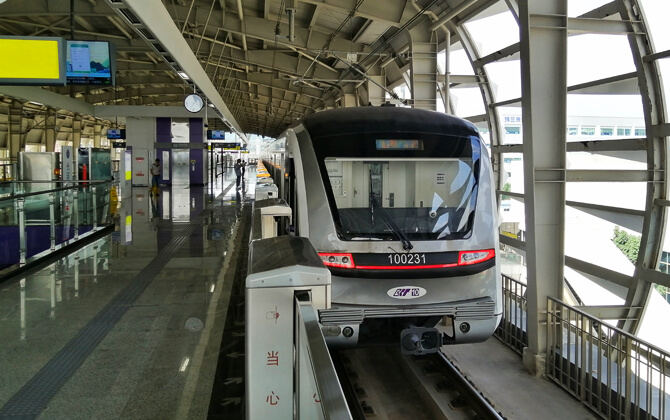
Chongqing Rail Transit runs every day, including public holidays. The usual operating hours are 6:30 am to 10:30 pm, though opening hours, opening times, starting time, closing time, and last train timings can vary by station and route.
| Service detail | Timings |
|---|---|
| Regular daily service | 6:30 am to 10:30 pm |
| By station and route | First and last train timings may vary |
| Maximum time allowed inside fare-paid area | 3 hours |
That means if you are checking the timetable, route timetable, train schedule, or schedule today for a specific journey, it is best to confirm the timings today for your exact stations.
All trips must be completed within 3 hours after entering the paid area. If you stay longer, the highest ticket price in the system may be charged in addition to the normal fare.
During major events, holiday evenings, or other busy periods, some stations may close temporarily to reduce crowding. Service patterns and frequency can also change, so if you plan to travel late, check the latest schedule before you go.
Connection to the Airport
CRT provides a direct airport connection through Line 3 and Line 10. Line 3 serves Jiangbei Airport Terminal 2, while Line 10 serves the airport terminals and links Terminal 2 with Terminal 3.
For airport travel, the operating hours listed in this article are 6:00 am to 10:30 pm on these airport-related services. Fares range from CNY 2 to CNY 10 (about $0.28 to $1.40), depending on distance. Tickets can be bought as single-use tickets at CRT stations, and the Transport Card can also be used for metro and bus trips.
Line 3 is a practical route to the city center and other major destinations. Reaching Jiefangbei takes about 40 minutes of running time and costs about CNY 5 (around $0.70). Chongqing North Railway Station takes about 20 minutes and costs around CNY 3 (about $0.42).
Line 10 is especially useful for airport transfers because it serves both Terminal 2 and Terminal 3 and also links the airport with Chongqing North Railway Station.
In addition to rail service, free terminal shuttle bus service runs between T2 and T3 every day from 4:30 am to 10:30 pm, with a journey time of about 20 minutes.
Fun Facts
CRT is unusual even by big-city standards. It was built for a dense mountain city with steep slopes and deep river valleys, and that geography shaped the entire system.
Its two monorail lines, Lines 2 and 3, are designed to handle tight curves and steep grades while still offering rapid transit capacity. Each can carry up to 32,000 passengers per hour per direction.
Together, Lines 2 and 3 form the longest monorail system in the world, and Line 3 is the world’s longest single monorail line. It is also described as the world’s busiest single monorail line, while the overall monorail network is said to be the busiest monorail system in the world.
CRT also has some striking engineering records. The Caijia Rail Transit Bridge on Line 6 is the world’s highest metro-only bridge, with its deck around 100 m (0.1 km / 0.06 mi) above the water. The Egongyan Rail Transit Bridge and the Nanjimen Bridge are the world’s longest metro-only suspension bridge and cable-stayed bridge by main span, respectively.
There are station records too. Hongyancun is described as the deepest metro station in the world, while Hongtudi and Liyuchi are also among the deepest stations in China. On the other end of the scale, Hualongqiao is the world’s tallest metro station, with trains stopping 48 m (157.5 ft) above ground.
Another well-known local curiosity is that Line 2 once passed through a building, with a station built inside it to avoid demolishing homes.
CRT also gives lines their own cultural themes, including Bashu culture for Line 2 and Landscape for Line 6. It’s a small detail, but a memorable one.
Regulations
Passengers are expected to follow CRT rules to keep the system safe and orderly.
- Do not obstruct the movement of other passengers.
- Keep belongings from blocking doors or inconveniencing others.
- Children over the age of six must have a ticket.
- Do not lean against platform doors.
- Fireworks are strictly forbidden.
- Flammable objects are not allowed in stations or trains.
- Smoking is prohibited in the metro.
- Running is prohibited in stations.
- Alcohol consumption is not allowed in the metro.
- Entering the metro under the influence of alcohol or drugs is strictly forbidden.
- Respect metro staff.
- Follow instructions from metro security personnel.
- Place prams at the front or rear of trains.
- Do not play multimedia without headphones.
- Do not enter or exit once the closing door warning has sounded.
- Do not obstruct staff in the performance of their duties.
- Begging is forbidden in metro facilities and on trains.
- Unauthorized video recording inside the metro is prohibited.
- Sharp objects are not permitted unless safely stored and protected.
- Firearms are strictly prohibited unless carried by an on-duty Metropolitan Police officer.
Future Expansions
CRT expansion is ongoing as Chongqing continues to grow. The current Phase 4 program includes Line 6 (branch), Lines 7, 15, 17, 24, 27, and Line 18 Phase 2.
According to the approved short-term plan, construction on several lines began in March 2021. In April 2021, Lines 7 and 17 were redesigned from mostly elevated heavy monorail routes to conventional underground Type A metro lines, bringing them closer to the rest of the heavy-rail system.
The expansion program includes the following projects:
- Line 15 Phase 1: Chongguanglijiao to Liangjiang Movie City, planned for 2026.
- Line 15 Phase 2: Zengjia to Chongguanglijiao, planned for 2027.
- Line 18 northern extension: Fuhualu to Xiaoshizi, planned for 2027 or later.
- Line 24 Phase 1: Lujiaobei to Guangyangwan, planned for 2027 or later.
- Line 27 full line: Bishan to Huimin, planned for 2027 or later.
- Jiangtiao line Phase 2: Shengquansi to Dingshan, planned for 2027 or later.
- Line 7 Phase 1: Kexuecheng to Jinfeng, planned for 2028 or later.
- Line 17 Phase 1: Shijiayuanzi to Daxuecheng, planned for 2028 or later.
Together, these projects add 196.594 km (122.2 mi) of track and 88 new stations to the route plan. Longer-term official planning is even bigger, with a 2019 plan targeting a 30-line system by 2050 and a total length of about 1,473 km (915.3 mi).
These future extensions are meant to improve links across Chongqing’s main urban districts, support access to key growth areas, and strengthen the city’s wider transport network.
Tourist Attractions
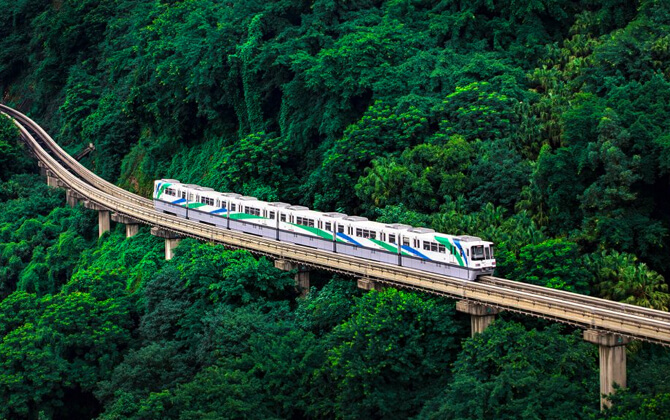
One of the best-known sights on Chongqing Rail Transit is Liziba Station on Line 2. It is famous for the monorail passing through a residential building, making it one of the city’s most recognizable transport landmarks.
You can watch the train from the observation platform across the road, or simply ride the line yourself. The station is also near Liziba Old Street, where visitors can try local food, and the Bayu Old News Exhibition Hall, which gives a look at local history.
Other nearby attractions include Liziba Anti-Japanese War Relics Park, the Three Gorges Museum, and E’ling Park. So if you want a stop that mixes rail interest with sightseeing, this is an easy pick.
- Best for photos: the observation platform near Liziba Station
- Best for history: Bayu Old News Exhibition Hall and Liziba Anti-Japanese War Relics Park
- Best for local food: Liziba Old Street
- Nearby attractions: Three Gorges Museum and E’ling Park