The Santo Domingo Metro, known in Spanish as Metro de Santo Domingo, is the rapid transit system serving Greater Santo Domingo, the capital of the Dominican Republic. It opened for commercial service on January 30, 2009, and is the most extensive metro system in the insular Caribbean and Central American region by both route length and number of stations. The system is operated by the Oficina de Reordenamiento del Transporte, or OPRET, and forms a key part of public transport in the city.
| Key | Information |
|---|---|
| System | Rapid transit for Greater Santo Domingo |
| Operator | Oficina de Reordenamiento del Transporte, OPRET |
| Opening date | January 30, 2009 |
| Lines | 2 main metro lines |
| Interchange station | Juan Pablo Duarte |
| System length in open sections by August 2013 | 27.35 km (16.99 mi) |
| Standard fare | DOP$20, about US$0.34 |
| Main role | City transport and congestion relief on major corridors |
Santo Domingo Metro Map
Map of Santo Domingo Metro showing different lines and stations. Click on the map to enlarge it or download the Santo Domingo Metro map in PDF format.
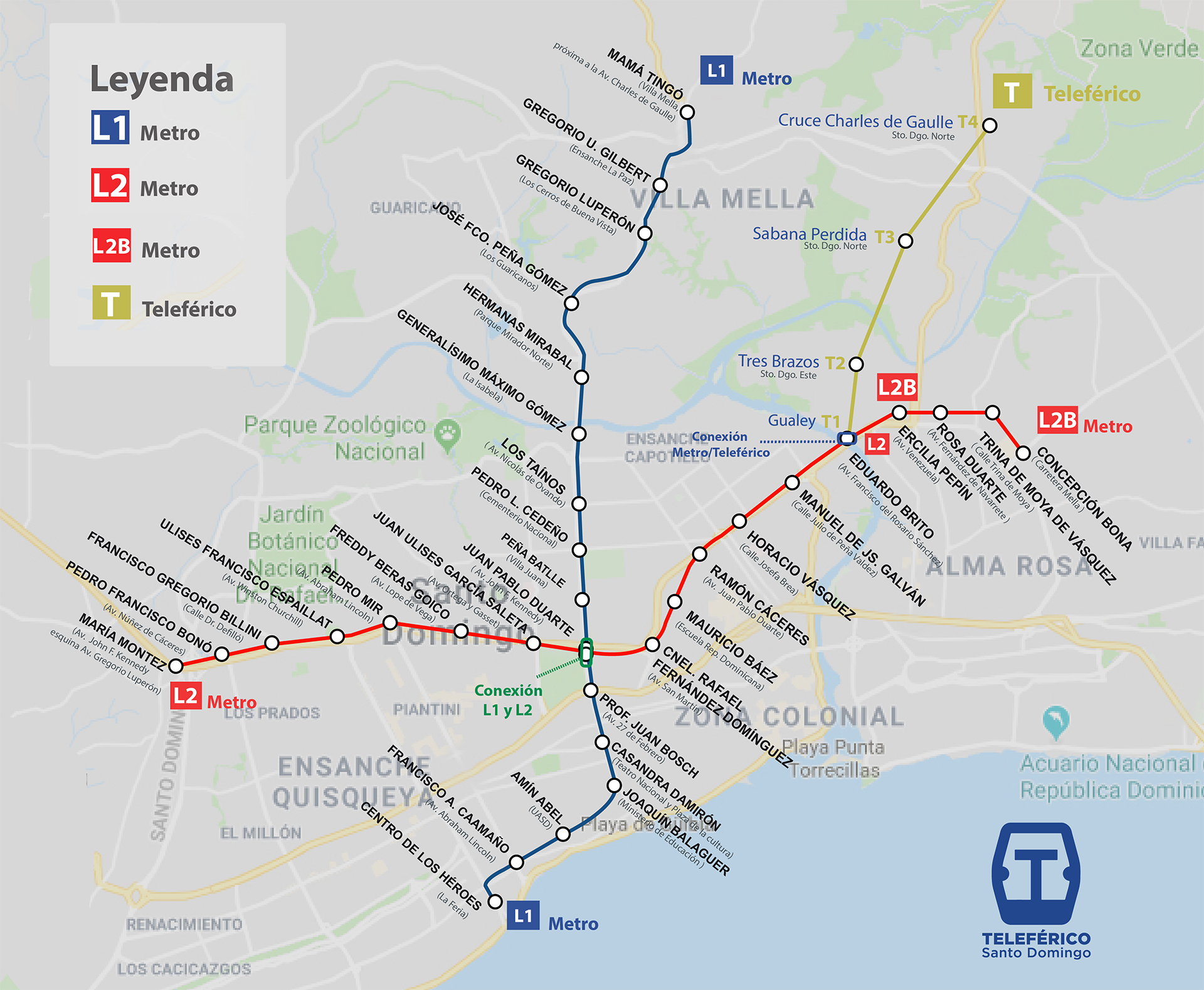
Santo Domingo Metro Lines and Stations
The Santo Domingo Metro has two main lines. Line 1 opened in January 2009 and runs north to south from Mamá Tingó to Centro de los Héroes, covering 14.5 km (9.0 mi) with 16 stations. Line 2 opened in April 2013 and runs east to west from María Montez to Concepción Bona, with 23 stations over 16.5 km (10.3 mi).
The route plan was built around the city’s busiest corridors. Line 1 helps reduce traffic on Máximo Gómez and Hermanas Mirabal avenues, while Line 2 serves the Duarte-Kennedy-Centenario corridor. The two lines meet at Juan Pablo Duarte, the only interchange station in the system.
Line 1 stations list:
| Station | Details |
|---|---|
| Mamá Tingó | Line 1 northern terminal |
| Gregorio Urbano Gilbert | Line 1 station |
| Gregorio Luperón | Line 1 station |
| José Francisco Peña Gómez | Line 1 station |
| Hermanas Mirabal | Line 1 station |
| Máximo Gómez | Line 1 station |
| Los Taínos | Line 1 station |
| Pedro Livio Cedeño | Line 1 station |
| Manuel Arturo Peña Batlle | Line 1 station |
| Juan Pablo Duarte | Interchange with Line 2 |
| Juan Bosch | Line 1 station |
| Casandra Damirón | Line 1 station |
| Joaquín Balaguer | Line 1 station |
| Amín Abel | Line 1 station |
| Francisco Alberto Caamaño | Line 1 station |
| Centro de los Héroes | Line 1 southern terminal |
Line 2 stations list:
| Station | Details |
|---|---|
| Pablo Adón Guzmán | Line 2 station |
| Freddy Gatón Arce | Line 2 station |
| 27 de Febrero | Line 2 station |
| Franklin Mieses Burgos | Line 2 station |
| Pedro Martínez | Line 2 station |
| María Montez | Line 2 station |
| Pedro Francisco Bonó | Line 2 station |
| Francisco Gregorio Billini | Line 2 station |
| Ulises Francisco Espaillat | Line 2 station |
| Pedro Mir | Line 2 station |
| Freddy Beras Goico | Line 2 station |
| Juan Ulises García Saleta | Useful for Museo del Hombre Dominicano and National Zoological Park connections |
| Juan Pablo Duarte | Interchange with Line 1 |
| Colonel Rafael Tomás Fernández | Line 2 station |
| Mauricio Báez | Line 2 station |
| Ramón Cáceres | Taxi access toward airport transfers |
| Horacio Vásquez | Taxi access toward airport transfers |
| Manuel de Jesús Galván | Line 2 station |
| Eduardo Brito | Closest metro station to the Santo Domingo Cable Car line |
| Ercilia Pepin | Line 2 station |
| Rosa Duarte | Line 2 station |
| Trina de Moya de Vasquez | Line 2 station |
| Concepción Bona | Line 2 eastern terminal |
The stations were designed with future growth in mind, including space for longer trains as demand increases. If you are checking a stations map before travel, Juan Pablo Duarte is the key point to note because it is where the path train between both lines changes.
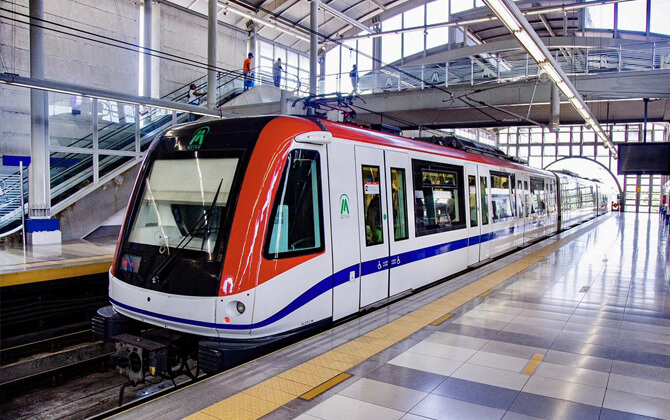
Operating Hours and Train Frequency
The Santo Domingo Metro runs every day. The usual starting time is 6:00 AM, and the closing time depends on the day and the published service information being used. For planning, treat the last train and current timings today as details worth checking before a late trip.
| Service detail | Timings |
|---|---|
| Weekday opening hours | 6:00 AM to 10:30 PM |
| Weekend and public holiday opening times | 6:00 AM to 10:00 PM in one provided schedule; another gives service until 10:30 PM |
| Typical train frequency | About every 5 to 10 minutes |
| Busiest weekday running time | 7:00 AM to 9:00 AM and 5:00 PM to 7:00 PM |
During rush hours, trains can feel busier, so travel outside the main peaks if your schedule is flexible. The route timetable is simple by metro standards, but checking the schedule today is still a smart move if you plan to ride close to closing time.
Fare Information
The Santo Domingo Metro uses a flat fare system, so the ticket price does not change by distance. A standard single trip costs DOP$20, about US$0.34. Students and seniors have a discounted fare of DOP$10, about US$0.17.
Passengers can use a rechargeable smart card, known as Tarjeta Inteligente, or a single-use magnetic card ticket. A rechargeable card costs DOP$60, about US$1.02, and each ride then costs DOP$20, about US$0.34. A single-use card costs DOP$15, about US$0.25, so one ride with that card comes to DOP$35, about US$0.59.
A return ticket may be better value if you are coming back the same way, and a day pass is also available. The system works with swipe-in and swipe-out gates, and contactless payment is not available. A fare calculator is rarely needed here because the cost is fixed.
Intra-City Connections
The metro connects well with taxis, buses, and other local transport options across Santo Domingo. It does not have a direct station link to Las Americas International Airport, but it can get you to stations where onward bus or taxi connections are available.
The closest metro station to the Santo Domingo Cable Car is Eduardo Brito on Line 2. A direct connection between the two systems has been under development. Until then, passengers can walk about 6.1 km (3.8 mi) along Los Restauradores Avenue, which takes around one hour, or take a taxi in about 21 minutes depending on traffic.
For Sans Souci Terminal, the fastest option described is to travel on Line 1 toward Hermanas Mirabal and get off at Profesor Juan Bosch station. From there, buses continue to the terminal. A taxi is another option and takes about 30 minutes.
The metro also works as a practical starting point for short bus or taxi trips to popular places around the city. Ciudad Colonial can be reached from Line 1 via Kennedy station and a taxi ride of less than 15 minutes. For Museo del Hombre Dominicano, use Line 2 to Juan Ulises García Saleta and continue by taxi or bus in under 10 minutes. The National Zoological Park is also closest to Juan Ulises García Saleta; from there, a taxi takes about 9 minutes, or the walk is roughly 48 minutes.
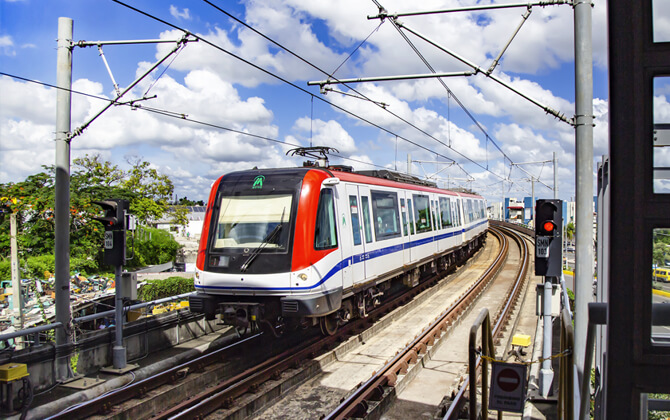
Airport Connectivity
The Santo Domingo Metro does not close the gap all the way to Las Americas International Airport. The airport is about 30 minutes from the capital, and there is no direct airport rail service at this time. Even so, the metro can shorten the first part of the trip if you connect to a taxi or airport-bound bus.
If you are coming from the north or south of the city, take Line 1 to Pedro Livio Cedeño, transfer to Line 2, and continue to Horacio Vásquez. From there, taxis are available to the airport, with the onward trip taking about 27 minutes depending on traffic.
The road route to the airport follows Calle Josefa Brea toward Calle Luis Reyes Acosta, continues for about 1.4 km (0.9 mi), then turns toward the Juan Pablo Duarte Bridge. After another 750 meters (0.47 mi), the route turns left onto Carretera 3, where the highway exit leads to Las Americas International Airport.
From the western part of the city, board Line 2 and get off at Ramón Cáceres or Horacio Vásquez. Taxi services to the airport are available from both stations.
Tips for Metro Use
If it is your first ride, check the route before entering the station. At Joaquín Balaguer on Line 1, for example, you need to enter on the correct side of the street because you cannot switch platforms once inside.
Tickets are sold at the Boleteria. The rechargeable card is usually the easier option if you plan to use the system more than once, while the single-use card works for a simple one-way trip. Keep your card handy because you need it to enter and exit.
Transfers between Line 1 and Line 2 are made at Juan Pablo Duarte without buying another ticket. The trains are air-conditioned, the ride is generally smooth, and station displays help you follow your route. The system does not allow dogs, guns, knives, or radios.
For a smoother trip, avoid peak hours when possible, confirm the working hours if you are traveling late, and look at the stations map before you go. It saves time, especially if you need a bus or taxi connection after leaving the metro.
History
The idea behind the Santo Domingo Metro was tied to a wider National Master Plan for improving transportation in Greater Santo Domingo and across the Dominican Republic. President Leonel Fernández proposed the project as a way to reduce congestion on major city corridors and strengthen public transport.
Line 1 was planned as a north-south route between Villa Mella in Santo Domingo Norte and La Feria in Santo Domingo. It was unofficially inaugurated on February 27, 2008, then began non-commercial operation on December 22, 2008, with free service during the Christmas holiday season. After a short closure for final preparations, it opened commercially on January 30, 2009.
Line 2 was planned during Fernández’s second presidential term, and construction began by mid-2009. It opened on April 1, 2013, as an east-west line under Avenida John F. Kennedy, crossing Line 1 in the city center. The line was first planned as fully underground, but financial considerations led to a phased buildout.
An eastern extension from Eduardo Brito to Concepción Bona was approved in January 2014, construction began on April 1, 2014, and the extension opened on August 8, 2018. Construction of the western extension from Avenida Luperon to Los Alcarrizos began in 2022, and the extension opened on February 25, 2026.
By August 2013, the open sections of the system measured 27.35 km (16.99 mi). Ridership rose from 30,856,515 passengers in 2012, before Line 2 opened, to 61,270,054 in 2014. Between May 2022 and May 2023, ridership reached 104,003,341 passengers.
Alstom supplied the rolling stock. The trains were designed with air conditioning, CCTV, and passenger information systems, while stations were built to allow future six-car operation. Later train orders supported service expansion as demand grew.
Future Expansion Plans
Future expansion plans for Metro Santo Domingo focus on a more connected, multimodal transport network. Line 2C toward Los Alcarrizos is described as a 7.3 km (4.5 mi) expansion with five new stations, intended to connect a large suburban population to the metro and ease road congestion.
Line 2 is also being positioned for farther eastern growth beyond Concepción Bona, with San Luis identified as a possible destination. That would improve cross-city connectivity and bring another suburban area into the system.
Metro Line 3 is another major long-term proposal. Officials have been planning and seeking financing for a new diagonal route across the metropolitan area, from Los Bajos de Haina to near Las Americas International Airport. Early plans describe a route of around 20 to 23 km (12.4 to 14.3 mi) with more than 20 stations and transfers to Lines 1 and 2.
The wider transport plan is not limited to metro rail. It also includes cable cars, bus rapid transit, express bus services, and corridor-based links designed to feed into the metro. This would make city transport easier for communities beyond the current rail network.
Recent works include girders at the intersection of the extended 27 de Febrero Avenue and the Duarte Highway as part of Line 2C construction, along with preparation for future integration with the Metropolitan Train. International partnerships are also expected to matter, with Japan expressing interest in Line 3 and France’s AFD backing capacity improvements and expansions.
- Opening and integrating Line 2C to Los Alcarrizos
- Extending Line 2 farther east
- Advancing planning and financing for Line 3
- Connecting the metro with cable cars, BRT, express bus services, and the Metropolitan Train
- Expanding capacity as ridership increases
Fun Facts
- The Santo Domingo Metro began commercial operation on January 30, 2009.
- It is the most extensive metro system in the insular Caribbean and Central American region by length and number of stations.
- Line 1 was built with 16 stations, including six elevated and ten underground stations.
- Line 1 links Villa Mella in Santo Domingo Norte with La Feria in Santo Domingo.
- Line 2 runs east to west and intersects Line 1 at Juan Pablo Duarte station.
- The system uses overhead line power rather than a third rail.
- The trains are Alstom Metropolis 9000 three-car trainsets, and each trainset can carry 617 passengers.
- Stations were built to handle six-car trains in the future.
- The metro has a reloadable smart card called Boleto Viajero for fare payment.
- The Teleférico de Santo Domingo operates as part of the metro system.
Popular Tourist Destinations
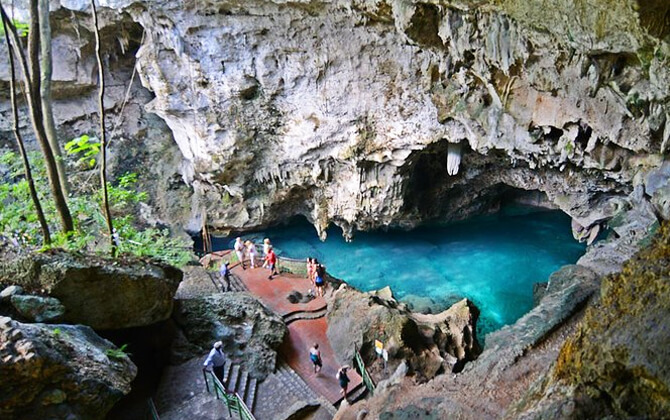
Santo Domingo is one of the Caribbean’s major tourist destinations, and the metro can help visitors reach several well-known sights. The Ciudad Colonial is the big draw, with colonial buildings, cobblestone streets, museums, restaurants, cafés, and landmark squares close together.
Historic and cultural stops include Ciudad Colonial, Alcázar de Colón, Calle Las Damas, Columbus Park, the Museum of the Royal Houses, and the Cathedral of Santa Maria la Menor. The Museo del Hombre Dominicano in Plaza de la Cultura is another useful metro-linked destination, while the National Palace and Palacio de Bellas Artes are important city landmarks.
For outdoor visits, Los Tres Ojos National Park is one of the city’s most distinctive natural attractions. The National Botanical Garden is another popular choice if you want greenery and a quieter break from the historic center.
Line 1 and Line 2 both help with sightseeing, often followed by a short taxi ride. Line 1 is useful for trips toward the Colonial Zone, while Line 2 works well for places such as Museo del Hombre Dominicano and the National Zoological Park.
- Ciudad Colonial
- Alcázar de Colón
- Calle Las Damas
- Columbus Park
- Museo del Hombre Dominicano
- National Zoological Park
- Los Tres Ojos National Park
- National Botanical Garden
For visitors, the metro is a practical first leg for a day out: service starts at 6:00 AM, trains usually arrive every 5 to 10 minutes, and the route is easy to follow once you know your station.