Sofia Metro is the rapid transit system serving Sofia, the capital of Bulgaria. It is the only metro system in the country, opened on 28 January 1998, and now forms a major part of public transport in the city. As of 2024, the network has four interconnected lines, 47 stations, and a total route length of 52.0 kilometres (32.3 miles), with service to major residential districts, the city centre, business areas, and Vasil Levski Sofia Airport.
| Key | Information |
|---|---|
| System | Sofia Metro |
| City | Sofia, Bulgaria |
| Opened | 28 January 1998 |
| Lines | Four interconnected lines |
| Stations | 47 stations as of 2024 |
| Route length | 52.0 kilometres (32.3 miles) |
| Main districts served | Lyulin, Mladost, Nadezhda, Lozenets, and other areas |
| Airport connection | Sofia Airport Metro Station next to Terminal 2 |
| Typical opening times | About 5:30 AM to 12:00 AM |
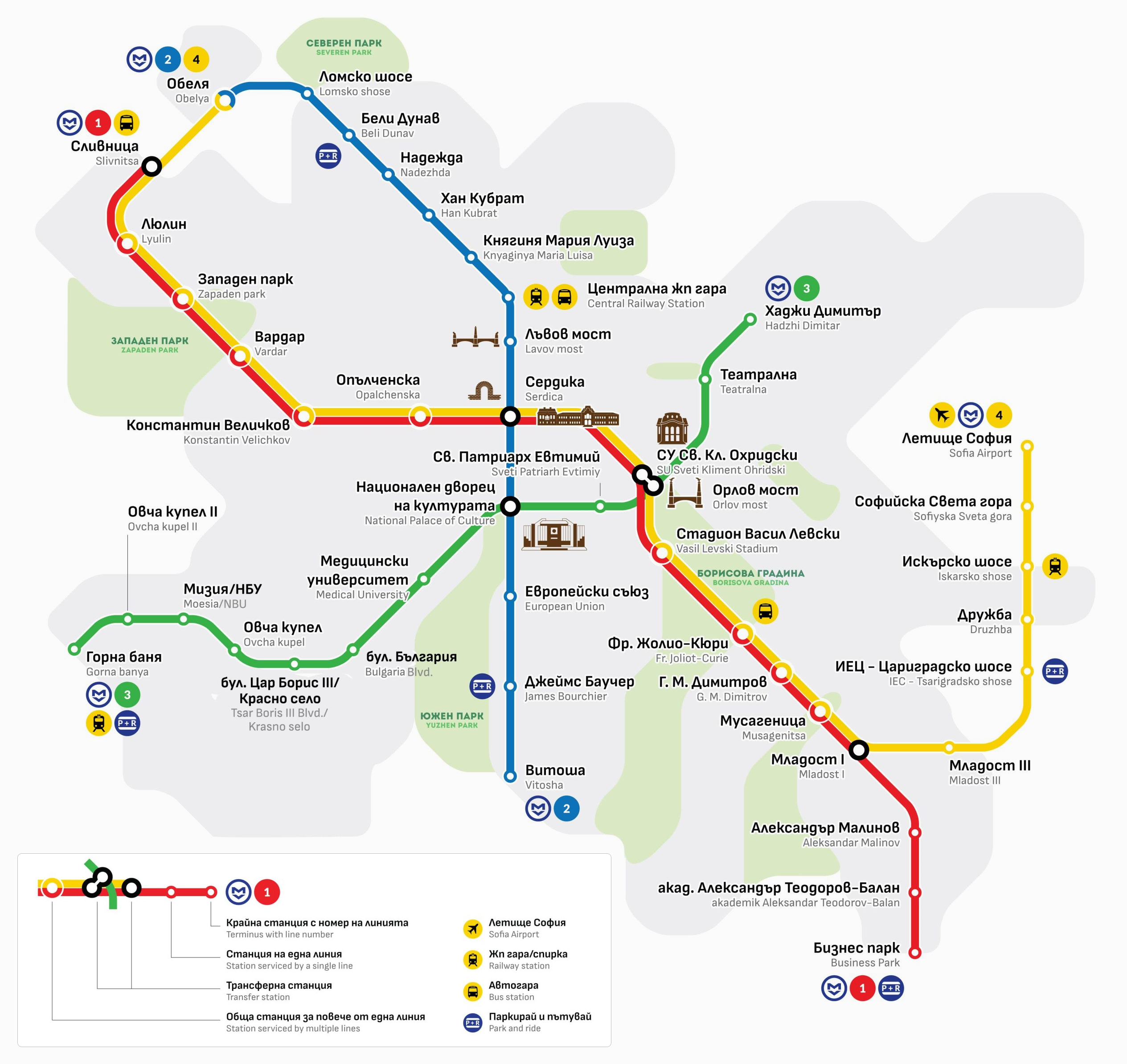
Sofia Metro Map
Map of Sofia Metro showing different lines and stations. Click on the map to enlarge it or download the Sofia Metro map in PDF format.
Overview of Lines and Stations
The Sofia Metro network connects major parts of the capital through four lines. It serves dense residential districts such as Lyulin, Mladost, Nadezhda, and Lozenets, while also linking the city centre, Sofia Airport, and important transport interchanges. For route planning, the stations map and train destination signs are especially useful because some sections are shared between lines.
Line structure is simple once you know the main route plan. M1 links Slivnitsa and Business Park Sofia, serving the Lyulin and Mladost areas. M2 runs between Obelya and Vitosha, connecting Nadezhda, the centre, and Lozenets. M3 is planned to connect the Ovcha Kupel and Vasil Levski areas, with parts already operating. M4 serves the airport corridor between Obelya and Sofia Airport and appears on maps and signage as part of the M2 and M4 split.
| Line | Status | Stations | Route |
|---|---|---|---|
| M1 | Operating | 16 | Slivnitsa to Business Park Sofia |
| M2 | Operating | 13 | Obelya to Vitosha |
| M3 | Partly operating | 12 in operation | Hadzhi Dimitar to Gorna Banya |
| M4 | Operating | 20 | Obelya to Sofia Airport |
Several stations work as key transfer points in the system. The stations list includes both underground and overground stops, depending on the section and line.
| Station | Details |
|---|---|
| Serdika | One of the most important interchange stations in the city centre. |
| Central Railway Station | Connects metro passengers with rail services and nearby bus transport. |
| Sofia Airport | Serves Terminal 2 and connects the airport corridor with the metro network. |
| NDK | An important interchange point connected with central Sofia travel flows. |
| Obelya | Part of the shared network structure and a key point for line connections. |
| Beli Dunav | Served by park-and-ride facilities. |
| Inter Expo Center – Tsarigradsko shose | Served by park-and-ride facilities and useful for eastern city access. |
The system was planned for long-term growth, so future stations and extensions are expected to improve coverage in outer districts and make cross-city travel easier.
Operating Hours and Frequency
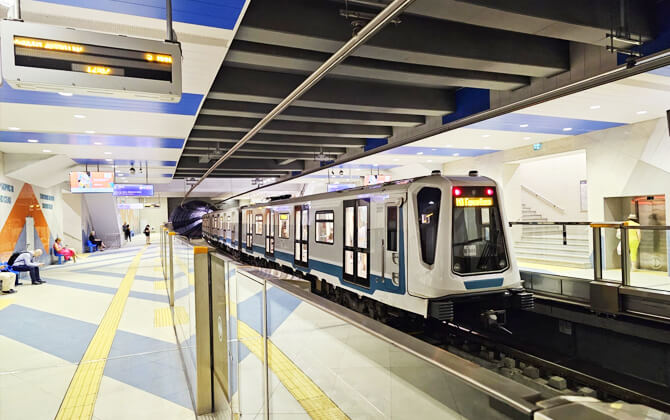
Sofia Metro operating hours are daily, with trains usually running from 5:30 AM to 12:00 AM. In practice, the last train from many stations leaves around 11:45 PM to 11:50 PM, so late-evening trips need a little buffer. If you are checking timings today, pay attention to the station and line, since the final departure can vary.
Frequency is best during peak periods, when trains can arrive every 2 to 3 minutes. Outside rush hour, the normal interval is usually 4 to 7 minutes, while evening and weekend gaps may reach up to 10 minutes. Opening hours may be shorter on major holidays, and special schedules apply on New Year’s Eve and New Year’s Day.
| Service detail | Timings |
|---|---|
| Daily service | 5:30 AM to 12:00 AM |
| First trains | Generally around 5:00 AM on all four lines |
| Last trains | About 11:00 PM to 11:40 PM depending on station and line |
| Typical closing time | Around midnight |
| Peak frequency | Every 2 to 3 minutes |
| Off-peak frequency | Every 4 to 7 minutes |
| Evening and weekend frequency | May be up to 10 minutes |
| Holiday service | Reduced frequency on national holidays |
For the most reliable train schedule, use station screens and route timetable information at the station before boarding. The system does not close early on a normal day, but holiday working hours can be different.
Sofia Metro Ticket Prices and Options
Sofia Metro fare options are easy to use. Occasional riders can buy a paper ticket or tap a contactless bank card, while regular passengers may prefer a reusable card or pass. Prices below are shown as listed in euros, with approximate US dollar equivalents for quick comparison.
A single metro ticket costs €0.80, about US$0.86, and is valid for one trip. It can be bought from ticket machines or cashier desks in metro stations and must be validated at the entry barriers. The ticket is valid for up to 30 minutes from the time of issue, and changing between metro lines does not count as a transfer.
Contactless payment works at the blue validators. It uses Ticket 30+, allowing transfers within 30 minutes for €0.80, about US$0.86. If the same bank card is used more than twice in one day, the total charge becomes €2.00, about US$2.16, for a Day Ticket. With this simple ticket price structure, most metro trips do not need a fare calculator.
| Ticket or pass | Price |
|---|---|
| Ticket 30+ | €0.80, about US$0.86 |
| Ticket 60+ | €1.10, about US$1.19 |
| Day Pass | €2.00, about US$2.16 |
| 24-Hours Pass | €3.00, about US$3.24 |
| 72-Hours Pass | €7.60, about US$8.21 |
The Sofia City Card and Ultralight card can be loaded with tickets and passes. Both are available at metro station cashier desks and Center of Urban Mobility desks. The Sofia City Card costs €1.50, about US$1.62, as a one-time card fee, while the Ultralight card costs €0.40, about US$0.43.
| Longer-term pass | Cost |
|---|---|
| Personalized 1-Month Metro Pass | €17.50, about US$18.90 |
| 1-Month Metro Pass | €21.00, about US$22.68 |
| Personalized 1-Month All-Mode Pass | €25.50, about US$27.54 |
| 1-Month All-Mode Pass | €35.50, about US$38.34 |
| Personalized 1-Month All-Mode Pass for Youth under 25 | €12.70, about US$13.72 |
| Personalized Yearly All-Mode Pass | €185.00, about US$199.80 |
| Yearly All-Mode Pass | €305.00, about US$329.40 |
| Personalized Yearly All-Mode Pass for Youth under 26 | €127.00, about US$137.16 |
All-mode passes cover metro, trams, trolleybuses, and buses in Sofia. Children under 7 travel free on public transport. If you cannot show a valid ticket during inspection, the fine is €20.00, about US$21.60. Special fare conditions for pupils, students, pensioners, and other categories are handled through the Urban Mobility Centre.
Interlinkages with Other Transportation Systems
The Sofia Metro is closely integrated with the wider city transport network and works as the backbone of local transport in the Bulgarian capital. It handles busy passenger corridors between residential districts, the centre, Sofia Airport, and major interchange points.
Central Railway Station connects metro riders with BDZ trains, intercity buses, international buses, Sofia Central Station, and Central Bus Station Sofia. Sofia Airport station provides direct access to Terminal 2, with a free shuttle bus to Terminal 1 between 7:00 AM and 7:00 PM. The metro also connects with major destinations such as Sofia University, the National Palace of Culture, and Vasil Levski Stadium.
Transfers to surface transportation in Sofia are common across the network. Buses, trolleybuses, trams, and the city tramway network all form part of the same urban mobility system, so combining modes is straightforward. Some metro stations are directly linked with bus or tram routes.
Park-and-ride facilities are available at stations including Beli Dunav and Inter Expo Center – Tsarigradsko shose. Station parking can be useful if you are coming from outer districts, but check local information before arrival for parking charges and parking charges per day, since specific fees are not listed here.
Within the metro itself, line sharing and interchanges help the system work as one connected network. Serdika, NDK, and Obelya are among the stations that have played important roles as the system expanded.
Airport Connectivity
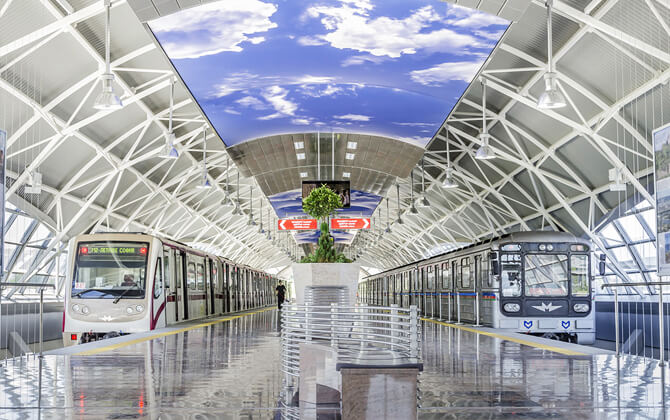
Sofia Airport is connected to the city by the M4 metro line. Sofia Airport Metro Station is next to Terminal 2, making the metro one of the easiest ways to travel between the airport and central Sofia.
| Service detail | Timings |
|---|---|
| Metro from Sofia Airport on business days | 5:26 AM to 11:49 PM |
| Metro from Sofia Airport on weekends and public holidays | 5:27 AM to 11:33 PM |
| Terminal 1 to Terminal 2 shuttle | Free shuttle bus available between 7:00 AM and 7:00 PM |
| Typical airport to Serdika running time | About 18 to 20 minutes |
A single ride costs €0.80, about US$0.86, and the ticket is valid across the entire metro network, including transfers to other lines. You can tap a contactless credit or debit card, buy a ticket from a machine, or use the cashier desks at the station.
If your flight uses Terminal 1, use the free shuttle bus between Terminal 1 and Terminal 2. Shuttle stops in front of both terminals are marked with signs and pavement markings. Additional airport information is available by phone at +359 2 937 22 11/12/13.
Rules and Regulations
Travel on Sofia Metro is allowed only with a valid transport pass, ticket, or electronic card. A single ride ticket or card becomes valid after validation at the electronic barriers at metro entrances. Single ride tickets may be used to enter the metro up to 30 minutes after issue.
Passengers must keep their valid transport document during the trip and show it to control officers on request. If you use a personalized electronic card, you may also be asked to show an identity document. Passengers who violate the rules and refuse to buy a single ride ticket from a control officer must leave at the next stop and identify themselves for the required administrative procedure.
With a valid metro pass, passengers may bring a limited number of items free of charge, including up to two carry-on items, a baby carriage with a child, or a wheelchair for a passenger with disabilities. Rules also apply to bicycles, pets, skis, snowboards, skateboards, folded individual electric vehicles with no more than two wheels, and other permitted items, as long as they do not inconvenience other passengers.
Passengers may not board or leave while a vehicle is moving, before doors are fully open, or after the door closing signal. It is also forbidden to litter, damage vehicles or ticket equipment, smoke, eat, drink alcoholic beverages inside vehicles or metro stations, beg, collect donations, conduct commercial or propagandistic activity, share a transport pass, cross turnstiles without a valid pass, step over the platform safety line, go onto the tracks, or enter a temporarily closed station.
Public transport rules also restrict people who may endanger others, people under the influence of alcohol or intoxicating substances, people in an unhygienic condition or with contagious diseases, dangerous or illegal items, and live animals or birds except where specifically allowed.
At the time of purchase, passengers may report and dispute incorrect information printed on a travel pass or errors during the financial transaction, including incorrect change.
Travel Tips
Sofia Metro is one of the most reliable ways to move around the city, especially during rush hour when roads can be congested. It is clean, punctual, and useful for trips to the city centre, the airport, the Central Railway Station, and several large residential districts.
Before boarding, check the destination shown on the train. M4 goes to Sofia Airport, while M1 serves Business Park Sofia. Some lines share platforms and sections, so the train destination is the easiest way to avoid the wrong route.
For airport transfers, the M4 ride from Terminal 2 to Serdika takes about 18 to 20 minutes. If you arrive at Terminal 1, use the free shuttle to Terminal 2 or take Bus 84. For late arrivals, the N4 night bus also serves the airport.
For tickets, you can tap a contactless card or phone, or use a single ride ticket. A standard single ride is listed at about €0.80 to €0.82, about US$0.86 to US$0.89, and the daily cap is about €2.00 to €2.05, about US$2.16 to US$2.21, after more than two rides with the same card. Day and 24-hour passes are useful if you plan several trips.
Timing matters. The metro usually runs from about 5:30 AM until midnight, with trains every 2 to 5 minutes in peak hours. If you are traveling after the metro closing time, night buses run until 4:00 AM.
Stay alert in crowds. The network is generally safe, but pickpocketing can happen on crowded routes and at major interchange stations. Keep your belongings close, especially when moving between metro and surface transport.
Google Maps and Moovit are useful for checking route options, transfers, schedule today information, and walking connections. If you need a taxi, local apps such as Taxi Me or Yellow Taxi are mentioned as options, since there is no Uber in Bulgaria.
Newer metro stations have elevators and are wheelchair-accessible, making the metro a dependable option for many travelers with reduced mobility. Accessibility can still vary by station, so check before you travel if step-free access is essential.
One more practical rule: trams always have the right of way, so be careful near tracks and crossings.
Short Historical Overview
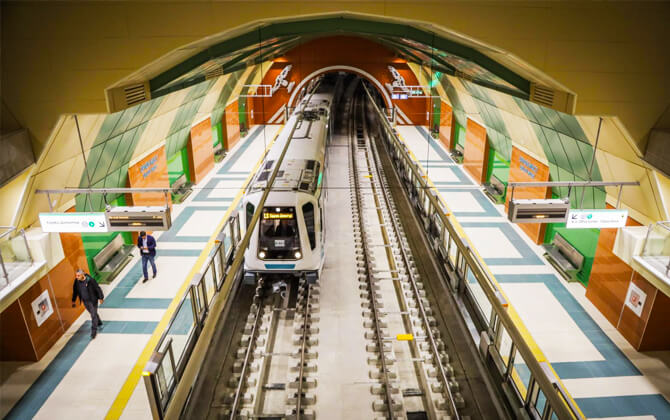
Planning for the Sofia Metro began in the 1960s. Formal approval followed in 1972, when the technical and budgetary report was accepted by the Council of Ministers. The master plan was approved in 1974, and construction started in stages in the late 1970s and 1980s.
Work slowed in the early 1990s because of funding shortages and complex engineering conditions. In the city centre, construction also revealed important archaeological remains, including Thracian and Roman ruins at Serdika Station.
The first section opened on 28 January 1998. It covered 6.5 kilometres (4.0 miles) and included five stations, running from Slivnitsa Boulevard through Lyulin to K. Velichkov Boulevard. Early additions followed in 1999 and 2000, extending the first line toward the centre.
Expansion continued through the 2000s and 2010s. A major extension opened in 2012, the route to Sofia Airport was completed in 2015, and the extension to Vitosha opened in 2016. In 2020, the network was reorganized into four interconnected lines.
As of 2024, the Sofia Metro has 47 stations and 52.0 kilometres (32.3 miles) of route length. Construction has focused on busy travel corridors, and the system remains under development with additional stations and extensions planned.
Planned Expansions
Sofia Metro expansion continues, with 10 new stations under construction and completion planned by 2027. The projects are spread across three main parts of the city and are intended to strengthen public transport links, add capacity, and improve access from outer districts.
Three stations are being built on Vladimir Vazov Blvd. in the Poduyane district. Six more stations are under construction in the Slatina residential area, extending toward Tsarigradsko Shose. Another station is planned on Pancho Vladigerov Blvd. to link the Slivnitsa and Obelya districts.
One advanced project is the route through Poduyane, H. Dimitar district, and the Levski residential area. It is reported to be nearly 70% complete and scheduled for mid-2026. In parallel, the Line 3 extension through Slatina to Arena 8888 Sofia and Tsarigradsko Shose started in late 2023 and is expected to be finished by 2027.
A tunnel boring machine is planned for the Slatina metro extension and is expected to advance more than 10 metres per day, about 0.006 miles per day. Work is also underway on a new metro station in Obelya, between the Slivnitsa and Obelya municipal districts, with completion planned for fall 2026. This station will provide an intermodal connection with the railway network and bus transport.
After these expansions, the Sofia Metro network is expected to reach 61 kilometres (37.9 miles) with 57 stations and serve around 650,000 passengers daily. Feasibility studies are also being prepared for future extensions to Studentski Grad and to the lower station of the Simeonovo lift.
Interesting Facts
- Sofia Metro is the only metro system in Bulgaria. As of 2024, it has four interconnected lines, 47 stations, and a total route length of 52.0 kilometres (32.3 miles), placing it among the 15 most extensive metro systems in Europe.
- The system was planned as early as the 1960s, but construction did not begin until the 1980s. Work was interrupted in the early 1990s because of funding shortages and the difficulty of building underground in a city with many historical layers.
- Archaeology became part of the metro’s identity. At Serdika Station, passengers can see Thracian and Roman ruins found during construction. Some stations near the National Palace of Culture were partly completed decades before they entered service.
- The first section to open was a 6.5-kilometre (4.0-mile) stretch of M1 with five stations, linking Slivnitsa Boulevard through Lyulin and Konstantin Velichkov Boulevard. Later extensions reached the city centre, Business Park Sofia, Sofia Airport, and Vitosha.
- Technical details also stand out. The average distance between stations is around 1,000 metres (0.6 miles), the maximum speed is 80 km/h, and listed transport capacity is 50,000 passengers per hour in one direction.
- The Sofia Metro has been financed by Sofia Municipality, the national budget, and European funds. Its continued expansion makes it one of the country’s major infrastructure projects.
Exploring Sofia Via the Metro
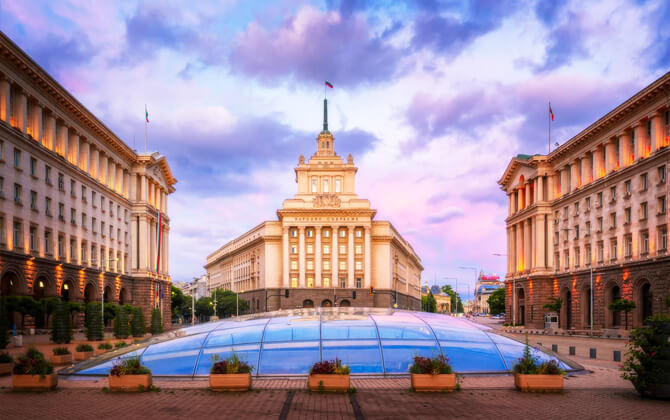
Sofia Metro is a practical way to explore the city. The trains are air-conditioned, the stations are generally clean and bright, and transfers across the network are straightforward. For visitors, it offers a clear route plan for reaching central Sofia, the airport, railway connections, business districts, and residential neighborhoods.
The system has four routes and 47 stations in operation. English signage appears in many places, and station maps help with route planning and transfer decisions. Some stations feel newer and more spacious, while others have longer platforms, more seating, or distinctive decoration.
The metro is also affordable. A contactless single trip is listed at €0.80, about US$0.86, with transfers allowed within 30 minutes of first validation. Using the same bank card more than twice in one day creates a daily cap of €2.00, about US$2.16. That makes the metro a strong option if you want to save time and keep transport costs predictable.
Typical frequency is about every 6 to 8 minutes during much of the day, with waits of up to 14 minutes in the evening and at night. Tickets can also be loaded onto a Sofia City Card or Ultralight card, giving travelers several easy ways to pay.
The network is generally clean and safe, with good lighting and comfortable platforms. Not every station has elevators, though, so accessibility can differ depending on where you start or finish your trip.
- Four metro routes are in operation.
- Transfers are allowed within 30 minutes of first validation.
- Single-trip contactless fare: €0.80, about US$0.86.
- Daily cap with the same bank card: €2.00, about US$2.16.
- Typical frequency: every 6 to 8 minutes during most of the day.
- Some stations have elevators, but not all.