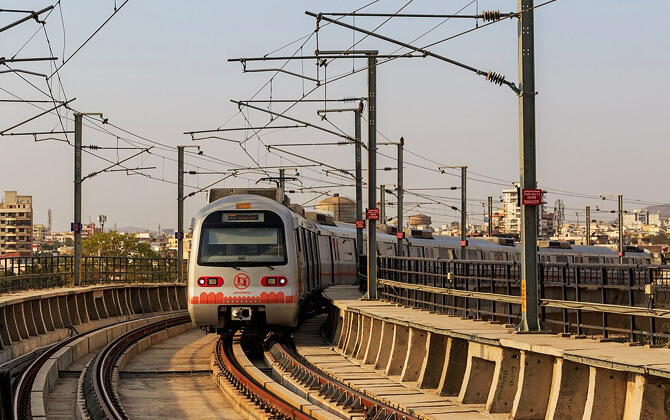
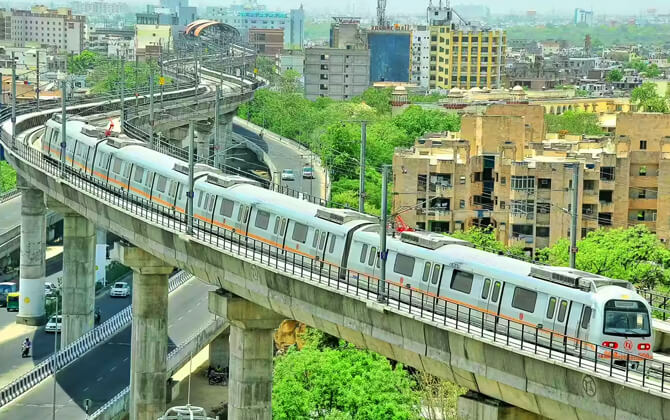
Jaipur Metro is the rapid transit system in Jaipur, Rajasthan, and the city’s main metro network for everyday public transport. It was developed in phases, with Phase 1A opening between Mansarovar and Chandpole on a mostly elevated 9.63 km (5.98 miles) route, followed by the Phase 1B extension to Badi Chaupar. The system is operated by Jaipur Metro Rail Corporation Ltd. (JMRC), and as of September 2020, the Pink Line was the active route with 11 stations over 11.97 km (7.44 miles). It is also known as the first metro in India to run on a triple-storey elevated road and metro track.
| Key | Information |
|---|---|
| System | Jaipur Metro |
| City | Jaipur, Rajasthan, India |
| Operator | Jaipur Metro Rail Corporation Ltd. (JMRC) |
| Operating line | Pink Line |
| Stations | 11 |
| Route length | 11.97 km (7.44 miles) |
| Initial opening | 3 June 2015 |
| Latest extension in service | Phase 1B to Badi Chaupar, opened 23 September 2020 |
| Notable feature | First metro in India to run on a triple-storey elevated road and metro track |
| Planned expansion | Orange Line and further Pink Line extensions |
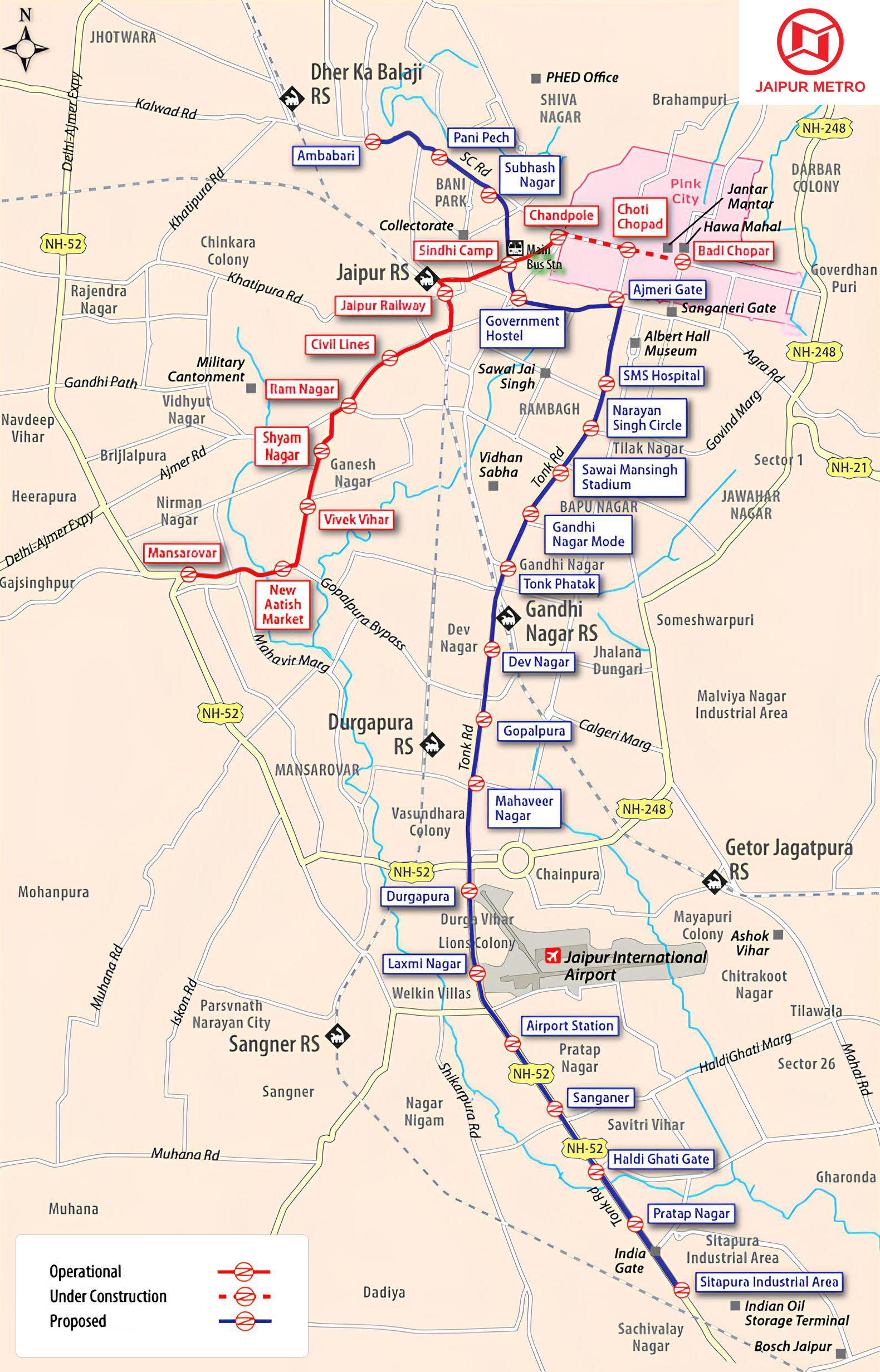
Jaipur Metro Map
Map of Jaipur Metro showing different lines. Click on the map to enlarge it or download the Jaipur Metro map in PDF format.
Jaipur Metro Timings, Frequency and Timetable
Jaipur Metro currently runs on the Pink Line between Mansarovar and Badi Chaupar. The timetable is designed for daily city transport, with trains generally running every 10 to 15 minutes, so frequency is fairly convenient for both commuters and occasional riders. If you are checking Jaipur Metro timings today, it is still smart to confirm the latest train schedule, especially near festivals or special events.
For smoother travel, check the opening hours, starting time, and last train before leaving. That helps if you need the closing time for a specific station or want to plan your route timetable in advance.
| Service detail | Timings |
|---|---|
| Mansarovar to Badi Chaupar | First train 6:00 AM; last train 1:00 PM; frequency every 10 to 15 minutes |
| From Badi Chaupar | First train 6:00 AM; last train 1:00 PM; frequency every 10 to 15 minutes |
Weekday Service
On weekdays, Jaipur Metro operating hours are 6:00 AM to 10:00 PM. During peak periods, trains run every 10 minutes. Outside those hours, the usual frequency is every 15 minutes.
Peak hours: 8:00 AM to 11:00 AM and 5:00 PM to 8:00 PM.
Off-peak frequency: every 15 minutes.
Weekend Service
On weekends, the opening times are 7:00 AM to 10:00 PM. Trains usually run every 15 minutes through the day.
Holiday Service
On holidays, service starts at 8:00 AM and continues until 9:00 PM. The schedule today on a holiday is generally every 20 minutes.
Special Occasion Timings
| Service detail | Timings |
|---|---|
| Diwali, October 31, 2025 | Extended service until 11:30 PM |
| Holi, March 14, 2025 | Service from 12:00 PM to 10:00 PM |
| New Year’s Eve, December 31, 2025 | Extended service until 1:00 AM |
Station-wise First and Last Train Timings
| Station | Details |
|---|---|
| Mansarovar | First train 6:00 AM; last train 10:00 PM |
| New Aatish Market | First train 6:05 AM; last train 10:05 PM |
| Vivek Vihar | First train 6:08 AM; last train 10:08 PM |
| Shyam Nagar | First train 6:11 AM; last train 10:11 PM |
| Ram Nagar | First train 6:14 AM; last train 10:14 PM |
| Civil Lines | First train 6:17 AM; last train 10:17 PM |
| Railway Station | First train 6:21 AM; last train 10:21 PM |
| Sindhi Camp | First train 6:25 AM; last train 10:25 PM |
| Chand Pole Gate | First train 6:29 AM; last train 10:29 PM |
| Choti Chaupar | First train 6:33 AM; last train 10:33 PM |
| Badi Chaupar | First train 6:37 AM; last train 10:37 PM |
Important Notes
- Train timings may change during festivals and special events.
- The last train timing refers to departure from the first station.
- Arrive at least 5 minutes early for easier boarding.
- The Jaipur Metro mobile app can help with real-time updates.
- Stations make announcements in case of service disruptions.
The Jaipur Metro timetable is available on the JMRC website, at stations, and in the Jaipur Metro app.
Tickets and Cards
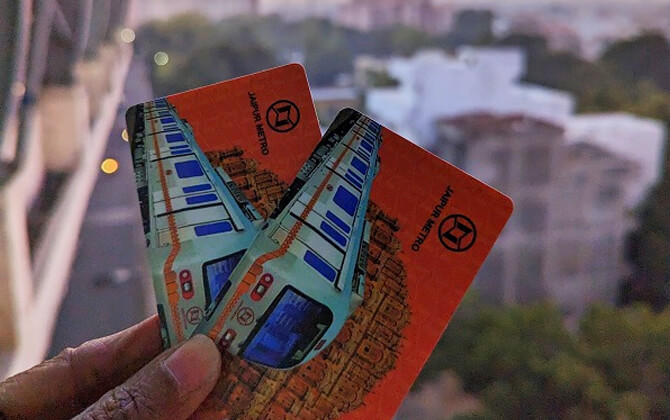
Jaipur Metro offers several ticket options for different types of travel, from one-off rides to regular commuting. If you are comparing fare, ticket price, or card options, the system includes tokens, Smart Cards, and Tourist Cards.
Ticket Types
- Single Journey Token — valid for one trip on the day of purchase. Price: ₹10 to ₹30 (about $0.12 to $0.36), depending on distance.
- Return Journey Token — valid for a return trip on the same day. Price: ₹20 to ₹60 (about $0.24 to $0.72), depending on distance.
- Smart Card — a rechargeable card for regular riders. Price: ₹100 (about $1.20), including a ₹50 refundable security deposit and ₹50 minimum balance.
- Tourist Card — unlimited travel option for visitors. Price: ₹200 for 1 day (about $2.40) or ₹500 for 3 days (about $6.00).
- Student Smart Card — for students with added discounts. Price: ₹100 (about $1.20), including a ₹50 refundable security deposit and ₹50 minimum balance.
- Senior Citizen Smart Card — for passengers aged 60 and above. Price: ₹100 (about $1.20), including a ₹50 refundable security deposit and ₹50 minimum balance.
Benefits and Discounts
- Smart Card users get a 10% discount on journeys.
- Student Smart Card holders get a 15% discount.
- Senior Citizen Smart Card holders get a 25% discount.
- Return Journey Tokens offer a 5% discount compared with buying two single tokens.
- Tourist Cards can lower the overall cost if you plan to travel several times during the validity period.
How to Purchase Tickets
- Station counters, usually open from 6:00 AM to 10:00 PM.
- Jaipur Metro mobile app for QR ticket booking and Smart Card recharge.
- Authorized retail outlets across Jaipur.
- Tourist information centers for Tourist Cards.
- Online portal for ticket purchase and card recharge.
Fare and Refund Information
Jaipur Metro uses a distance-based fare system, so the price depends on how many stations you travel through. Single Journey Tokens can be refunded on the same day with a small processing fee, Smart Card security deposits are refundable when the card is returned in good condition, and Tourist Cards are non-refundable after activation.
For the exact fare for your route, use the fare calculator before you travel.
Connections to Other Systems
Jaipur Metro is part of the city transport network, even though the documented direct links are fairly limited. The clearest interchange is at Sindhi Camp, where the metro connects with Jaipur’s main bus terminal. For local transport and wider transportation in Jaipur, this is one of the most useful transfer points.
Railway Station is another key stop. It provides direct access to Jaipur Railway Station and works as an important link for passengers arriving or leaving by rail. Stations such as Civil Lines, Chandpole, and Badi Chaupar also help connect the metro system with central Jaipur and the historic Pink City area.
For places farther away, including Amber Fort, passengers may need to combine metro travel with taxis or auto-rickshaws for the last part of the trip. In other words, Jaipur Metro works best as one part of a broader public transport journey.
In future route plans, the proposed Orange Line is shown with a connection at Sindhi Camp, where it would interchange with the Green Line mentioned in the available route material. If completed, that expansion would improve cross-city transfers.
Airport Connections
Jaipur Metro does not currently have a direct airport link. The nearest metro station to Jaipur International Airport is New Aatish Market, and from there the airport is about 6 to 7 km (3.73 to 4.35 miles) away. You can continue by taxi, auto-rickshaw, or local bus.
One practical option is feeder bus FB-04, which runs from Civil Lines Metro Station to Jaipur International Airport. The fare is ₹25 (about $0.30). It operates from 5:00 AM to 11:00 PM and is intended for air passengers, including those traveling with luggage.
For rail travelers, Railway Station metro station has a direct connection to Jaipur Junction Railway Station on the Platform No. 1 side, making it the easiest stop for train access.
The Pink Line generally operates from 6:20 AM to 9:20 PM, though first and last train timings can vary slightly between Mansarovar and Badi Chaupar.
Looking ahead, Phase 2 is proposed to include an underground station within the airport complex, with direct access to Terminals 1, 2, and 3. According to the available plans, this would make airport transfers much easier.
Parking near the Metro
Station parking is part of Jaipur Metro’s wider access plan for multimodal transport. In the available material, parking facilities are described across all nine stations, with a total area of 10,730 square meters.
The listed stations are Mansarovar, New Aatish Market, Vivek Vihar, Shyam Nagar, Ram Nagar, Civil Lines, Railway Station, Sindhi Camp, and Chandpole.
| Station | Details |
|---|---|
| Mansarovar | Parking facility listed in available material |
| New Aatish Market | Parking facility listed in available material |
| Vivek Vihar | Parking facility listed in available material |
| Shyam Nagar | Parking facility listed in available material |
| Ram Nagar | Parking facility listed in available material |
| Civil Lines | Parking facility listed in available material |
| Railway Station | Parking facility listed in available material |
| Sindhi Camp | Parking facility listed in available material |
| Chandpole | Parking facility listed in available material |
The parking arrangement covers bicycles, two-wheelers, and four-wheelers. After metro passenger vehicles are parked, remaining space may also be used for feeder services and other passenger vehicles at prescribed rates.
The areas are planned with CCTV coverage, and separate provisions are available for vehicles used by persons with disabilities. Penalty rates apply if a vehicle is not removed within 24 hours.
The source material does not specify the exact parking charges or parking charges per day, so travelers should check station notices for the current price.
History
Jaipur Metro began with Phase 1A, a mostly elevated 9.63 km (5.98 miles) route from Mansarovar to Chandpole Bazaar. Construction started in November 2010 and was completed in 2014.
Jaipur Metro Rail Corporation Ltd. was created on 1 January 2010 as the state-owned company responsible for the system. JMRC consulted the Delhi Metro Rail Corporation on operations and construction methods. Trial runs started on 18 September 2013 and were described as the fastest trial run after the start of construction among India’s rapid transit systems.
Physical construction work began on 24 February 2011. Commercial service opened between Chandpole and Mansarovar on 3 June 2015, when the line was inaugurated by Rajasthan Chief Minister Vasundhara Raje. With that launch, Jaipur Metro became the sixth rapid transit system in India.
Phase 1B, extending the Pink Line from Chandpole to Badi Chaupar, entered service on 23 September 2020. The system also stands out in Indian metro history as the first to run on a triple-storey elevated road and metro track.
Future Extensions
Jaipur Metro expansion plans go beyond the current Pink Line, with projects aimed at improving access across the city and reducing pressure on road transport. The next steps focus on extending the east-west corridor and preparing a new north-south route for the longer term.
Pink Line Extensions
Two Pink Line extensions are planned. Phase 1C would extend the line from Badi Chaupar to Transport Nagar, linking the city core with an important transport hub. The detailed project report describes this section as a mix of underground and elevated alignments, with Ramganj Chaupar and Transport Nagar named as key stations.
Phase 1D is planned on the western side, extending service from Mansarovar to Ajmer Road Chauraha. This route is intended to improve access for residential areas and make daily travel easier for commuters heading toward Ajmer Road.
Phase 2 Planning
Phase 2 is the largest planned addition to the Jaipur Metro system. It is proposed as a north-south corridor from India Gate in the Sitapura Industrial Area to Ambabari. The planned line would cover about 23.5 km (14.60 miles) and serve major business, residential, and institutional areas.
The proposed route includes locations such as Tonk Phatak, Rambagh, Sindhi Camp, and Bani Park. According to the available project information, the detailed project report is ready, while approvals are still awaited.
What These Extensions Could Mean
If completed, these projects would likely improve transfers, shorten commute times, and connect more major bus points and busy districts. The existing Jaipur Metro smart card is expected to work across the expanded network, supporting a more connected city transport system.
Tips and Rules
Jaipur Metro follows the Metro Railways (O&M) Act, 2002 and the operating rules issued by JMRC. These rules apply inside stations, on trains, in depots, and across other metro premises. They are meant to keep the system safe for everyone.
Key passenger rules
- Do not travel while drunk, create nuisance, behave indecently, or disturb other passengers.
- Do not carry offensive or dangerous material.
- Do not demonstrate, paste posters, or write or draw on walls, carriages, or premises.
- Do not travel on the roof of a train or walk on the track without lawful authority.
- Do not obstruct train movement or interfere with metro staff on duty.
- Travel only with a valid pass or ticket and do not go beyond the authorized journey distance.
- Do not interfere with communication systems or misuse the alarm bell.
- Do not alter, deface, or counterfeit passes, tickets, or public notices.
- Do not sell articles or tickets without authorization.
- Do not make false compensation claims.
Penalties and enforcement
Penalties can include fines, removal from the train or station premises, forfeiture of fare, recovery of charges, and imprisonment, depending on the offence. Serious offences, such as sabotage or damage that endangers passenger safety, can lead to long prison terms and, in the most severe cases, the punishments stated in the Act.
Authorized Jaipur Metro officials, including Station Controllers, Depot Controllers, and designated supervisors, may impose penalties within their areas of authority. If a person refuses to pay a fine or comply, they may be detained and handed over to the police for further action.
Fare and token rules
- Travel without a valid pass or ticket, or beyond the authorized distance, may lead to an excess charge plus the ordinary fare.
- Incorrect use of a token or card, including pseudo entry, tailgating, or trying to exit without paying the difference in fare, may attract penalty.
- Free Exit Tokens are issued only in exceptional cases, such as read-ticket errors at exit or gate malfunction.
- Paid Exit Tokens are issued when a passenger must exit after a fare or ticket irregularity; once issued, they are not cancelled or refunded.
Keep your ticket, token, or smart card ready for inspection and use it only as intended to avoid delays and penalties.
Nearby Attractions
Jaipur Metro gives fairly easy access to several of the Pink City’s best-known landmarks, markets, and transport hubs. For sightseeing, the most convenient stations are Badi Chaupar, Chhoti Chaupar, Chandpole, Sindhi Camp, and Jaipur Railway Station.
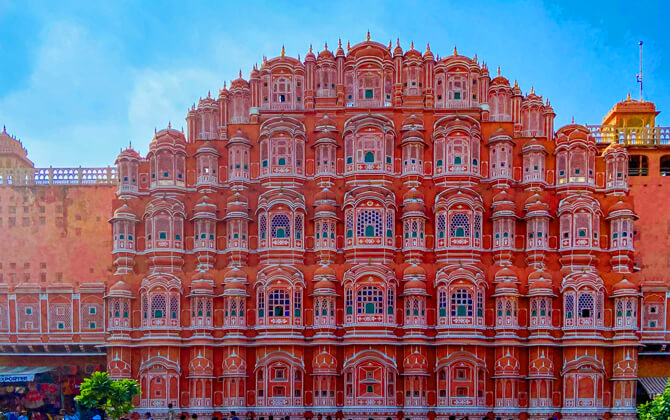
| Station | Details |
|---|---|
| Badi Chaupar | Hawa Mahal, Jantar Mantar, City Palace |
| Chhoti Chaupar | Chhoti Chaupar Square, Tripolia Bazaar |
| Chandpole | Chandpole Bazaar, Govind Dev Ji Temple |
| Sindhi Camp | Sindhi Camp Bus Stand, MI Road |
| Jaipur Railway Station | Jaipur Junction Railway Station, Sindhi Camp Bus Stand |
| Civil Lines | Civil Lines Market, Raj Bhavan |
| Mansarovar | Akshardham Temple, Mansarovar Garden |
| New Aatish Market | New Aatish Market, Gopalpura Bypass |
| Ram Nagar | Ram Nagar Market, Gurdwara Sahib Ram Nagar |
| Shyam Nagar | Shyam Nagar Market, Elements Mall |
| Vivek Vihar | Vivek Vihar Park, Gurudwara Sahib |
For heritage sights, Badi Chaupar is the best access point. Sindhi Camp is especially useful if you also need bus connections, while Chandpole works as another handy gateway to the walled city.