The Oslo Metro, locally called the T-bane or Tunnelbane, is Oslo’s rapid transit system and a core part of public transport in the city. Operated by Sporveien T-banen on behalf of Ruter, it has five lines running through the city centre, covers 85 kilometres (52.8 miles), and serves 101 stations, including 17 underground or indoor stations. The system also reaches parts of neighboring Bærum, linking central Oslo with residential districts, suburbs, and major transfer points.
| Key | Information |
|---|---|
| System name | Oslo Metro (T-bane / Tunnelbane) |
| Operator | Sporveien T-banen on contract from Ruter |
| Lines | 5 |
| Network length | 85 kilometres (52.8 miles) |
| Stations | 101 |
| Underground or indoor stations | 17 |
| Area served | Oslo and parts of Bærum |
| First line opened | Holmenkollen Line, 1898 |
| Nordic underground milestone | Line to Nationaltheatret opened in 1928 |
| Major network step | Common Tunnel opened in 1993 |
| Current rolling stock | MX3000 trains |
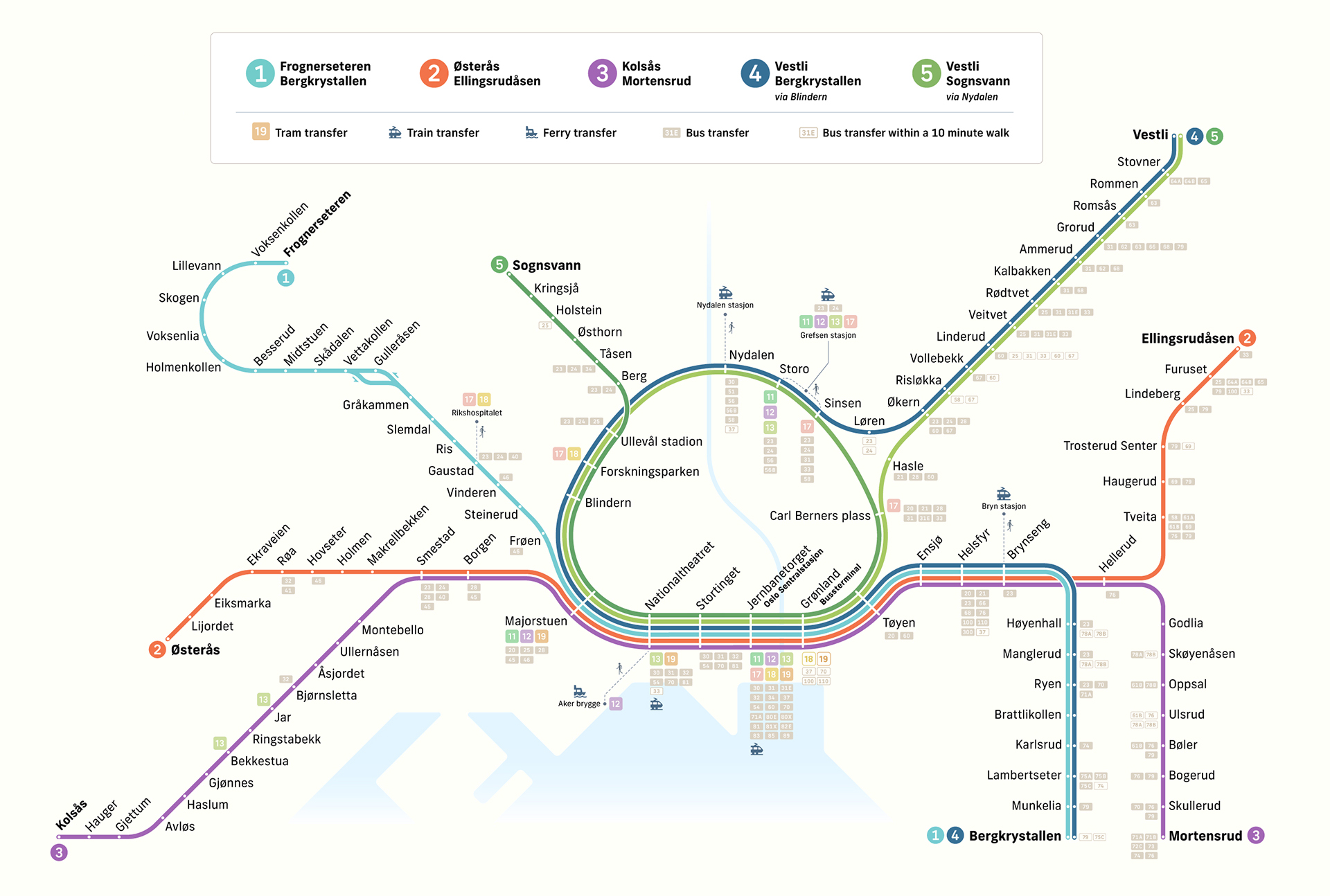
Oslo Metro Map
Map of Oslo Metro showing different lines and stations. Click on the map to enlarge it or download the Oslo Metro map in PDF format.
Lines and Stations
The Oslo Metro system has five lines, numbered 1 to 5, and all of them pass through the city centre. Together they form an 85-kilometre (52.8-mile) network with 101 stations. If you are checking the stations map or building a route plan, the Common Tunnel is the key section to remember, since every line uses it.
Some branches are shared. The Grorud branch is served by Lines 4 and 5, while the Lambertseter branch has full-time service on Line 4 and limited service on Line 1. The network reaches all fifteen boroughs of Oslo and extends slightly into Bærum.
The main lines are listed below.
| Station | Details |
|---|---|
| Line 1 | Frognerseteren – Stortinget – Helsfyr – Bergkrystallen |
| Line 2 | Østerås – Stortinget – Ellingsrudåsen |
| Line 3 | Kolsås – Stortinget – Mortensrud |
| Line 4 | Vestli – Storo – Stortinget – Bergkrystallen |
| Line 5 | Sognsvann – Stortinget – Storo – Stortinget – Vestli |
Several stations are important interchanges. Jernbanetorget, Majorstuen, Nationaltheatret, Stortinget, Grønland, Tøyen, Helsfyr, Brynseng, and Storo make transfers easier across the network, and some also connect with the Oslo Tramway, bus services, or national rail.
Notable station groupings
| Station | Details |
|---|---|
| Central stations | Jernbanetorget, Stortinget, Nationaltheatret, Majorstuen |
| Busy transfer stations | Brynseng, Grønland, Tøyen, Helsfyr |
| Western branch stations | Frognerseteren, Holmenkollen, Sognsvann, Østerås, Kolsås |
| Eastern branch stations | Grorud, Furuset, Lambertseter, Østensjø, Mortensrud |
Most underground stations are in the city centre and on parts of the eastern network. On the western side, Nationaltheatret was the only underground station on the pre-metro network.
Planned expansion mentioned in the source material includes an extension of the Furuset Line toward Lørenskog and a second Common Tunnel between Majorstuen and Tøyen, with proposed stations at Bislett and Nybrua.
T-bane Prices, tickets and discounts
Oslo’s T-bane uses the same fare system as the rest of the Ruter public transport network. One ticket can also cover buses, trams, local ferries, and most local trains within the valid zones. For many visitors, Zone 1 is enough because it covers almost all of Oslo’s urban area.
The fare depends on how many zones you travel through. A single Zone 1 ticket costs about 44 NOK (about $4 USD) for an adult and is valid for 60 minutes, including transfers within that time. If your trip crosses additional zones, the price goes up and the validity period is extended by 30 minutes for each extra zone.
Typical adult prices in Zone 1
- Single ticket: about 44 NOK (about $4 USD)
- 24-hour ticket: a little over 130 NOK (about $12 USD)
- 7-day ticket: around 330–350 NOK (about $30–32 USD)
- 30-day pass: low-700s NOK (about $64–68 USD)
Children, youths, students, and seniors get significant discounts. Children under 6 travel free with a paying adult. If you plan to use city transport a lot, a pass or day pass can be more practical than buying separate tickets.
Ruter tickets are useful if you want to combine the metro with bus, tramway, or other local transport. Airport Express Train services on Flytoget are not included.
Connections
The Oslo Metro is closely integrated with other transport in the city, especially bus, trams, and rail. Several stations act as major transfer hubs, and the central area is especially well connected through the Common Tunnel.
| Station | Details |
|---|---|
| Jernbanetorget | Connects Lines 1, 2, 3, 4, and 5; links with Oslo Central Station, tram routes 11, 12, 13, 17, 18, and 19, and bus routes 30, 31, 34, 37, 54, 60, and 70 |
| Nationaltheatret | Connects Lines 1, 2, 3, 4, and 5; links with trains, tram routes 13 and 19, and bus routes 30, 31, 32, 70, 82, and 83 |
| Stortinget | Connects Lines 1, 2, 3, 4, and 5; links with tram routes 11, 17, and 18 |
| Majorstuen | Connects Lines 1, 2, 3, 4, and 5; links with tram lines 11, 12, and 19, and bus routes 20, 22, 25, 28, 45, 46, and 156 |
| Grønland | Connects Lines 1, 2, 3, 4, and 5; links with tram routes 18 and 19, the Oslo Bus Terminal, and bus routes 34, 37, and 74 |
| Brynseng | Connects Lines 1, 2, 3, and 4; links with bus routes 3B, 23, and 24 |
| Tøyen | Connects Lines 1, 2, 3, 4, and 5; links with bus routes 20 and 60 |
| Forskningsparken | Connects Lines 4 and 5; links with tram routes 17 and 18 |
| Storo | Connects Lines 4 and 5; links with tram routes 11, 12, and 13, plus bus routes 23, 24, 56, 56B, and F3 |
| Sinsen | Connects Lines 4 and 5; links with tram route 17 and bus routes 23, 24, 31, 33, 58, 301, 302, 321, and 363 |
| Smestad | Connects Lines 2 and 3; links with bus routes 6B, 23, 24, 42, 43, 45, and 202 |
| Stovner | Connects Lines 4 and 5; links with bus routes 64A, 64B, 65, 120, and N5 |
| Ullevål Stadion | Connects Lines 4 and 5; links with bus routes 22, 23, 24, 25, and F3 |
For airport travel, the metro does not run directly to Oslo-Gardermoen Airport. The usual route is to travel to Oslo Central Station via Jernbanetorget and continue by the Airport Express Train, which takes about 20 minutes.
Oslo Metro Schedule
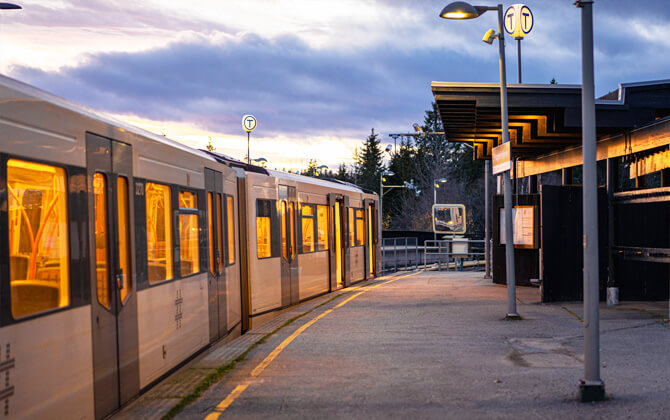
If you need the Oslo Metro timetable, train schedule, or route timetable for Lines 1, 2, 3, 4, and 5, the system provides route maps and timetable information for daytime and night service. You can also search by stop, address, or area in the journey planner. Downloadable route map and timetable PDFs are available in Norwegian.
In general, operating hours begin between 5:30 am and 6:00 am. Opening times vary slightly by line and direction, but that is the usual starting time for service. Trains normally continue until midnight, so the closing time for regular service is around 12:00 am.
From Monday to Friday, frequency is usually every 5 to 10 minutes until 9:00 pm. After that, and during weekends, trains generally run about every 30 minutes. For exact timings today, schedule today details, last train departures, and any service changes, it is best to check the live timetable before you travel.
| Service detail | Timings |
|---|---|
| Typical opening hours | Between 5:30 am and 6:00 am |
| Typical closing time | Around midnight |
| Weekday frequency until 9:00 pm | About every 5 to 10 minutes |
| Late evening frequency | About every 30 minutes |
| Weekend frequency | About every 30 minutes |
Airport Connection
There is no direct metro or path train connection to Oslo-Gardermoen Airport. Still, the trip is straightforward. From the city center, take the T-bane to Jernbanetorget, then walk to Oslo Central Station for Flytoget.
Flytoget departs from Oslo Central Station and reaches the airport in about 20 minutes. It is designed as a fast service with very limited stops, which keeps the running time short.
Jernbanetorget is served by all five metro lines, and its surface level is right next to Oslo S, so the transfer is easy. After arriving, you can buy a Flytoget ticket at the ticket window or in the mobile app.
Tips and Rules
The T-bane is easy to use once you know the basics. The network is well signposted, but it still helps to check your route and stations list in advance, especially if you are changing trains in the city centre tunnel.
Use the Ruter app or website to plan your trip, check the timetable, and see schedule today updates or timings today. The app is also the easiest way to buy a digital ticket, though route results may include bus and trams unless you filter for metro service.
Buy your ticket before boarding. You can get one in the Ruter app, from ticket machines at major stations, or from kiosks such as Narvesen and 7-Eleven. If you use a physical card or paper ticket, make sure it is valid before entering the system.
Ticket inspections are common, especially in central areas. If asked, you need to show your digital ticket, paper ticket, or travel card. Traveling without a valid ticket can lead to a fine.
Check the direction carefully. In the centre, platforms are often marked westbound or eastbound. Elsewhere, signs may say toward the city centre, away from the city centre, or show the final station on the route.
Look for the blue and white T signs. They are the easiest way to spot a station entrance. Some central stations have several entrances, so checking the stations map beforehand can save time.
The system is well integrated, but it does not cover every part of Oslo on its own. For some trips, you may need to switch to local transport such as bus or tramway.
Choose the right station for where you are going. Jernbanetorget works well for Oslo Central Station and the Opera House, Nationaltheatret for trains and trams, Majorstuen for Vigeland Sculpture Park, Holmenkollen for the ski jump, and Frognerseteren for access to Nordmarka forest.
Leave a bit of extra time for hills and walking. Holmenkollen, for example, may involve an uphill walk from the station. In winter, Frognerseteren is a popular starting point for skiing and sledding.
Keep your journey quiet and respectful. Let people off before boarding, avoid blocking doors, and keep noise low. It is a safe and orderly system when everyone follows the basics.
The source material mentions future expansion, including a new city centre tunnel intended to reduce pressure on the existing shared tunnel and improve connections.
No information on station parking, parking charges, or parking charges per day was provided in the source material.
History
Suburban lines in the west
Rail transport in Oslo began in 1854 with the opening of the Hoved Line to Eidsvoll through Groruddalen. The Drammen Line followed in 1872 through Oslo West, and the Østfold Line opened in 1879 through Nordstrand, giving these areas limited rail service. Horsecar trams appeared in 1875, and electric trams entered service in 1894.
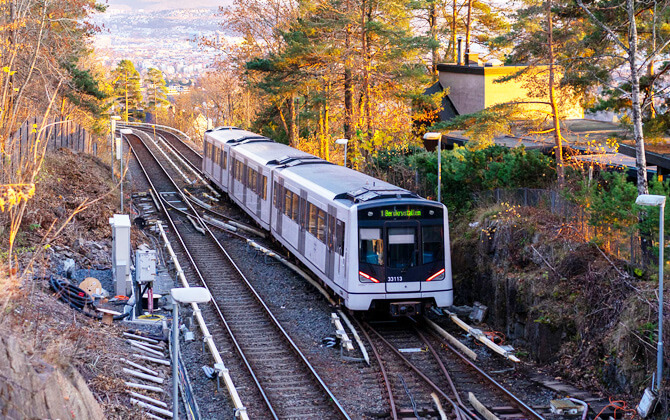
The first suburban tram line was the Holmenkollen Line, opened in 1898 by Holmenkolbanen. It used electric trams on a grade-separated right-of-way with proper stations rather than tram stops, making it Oslo’s first rapid transit line. Unlike later western lines, it was not extended into the city as a streetcar, so passengers had to change at Majorstuen. The line adopted wider suburban rolling stock in 1909, and branches later opened to Smestad in 1912 and to Tryvann in 1916. The last section from Frognerseteren was single-track, used for freight, and removed in 1939.
In 1912, construction began on the first underground railway project in the Nordic countries, when A/S Holmenkolbanen started extending the line from Majorstuen to Nationaltheatret. This 2.0-kilometre (1.2-mile) section opened in 1928 with an intermediate station at Valkyrie Plass, giving the western suburban lines access to the central business district. It is now seen as an early premetro example.
Success on the western suburban lines encouraged more expansion. The Lilleaker Line opened to Lilleaker in 1919, to Avløs in 1924, and to Kolsås in 1930. In 1942, a new section from Jar to Sørbyhaugen linked the Kolsås Line to Nationaltheatret, turning it into a rapid transit service with wider suburban-standard stock. High construction costs and compensation claims put pressure on the company, and in 1934 the municipality of Aker took over the common stock. Oslo Sporveier gradually assumed operation of the western suburban lines, while Akersbanerne opened the Sognsvann Line in 1934.
Metro
The idea of a citywide rapid transit system emerged in 1912 with the construction of the Ekeberg Line. Plans called for a tunnel under the city centre and through services, but the cost of the first section of the Common Tunnel stopped the project. After World War II, a planning office for the T-bane was established in 1949, and the first plans were launched in 1951.
In 1954, the city council decided to build the network in Eastern Oslo with four branches, based on a new metro standard with third rail power, cab signaling with Automatic Train Protection, longer stations, and the removal of level crossings.
At the time, eastern Oslo had two suburban tramways: the Ekeberg Line and the Østensjø Line. Only the Østensjø Line would be connected to the T-bane. Three new lines were planned: the Grorud Line and Furuset Line in Groruddalen, and the Lambertseter Line east of Nordstrand. These areas were chosen as new suburbs and needed fast public transport.
The Lambertseter Line opened in 1957 from Brynseng to Bergkrystallen, and the Østensjø Line was extended to Bøler in 1958. The metro opened on 22 May 1966, when the Common Tunnel opened from Brynseng to Jernbanetorget beside Oslo East Railway Station. The Grorud Line opened later that year, and the Østensjø Line joined the system in 1967 when it was extended to Skullerud. The Furuset Line opened to Haugerud in 1970 and was extended to Trosterud in 1974, while the Grorud Line was extended to Vestli. By 1981, the Furuset Line had reached Ellingsrudåsen. During this period, the metro received T1000 rolling stock, with 162 cars delivered for the eastern network between 1964 and 1978.
One tunnel
The eastern network was extended from Jernbanetorget to Sentrum in 1977. That station closed in 1983 because of water leakage, and when it reopened in 1987 under the name Stortinget, the western network tunnel had also been extended there. Through services were still not possible, though, because the signaling and power systems were incompatible.
Direct operation across the city began in 1993 after the Sognsvann Line had been rebuilt to metro standard. The Røa Line followed in 1995. The Holmenkollen and Kolsås lines remained outside metro standard for a time, using dual-mode trains that switched to overhead lines at Frøen and Montebello. The western network received 33 T1300 cars in 1978–81, and another 16 were converted from T1000 stock. Twelve T2000 cars were delivered for the Holmenkollen Line in 1994.
The Ring Line opened in 2003, connecting Ullevål stadion to Storo. The following year, construction work caused a tunnel collapse on the Grorud Line, the busiest in the system, leading to a shutdown until December and major disruption for replacement bus services. In 2006, the ring was completed to Carl Berners plass, and replacement of older rolling stock with MX3000 units began. The older T1000 stock was fully replaced between 2006 and 2010. The history of Oslo Metro, trams, and public transport is also reflected at the Oslo Tramway Museum in Majorstuen.
Future Extensions
The Oslo Metro is set for major changes, with one extension under construction and several others still proposed. These projects are intended to improve capacity, support new development areas, and strengthen public transport across the city.
Under construction
The Fornebu Line is the only extension currently being built. It will run from Majorstuen to Fornebu via Skøyen and Lysaker, adding six new underground stations: Skøyen, Vækerø, Lysaker, Fornebuporten, Flytårnet, and Fornebu. Construction began in December 2020, and the line is planned to open around 2027 to 2029.
The project is meant to improve transport to the Fornebu area, which is being developed with new homes and workplaces. Funding is shared between Oslo and the Norwegian state, along with contributions from other sources.
Proposed
Other expansion plans have been discussed under Oslo Package 3, but they are currently on hold.
- Extension of the Furuset Line to Lørenskog, with stations at Skårer and Lørenskog Centre and a new terminus at Akershus University Hospital.
- A second city centre tunnel from Majorstuen to Tøyen, with new stations at Bislett and southern Grünerløkka (Nybrua).
If the second tunnel is built, all lines would stop at Stortinget, which would gain four platforms. Majorstuen station would also move underground.
At the moment, only the Fornebu Line is moving forward.
Nearby Attractions
Oslo Metro is one of the easiest ways to reach many of the city’s best-known sights. Because the system runs through central Oslo and serves key stations such as Jernbanetorget, Nationaltheatret, Stortinget, Majorstuen, and Tøyen, many trips are short and simple.
Popular Stops for Sightseeing
- Holmenkollen – Take Line 1 to Holmenkollen station for the ski jump museum, panoramic views, and hiking trails.
- Vigeland Park – Reach Majorstuen on Lines 1, 2, or 3, then walk about 10 minutes.
- Sognsvann Lake – Use Line 5 for easy access to the lake, hiking trails, picnics, and summer swimming.
- Munch Museum – Take Line 4 or 5 to Tøyen, or continue by tram or bus toward Bjørvika.
- Norwegian Museum of Science & Technology – Visit from Kjelsås, served on the eastern side of the network.
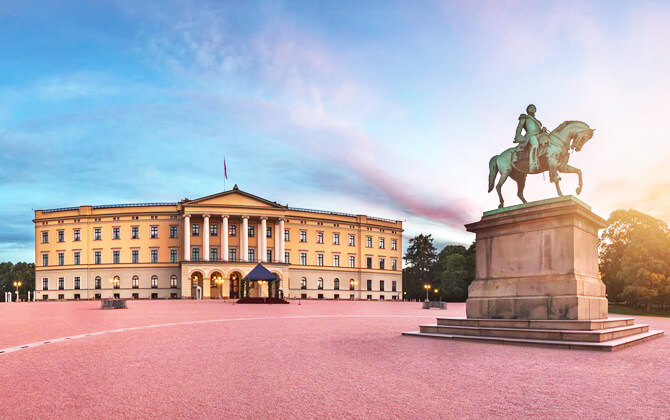
- Royal Palace and Karl Johans gate – Nationaltheatret is the most convenient stop for central Oslo landmarks and shopping.
- Oslo Central Station – Jernbanetorget connects to all five metro lines and sits right next to Oslo S.
Best Stations for Visitors
| Station | Details |
|---|---|
| Nationaltheatret | Close to the Royal Palace, the National Theatre, and Karl Johans gate. |
| Stortinget | Useful for the Parliament area and the walk toward the Opera House. |
| Majorstuen | Good for Vigeland Park and shopping on Bogstadveien. |
| Grønland | Handy for food halls, restaurants, and bus connections. |
| Holmenkollen | Best for ski jump views, the museum, and outdoor trails. |
| Sognsvann | Ideal for a quick escape into nature. |
If you want to mix city sightseeing with nature, Line 1 is especially memorable because it offers above-ground views on the way to Holmenkollen and Frognerseteren. For many visitors, the T-bane is not just transportation in Oslo, but part of the experience.