The Karen Demirchyan Yerevan Metro, also known as the Yerevan Subway, is the rapid transit system serving Yerevan, Armenia’s capital. It opened on March 7, 1981, as the eighth metro system in the former Soviet Union. Today, this compact public transport system has one main double-track route, a shuttle branch between Shengavit and Charbakh, and 10 stations across 13.4 km (8.3 miles) of track.
| Key | Information |
|---|---|
| Official name | Karen Demirchyan Yerevan Metro |
| City | Yerevan, Armenia |
| Opened | March 7, 1981 |
| System type | Rapid transit metro system |
| Route length | 13.4 km (8.3 miles) |
| Stations | 10 stations |
| Lines | One main line plus the Charbakh shuttle branch |
| Operator | Karen Demirchyan Yerevan Subway CJSC |
| Typical operating hours | 6:30 AM to 11:00 PM |
| Notable feature | The network includes deep-level, shallow-level, and above-ground stations |
Yerevan Metro Map
Map of Yerevan Metro showing different lines and stations. Click on the map to enlarge it or download the Yerevan Metro map in PDF format.

Yerevan Metro Interactive Map
Yerevan Metro Routes and Stations
The Yerevan Metro route is easy to understand: it runs from Barekamutyun to Garegin Nzhdeh Square, with a short shuttle branch between Shengavit and Charbakh. For visitors checking a stations map or building a simple route plan, this single-line layout makes city transport straightforward.
As of 2025, the system has 10 stations and a total running length of 13.4 km (8.3 miles). Most stations opened during the 1980s, while Charbakh opened in 1996. The path train riders follow includes underground sections, shallow stations, and three above-ground stations.
Stations on the route
| Station | Details |
|---|---|
| Barekamutyun | Western terminal of the main route |
| Marshal Baghramyan | Previously named Saralanj before its 1983 renaming |
| Yeritasardakan | Central station useful for access to major city areas |
| Republic Square | Formerly Lenin Square |
| Zoravar Andranik | Formerly Hoktemberyan, also referred to as General Andranik in historical name changes |
| David of Sasun | Serves the railway station area |
| Gortsaranayin | Part of the southern section of the line |
| Shengavit | Interchange point for the Charbakh shuttle branch |
| Charbakh | Branch station opened in 1996 |
| Garegin Nzhdeh Square | Southern terminal of the main route, formerly Spandaryan Square |
Several station names have changed over time. Lenin Square became Republic Square, Hoktemberyan became General Andranik, and Spandaryan Square became Garegin Nzhdeh Square.
Route development
The first phase was planned to connect dense residential areas with the railway station and industrial zone. Later extensions added more stations, gradually shaping the current route timetable and stations list.
Expansion remains part of the long-term route plan. Construction of an 11th station is expected to begin in 2026, and broader plans mention a future network with 32 stations and three lines, including possible extensions toward Ajapnyak, Davtashen, and other districts of Yerevan.
Operating Hours
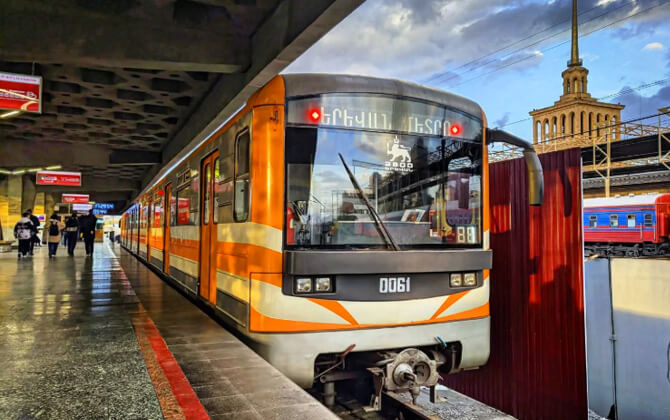
Yerevan Metro operating hours are usually listed as 6:30 AM to 11:00 PM daily. These working hours make the system useful for commuting, sightseeing, and connections with other local transport during most of the day.
Some materials also list opening times from 7:00 AM to 11:00 PM, and the airport connection section notes metro service from 7:00 AM to 12:00 AM. For practical trip planning, passengers should check timings today before traveling late in the evening, especially if they need the last train or a connection to a bus.
| Service detail | Timings |
|---|---|
| Commonly cited starting time | 6:30 AM |
| Alternative listed opening hours | 7:00 AM to 11:00 PM |
| Commonly cited closing time | 11:00 PM |
| Airport section listed metro timings | 7:00 AM to 12:00 AM |
| Rush-hour frequency | About 4 to 5 minutes |
| Off-peak frequency | About 5 to 10 minutes |
The metro starts service at Sasuntsi David station, the main railway station in Yerevan. If you are planning a late trip, keep the closing time in mind because the system does close overnight.
Service Frequency
Yerevan Metro frequency changes through the day. During regular hours, trains usually run about every 10 minutes. In peak periods, the interval falls to around 5 minutes, and some materials note that the shortest gaps can be about 4 minutes at the busiest times.
| Service detail | Timings |
|---|---|
| Rush-hour train schedule | About every 4 to 5 minutes |
| Regular schedule today | About every 10 minutes |
| Off-peak timetable | About every 5 to 10 minutes |
This flexible schedule helps the system match passenger demand, with shorter waits when the metro is busiest and longer intervals at quieter times.
Ticket Pricing and Payment Options
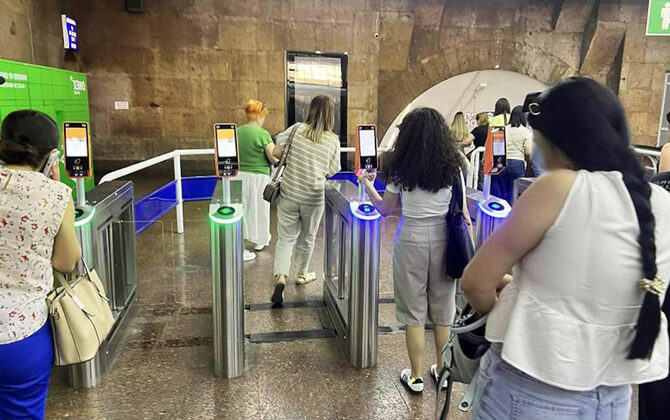
Yerevan Metro uses the city’s unified ticket system, so cash is no longer accepted on the metro, buses, or trolleybuses. Passengers can pay with a paper single-use QR ticket, the mobile app, permanent travel cards, or accepted bank cards.
Tickets and passes are available at self-service terminals in all 10 metro stations, next to ticket offices, and at TelCell points. Transport passes can also be obtained at Yerevan City Hall information support centers on Hanrapetutyan Street and France Square.
Accepted bank cards include ArCa, Visa, and Mastercard. American Express and Mir cards cannot be used. Bank cards may also be registered in the electronic transport system and linked to a fare package. QR codes can be bought through the TelCell Wallet app or as paper tickets from TelCell terminals, and metro validators scan both phone and paper QR tickets.
The fare table below works like a simple fare calculator for the current ticket price options. Dollar amounts are approximate.
| Ticket or pass | Price |
|---|---|
| 90-minute ticket with 3 trips | 280 AMD, about $0.70 |
| Daily package with 8 trips | 880 AMD, about $2.20 |
| Weekly package with 30 trips | 4,800 AMD, about $12.00 |
| Monthly package with unlimited trips | 8,800 AMD, about $22.00 |
| 90-day package with unlimited trips | 23,600 AMD, about $59.00 |
| Annual package with 365 days of unlimited trips | 88,800 AMD, about $222.00 |
For online tickets, the price is shown first; the amount in brackets refers to the physical travel card fare. As of February 1, only the short-term 90-minute ticket is available from terminals, while other packages can be paid for with transport cards, bank cards, or the TelCell Wallet app.
Discounts are available for several passenger groups. Students receive 15% off, schoolchildren and social welfare recipients get 20% off, and pensioners get 30% off. Free travel is available for children under 7, orphaned schoolchildren aged 8 to 18, orphaned students, people with first- and second-degree disabilities, children in orphanages, residents of nursing homes, national heroes, and parents with four or more children.
Each fare package works across public transport in Yerevan, including buses, the metro, and trolleybuses. Special operators may assist passengers with self-service terminals in the metro during designated hours when needed.
Connections to Other Systems
The Yerevan Metro is a single-line rapid transit system, so it does not have the kind of large interchange network found in bigger metro cities. Its most important connection is at Sasuntsi Davit, which serves Yerevan Railway Station and links the metro with the city’s main rail hub.
The system also connects with surface transport. Yerevan’s wider city transport network includes buses, minibuses, and trolleybuses, so metro riders often combine trips with other local transport services.
For airport access, buses from Zvartnots International Airport connect with central Yerevan, including routes that serve or pass close to Barekamutyun and Sasuntsi Davit. The airport is not directly connected by rail, but the metro can still be part of the journey.
A rail link integrating Zvartnots International Airport with the metro via Charbakh was proposed, but the project was frozen or cancelled. Future expansion toward Ajapnyak, Davtashen, and other districts could improve transportation in Yerevan and strengthen links with more neighborhoods.
Airport Connections
Yerevan is connected to Zvartnots International Airport by public transport, taxis, and car rental services. The city center is about 12 km (7.5 miles) from the airport, and the airport bus stop is in front of the terminal.
There are two airport bus routes: route 100 and route 201. Route 100 runs between France Square and the central long-distance bus station. Route 201 starts at the airport, passes the central bus station and Opera House, continues to Yeritasardakan metro station, and returns to the airport via Republic Square.
| Service detail | Timings |
|---|---|
| Route 100 | Runs 24 hours a day |
| Route 100 travel time | About 30 minutes |
| Route 100 frequency | About every 40 minutes |
| Route 201 | 7:00 AM to 10:00 PM |
| Route 201 travel time | About 30 to 40 minutes |
| Route 201 frequency | About every 30 minutes |
Airport bus timetables are indicative, so services can run early or late. Route 100 costs 500 AMD, about $1.25, and can be paid with a contactless bank card on the bus or with a paper QR ticket from an orange TelCell machine. Route 201 costs 300 AMD, about $0.75, and is cash only.
For other city buses, minibuses, trolleybuses, and the metro, the unified fare is 150 AMD, about $0.38, per ride. Other ticket options include 300 AMD, about $0.75, for 180 minutes and 900 AMD, about $2.25, for an all-day ticket.
The metro does not go directly to the airport, but it connects conveniently with route 201 at Yeritasardakan station. Station signage is available in Armenian, English, and Russian.
Taxis are available day and night, but there are no official airport taxis. Drivers at the terminal may quote high prices, so the GG mobile app is a more predictable option. Reported GG fares range from 2,900 AMD to 3,800 AMD, about $7.25 to $9.50, depending on demand.
Car rental companies including Europcar, Alamo, Sixt, and Enterprise also operate at the airport for travelers who prefer to drive.
Interesting Facts
The Karen Demirchyan Yerevan Metro opened on March 7, 1981, and became the eighth metro system in the former Soviet Union. It is the only metro system in Armenia.
The network has 10 stations on one main double-track line, plus the single-track Charbakh shuttle branch. Its total length is 13.4 km (8.3 miles).
Yerevan’s uneven terrain means some metro sections run above ground. The system includes deep-level and shallow-level stations, and three stations are above ground.
All stations opened in the 1980s except Charbakh, which opened in 1996. Construction of an 11th station is expected to begin in 2026.
The metro route passes through basalt lava flows, lacustrine-alluvial deposits, sandy-clayey rocks, and silty rocks, which made construction difficult. Even so, the system was only slightly damaged in the 1988 Armenian earthquake and resumed service the next day.
Fare collection has changed over time. Passengers originally paid with 5-kopeck coins, then metal and plastic tokens appeared after 1991. Since 2009, turnstiles have supported both tokens and plastic cards.
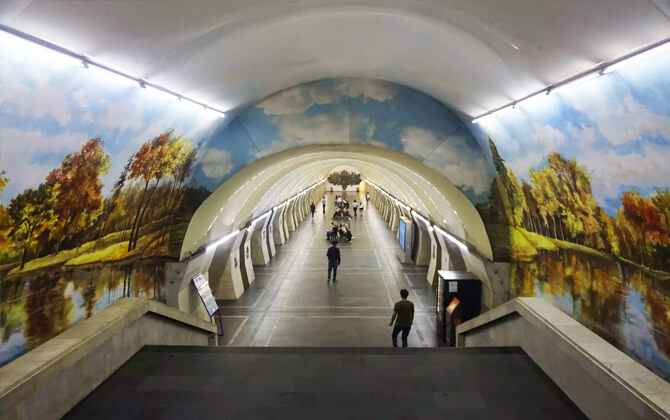
Many stations are decorated with granite, marble, tuff, basalt, gabbro, and travertine. Their design blends modernist architecture with Armenian motifs, with artistic work contributed by craftsmen from Moscow, Ukraine, Udmurtia, and Buryatia.
Passenger numbers have varied widely. The metro carried 14 million passengers in 1981, reached 31 million in 1987, and is now used by about 50,000 to 60,000 people per day.
The system was renovated with European support, and the full renovation was completed by 2012. A later drainage tunnel project was also undertaken to improve operation and reduce annual costs.
Digital timers at stations behave in a distinctive way: they count down and reset to 00:00 when a train departs, then continue until the next train leaves.
Development plans remain active. Project work has been announced for a future station named Surmalu, while a planned rail link to Zvartnots Airport was developed but later frozen or cancelled.
Park and Ride Services
Yerevan Metro does not have dedicated Park and Ride services. Still, station parking may be available near several stations, including Barekamutyan and Marshal Baghramian.
Parking charges typically range from 100 to 200 AMD, about $0.25 to $0.50, regardless of how long you stay. Separate parking charges per day are not listed in the provided information, so drivers should check the local signs when they arrive.
History
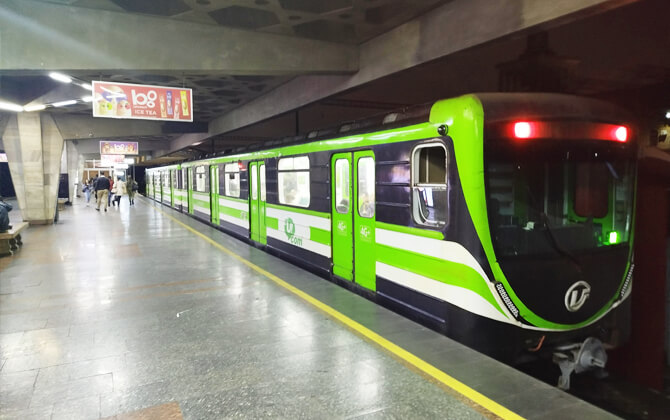
The history of the Yerevan Metro began in the late 1960s, when rapid growth made Yerevan’s transport problems more serious. Under Anton Kochinyan, First Secretary of the Communist Party of Armenia, planners first considered an overhead transport system. They later chose a high-speed tram with several underground stations, because full metro construction was then considered unacceptable for cities with fewer than one million residents.
Specialists from Kavgiprotrans visited Yerevan several times, carried out feasibility studies, and prepared design documentation. The first phase was planned to connect dense residential districts with the railway station and the industrial zone, cutting the time people spent traveling between home and work.
Construction of the high-speed tram began in 1972, with tunnels built so they could later be converted into a metro. By the end of 1978, about 4 km (2.5 miles) of tunnels had been completed. In 1981, the project was redefined as an underground rapid transit system after a decree from Soviet authorities.
The first opening had originally been planned for November 7, 1980, but only a test train carrying officials ran that day. The commissioning certificate was signed on February 24, 1981, and the metro officially opened on March 7, 1981. The launch section was 7.6 km (4.7 miles) long, including 1.9 km (1.2 miles) above ground, and opened with four stations: Barekamutyun, Saralanj, Yeritasardakan, and David of Sasun. Lenin Square opened a few months later, in December 1981.
Expansion continued through the 1980s. Gortsaranayin opened in 1983, Shengavit followed in 1985, and Suren Spandaryan Square opened in 1987. The line later took its present form, while the Charbakh depot opened together with Shengavit. Plans to extend north to Ajapnyak were interrupted by the collapse of the USSR. Charbakh, the last station added to the system, opened in 1996.
After Armenia’s independence, several stations were renamed. Lenin Square became Republic Square, Hoktemberyan became General Andranik, and Spandaryan Square became Garegin Nzhdeh Square. Saralanj had already been renamed Marshal Baghramyan in 1983.
The metro was closed from April 1 to May 18, 2020, because of the COVID-19 pandemic. In December 1999, the system was named after Karen Demirchyan.
| Line | Segment | Date opened |
|---|---|---|
| 1 | Barekamutyun–David of Sasun | March 8, 1981 |
| 1 | David of Sasun–Gortsaranayin | July 11, 1983 |
| 1 | Gortsaranayin–Shengavit | December 26, 1985 |
| 1 | Shengavit–Garegin Nzhdeh Square | January 4, 1987 |
| 1 | Shengavit–Charbakh | December 26, 1996 |
- In 1983, Saralanj was renamed Marshal Baghramyan.
- In 1992, Lenin Square was renamed Republic Square.
- In 1992, Hoktemberyan was renamed General Andranik.
- In 1992, Spandaryan Square was renamed Garegin Nzhdeh Square.
The system’s early story also explains why the city’s metro has links to tramway planning: the first tunnels were built with future metro conversion in mind, even though the project began as a high-speed tram concept.
Future Extensions
Yerevan Metro has long been planned as a system with room to grow beyond its current single line. The main development plan describes a possible future network of 32 stations and three lines, which would greatly expand coverage across the city.
The first line is intended to continue northwest toward Ajapnyak and Davtashen. This extension would improve access to dense districts beyond the current terminal area, but it remains technically and financially difficult because it would require a bridge over the Hrazdan River. No final budget or deadline has been set.
The Ajapnyak station project has received renewed attention. The station was originally planned in Soviet times, and some preparatory work was completed before the 1988 earthquake interrupted construction. Design work later restarted, and in 2021 Metrogiprotrans won the tender to prepare the project, including the bridge over the Hrazdan River. In 2024, city officials said construction was expected to begin in 2026.
Another proposed station is Surmalu, planned between Sasuntsi David and Zoravar Andranik. It would improve access to the Surmalu and Petak shopping areas and reduce pressure on nearby streets. Official information, however, indicates that it remains a private proposal and has not been included in an approved expansion program.
Beyond the first line, long-term plans include two additional routes. One would connect northern and southern districts through the center, while another would link eastern neighborhoods with the city centre and continue toward the western side of Yerevan.
For now, future expansion depends on engineering work, funding, and political decisions. Still, the return of Ajapnyak and Surmalu to public discussion shows that metro growth remains part of Yerevan’s transport strategy.
Nearby Attractions
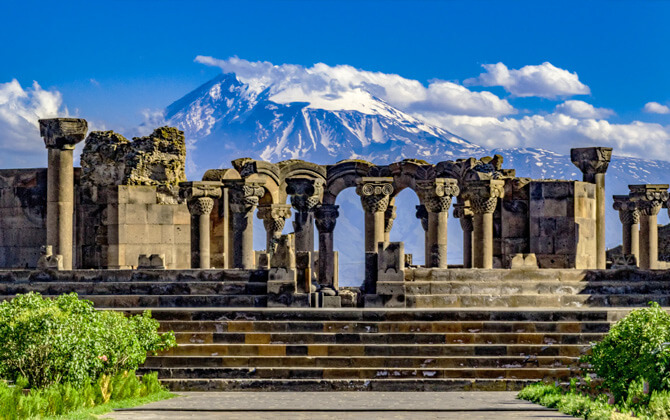
Yerevan Metro is a practical way to reach several central sights. The system is small, but it works well for a short city tour and for reaching attractions near the main stations.
Republic Square is one of the most useful stops for visitors. The station itself is described as a neglected architectural gem, with design elements that echo ancient Armenian ritual altars. Nearby attractions include the History Museum of Armenia, the National Gallery of Armenia, the Dancing Fountains, and Republic Square.
Marshal Baghramyan station is close to the Parliament, the President’s residence, and Lovers’ Park. From here, the Opera and the Cascade are within short walking distance.
Yeritasardakan is another convenient stop. It is close to major educational institutions, the Matenadaran manuscript museum, the Cascade, and the Opera House. The surrounding area also has many cafes, restaurants, and shops within walking distance.
Barekamutyun can be used to reach Tsitsernakaberd, the Armenian Genocide memorial, and the Sport and Concert Complex. The station is also associated with Komitas Avenue and its surroundings.
Zoravar Andranik offers access to the Cathedral of St. Gregory the Illuminator, Lunapark, and nearby commercial areas. Sasuntsi David station is located at Yerevan Central Station, with the monument to Sasuntsi David in front of the railway terminal.
For trips beyond the metro network, public transport from central points can also connect travelers to Victory Monument, Erebuni Museum, Karmir Blur, Yerablur, and Etchmiadzin.
- History Museum of Armenia
- National Gallery of Armenia
- Dancing Fountains
- Lovers’ Park
- Matenadaran
- Cascade and Opera House
- Tsitsernakaberd Armenian Genocide Museum
- Cathedral of St. Gregory the Illuminator
- Yerevan Central Station