The Lisbon Metro, or Metro de Lisboa, is Lisbon’s rapid transit system and the first metro ever opened in Portugal. It started service in December 1959 and, as of 2023, the system has four lines, 56 stations, and 44.5 km (27.7 miles) of route. It remains a core part of public transport in the city, linking key districts, supporting urban expansion, and connecting with other local transport services.
| Key | Information |
|---|---|
| System name | Lisbon Metro / Metro de Lisboa |
| Type | Rapid transit system |
| Opened | December 1959 |
| Lines | 4 |
| Stations | 56 |
| Route length | 44.5 km (27.7 miles) |
| Main role | Public transport in Lisbon with links to key city areas |
Lisbon Metro Map
Map of Lisbon Metro showing different lines and stations. Click on the map to enlarge it or download the Lisbon Metro map in PDF format.
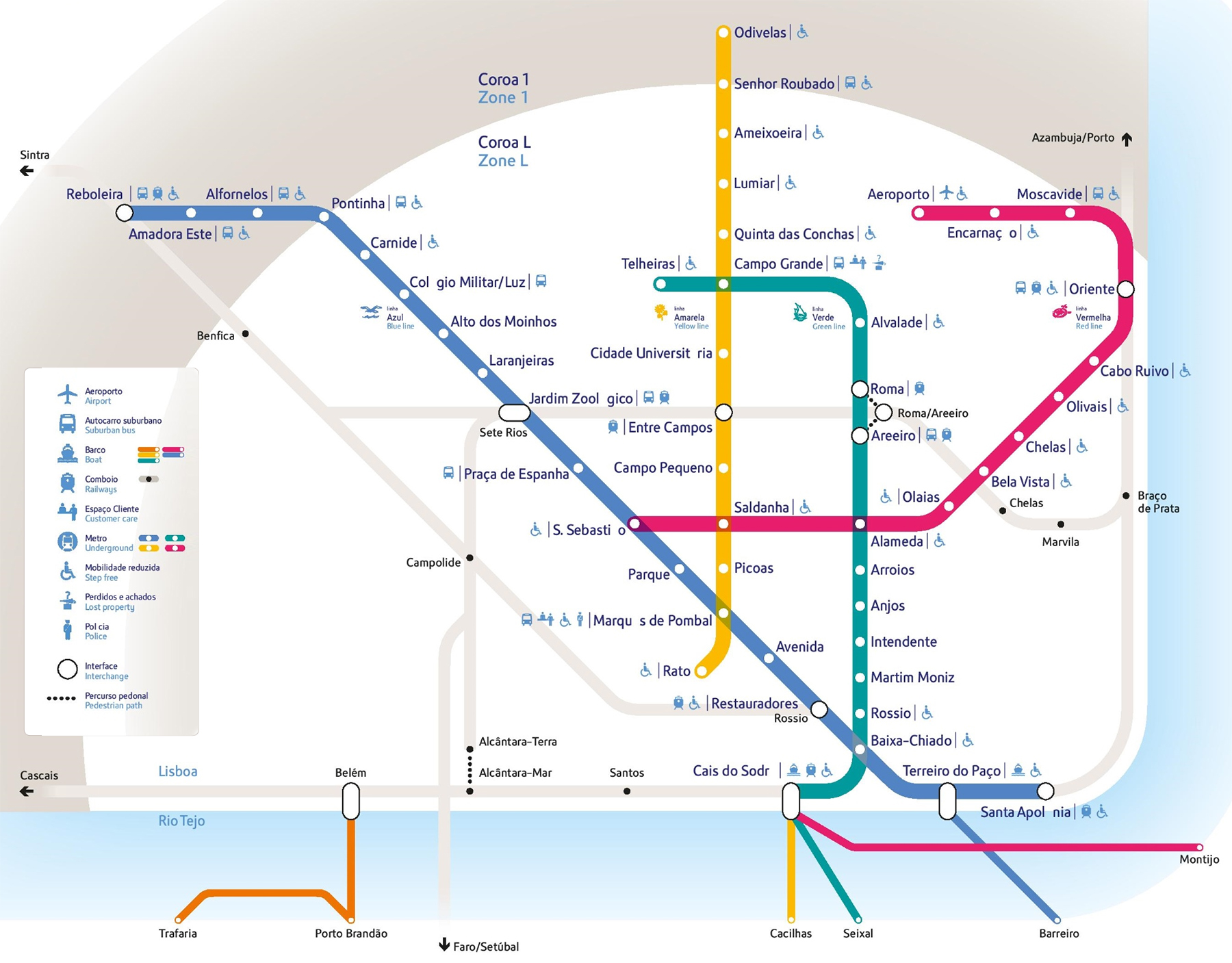
Lisbon Metro – Interactive Map
Overview of Lines and Stations
The Lisbon Metro system has four color-coded lines and a fairly simple route plan, which makes the stations map easy to follow for visitors. As of 2023, the network serves 56 stations across 44.5 km (27.7 miles) of route.
The lines are:
| Station | Details |
|---|---|
| Blue Line | Santa Apolónia to Reboleira |
| Yellow Line | Rato to Odivelas |
| Green Line | Cais do Sodré to Telheiras |
| Red Line | São Sebastião to Aeroporto |
The network grew from an original Y-shaped layout into today’s four-line system. The Blue and Yellow lines are the oldest parts of the metro, while the Green Line developed from central sections added in the 1960s and 1970s. The Red Line came later, opening in 1998 and eventually extending to the airport.
Several stations matter most for transfers and onward travel. Baixa-Chiado connects the Blue and Green lines, Marquês de Pombal links the Blue and Yellow lines, Campo Grande connects the Green and Yellow lines, and São Sebastião joins the Blue and Red lines. Oriente is another major station, especially for long-distance rail and bus connections.
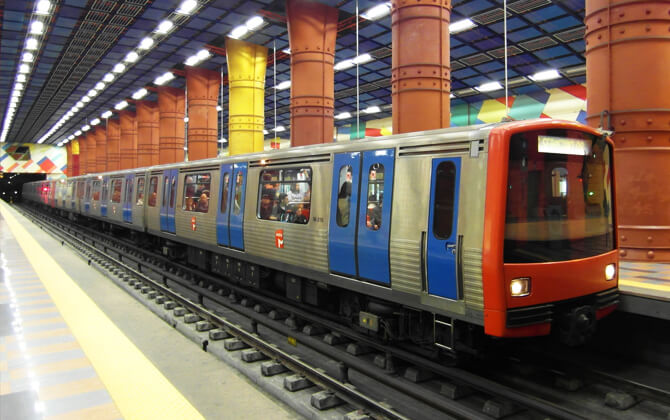
Some stations are particularly useful for visitors. Cais do Sodré connects with trains and ferries, while Oriente serves Parque das Nações and the airport corridor. Many stations are also known for their design, with tiled walls and artwork by Portuguese artists.
Operating Hours and Frequency
The Lisbon Metro runs every day, including weekends and public holidays. Under normal conditions, opening hours are from 6:30 a.m. to 1:00 a.m. These are the usual operating hours, opening times, and working hours across the network.
The last train leaves the terminal stations of each line at 1:00 a.m. In other words, the standard closing time for service is 1:00 a.m. Some minor stations may close earlier, at 9:30 p.m., so if you are checking timings today or planning a late trip, it is worth confirming before you travel.
| Service detail | Timings |
|---|---|
| Network opening time | 6:30 a.m. |
| Network closing time | 1:00 a.m. |
| Last train from terminal stations | 1:00 a.m. |
| Some minor stations close | 9:30 p.m. |
| Weekday peak frequency | Every 3 to 6 minutes |
| Off-peak frequency | Every 6 to 12 minutes |
| Weekends and public holidays | Generally less frequent than weekday peaks |
Train frequency depends on the line, the time of day, and whether it is a weekday or weekend. Typical running time between trains ranges from 6 to 12 minutes, with better frequency during peak periods.
Typical service frequency
- Peak hours on weekdays: trains can run every 3 to 6 minutes.
- Off-peak periods: trains usually run every 6 to 12 minutes.
- Weekends and public holidays: service is usually less frequent than during weekday peaks.
If you need the latest timetable, route timetable, or schedule today, check the live service status before traveling.
Pricing, Tickets, and Passes
Lisbon Metro has several fare and ticket options, depending on how often you travel and whether you also use other city transport operators. Most fares are loaded onto the reusable Navegante card, which can hold travel credit or passes.
The Navegante card costs 0.50€ (about $0.54) and is valid for one year. Each passenger needs their own card.
| Service detail | Timings |
|---|---|
| Navegante card availability for next month | From the 26th onward |
| Current month pass purchase at vending machines and ticket offices | Until the 25th |
Refunds and exchanges depend on the pass type. Municipal passes can be returned before the relevant month starts. After that, they can only be exchanged for a Metropolitano pass until the 25th of that month. Exchanges between Municipal passes are not allowed. For combined 30-day passes, refunds are accepted in full before validity starts. After the first day of validity, returns are still possible, but a daily fee of 12.5% of the price is charged for each day used.
Ticket Options
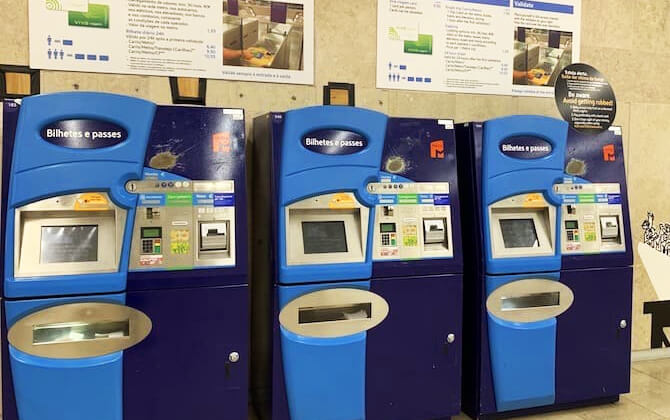
You can buy metro tickets and passes from ticket vending machines, ticket offices, ATM (Multibanco) cash machines, and the Portal VIVA online service. Contactless bank card payment is also available at the fare gates for metro journeys.
- Ticket vending machines (TVM)
- Ticket offices
- Bank card contactless
- ATM (Multibanco) cash machines
- Portal VIVA (online)
For occasional travel, the main ticket options are the Carris/Metro Ticket, a single metro journey paid with a bank card, and Zapping credit. For regular travel, there are monthly and 30-day Navegante passes, including Metropolitan, Municipal, +65, family, and other reduced-fare options.
Here are the main fare choices and ticket prices mentioned in the available information:
| Station | Details |
|---|---|
| Carris/Metro Ticket | 1.90€ (about $2.05). Valid for unlimited journeys on Carris and Metro during the 60 minutes after first validation. It cannot be used for consecutive metro journeys. |
| Metro journey with bank card | 1.92€ (about $2.07). Pay directly at the fare gates with a bank card. |
| Carris/Metro 24-hour ticket | 7.25€ (about $7.83). Unlimited journeys on Carris and Metro for 24 hours after first validation. |
| Carris/Metro/Transtejo (Cacilhas) 24-hour ticket | 10.35€ (about $11.18). Valid for 24 hours on Carris, Metro, and Transtejo services to Cacilhas. |
| Carris/Metro/CP 24-hour ticket | 11.40€ (about $12.31). Valid for 24 hours on Carris, Metro, and CP lines, including Sintra, Cascais, Azambuja, and Sado lines. |
| Zapping metro journey | 1.72€ (about $1.86). Valid for a single journey on the metro network. |
| Navegante Metropolitano monthly pass | 40€ (about $43.20). Valid in Lisbon’s Metropolitan Area. |
| Navegante Municipal monthly pass | 30€ (about $32.40). Valid in Lisbon, Amadora, or Odivelas municipality. |
| Navegante +65 monthly pass | 20€ (about $21.60). Valid in Lisbon’s Metropolitan Area for eligible senior passengers and retirees/pensioners. |
| Navegante Urbano 3i/Ref./Pens. 30-day pass | 15€ (about $16.20). Valid on Carris and Metro within Lisbon’s municipality boundaries and on CP connections to Benfica, Belém, and Moscavide. |
| Navegante família Metropolitano monthly pass | 80€ (about $86.40). Valid in Lisbon’s Metropolitan Area. |
| Navegante família Municipal monthly pass | 60€ (about $64.80). Valid in Lisbon municipality. |
Zapping is prepaid credit that works across different operators. Available top-up amounts are 3€, 5€, 10€, 15€, 20€, 25€, 30€, 35€, and 40€ — about $3.24, $5.40, $10.80, $16.20, $21.60, $27.00, $32.40, $37.80, and $43.20.
Discounted Circula PT fares are available for eligible passengers, and a free Under 23 pass is also offered for young passengers up to age 23.
Interchanges
The Lisbon Metro has fewer interchange stations than some larger metro systems, so route choices can be a bit less flexible. Still, several transfer points connect the four lines and link the metro with suburban rail and other transport services.
| Station | Details |
|---|---|
| Baixa-Chiado | Connects the Blue and Green lines; also known for a cross-platform transfer between northbound Blue and southbound Green services. |
| Marquês de Pombal | Links the Blue and Yellow lines. |
| Saldanha | Interchange between the Yellow and Red lines. |
| São Sebastião | Connects the Blue and Red lines. |
| Campo Grande | Transfer between the Yellow and Green lines. |
| Jardim Zoológico | Connects the Blue Line with suburban rail. |
| Restauradores | Offers a connection to Rossio suburban station. |
| Cais do Sodré | Links the Green Line with suburban rail and the boat station. |
| Oriente | Serves Lisbon’s main rail terminal on the Red Line. |
In 1998, the removal of the Restauradores-Rossio connection from regular service changed some transfer patterns in the central network. By August 2009, all four lines were fully interconnected through the addition of the second platform at São Sebastião.
Connections to Other Transport Systems
The Lisbon Metro is well integrated with other public transport in the city. Several stations connect directly with suburban and regional rail, as well as bus and ferry services, which makes transportation in Lisbon much easier.
Key interchange points include Cais do Sodré for train and boat services, Baixa-Chiado as a central metro transfer, Saldanha and São Sebastião for line changes, and Oriente for long-distance trains and buses.
The metro also works with the wider transport network through shared cards and tickets. Cartão 7 Colinas/Viva Viagem, Lisboa Viva, and Lisboa Navegante can also be used on other forms of transport, including CP suburban rail, Fertagus, and the Transtejo & Soflusa ferry service.
This integrated system makes it possible to move between metro, rail, bus, and ferry services across the Lisbon metropolitan area without too much hassle.
Access to the Airport
Lisbon Airport is connected by the Red Line, and the metro station is just outside the arrivals building. For many visitors, it is the easiest route into the city center: safe, low-cost, and often the quickest option.
The airport is about 7 km (4.3 miles) north of central Lisbon. If you are heading into the center, you will usually need to change to the Blue or Green Line, depending on your destination. Areas such as Alfama and Baixa are not reached directly from the airport station, so a transfer at Alameda or São Sebastião is often needed.
The metro operating hours for airport trips are 6:30 a.m. to 1:00 a.m., with service frequency typically every 6 to 12 minutes depending on the day and time.
At the airport, just follow the metro signs from the arrivals hall. The station is well marked and easy to find once you step outside the terminal.
If the metro does not fit your route or travel time, taxis and ride-hailing apps are also available. Even so, for plenty of journeys into the city, the metro is still the simplest and best-value choice.
Rules, Tips, and Warnings
Using the Lisbon Metro is straightforward, but a few rules matter. A journey starts when you pass through the entry gates and ends when you leave through the exit gates at your destination. You must carry a valid electronic travel card with a valid ticket loaded onto it.
It is mandatory to validate your ticket at both entry and exit gates. Touch in and touch out, and make sure the reader shows a green light before you continue. Keep your ticket until you leave the system, and show it to inspectors if asked.
Passengers with reduced mobility should check the stations map in advance to confirm whether both stations are fully accessible. Lift and escalator status can also be checked through the Call Centre. Wide gates are reserved for passengers with reduced mobility, baby strollers, large objects, and children under 4. Help Points may also be available.
For a safer trip, keep backpacks down, avoid blocking crossing areas, stay behind the yellow platform line, and watch for pickpockets. Do not leave belongings unattended or keep valuables on display. When stations are quieter, it is smart to avoid isolated areas.
Up to 2 bicycles per metro train car are allowed when there are no large crowds. Scooters, skates, hoverboards, unicycles, and similar items are allowed, but they must not be ridden or parked inside metro premises.
Pets may travel in proper carriers if they do not disturb other passengers. Dangerous items and substances, including toxic, explosive, radioactive, corrosive, flammable, or pressurized materials, are not allowed.
Smoking is forbidden in trains, stations, access areas, and adjoining facilities. Service changes can happen, including delays, interruptions, reduced frequency, or operational changes. For help, use station Help Points and follow staff instructions. In an emergency, call 112.
Interesting Facts
The Lisbon Metro opened in December 1959, making it the first rapid transit system in Portugal.
Its original route was a Y-shaped network with 11 stations, and on its first full year of operation it carried more than 15.3 million passengers. That quickly made it an important part of city transport.
The system has also shaped Lisbon’s urban growth, helping connect new residential and service areas.
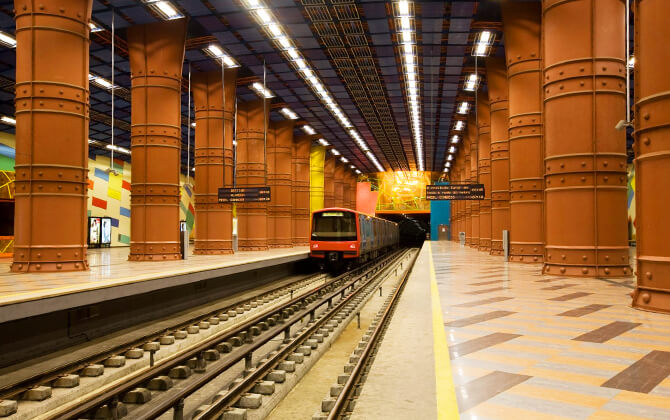
Many stations are known for their artwork. The original eleven stations followed a common architectural model by Francisco Keil do Amaral, and most featured art by Maria Keil. Later extensions kept that artistic tradition going.
Parque is often singled out as one of the most notable stations thanks to its tile work inspired by Fernando Pessoa’s literary heritage.
The network changed dramatically in the 1990s, when the original Y was split into separate lines and expanded into today’s four-line system.
By 2023, the metro had four lines, 56 stations, and 44.5 km (27.7 miles) of route, with the Red Line providing a direct link to the airport.
History
The idea of an underground railway in Lisbon dates back to 1888, when Henrique de Lima e Cunha proposed a network of several lines. Further plans appeared in 1923 and 1924, but none were built. After World War II, stronger economic conditions and Marshall Plan-related support helped revive the project. A society was formed on 26 January 1948 to study its technical and economic feasibility.
Construction began on 7 August 1955, and the Lisbon Metro opened on 29 December 1959. The original route was a Y-shaped line linking Restauradores to Rotunda, now Marquês de Pombal, and then branching toward Entre Campos and Sete Rios, now Jardim Zoológico. The first extension reached Rossio in 1963, followed by Anjos in 1966 and Alvalade in 1972.
After that first expansion period, development slowed for many years. Following the Carnation Revolution in 1974, the metro was nationalized in 1975 and renamed Metropolitano de Lisboa, EP in 1978. During this period, platforms built for two-car trains were extended to handle four cars.
Expansion resumed in the 1980s. In 1988, the extension from Sete Rios to Colégio Militar/Luz opened, together with Cidade Universitária on the other branch. These were the first stations built from scratch with platforms long enough for six-car trains and with artwork integrated directly into the platforms.
In the 1990s, the network expanded quickly in preparation for Expo ’98. Campo Grande opened in 1993 as the first elevated station. In 1995, the original Y-shaped system was split into separate Blue and Yellow lines. In 1998, more station names changed, the Green Line was created, and the Red Line opened to serve the Expo area. Cabo Ruivo and Olivais were added later that year.
From 2001 onward, the network kept growing. The Green Line reached Telheiras in 2002. The Yellow and Blue lines extended beyond Lisbon’s city limits in 2004. The Blue Line reached Santa Apolónia in 2007 after difficult construction. In 2009, the Red Line was extended between Alameda and São Sebastião, creating crossings between all lines. In 2012, the Red Line reached Aeroporto. Modernization work also continued, including the closure of Arroios in 2017 for renovation and platform lengthening.
- December 1959: the original Y-shaped network opens with 11 stations.
- 1963, 1966, 1972: extensions open to Rossio, Anjos, and Alvalade.
- 1988: new stations open on the Sete Rios and Entre Campos branches.
- 1993: Campo Grande opens as the first elevated station.
- 1995: the network is split into separate Blue and Yellow lines.
- 1998: the Green and Red lines are introduced.
- 2002, 2004, 2007, 2009, 2012: major extensions continue across the network.
- 2016: the Blue Line is extended to Reboleira.
Future Developments
Several Lisbon Metro expansion projects are planned. The most advanced is the connection between the Yellow Line at Rato and the Green Line at Cais do Sodré. This project would add two new stations, Estrela and Santos, and includes refurbishment work at Campo Grande station and related bridges.
Once completed, the Green Line is expected to operate as a circular route, while the Yellow Line is proposed to be rerouted from Telheiras to Benfica. The project has already faced opposition from some local groups and authorities.
Another proposed extension would continue the Red Line beyond São Sebastião to Alcântara, adding Campolide/Amoreiras, Campo de Ourique, Infante Santo, and Alcântara. If it moves forward, the extension is projected to open around 2026.
The network may also be joined by a new Violet Line, planned as a surface light rail or tramway service rather than a heavy metro line. It would connect Infantado in Loures with Odivelas metro station and Beatriz Ângelo Hospital in a C-shaped route. According to the available information, completion is planned around 2025.
Rolling stock is also being renewed. In 2021, Stadler Rail and Siemens Mobility won a contract to supply 14 three-car ML20 series trains. The first train was delivered in August 2024 and is planned to enter service in January 2025. In October 2024, the metro also signed a contract for 24 more three-car ML24 series trains, with an option for 12 additional units.
Beyond the metro itself, wider public transport planning in Lisbon also includes other improvements for areas not yet covered by the current network.
Touring Lisbon via Metro
Lisbon’s metro is one of the easiest ways to get around the city between 6:30 a.m. and 1:00 a.m. It is clean, safe, and efficient, linking downtown areas, northern districts, and suburbs such as Amadora and Odivelas. For many trips, it is the backbone of transportation in Lisbon.
That said, the network does not reach every major area. Belém is not on the metro, and neither are neighborhoods on the highest hill around the castle, including Graça and the upper part of Alfama. Even so, it is still a very practical way to cross the city quickly.

Nearby Attractions
The Blue Line is especially useful for visitors, with stations near central Lisbon, the riverfront, and major rail connections. Baixa-Chiado gives access to Baixa, Chiado, Rua Augusta, the Santa Justa Elevator, Carmo Convent, and Bairro Alto. Terreiro do Paço is within walking distance of Praça do Comércio and the Arco da Rua Augusta. Santa Apolónia is near the Museu Militar and the Museu Nacional do Azulejo.
On the Red Line, São Sebastião is close to the Calouste Gulbenkian Museum and El Corte Inglés. Oriente is the gateway to Parque das Nações, the Oceanarium, and Vasco da Gama mall, and it also connects with long-distance trains and buses. The Red Line also links directly to the airport.
The Green Line is handy for Rossio Square and Cais do Sodré, where you can connect to trains for Cascais and ferries across the Tagus. It is also a convenient stop for the riverside area and nearby nightlife.
The Yellow Line is used more by locals, but Marquês de Pombal is a good base for Avenida da Liberdade and Parque Eduardo VII. Campo Grande also gives access to a bus terminal and Pimenta Palace.
Only some metro stations are fully accessible for wheelchair users or passengers with limited mobility. All stations on the Red Line, including Aeroporto and Oriente, have elevators to the platforms, while many stations on the Blue, Yellow, and Green lines do not. Most stations do have escalators, and all trains include priority seating for pregnant women, elderly passengers, passengers with small children, and passengers with disabilities.
Some popular areas still require other transport. For places like Belém or parts of Alfama, you may need a bus or trams to complete the trip.