The Warsaw Metro, known in Polish as Metro Warszawskie, is the rapid transit system serving Poland’s capital and a core part of Warsaw public transport. It currently operates two lines: M1, running north–south, and M2, running east–west. The system is operated by Metro Warszawskie and managed by the Public Transport Authority in Warsaw.
| Key | Information |
|---|---|
| System | Warsaw Metro, the only metro system in Poland |
| Operating lines | M1 and M2 |
| Main interchange | Świętokrzyska, connecting M1 and M2 |
| Current stations | 39 stations |
| Total network length | 41.3 km / 25.7 miles |
| M1 length | 23.1 km / 14.4 miles |
| M2 length | 19.6 km / 12.2 miles |
| First opening | 7 April 1995 |
| Planned expansion | Five metro lines by 2050, including M3, M4, and M5 |
Warsaw Metro Map
Map of Warsaw Metro showing different lines and stations. Click on the map to enlarge it or download the Warsaw Metro map in PDF format.

Interactive Map of Warsaw Metro
Transit Routes and Stations
The Warsaw Metro route network is simple to understand: M1 links Młociny with Kabaty, while M2 connects Bródno with Bemowo. For most cross-city trips, Świętokrzyska is the key transfer point. If you are checking a stations map or building a route plan, start with the line color, then confirm the final destination shown on the train.
| Station | Details |
|---|---|
| Młociny | M1 northern terminus; route to Kabaty |
| Wawrzyszew | M1 station |
| Stare Bielany | M1 station |
| Słodowiec | M1 station |
| Marymont | M1 station |
| Plac Wilsona | M1 station |
| Dworzec Gdański | M1 station with railway connections nearby |
| Ratusz Arsenał | M1 station |
| Świętokrzyska | Main interchange between M1 and M2 |
| Centrum | M1 station for the central city area |
| Politechnika | M1 station |
| Pole Mokotowskie | M1 station |
| Racławicka | M1 station |
| Wierzbno | M1 station |
| Wilanowska | M1 station |
| Służew | M1 station |
| Ursynów | M1 station |
| Stokłosy | M1 station |
| Imielin | M1 station |
| Natolin | M1 station |
| Kabaty | M1 southern terminus; route to Młociny |
| Bródno | M2 eastern terminus; route to Bemowo |
| Kondratowicza | M2 station |
| Zacisze | M2 station |
| Targówek Mieszkaniowy | M2 station |
| Trocka | M2 station |
| Kijowska | M2 station |
| Dworzec Wileński | M2 station with useful connections for Praga |
| Stadion Narodowy | M2 station |
| Rondo Daszyńskiego | M2 station |
| Rondo ONZ | M2 station |
| Świętokrzyska | M2 station and interchange with M1 |
| Nowy Świat-Uniwersytet | M2 station |
| Powiśle | M2 station |
| Mariensztat | M2 station |
| Wola | M2 station |
| Młynów | M2 station |
| Księcia Janusza | M2 station |
| Bemowo | M2 western terminus; route to Bródno |
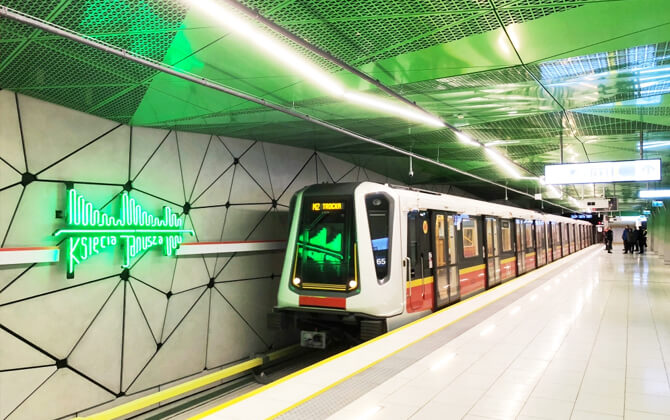
M1 has 21 stations and a typical end-to-end running time of about 40 minutes. M2 has 18 stations. The M2 central section opened in 2015 with seven stations over 6.3 km / 3.9 miles, and further extensions have been opening in stages.
Service Hours and Schedules
Warsaw Metro operating hours are easy to remember. The usual starting time is around 05:00, with last train service around midnight on most days. On Friday and Saturday nights, the metro runs later, usually until about 03:00. Exact opening times, closing time, and timings today can vary by station, so check platform boards before you travel.
| Service detail | Timings |
|---|---|
| General opening hours | First trains generally start around 05:00 daily |
| Weekday and Sunday closing time | Last trains run around midnight, with some station-level times as late as 00:40 |
| Friday and Saturday night service | Extended service usually runs until about 03:00 |
| M1 first train pattern | Usually from 05:00 at Młociny and from 05:40 at Kabaty |
| M1 frequency | About every 2 to 9 minutes on weekdays; about every 5 to 10 minutes on weekends and holidays |
| M2 first train pattern | Usually from 05:00 at Bródno, with later departures at following stations |
| M2 frequency | About every 3 to 8 minutes on weekdays; 6 to 8 minutes on Saturdays; 7 to 8 minutes on Sundays and holidays |
| Peak periods | Trains are more frequent during busy commuting hours |
| Late evening | Intervals are longer than during the day |
For a route timetable or train schedule today, use the station displays and announcements. They show the next train and help you confirm the correct path train direction before boarding.
Prices, Tickets, and Cards
Warsaw uses one fare system for the metro, trams, buses, night buses, and SKM city trains. Ticket price depends mainly on validity time and travel zone. Zone 1 covers the city boundary, while zone 2 covers suburban travel. Approximate USD prices below are rounded.
| Key | Information |
|---|---|
| 20-minute ticket | 3.40 PLN / about $0.85 |
| 75-minute ticket | 4.40 PLN / about $1.10 |
| 90-minute ticket | 7.00 PLN / about $1.75 |
| 1-day ticket, Zone 1 | 15.00 PLN / about $3.75 |
| 1-day ticket, Zones 1 and 2 | 26.00 PLN / about $6.50 |
| 3-day ticket, Zone 1 | 36.00 PLN / about $9.00 |
| 3-day ticket, Zones 1 and 2 | 57.00 PLN / about $14.25 |
| Weekend ticket | 24.00 PLN / about $6.00 |
| Group weekend ticket, up to 5 people | 40.00 PLN / about $10.00 |
| Monthly ticket | 110.00 PLN / about $27.50 |
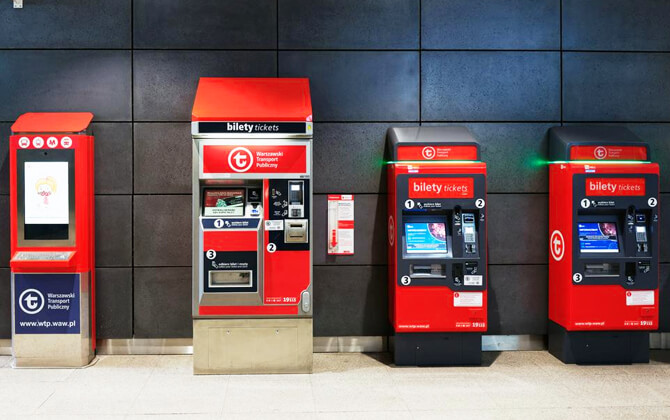
You can buy a ticket at ZTM points, selected newspaper kiosks, and ticket machines in metro stations, at bus stops, and on some buses and trams. Payment is usually possible by cash or card. A 75-minute or 90-minute ticket is practical if your route includes transfers, while a day pass or 3-day ticket is often easier for visitors making several trips.
Validate your ticket before entering the metro platform area, or immediately after boarding a bus or tram. Discounted fare options are available for eligible passengers, including selected children, seniors, and students. Luggage and animals can be carried on public transport free of charge.
Interconnections
A ZTM ticket lets Warsaw Metro riders transfer across city transport, including trams operated by Tramwaje Warszawskie, buses operated by Miejskie Zakłady Autobusowe, and SKM services. The metro also connects with buses run by private operators such as Mobilis, PKS Grodzisk Mazowiecki, and ITS Michalczewski.
Świętokrzyska is the main interchange between M1 and M2. Centrum connects with Warsaw Śródmieście railway station and Warszawa Centralna railway station, while Dworzec Gdański links with Warszawa Gdańska station. Several M2 stations also put major railway hubs within walking distance.
This integrated local transport setup makes it easy to combine metro, bus, tramway, trams, and regional train journeys with one ticket system.
Airport Access
Warsaw Chopin Airport is the easiest airport to reach from the city by public transport. The train station is directly under the terminal, and the main rail links are S2, S3, and RL. They connect the airport with Warszawa Zachodnia, Centralna, Śródmieście, and Wschodnia. The ride into central Warsaw usually takes about 20 to 25 minutes.
Bus routes are also useful from Chopin Airport. Routes 175, 148, 188, 331, and night bus N32 serve the airport. Route 175 is a strong option for the city center, 148 works well for Ursynów and Praga, 331 connects with Metro Wilanowska, and N32 runs overnight to Central Railway Station. The bus stop is on the arrivals level, in front of the south pier.
For Modlin Airport, the common public transport route is the airport shuttle plus train connection. The shuttle takes passengers to Modlin railway station, where Koleje Mazowieckie trains continue to Warsaw. The trip takes about 1 hour 15 minutes in total. Direct coaches are simpler if you prefer a one-seat journey, and Modlinbus arrives at Centrum station. Taxis from Modlin are much more expensive than from Chopin.
Simple rule: for Chopin Airport, try the train first, then the bus. Use a taxi if you are late, tired, or carrying heavy luggage. For Modlin Airport, the shuttle plus train is better value, while a direct coach is easier.
Tips for Navigating Metro Warsaw
The Warsaw Metro is straightforward because there are only two operating lines. M1 is the older north–south line, and M2 is the newer east–west line. Before boarding, check the final destination on the train front and on the platform screens. That is the quickest way to confirm you are going in the right direction.
Buy a time-based ticket rather than looking for a single-journey metro-only fare. Ticket machines are available in stations and support several languages, including Polish, English, German, and Russian. The same ticket can cover buses, trams, and metro travel as long as it stays within its validity period.
Jakdojade can help with route planning, ticket choice, and city transport connections if you are new to Warsaw. It is especially useful when a trip combines metro and bus or tram travel.
- Use the same valid ticket on buses, trams, and the metro.
- Check the final destination before boarding.
- Validate your ticket before travel.
- Use a route planner if you are unsure about transfers or travel time.
- Remember the working hours: metro service starts around 05:00 and runs later on Friday and Saturday nights.
Rules for Traveling
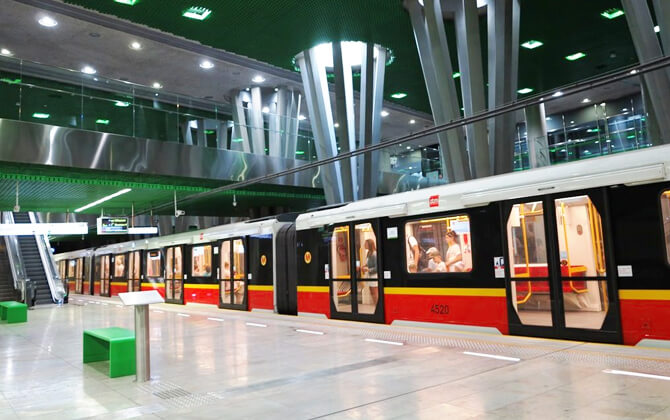
Passengers must have a valid ticket, card, or transport pass when using Warsaw public transport. Travelling without a validated ticket can result in a fine.
On buses and trams, validate your ticket immediately after boarding. On the metro, validate it before entering the platform area and pass through the gates. Tickets bought on board or through approved mobile apps may be used at gates with QR code readers.
Transport inspectors can ask to see your validated ticket at any time. This applies across the metro, tram, bus, and SKM network.
Warsaw Metro is designed to be safe and accessible for independent travel. Lifts provide step-free access to platforms, trains include designated wheelchair spaces, and navigation is supported by signage, announcements, and tactile paving. Assistance is often available on request, especially at major hubs and on longer routes.
If you take a taxi instead of public transport, use only officially registered vehicles. The registration or company number should be visible, the fare per kilometre should be displayed on the passenger-side rear window, and the fare counter should be switched on.
Fun Facts
The Warsaw Metro is the only metro system in Poland.
The first line opened on 7 April 1995. Today, the system has 2 operating lines, with 3 more planned.
The network currently has 39 stations and a total length of 41.3 km / 25.7 miles.
The two lines run in different directions: M1 goes north–south, while M2 goes east–west.
Świętokrzyska is the transfer station where passengers can change between M1 and M2.
Plans for underground rail in Warsaw go back to 1918.
One short tunnel built in 1938 is now used as a wine cellar.
The metro uses 750 V DC third rail electrification and 1,435 mm standard gauge track.
The first M2 section opened in 2015 with 7 stations over 6.3 km / 3.9 miles. The line is expected to be completed in 2026 with 21 stations.
In 2023, Warsaw’s mayor announced a long-term expansion plan for the metro to grow to five lines by 2050.
History
Ideas for an underground railway in Warsaw date back to 1918, soon after the city regained its status as Poland’s capital. Preliminary planning and boring work began in 1925, but the Great Depression stopped those early efforts. In 1934, under Mayor Stefan Starzyński, the plans returned, and construction was expected to begin in the late 1930s. Work finally started in 1938, but World War II ended the project.
After the war, Warsaw considered several new plans, first for a shallow fast urban railway and later for a deep metro with strategic transport uses. Construction began again in the 1950s, but by 1957 the work had stopped and the unfinished tunnel later flooded. Serious progress did not begin until 1983, when the government approved the modern metro program.
The Warsaw Metro opened on 7 April 1995 with 11 stations on the initial M1 line. The route expanded step by step until M1 reached its full length in October 2008. Extensions added stations such as Centrum, Ratusz Arsenał, Dworzec Gdański, Plac Wilsona, Marymont, Słodowiec, and Młociny.
Planning for M2 moved ahead with a contract signed on 28 October 2009, and construction began on 16 August 2010. The first 6.3 km / 3.9 mile section, with seven stations including the Świętokrzyska interchange, opened on 8 March 2015. Further extensions followed to Trocka in 2019, Księcia Janusza in 2020, Bemowo in 2022, and Bródno later that year.
Future Expansions
Warsaw Metro expansion is planned well beyond the current two-line system. The long-term vision would create five lines by 2050, with three new routes named M3, M4, and M5. The plan also includes additional stations on the existing network, helping the metro serve 17 of Warsaw’s 18 districts.
Two extra M1 stations are planned: Plac Konstytucji and Muranów. On M2, extensions are proposed toward Marymont and Ursus-Niedźwiadek.
The M2 line is also continuing westward. The final part of this extension includes Lazurowa, Chrzanów, and Karolin, plus the new Karolin Depot. This section is expected to be completed in 2026, with the full M2 line planned to reach 21 stations.
M3 is the most advanced of the new lines in planning. Construction is expected to begin in 2028, and the first section from Stadion Narodowy to Gocław is planned for completion by 2032. M4 and M5 are shown as future lines in the broader 2050 network plan.
Earlier ideas for a third line to Warsaw Chopin Airport have been abandoned for the foreseeable future, as the airport is now served by a railway station.
Nearby Attractions
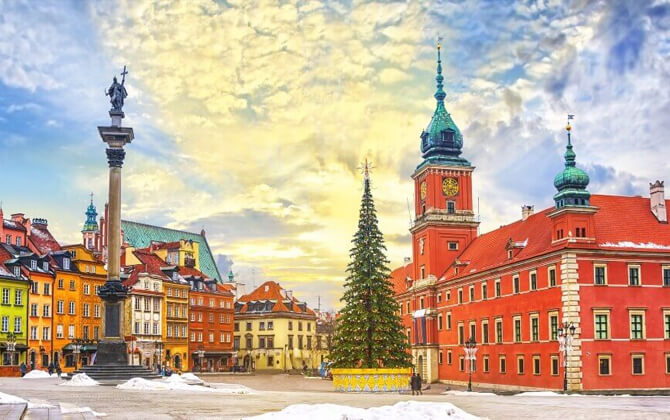
Warsaw Metro stations put many major sights within easy reach. For a short sightseeing route, choose the closest station and finish the trip on foot.
| Station | Details |
|---|---|
| Świętokrzyska | Good for Saxon Garden, the Museum of Modern Art, and Grzybowski Square |
| Centrum | Best for the Palace of Culture and Science, Golden Terraces, and the Roma Musical Theatre |
| Ratusz Arsenał | Useful for the Old Town, the Royal Castle, Sigismund’s Column, the Independence Museum, and Krasinski Gardens |
| Centrum Nauki Kopernik | Ideal for the Copernicus Science Centre and the Vistula Boulevards |
| Dworzec Wileński | Convenient for Praga District and Centrum Praskie Koneser, including the Vodka Museum |
The metro also helps you reach walking tours, Chopin concerts, museums, parks, and riverfront areas across central Warsaw without relying only on road transport.