The Lima Metro, officially the Lima and Callao Metro, is the rapid transit system serving Peru’s capital and Callao. It is the only metro system in the country and currently has two operating lines. Line 1 links the south of the metropolitan area with central and northeastern Lima, while Line 2 serves the eastern corridor and introduced Peru’s first underground metro service. The system is a key part of public transport in Lima, especially in a city known for heavy traffic and strong reliance on road transport.
| Key | Information |
|---|---|
| Official name | Lima and Callao Metro |
| System type | Rapid transit system |
| Lines in operation | 2 |
| Line 1 | 26 stations, 34.6 km / 21.5 miles, elevated |
| Line 2 | First 5 stations in service, 5 km / 3.1 miles, underground |
| Line 1 full operation | July 28, 2014 |
| Line 2 first segment opening | December 21, 2023 |
| Role in city transport | Part of Lima’s broader transport modernization alongside the Metropolitano bus system |
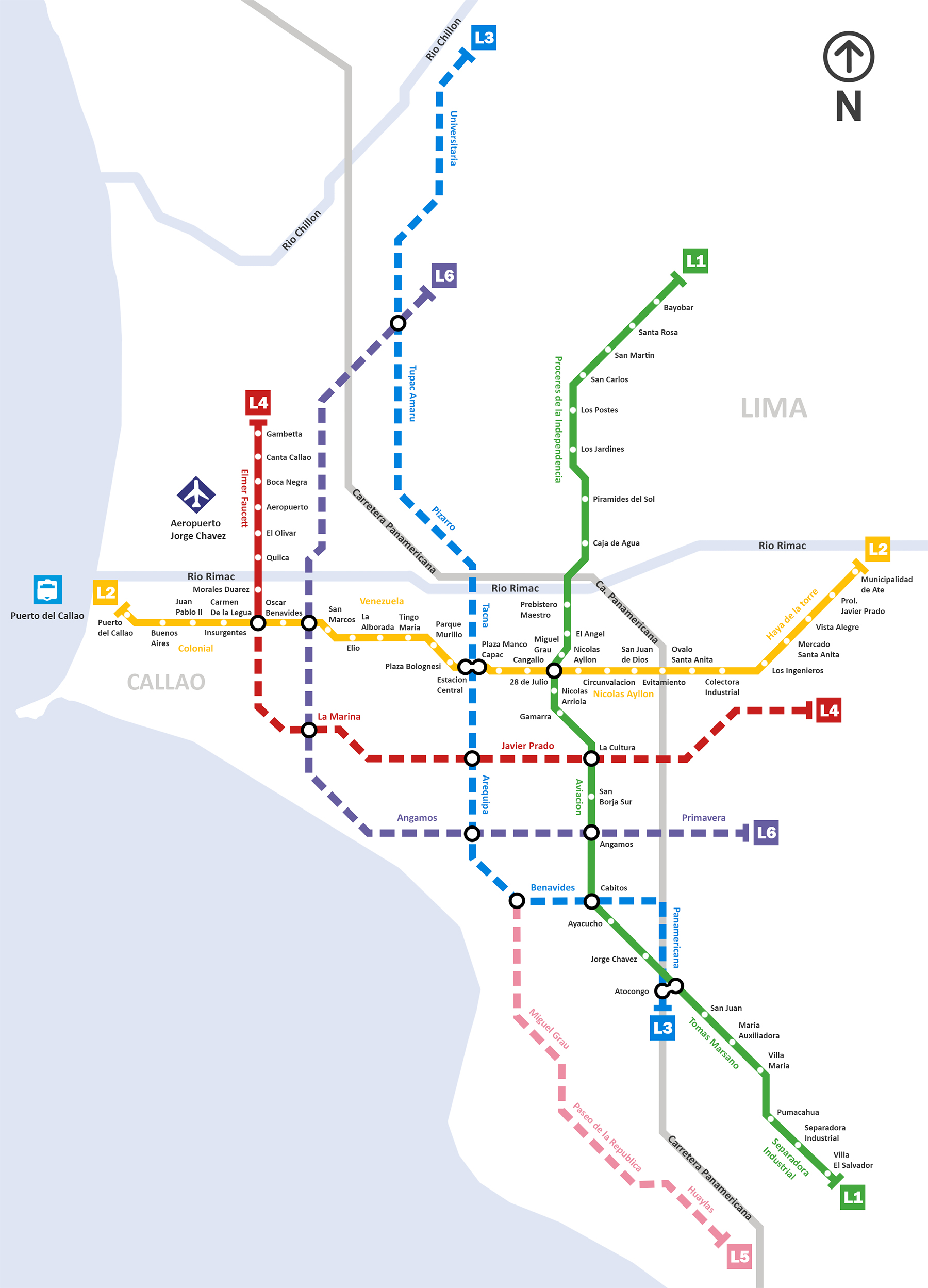
Lima Metro Map
Map of Lima Metro showing different lines and stations. Click on the map to enlarge it or download the Lima Metro map in PDF format.
Line and Stations
The Lima and Callao Metro currently has two operating lines. Line 1 runs from Villa El Salvador in the south to San Juan de Lurigancho in the northeast. Line 2 serves eastern Lima, with its first section opening in December 2023.
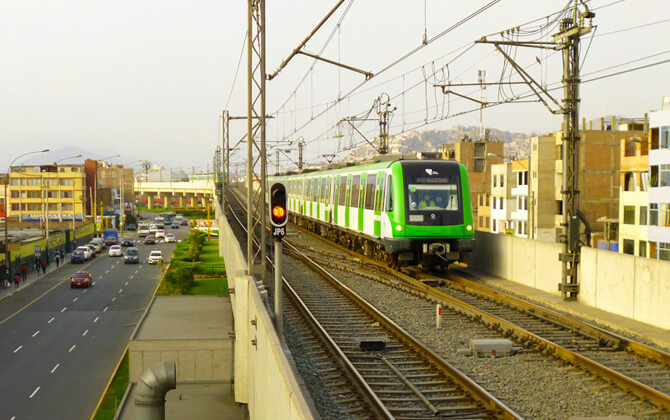
Line 1 is an elevated route with 26 stations across 34.6 km, or 21.5 miles. It passes through Villa El Salvador, Villa María del Triunfo, San Juan de Miraflores, Santiago de Surco, Surquillo, San Borja, San Luis, La Victoria, Lima District, and San Juan de Lurigancho.
Line 2 is an underground east-west route. Its first operating segment covers 5 km, or 3.1 miles, with 5 stations between Evitamiento and Mercado Santa Anita in Santa Anita. The rest of the line is still under construction.
The wider system also includes planned corridors for Lines 3, 4, 5, and 6, so the current stations map is only part of the long-term route plan.
Operating Lines
| Station | Details |
|---|---|
| Line 1 | 34.6 km / 21.5 miles, 26 stations, elevated viaduct |
| Line 2 | First 5 km / 3.1 miles and 5 stations in service, underground |
Planned Lines
| Station | Details |
|---|---|
| Line 3 | Planned underground north-south line |
| Line 4 | Planned east-west route, with a branch linked to Line 2 and the airport |
| Line 5 | Planned to connect southern districts such as Miraflores, Barranco, and Chorrillos |
| Line 6 | Presented as a private initiative and under evaluation |
The stations list includes the original Line 1 stations, the Line 1 extension stations, and the first stations opened on Line 2. More stations are planned in future expansion stages.
Schedule
The Lima Metro runs every day, but published operating hours vary depending on the source and station. One general timetable gives opening hours from 5:00 AM to 11:00 PM, while another reference lists working hours from 6:00 AM to 10:00 PM. If you need exact timings today, the safest option is to check the station schedule before you travel.
| Service detail | Timings |
|---|---|
| General metro operating hours | 5:00 AM to 11:00 PM |
| Alternate published schedule | 6:00 AM to 10:00 PM |
| Line 1 – Villa El Salvador | First train 05:00, last train 22:30 |
| Line 1 – Parque Industrial | First train 05:05, last train 22:35 |
| Line 1 – Pumacahua | First train 05:10, last train 22:40 |
| Line 1 – Bayóvar | First train 05:50, last train 23:20 |
| Line 2 – Ate | First train 05:00, last train 22:30 |
| Line 2 – Santa Anita | First train 05:04, last train 22:34 |
| Line 2 – La Muralla | First train 05:08, last train 22:38 |
| Line 2 – Callao | First train 05:45, last train 23:15 |
So, the starting time and closing time are not completely consistent across the available material. The first train and last train can also differ by station. For route timetable details and schedule today updates, checking locally is the best move.
The source material also includes Metropolitano bus schedule information, which matters if your route uses both systems.
| Service detail | Timings |
|---|---|
| Metropolitano regular services Route A, B and C | Generally 5:00 AM to 11:00 PM, with Route B starting later on weekdays |
| Metropolitano Route D | Generally 5:00 AM to 10:30 PM on weekdays |
| Express and super express services | Different schedules depending on route |
| Lechucero service | Thursday to Saturday, 11:30 PM to 4:00 AM |
If you are planning a transfer, check the train schedule and bus timetable together. It can save time, especially during busy periods.
Fares and Tickets
The Lima Metro uses a flat fare system, so the ticket price does not depend on distance. One source lists a standard single journey at 2.5 PEN, about 0.65 USD, while another fare reference gives 1.50 PEN, about 0.39 USD. Because the published fare varies in the available materials, it is smart to confirm the current price before you travel.
Passengers can buy single-journey tickets or rechargeable cards at station ticket counters or automated machines. Cash and credit card payments are accepted, and some sources also mention smart cards. There is also a 30-day pass available for regular riders.
- Standard single journey ticket: 2.5 PEN or about 0.65 USD
- Alternate single journey fare reference: 1.50 PEN or about 0.39 USD
- Student ticket: 1.25 PEN or about 0.33 USD, with valid student ID
- Senior ticket: free for passengers aged 65 and older, with ID
- 30-day pass: 100 PEN or about 26.00 USD for unlimited rides
Children under six travel free when accompanied by a legal guardian. Members of the national police and fire brigade also travel free. The reduced student fare is not available during school holidays or vacation periods.
Some materials also mention service timings ranging from around 5:00 AM to 11:00 PM, 6:00 AM to 10:00 PM, or even 10:30 to 21:00 in certain references. Since both fare and timetable information vary, verify the latest details before heading out.
Prices
The Lima Metro applies a flat fare, so the cost stays the same regardless of your route or running time. In the available source material, a standard single journey is listed at 1.50 PEN, about 0.39 USD, while another source gives 2.50 PEN, about 0.65 USD. Because of that difference, checking the latest fare is worth it.
Discounted and special fare options mentioned in the sources include:
- Student ticket: 1.25 PEN, about 0.33 USD, with valid student ID required
- Senior ticket: free for passengers aged 65 and older, ID required
- 30-day pass: 100 PEN, about 26.00 USD, for unlimited rides
Tickets and rechargeable cards are sold at station counters or automated machines. Cash and credit card payments are accepted, and some information also refers to smart cards as part of the system.
Interconnections with Other Systems
Line 2 was planned as part of a broader public transport network, not as a standalone project. It was designed to connect with the Metropolitano bus rapid transit system and Metro Line 1, with the goal of better physical, operational, and fare integration across Lima and Callao.
Project documents also state that Line 2 will intersect future Metro Lines 3 and 6. In addition, the first stage of Line 4 was planned as a branch linking Line 2 with the international airport and other areas of Callao.
To support these interconnections, the project included a Multimodal Integration and Accessibility Plan. This covered integrated fare collection, feeder bus route reorganization, regulation of competing services around stations, and improved access at transfer points. Two major transfer stations, 28 Julio and Estación Central, were specifically identified in this plan.
The institutional side matters too. The Ministry of Transport and Communications pushed for a more coordinated approach to urban mobility, and the Urban Transport Authority for Lima and Callao was described as important for integrating the transport system and improving coordination across major projects.
- Existing systems: Metro Line 1 and the Metropolitano BRT
- Planned links: Future Metro Lines 3 and 6, plus the Line 4 branch toward the airport
- Integration measures: Physical transfers, fare interoperability, feeder route reorganization, and accessibility improvements around stations
- Institutional coordination: Support from MTC, AATE, and later ATU
Connection to the Airport
Right now, the Lima Metro does not offer a direct airport connection to Jorge Chávez International Airport. The airport is in Callao, so travelers still need other transport options to reach the terminal.
Line 4 is planned to include a branch connecting Line 2 with the airport. According to the available information, this first stage of Line 4 will link the system at Carmen de la Legua station to Jorge Chávez International Airport and will have eight stations. Construction began in 2024 and is expected to last four years.
For now, passengers should rely on airport bus services, official taxis, ride-hailing, or pre-arranged transfers. The new terminal is accessed via Av. Morales Duárez, and travel time can change a lot depending on road traffic.
The planned metro link should eventually make airport access much easier, but it is not in service yet.
Rules
The Lima Metro has straightforward rules to keep the system safe, orderly, and comfortable. If you are using Line 1, pay close attention to station instructions and onboard guidance.
During the Journey
- Keep a safe distance from the yellow line while waiting for the train.
- Do not run, play, or push inside the system.
- Do not block doors, entrances, exits, or restricted areas.
- Follow staff instructions at all times, especially in an emergency.
- Do not eat or drink inside the train or in other system areas.
- Keep your belongings under control and be careful with sharp or bulky items.
- Take extra care with children and older adults.
Allowed and Restricted Items
- Pets may travel only in special boxes, except guide dogs.
- Packages and luggage must comply with system requirements.
- Heavy objects that could be dangerous or inconvenient are not allowed.
- Smoking is prohibited in the metro.
- Abnormal, altered, cloned, or fraudulent cards are forbidden.
Accessibility and Courtesy
- Give priority to passengers with reduced mobility, older adults, pregnant women, and others needing preferential attention.
- If you travel with a stroller or wheelchair, use designated facilities and elevators when available.
- Always hold children by the hand.
- Avoid using your mobile phone while walking through the station.
- Do not lie down on platforms or stairs.
- Respect other passengers and keep device volume low.
Practical Advice
- Load your travel card in advance, especially if you expect to make several trips.
- Wait for the train behind the yellow line.
- Use handrails and escalators correctly, following arrows and station signs.
- If an emergency happens, use the available help systems and alert staff immediately.
Fun Facts
The Lima Metro is the only metro system in Peru, and for now it has two lines in operation.
Line 1 took 20 years to build before opening in 2011, and it now extends 34.6 km, or 21.5 miles.
Line 2 opened its first phase in December 2023 after nine years of construction, becoming Peru’s first underground metro line.
The first five stations on Line 2 were free to ride until March 2024 during a testing phase.
After that, Line 2 began charging S/7.50 per trip, while Line 1’s fare in the source material is S/1.50 per person.
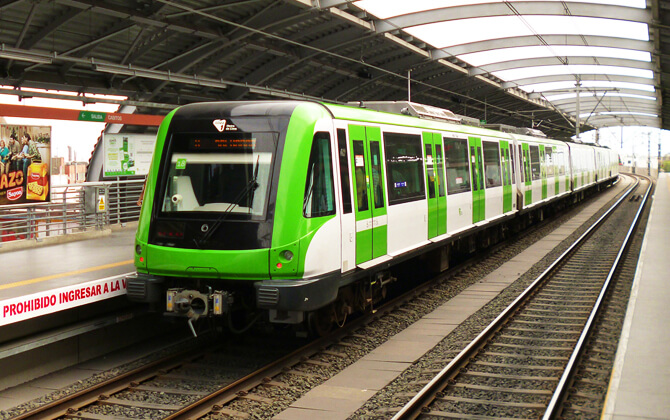
Line 1 uses Alstom Metropolis 9000 series trains, the same train family used on the Barcelona Metro, along with five AnsaldoBreda MB 300 series sets previously used in Rome.
The trains on Line 1 are green and white, while the MB 300 sets have a red and silver livery.
Line 2 uses AnsaldoBreda GoA4 driverless trains in yellow and white to match the line’s icon.
The two lines are very different: one is fully elevated, the other fully underground and automatic.
Still, both are modern and relatively safe, with staff present at every station. Rush hour can get hectic, though, because the network is still small for a city the size of Lima.
Even so, the service is frequent and efficient when it fits your route.
History
1970s: First designs
Between 1972 and 1973, the Metrolima consortium prepared technical and economic feasibility studies and a draft for a mass rapid transit system for Lima and Callao. The project was approved by the Peruvian government in 1974, but political instability, difficult soil conditions in a highly seismic area, and the international economic crisis made financing impossible. The planned underground network was never built.
1980s: Initial construction
In 1986, during Alan García’s first presidency, the government created the Autonomous Authority for the mass transit electric transport project. An international tender was awarded to the Italian-backed Tralima consortium, which started work on an elevated metro viaduct. Construction officially began on October 18, 1986.
Work advanced in southern Lima, including a maintenance facility in Villa El Salvador, but later stalled when the line reached Atocongo. Economic crisis, corruption scandals, and an exhausted budget left the project incomplete. The line was formally opened in 1990, even though it still did not reach the city’s main demand centers. For years, unfinished structures remained visible across Lima while the metro saw only limited maintenance movements.
2010s: Completion of Line 1
In 2009, the government returned administration of the project to the Ministry of Transport and Communications and launched a new bidding process to complete Line 1. Financing came from a CAF loan approved in August 2009, and construction of the remaining section began in March 2010. A basic metro network for Lima and Callao was also approved in December 2010, creating the framework for future lines.
The first completed segment of the renewed Line 1 opened in July 2011, followed by commercial service in April 2012. The final extension to San Juan de Lurigancho was completed in 2014, and full service across the line began on July 25, 2014.
2020s: Construction of Line 2
Line 2 was awarded to the Nuevo Metro de Lima consortium in 2014. It was designed as an underground east-west route, with an airport connection planned through part of future Line 4. Its first five-station segment began operations on December 21, 2023, in Santa Anita.
By early 2024, only this first segment had been completed, while the rest of the line remained under construction. The project reflects the continued expansion of the Lima and Callao Metro system beyond Line 1.
Future Expansions
The Lima and Callao Metro is planned to grow beyond the two lines currently in service. The network plan approved in 2010 envisioned five metro lines, and later updates expanded the long-term system to six lines across Greater Lima and Callao.
Several projects are already underway or in advanced planning. Line 2 is being built as a west-east underground corridor from Ate to Callao, with an airport branch on Line 4. According to the available materials, the remaining sections of Line 2 are projected for completion by 2028, while the Line 4 airport branch began construction in 2024 and is expected to take about four years.
Other proposed lines remain at earlier stages.
- Line 3 is planned as an underground north-south route with high ridership potential.
- Line 5 would connect southern districts such as Miraflores, Barranco, and Chorrillos.
- Line 6 has been presented as a private initiative and is still under evaluation.
The broader goal is a more integrated city transport network linking metro lines with the Metropolitano BRT and other local transport services across Lima and Callao.
Tourist Attractions
Lima combines history, heritage, coastal scenery, and modern urban life. From colonial landmarks in the Historic Center to archaeological sites, seaside walks, and family-friendly parks, the city offers plenty to see.
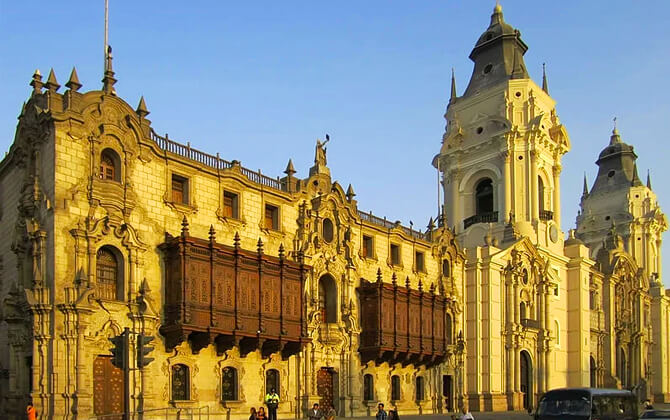
- The Lima Cathedral stands in front of Plaza Mayor and is one of the key landmarks of the historic center. Inside, you will find viceregal art and the crypt of Francisco Pizarro.
- Huaca Pucllana is a pre-Inca ceremonial center in Miraflores with an adobe pyramid, archaeological trails, and a small site museum.
- Cerro San Cristóbal offers panoramic city views from its summit in the Rímac district and is marked by a large illuminated cross.
- Magic Water Circuit in Parque de la Reserva is known for dancing fountains, lights, and music, especially in the late afternoon and evening.
- Park of Legends in San Miguel is a large zoo with animals from Peru’s coast, highlands, and jungle, plus archaeological remains, museums, lagoons, and recreational areas.
- Miraflores Boardwalk is a scenic place for walking, relaxing, and enjoying ocean views near Larcomar.
- Bridge of Sighs in Barranco is a pedestrian bridge surrounded by art, greenery, cafes, galleries, and restaurants.
- Catacombs of the Convent of San Francisco are one of the oldest underground cemeteries in the Americas and a memorable stop for visitors interested in history and religious architecture.
These attractions show that Lima is much more than a transport hub. The city brings together colonial legacy, pre-Hispanic history, and a lively urban culture.