Harbin Metro is the rapid transit system serving Harbin, the capital of Heilongjiang Province in northeastern China. It opened on 26 September 2013 with Line 1 and now operates three lines. The system is built to ease road congestion and provide a practical public transport option across the city. Metro trains run daily, with general operating hours from 5:30 AM to 10:30 PM, while fare is distance-based and starts at ¥2 (about $0.28). Riders can buy a ticket at station counters or machines, use rechargeable cards, or pay by mobile apps such as Alipay and WeChat.
| Key | Information |
|---|---|
| System | Harbin Metro |
| City | Harbin, Heilongjiang Province, China |
| Opening date | 26 September 2013 |
| Lines in operation | 3 |
| Network length | 91.57 km (56.90 miles) |
| Stations | 78 |
| Usual operating hours | About 5:30 AM to 10:30 PM |
| Starting fare | ¥2 (about $0.28) |
| Payment options | Single-ride ticket, rechargeable fare card, Alipay, WeChat |
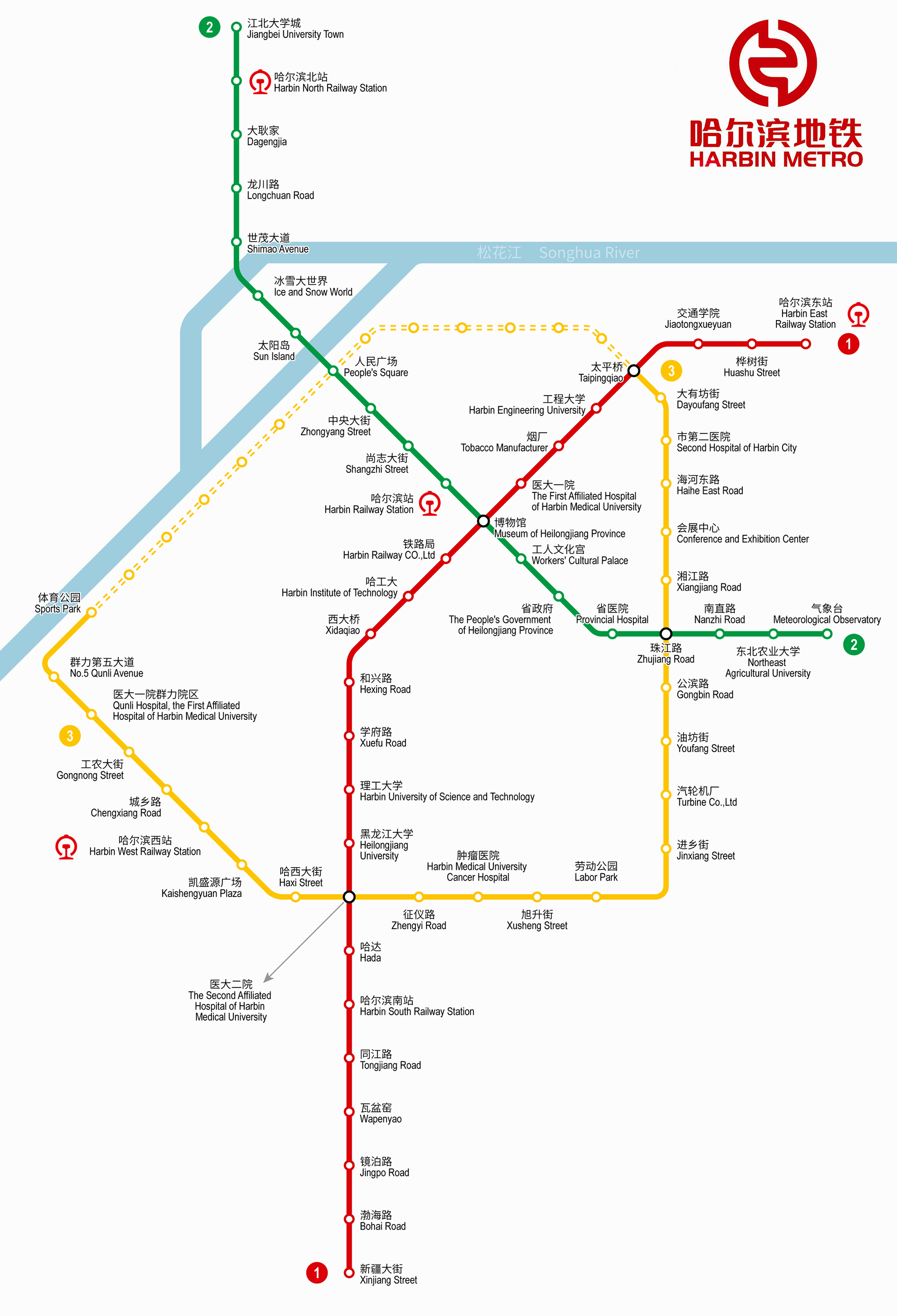
Harbin Metro Map
Map of Harbin Metro showing different lines. Click on the map to enlarge it or download the Harbin Metro map in PDF format.
Harbin Metro Lines
The Harbin Metro system currently has three lines in operation. Together, they form the main urban transport network and connect key parts of the city with a simple route plan for everyday travel.
| Station | Details |
|---|---|
| Line 1 | Route: Harbin East Railway Station to Xinjiang Street. Opened in 2013. Runs along the east-west axis of the urban area. |
| Line 2 | Route: Jiangbei University Town to Meteorological Observatory. Opened on 19 September 2021. Adds an important north-south connection. |
| Line 3 | Circular route around central Harbin. First phase opened in 2017, and the loop was completed in 2024. |
Line 1 was the first to open and began service on 26 September 2013. It links Harbin East Railway Station with Xinjiang Street and follows an east-west route across the city.
Line 2 opened on 19 September 2021 and runs between Jiangbei University Town and Meteorological Observatory. It gives the metro system a key north-south path through Harbin.
Line 3 is the loop line around central Harbin. Its first phase opened in 2017, and the full circular route started on 27 November 2024. It serves areas around the city center and includes important stops such as Sports Park.
Based on the operating data provided, the three lines total 91.57 km (56.90 miles) and 78 stations. Line 1 has 23 stations, Line 2 has 19 stations, and Line 3 has 36 stations. Future expansion is also planned, with Lines 4 and 5 under consideration.
Timetable & Operating Hours
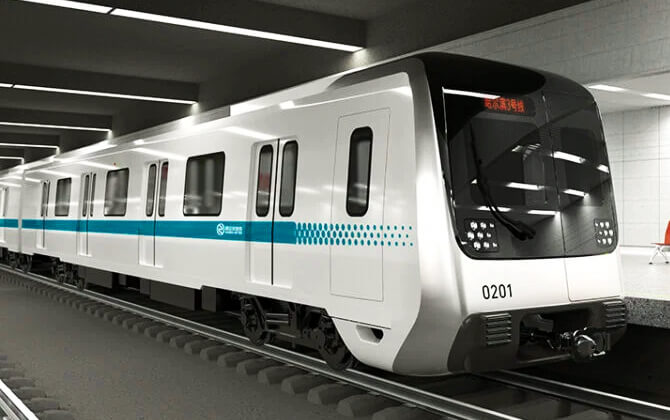
Harbin Metro timetable details vary a little by line, station, and holiday period, but most trains run daily from early morning until late evening. In general, opening hours start around 5:30 AM to 6:00 AM, and closing time falls between 10:30 PM and 11:30 PM depending on the line. If you need timings today or a schedule today, it is best to check station noticeboards or the official app before you travel.
| Service detail | Timings |
|---|---|
| Line 1 operating hours | About 5:30 AM to 10:30 PM |
| Line 2 operating hours | About 5:30 AM to 11:00 PM |
| Line 3 operating hours | About 5:30 AM to 11:30 PM |
| Peak hours | About 7:30 AM to 9:00 AM and 5:00 PM to 7:00 PM |
These opening times and working hours can change during public holidays or special operating conditions. For the latest route timetable, train schedule, starting time, last train information, or exact running time, check live service updates before setting out.
Station and train information appears in both Chinese and English, which makes the system easier to use for international visitors. During busy periods, especially in peak hours, trains can get crowded.
If you miss the last train, taxis and night bus services may still be available. Some routes may also have slightly later short-turn services, so always confirm the latest schedule before your trip.
Prices, tickets and discounts
Harbin Metro uses a distance-based fare system, so the ticket price depends on how far you travel. The fare is calculated automatically when you enter and exit, and all trains use standard class seating.
| Distance travelled | Regular fare |
|---|---|
| 0–4 km (0–2.49 miles) | ¥2 (about $0.28) |
| 4–8 km (2.49–4.97 miles) | ¥3 (about $0.42) |
| 8–12 km (4.97–7.46 miles) | ¥4 (about $0.56) |
| 12–18 km (7.46–11.18 miles) | ¥5 (about $0.70) |
| Over 18 km (11.18 miles) | +¥1 (about $0.14) for every additional 8 km (4.97 miles) |
You can buy tickets and passes at station ticket machines, service counters, or by mobile payment. Alipay and WeChat Pay are accepted, including QR code entry at metro gates. A single-journey ticket works well for occasional rides, while a one-day pass costs about ¥15 (about $2.11) and allows unlimited travel for 24 hours from the first tap.
| Ticket type | Price / deposit | Best for |
|---|---|---|
| Single-journey ticket | Fare varies by distance | One-time rides |
| Mobile QR ride code | Same as regular fare | Cashless everyday travel |
| One-day pass | ¥15 (about $2.11) | Unlimited rides for 24 hours |
| China T-Union Card | Fare varies by distance | Travel across public transport systems in multiple Chinese cities |
Passenger discounts
- Free travel: children under 1.2 m, seniors aged 65 and above, and people with disabilities or active military personnel with valid ID.
- Half-price travel: children between 1.2 m and 1.5 m, and students with a recognized Chinese student card.
If you want to skip paper tickets, the QR ride code in Alipay or WeChat Pay is the quickest option. It can save time at busy stations and helps you avoid queues at the ticket machine. For riders comparing fare, price, ticket cost, or pass options, the one-day pass may be useful if you plan several trips in one day.
Connections to Other Systems
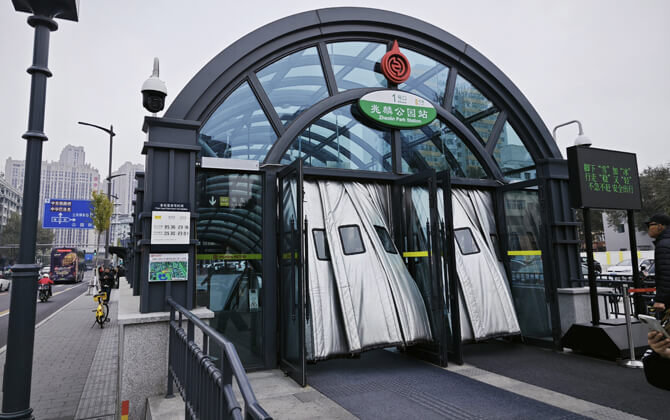
Harbin Metro is part of the wider city transport network and works alongside other public transport options, especially the bus system. For daily transportation in Harbin, this makes trips across the city more straightforward.
The system includes internal transfer points between metro lines. Line 1 connects East Railway Station and South Railway Station, while Line 3 serves West Railway Station, giving riders direct access to important rail hubs.
Some opened and planned routes also mention links with major locations such as Harbin Railway Station, North Railway Station, and Taiping International Airport. That underlines the metro’s role in local transport and city transport planning.
Harbin also has a long-distance rail connection to Beijing through the Beijing-Harbin high-speed railway. In practice, the metro, bus, and mainline rail network work together as a broader urban transport system.
Airport Connections
Harbin Taiping International Airport (HRB) is about 41 km (25.48 miles) from downtown Harbin, and the journey usually takes around 40 to 60 minutes depending on traffic and the transport option you choose. There is no direct metro route to the airport at present, so most travelers use airport shuttle buses, taxis, or private transfers.
The airport is located on Yingbin 1st Rd, Daoli District, Harbin, Heilongjiang Province, China. For most visitors, the airport bus is the cheapest option, with a single ticket price of ¥20 (about $2.81). Taxi fare is usually around ¥120 to ¥150 (about $16.87 to $21.09), which is more expensive but often easier with heavy luggage or a hotel drop-off.
Airport Shuttle Bus Options
There are four main airport shuttle bus lines plus a Wanda Plaza line. These services connect the airport with different parts of Harbin, including Daoli District, Nangang District, Xiangfang District, Songbei District, and Hulan District. Travel time to downtown is about 1 hour, and frequency depends on the route.
| Service detail | Timings |
|---|---|
| Airport Bus No.1 — Harbin Airport, Kangan Road, Tongda Street, Anfa Bridge, Harbin Railway Station | From 7:30 until arrival of the last flight; according to flight arrivals |
| Airport Bus No.2 — Harbin Airport, Ling Gong Li, Chilun Road, Harbin West Coach Station, Clothing Mall, Harbin University of Science and Technology, Hexing Commercial Building, Lesong Square, Tongxiang Store, Nongken Building, Tianyang Hotel, Convention Center, Minfang Commercial Hotel | 8:30 AM–1:30 AM; every 30 minutes |
| Airport Bus No.3 — Harbin Airport, Chilun Road, Guxiang, Anhong Street, Central Street, Baqu, Daowai Coach Station, Jungong, Taiping Bridge, Harbin East Railway Station | 8:30 AM–12:30 AM; every 30 minutes |
| Airport Bus No.4 — Harbin Airport, Chilun Road, Qunli Yi Da, Qunli Yuan Da, Highway Bridge, Ice and Snow World, Qianjin Dao Kou, Da Geng Jia, Harbin North Railway Station, Xueyuan Road | 9:30 AM–12:30 AM; every 1 hour |
| Wanda Plaza Line — Harbin Airport, Jiangbei Wanda Plaza, Wanda Plaza, Beian Runhe City, Harbin’s Outlets | 9:00 AM–12:30 AM; every 1 hour |
Route information may change, so it is wise to confirm details on site before boarding. A taxi is faster and more direct, especially if you are heading to Central Street, Harbin Railway Station, or another point in the city center.
Private transfers arranged by travel agencies are also available and may be more comfortable for a direct hotel transfer. For places such as Central Street, Ice and Snow World, and Sun Island, many travelers combine the airport bus with local bus or taxi connections after reaching the city.
Tips and Rules
Before you ride, it helps to know the basic Harbin Metro rules. A valid ticket is required to enter the paid area, and the system uses one person, one ticket. If you need a safe and smooth trip, following station instructions really matters.
Ticket and Fare Tips
- Regular passengers may use single-journey tickets or a Citytong card.
- From the time of entry, each trip is valid for 120 minutes. If you exceed this limit, you must pay the highest fare for the station.
- If the ticket balance is not enough to cover your trip, you need to pay the difference before exit.
- If you tap in but cannot enter successfully, update the ticket at the Passenger Service Center within 30 minutes.
- Single-journey tickets are valid only at the station where they were purchased and only on the day of purchase.
- Unused single-journey tickets can be refunded on the day of purchase at any station.
- If service is delayed or passengers are cleared out for metro-related reasons, affected riders may request a refund or free ticket update within 7 days.
Discounted Travel Rules
- Primary and secondary students in Harbin can receive a 50% discount with a student Citytong card.
- Seniors aged 65 and above with the Harbin Senior Courtesy Certificate may travel free during off-peak hours.
- Seniors aged 60 to under 65 may travel at half price during off-peak hours.
- One adult may bring one child under 1.2 metres free of charge; additional children must buy full-price tickets.
- Children under 1.2 metres should not ride alone.
Passenger Conduct
- Do not bring bicycles, electric bikes, animals, roller skates, skateboards, or spiked shoes into the metro.
- Do not enter barefoot, bare-chested, in oil-stained clothing, while drunk, or with a serious contagious or mental illness that may endanger others.
- Do not smoke, eat, spit, litter, or damage station or train facilities.
- Do not run, fight, lie on seats, crowd near doors, or stand in the train connection area.
- Keep clear of platform doors and train doors, and move through the gates quickly once they open.
- Give priority seating to elderly, young, sick, disabled, and pregnant passengers, as well as anyone else who needs help.
Safety Rules
- Dangerous goods such as explosives, fuel, corrosive substances, toxic materials, and controlled knives are strictly forbidden.
- Do not bring sharp or fragile items, or anything with strong odors that may affect normal operation or passenger safety.
- Do not touch or operate warning buttons, switches, or equipment without permission.
- When trains arrive, wait for sound and light signals before boarding, and do not rush in or out.
- Do not interfere with radio frequencies, communication systems, power systems, monitoring equipment, or other station facilities.
- Do not use escalators to transport heavy items, carts, baby strollers, or wheelchairs.
If you need help, ask metro staff. If station or train service cannot operate normally, stay calm, follow instructions, and avoid remaining in the station or carriage longer than necessary.
History
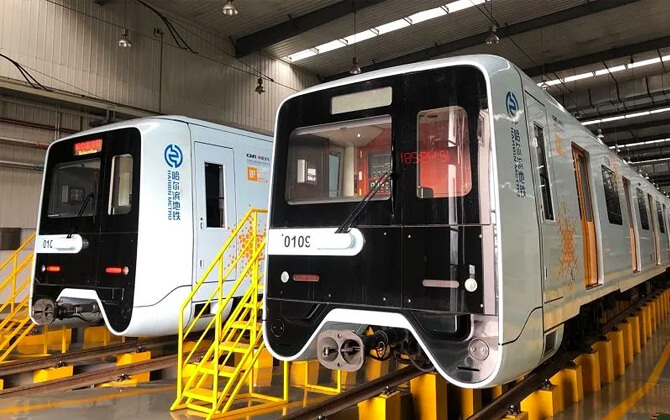
The history of Harbin Metro began with State Council approval in July 2005. The project was originally estimated at US$643 million and was led by the Harbin Municipal People’s Government Metro Construction, which set up a Track Traffic Construction Office under the city construction commission.
In 2006, an official initiation ceremony marked the start of the Harbin Metro trial project. One of the most notable engineering features of Line 1 was the reuse of a 10.1 km (6.28 miles) air-defense tunnel built in the 1970s as part of the “7381” civil air-defense project. This tunnel forms the section between Xidaqiao and Tobacco Manufacturer stations, where both tracks run inside one large tunnel with side platforms.
Construction on Line 1 began again on 29 September 2009, was later halted, and resumed on 1 March 2010. In March 2011, the contract for the first line’s traincars was signed with Changchun Railway Vehicles Co. Ltd. Although the opening had been planned for the end of 2012, Line 1 finally started service on 26 September 2013.
Line 2 construction began in December 2014. Its first phase, 18.5 km (11.50 miles) long with 16 stations, opened on 19 September 2021. Line 3 opened in stages: the southeast half-ring, 19.19 km (11.92 miles) with 19 stations, entered service on 26 November 2021, and the remaining northwest section opened on 26 November 2024, completing the 32.18 km (20.00 miles) loop with 28 stations.
In April 2016, Harbin Metro Group published an environmental impact assessment notice for the second phase of the urban rail transit construction plan for 2017–2022. The updated plan announced in July 2022 for 2022–2027 reduced the program to Lines 4 and 5 only, with a total length of 70.6 km (43.87 miles) and 54 stations. In July 2025, the Harbin rail transit network plan for 2021–2035 was approved, confirming these lines.
Future Extensions
Harbin Metro expansion is set to continue in phases. Based on the latest published planning material, the next confirmed additions are Line 4 and Line 5. Both are included in the updated second-phase construction plan for 2022–2027 and were reaffirmed in the 2021–2035 rail transit network plan approved in July 2025.
| Station | Details |
|---|---|
| Line 4 | Phase 1. Under planning. Length: 34.5 km (21.44 miles). Stations: 29. Terminus: Qiansha – Minzu College. |
| Line 5 | Phase 1. Under planning. Length: 36.1 km (22.43 miles). Stations: 25. Terminus: Dongsanhuan – Nanjing Road. |
Earlier plans mentioned a broader second phase, but the latest update shortened the program and narrowed it to these two lines. As with any major metro system, timelines can shift, so official announcements remain the best source for progress updates.
For now, the practical reference for riders is the current network: daily operating hours from about 5:30 AM to 10:30 PM and distance-based fares starting at ¥2 (about $0.28).
Nearby Attractions
Harbin Metro is a convenient way to reach many of the city’s best-known sights, especially in winter when road traffic can slow down and walking conditions are less pleasant. For visitors using the stations map or planning a simple sightseeing route, the metro is often the easiest starting point.
- Zhongyang Street (Central Street) — A major pedestrian shopping street with European-style architecture. It is served by Line 2.
- Saint Sophia Cathedral — One of Harbin’s best-known landmarks. From Line 2, it can be reached with a short walk.
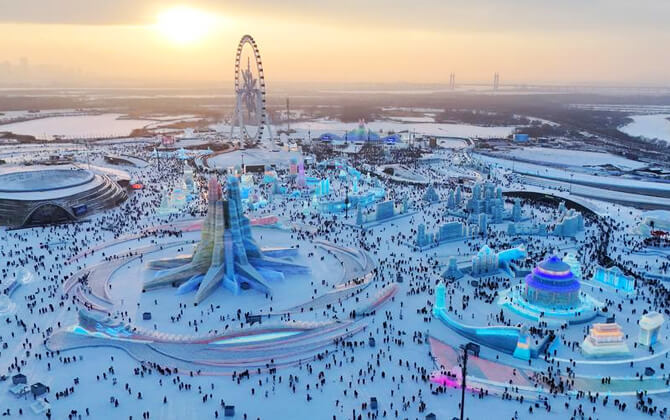
- Harbin Ice and Snow World — A signature winter attraction. Take Line 2 and continue by short bus or taxi ride, or use Line 3 as part of the trip.
- Sun Island — A popular area for snow sculpture and winter scenery. Line 2 stops nearby, which makes day visits easier.
- Harbin Railway Station — A key transport hub and a useful base for sightseeing. It is connected by the metro and close to several central attractions.
- Harbin West Railway Station — Important for high-speed rail travelers. Line 3 connects it with other parts of the city.
If you are planning a full day out, combining the metro with short walks, taxi rides, or local bus connections works well for attractions that are not right beside a station.