Metrolink Los Angeles is the commuter rail system serving Southern California across Los Angeles, Orange, Riverside, San Bernardino, Ventura, and San Diego counties, including Oceanside. Created as the Southern California Regional Rail Authority in 1991 and launched in 1992, the system operates eight lines and 69 stations over 545.6 miles (878.1 km) of track. It is a major part of regional public transport, linking downtown Los Angeles with airports, suburbs, coastal cities, sports venues, and local transport connections.
| Key | Information |
|---|---|
| System type | Commuter rail and regional city transport |
| Service area | Los Angeles, Orange, Riverside, San Bernardino, Ventura, and San Diego counties |
| Lines | 8 lines, including Arrow |
| Stations | 69 stations |
| Network length | 545.6 miles (878.1 km) |
| Main hub | L.A. Union Station |
| Connections | Metro Rail, Metro Busway, Metro buses, Amtrak, Coaster, Sprinter, and local bus services |
| Fare system | Flat boarding fee plus distance-based fare, with selected passes and discounts |
| Weekend service | Available on all routes except the Riverside Line |
Metrolink Los Angeles Map
The Metrolink Los Angeles map shows all available stops. Click on the map to enlarge it or download the AirTrain JFK map in PDF format.
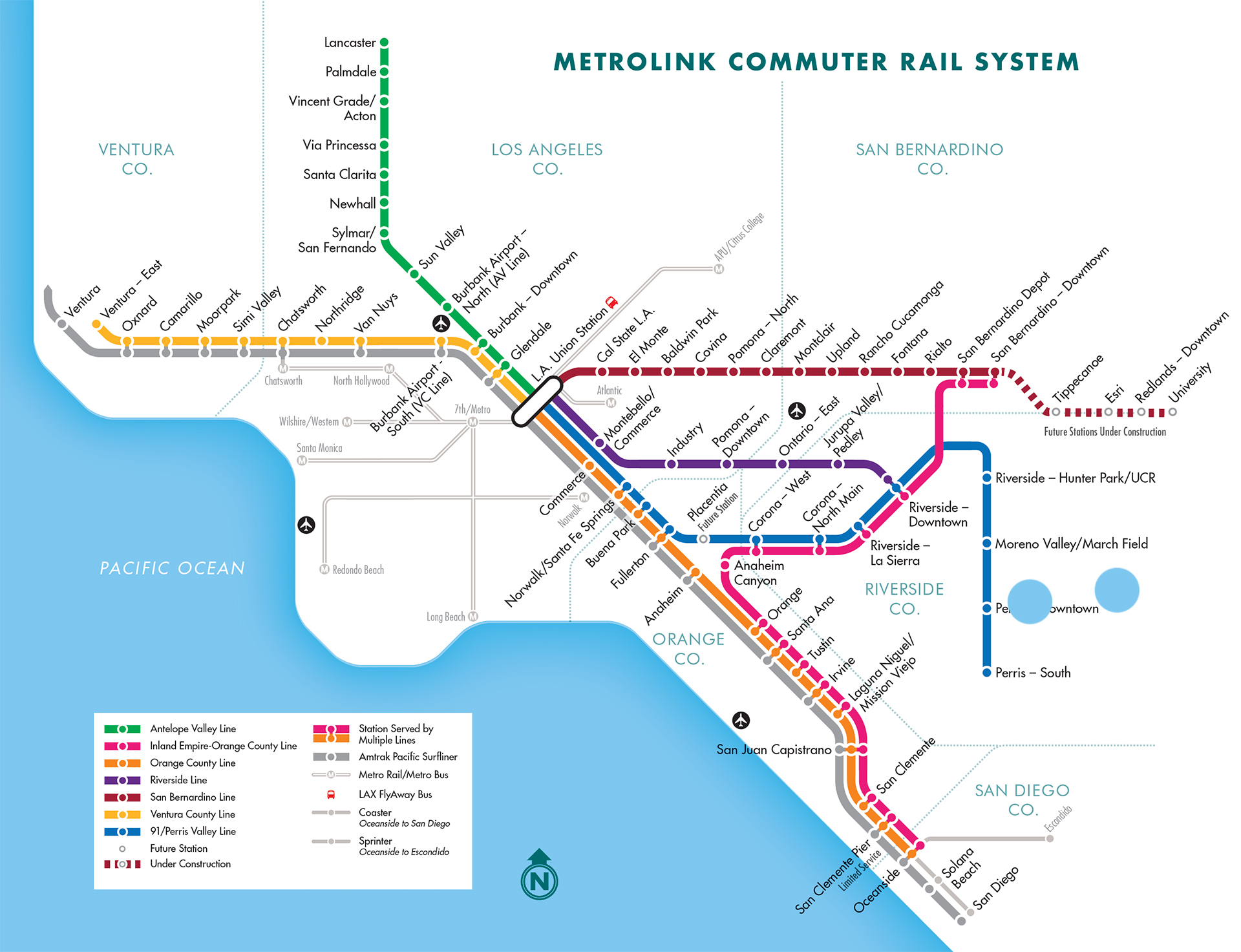
Metrolink Los Angeles Lines and Stations
The Metrolink system map covers a wide regional rail network centered on Los Angeles. Riders use the stations map to compare routes, check nearby stops, and plan trips across Southern California. The network reaches downtown Los Angeles, downtown San Bernardino, Burbank, Hollywood Burbank Airport, Cal State LA, Angel Stadium, San Clemente Pier, and Oceanside.
Metrolink is governed by the Southern California Regional Rail Authority and operated under contract by Amtrak. Some routes share track with freight railroads, while Metrolink also owns several hundred miles of right-of-way.
| Station | Details |
|---|---|
| L.A. Union Station | Main Metrolink hub with Metro Rail, Metro Busway, Metro bus, and Amtrak connections |
| Cal State L.A. | Los Angeles-area station serving the university area |
| Downtown Burbank | Regional stop serving Burbank |
| Glendale | Los Angeles County station with commuter rail service |
| El Monte | Station on the regional Metrolink network |
| Chatsworth | Station serving the northwest Los Angeles area |
| Hollywood Burbank Airport | Airport-area access through Burbank Airport stations |
| Auto Club Speedway | Closed special-event stop on the San Bernardino Line; service ended after the racetrack closed in 2023 |
| Placentia | Planned future station |
| L.A. General Medical Center | Planned future station |
| Pico Rivera | Planned future station |
| Hemet | Planned future station |
| San Jacinto | Planned future station |
Metrolink Los Angeles Routes
Metrolink Los Angeles routes form a regional path train network for commuters, airport travelers, students, and weekend riders. The route plan includes eight lines, and each route timetable depends on direction and day of travel.
| Line | Route length | Stations | Termini | Average weekday ridership |
|---|---|---|---|---|
| Antelope Valley Line | 76.6 miles (123.3 km) | 13 | Lancaster / L.A. Union Station | 2,647 |
| Inland Empire–Orange County Line | 100.1 miles (161.1 km) | 16 | San Bernardino–Downtown / Oceanside | 1,728 |
| Orange County Line | 87.2 miles (140.3 km) | 15 | L.A. Union Station / Oceanside | 2,950 |
| Riverside Line | 58.8 miles (94.6 km) | 7 | L.A. Union Station / Riverside–Downtown | 1,237 |
| San Bernardino Line | 56.5 miles (90.9 km) | 17 | L.A. Union Station / San Bernardino–Downtown | 4,719 |
| Ventura County Line | 76.6 miles (123.3 km) | 12 | Ventura–East / L.A. Union Station | 1,273 |
| 91/Perris Valley Line | 83.8 miles (134.9 km) | 12 | L.A. Union Station / Perris–South | 1,597 |
| Arrow | 9 miles (14 km) | 5 | San Bernardino–Downtown / Redlands–University | 184 |
Metrolink also connects with Amtrak intercity trains, including the Pacific Surfliner, Coast Starlight, Southwest Chief, Sunset Limited, and Texas Eagle. Arrow runs between San Bernardino–Downtown Station and Redlands–University Station under contract with the San Bernardino County Transportation Authority.
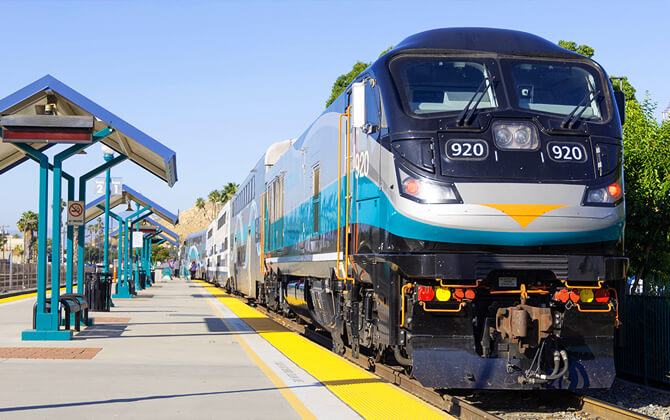
Metrolink Los Angeles Schedule
Metrolink schedule information is organized by line, direction, and service day. There is no single systemwide opening hours, closing time, starting time, last train, or frequency that applies to every route. For schedule today or timings today, choose your line first, then check whether you are riding on a weekday, Saturday, Sunday, or holiday.
The train schedule materials use train numbers, AM and PM times, and minutes past the hour. Routing, timings, and running time can change, so riders should check the current timetable before boarding, especially for early-morning service or the last train of the day.
| Service detail | Timings |
|---|---|
| Ventura County Line + Amtrak | Mon–Fri and Sat–Sun schedules listed separately |
| Antelope Valley Line | Mon–Fri and Sat–Sun schedules listed separately |
| San Bernardino Line + Arrow | Mon–Fri and Sat–Sun schedules listed separately |
| Arrow Service + L.A. Connections | Mon–Fri and Sat–Sun schedules listed separately |
| Redlands to L.A. and L.A. to Redlands | Mon–Fri and Sat–Sun schedules listed separately |
| Riverside Line | Mon–Fri only |
| 91/Perris Valley Line | Mon–Fri and Sat–Sun schedules listed separately |
| Orange County Line | Mon–Fri and Sat–Sun schedules listed separately |
| Orange County Line Amtrak Service | Daily |
| Inland Empire–Orange County Line | Mon–Fri and Sat–Sun schedules listed separately |
For L.A. Union Station trips, match your origin and destination with the correct route timetable before you travel. Weekend service runs on all routes except the Riverside Line.
Metrolink Los Angeles Tickets and Fares
Metrolink fare and ticket options are built around distance, day passes, flex travel, and monthly commuting. As of July 1, 2025, Metrolink is piloting a simplified fare structure with fewer ticket types, lower monthly pass prices, and broader everyday discounts through the end of 2025.
The system no longer offers Round-Trip Tickets, the 7-Day Pass, the 10-Day Flex Pass, or the Student Adventure Pass during this pilot. Riders who used those products should compare the one-way ticket, day pass, flex pass, and monthly pass options before buying.
Ticket Types
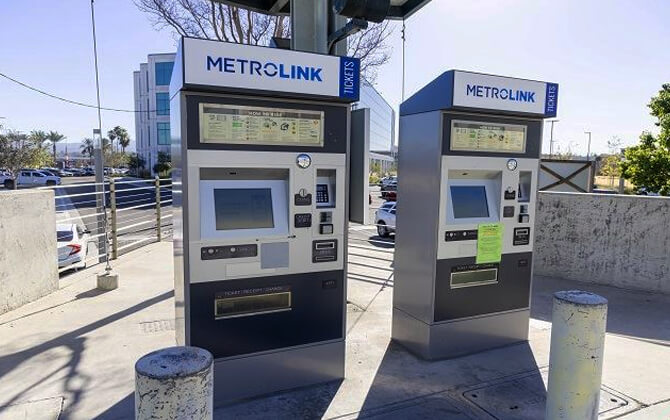
Tickets must be purchased before boarding. You can buy a ticket or pass through the Metrolink Mobile App, at station ticket machines, or at L.A. Union Station ticket windows. Tickets are not sold onboard.
- One-Way Ticket — One trip in one direction between selected origin and destination stations. The price is based on distance.
- SoCal Day Pass — Unlimited systemwide travel on the day of purchase. The weekday ticket price is $15 USD; weekend and holiday price is $10 USD.
- L.A. Zone Day Pass — Unlimited same-day travel within the L.A. Zone for $5 USD, valid only at listed zone stations.
- 5-Day Flex Pass — Five one-day passes to use within 30 days. Cost is based on the distance between the selected stations.
- Monthly Pass — Unlimited rides between the stations shown on the pass for the calendar month, plus systemwide weekend travel. Price is distance-based.
Metrolink discounts include 50% off most fares for students and youth, 50% off most fares for seniors age 65 and older, riders with disabilities, and Medicare riders, plus 25% off Monthly Passes for that same group. Veterans and active military receive 10% off most fares, and EBT cardholders receive 50% off tickets and passes. Discounts can be combined with EBT when eligible, except for the L.A. Zone Day Pass, where only the CA EBT discount applies.
Most Metrolink tickets include free transfers to participating local transport services, including many bus and rail connections in L.A. County. All fares are non-refundable and cannot be transferred to another rider. Kids ride free on weekends with a fare-paying adult, subject to Metrolink rider rules.
Transit Connections
Metrolink ticket holders can connect to Metro rail and bus routes in Los Angeles County at no additional cost. A valid ticket also unlocks many other local transport connections across Southern California, including city buses, shuttle buses, light rail, and subway lines.
- Your Metrolink ticket must be valid for the date of travel.
- Monthly passes must be valid for the current month.
- Free rides apply to participating local transit services only.
- Express or non-local bus services may require an additional fare.
- Show your valid Metrolink ticket to the driver or attendant when asked.
In Los Angeles County, the EZ Transit Pass program gives Metrolink riders unlimited free rides on participating local services. This includes Metro Rail, Metro Rapid buses, and Metro Local buses. Metro Rail connections include the A, B, C, D, E, and K lines.
Other participating public transport providers include Antelope Valley Transit Authority, Foothill Transit, Glendale Beeline, Long Beach Transit, LADOT/DASH, Montebello Bus Lines, Norwalk Transit, Pasadena Transit, Santa Clarita Transit, Torrance Transit, and several city shuttle systems.
Airport Connections by Metrolink
Metrolink connects riders with several major Southern California airports, helping reduce traffic stress and airport parking costs. Each airport connection works a little differently, so check the route, bus link, and fare before you go.
| Airport | Metrolink connection | Details |
|---|---|---|
| Los Angeles International Airport (LAX) | L.A. Union Station and LAX FlyAway Bus | FlyAway buses leave from Patsaouras Transit Plaza. Peak-hour departures run every 30 minutes, and travel time is usually 30 to 50 minutes depending on traffic. One-way FlyAway service between Union Station and LAX costs $12.75 USD. Monthly pass holders ride free when presenting a valid pass and same-day boarding pass. |
| Hollywood Burbank Airport (BUR) | Burbank Airport–North and Burbank Airport–South | Burbank Airport–North has complimentary shuttle service to the terminal from 5:00 a.m. to 10:00 p.m. daily. Burbank Airport–South is within walking distance, with an elevated walkway from the Regional Intermodal Transportation Center. |
| John Wayne Airport (JWA) | Tustin Station and iShuttle | Passengers can take Metrolink to Tustin Station and use iShuttle Route A for airport access. |
| Ontario International Airport (ONT) | Rancho Cucamonga Station or East Ontario Station | From Rancho Cucamonga, riders can use ONTConnect to Terminal 2. From East Ontario, Omnitrans Route 81 and Route 61 connect to the airport. Travel times can range from 35 to 45 minutes, and some bus transfers may require separate payment. |
For airport travel, build in extra time for transfers, traffic, and walking between platforms, bus bays, and terminals.
Passenger Safety and Rules
Metrolink rules are designed to keep travel safe and comfortable. Conductors are responsible for onboard safety and may decide whether an item can be brought onto the train.
- Bags and luggage should be stored under your seat when possible.
- Small pets are allowed only in a ventilated carrier that fits under a seat or on your lap.
- Service animals trained to assist people with disabilities are allowed.
- Strollers should be secured in the designated storage area.
- Snacks are allowed, but riders should use onboard trash cans.
- Bicycles must be secured in designated storage areas or on bike hooks on Arrow trains.
- Beach chairs, beach toys, umbrellas, towels, fishing poles, and ice chests are allowed if they can be safely stored.
- Do not play music or audio without headphones.
- Do not place feet or shoes on seats.
- Do not block aisles, doors, storage areas, or emergency exits.
- Smoking and alcohol consumption are not allowed.
- Tandem, three-wheeled, and gas-powered bikes are not allowed.
- Surfboards, beach carts, and wagons are not allowed.
- Firearms and weapons are not allowed except when carried by law enforcement personnel.
Wheelchairs must not exceed 32 inches wide by 58 inches long or weigh more than 600 pounds, including the rider. Segways may be accommodated for passengers with disabilities when used only as mobility devices.
For a safer ride, stand behind the yellow line until the train stops, use handrails, let passengers exit before boarding, and listen for crew announcements. If something looks suspicious, tell the conductor, fare inspector, station security guard, police officer, or call 911 or 800-371-LINK (5465).
How to Ride
Riding Metrolink is straightforward: find your station, check the timetable, buy your ticket, and be ready on the platform before the train arrives.
- Find your station on the system map or station finder. Look for ticket machines, parking, bike storage, ramps, and accessible features.
- Check the schedule for your line, direction, and travel day. Remember that Saturday and Sunday service is available on all lines except the Riverside Line.
- Buy your ticket before boarding. Use a station ticket machine or the Metrolink Mobile App. Ticket machines are available in English and Spanish and are ADA-compliant.
- Arrive early. Station stops are brief, and conductors cannot wait while riders buy tickets.
- Stand behind the yellow line, let others exit first, then board when it is safe.
- Keep your ticket available for inspection and for connecting bus, rail, or shuttle services.
The Metrolink Mobile App also lets you purchase tickets, activate them before boarding, and track your train in real time. Frequent riders can join the SoCal Explorer rewards program to earn points and receive selected local discounts.
Parking at Stations
Metrolink station parking varies by location. Many stations offer free parking, while others may have monthly permits, paid reserved spaces, EV charging, bike racks, bike lockers, accessible spaces, or limited overnight parking. Parking charges, parking charges per day, and permit rules are set station by station.
- Free parking is available at most stations.
- Some high-demand stations require paid permits or reserved parking.
- Monthly permits are generally best for frequent riders.
- EV charging is available at select stations during regular station hours.
- Bike storage may include racks, lockers, or secure bike rooms.
- Accessible parking is available at all Metrolink stations for riders with a valid disabled parking placard or license plate.
- Overnight parking is limited and may lead to citation or towing where it is not allowed.
Before you drive to a station, check the station parking rules, availability, payment methods, and current cost. That small check can save time, especially at busy commuter stations.
Brief History
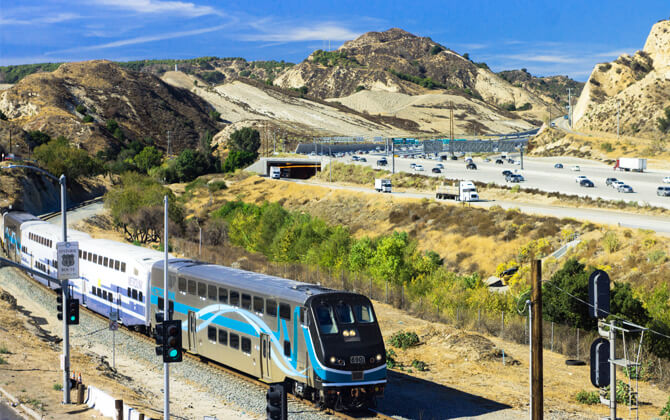
Metrolink’s history began in the late 1980s and early 1990s, when voters in Riverside, San Bernardino, Los Angeles, and Orange counties approved transportation funding measures. In 1991, the Southern California Regional Rail Authority was formed as a joint powers authority and selected Metrolink as the name for the future commuter rail agency.
Service began on October 26, 1992, with three routes: the Ventura County Line, the San Bernardino Line, and the Santa Clarita Line, later renamed the Antelope Valley Line. Los Angeles Union Station became the central hub.
The expansion moved quickly. The Riverside Line opened in 1993, the Orange County Line followed in 1994, and the Inland Empire–Orange County Line began service in 1995 as the nation’s first suburb-to-suburb commuter rail line. The 91 Line was added in 2002, strengthening regional transportation in Southern California.
Safety became a major focus in the mid-2000s. Metrolink invested in safer crossings, Crash Energy Management railcars, inward-facing cab cameras, the Sealed Corridor Program, and Positive Train Control. In 2015, it became the first railroad in the nation to operate PTC during regular service across its entire 341-mile (549 km) network of owned lines.
Future Improvements and SCORE Program
The Southern California Optimized Rail Expansion program, known as SCORE, is a $10+ billion USD capital improvement program for Metrolink. It includes grade crossing upgrades, station improvements, signal work, and added track across five counties.
SCORE is intended to improve safety, increase peak and off-peak rail service, support more reliable running time, expand access to jobs and affordable housing, and help reduce greenhouse gas emissions. The program is also part of Metrolink’s preparation for the 2028 Olympic and Paralympic Games.
- Simi Valley Double Track Project
- Burbank Junction Speed Improvements
- Chatsworth Station Improvements
- Marengo Siding Extension
- El Monte Siding Extension
- Rancho Cucamonga Siding Extension
- Serra Siding Extension Project
Grade-crossing improvements may help some cities apply for quiet zones, reducing noise in the service area. The broader expansion is also expected to support jobs, economic development, cleaner air, and better rail connections throughout Southern California.
Nearby Attractions

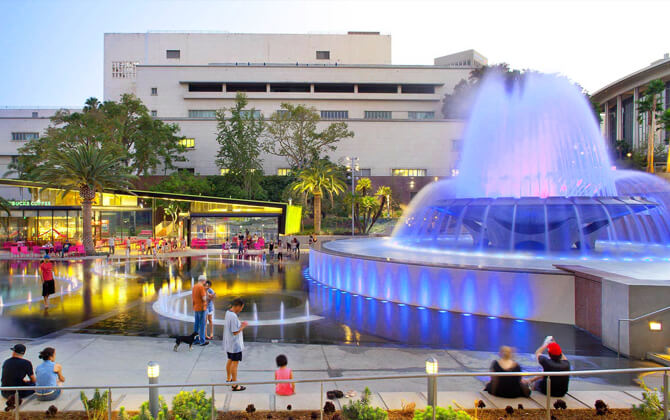
Metrolink gives riders a practical way to reach major attractions across Southern California without relying only on driving. From L.A. Union Station, visitors can connect to historic districts, museums, restaurants, shopping areas, and public spaces in Downtown Los Angeles.
Downtown highlights include Olvera Street, El Pueblo de Los Angeles Historic Monument, Los Angeles Central Library, Walt Disney Concert Hall, the Music Center, the Museum of Contemporary Art, Grand Central Market, Grand Park, The Bloc, and Figat7th.
Nearby neighborhoods are also easy to reach. Little Tokyo offers Japanese food, music, visual arts, and cultural sites, while Chinatown and the Arts District add more walkable options close to central Los Angeles.
Beyond downtown, Metrolink connects riders with Universal Studios Hollywood in Universal City, Angel Stadium in Anaheim, Discovery Cube Orange County in Santa Ana, and Six Flags Magic Mountain in Valencia. Coastal trips are possible too, including San Clemente Pier and Oceanside.
For history and arts, riders can visit Mission San Juan Capistrano, founded in 1776, or explore Old Town Newhall, known for its Old West history.