NYC Ferry is a public transport ferry system in New York City operated by Hornblower Cruises. It connects waterfront communities across all five boroughs, serving commuters, visitors, and local transport trips to jobs, parks, neighborhoods, and major transit areas. As of August 2023, the system includes six routes plus one seasonal route, 25 ferry piers, and a 38-vessel fleet, with route running time ranging from about 20 to 90 minutes depending on the season.
| Key | Information |
|---|---|
| System | Public ferry network serving New York City |
| Operator | Hornblower Cruises |
| Service area | All five boroughs of New York City |
| Routes | Six routes plus one seasonal route as of August 2023 |
| Stations | 25 ferry piers |
| Fleet | 38 passenger vessels |
| Running time | About 20 to 90 minutes, depending on route and season |
| Tickets | Single-Ride tickets, 10-Trip Pass, and Unlimited 2-Day ticket |
| Transfers | Free ferry transfers within 120 minutes after starting a one-way trip |
| Annual ridership | More than 7 million riders annually |
NYC Ferry Map
NYC Ferry map showing different lines and stations. Click on the map to enlarge it or download the NYC Ferry map in PDF format.
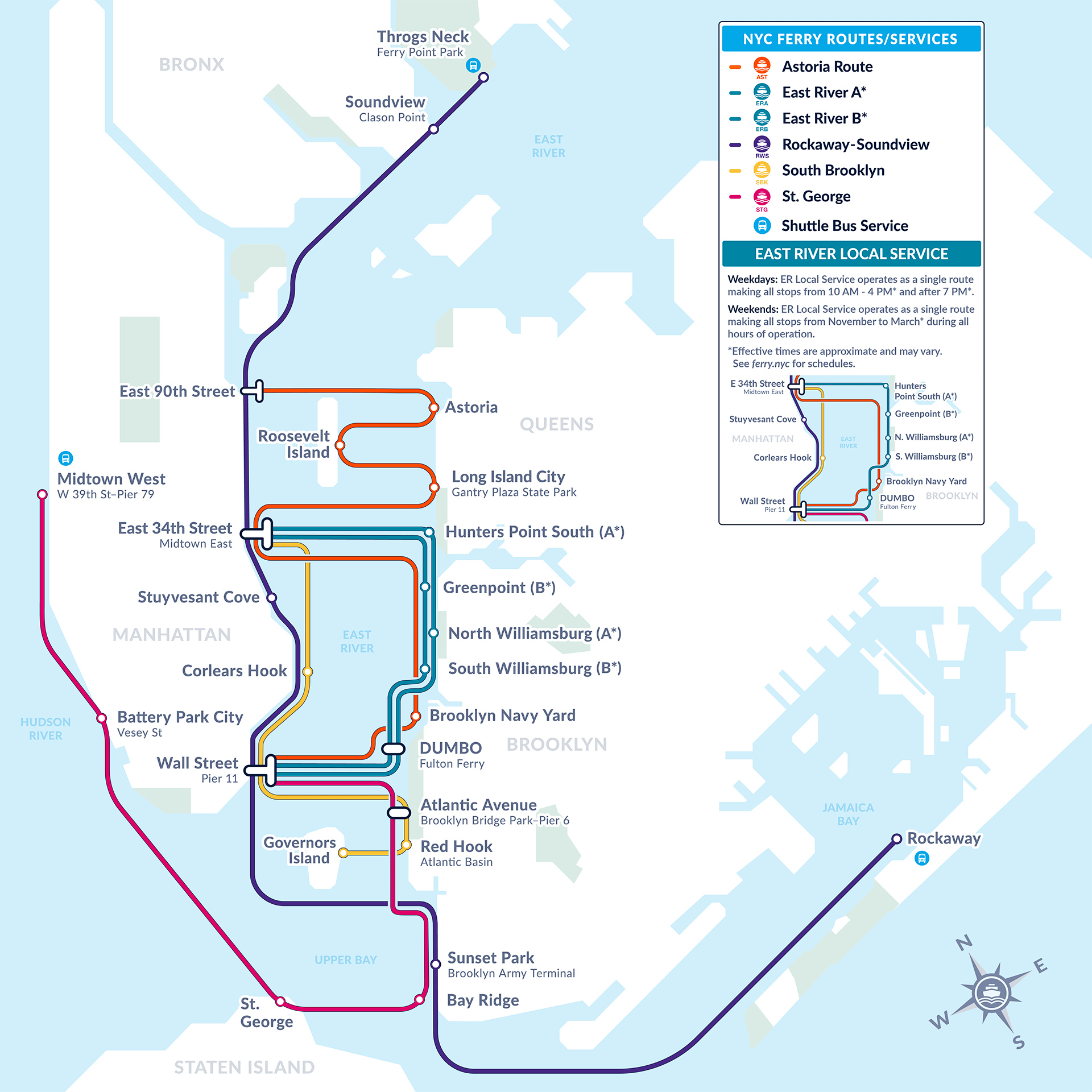
NYC Ferry Stops
NYC Ferry stops vary by route and season. Most routes operate between approximately 5 AM and 10 PM, though exact opening times, closing time, and last ferry details depend on the line and the time of year.
The main stations list includes stops on the East River, South Brooklyn, Astoria, Rockaway-Soundview, St. George, and Governors Island Shuttle services. A Coney Island route was listed as launching in 2022, but the available information does not confirm that it opened.
| Station | Details |
|---|---|
| Astoria route stops | Astoria, Roosevelt Island, Long Island City, East 34th Street, Brooklyn Navy Yard, Wall Street/Pier 11 |
| East River route stops | Hunters Point South, East 34th Street, Greenpoint, North Williamsburg, South Williamsburg, DUMBO, Wall Street/Pier 11 |
| Rockaway route stops | Rockaway, Sunset Park, Wall Street/Pier 11 |
| Soundview route stops | Throgs Neck/Ferry Point Park, Soundview-Clason Point, East 90th Street, East 34th Street, Stuyvesant Cove, Wall Street/Pier 11 |
| South Brooklyn route stops | Bay Ridge, Sunset Park, Governors Island, Red Hook, Brooklyn Bridge Park Pier 6/Atlantic Avenue, Wall Street/Pier 11, DUMBO, Corlears Hook |
| St. George route stops | St. George, Battery Park City, Midtown West/Pier 79 |
| Governors Island Shuttle | Governors Island Shuttle stop |
Some landings are shared by multiple routes. Pier 11/Wall Street is the terminal for all NYC Ferry routes except the Rockaway-Soundview and South Brooklyn lines. East 34th Street is served by the Astoria, East River, South Brooklyn, and Soundview lines.
Other notable shared or seasonal stops include Sunset Park, Bay Ridge, Governors Island, East 90th Street, and Brooklyn Navy Yard. Seasonal service can change which routes serve these landings, especially on summer weekends.
Cars, motorcycles, and trucks are not allowed on NYC Ferry.
Fares, Tickets, and Amenities
NYC Ferry fare options include Single-Ride tickets, 10-Trip Passes, and an Unlimited 2-Day ticket. Tickets can be purchased in the NYC Ferry App or at Ticket Vending Machines at NYC Ferry landings. All tickets expire 90 days after purchase and are non-refundable and non-transferable.
| Key | Information |
|---|---|
| One-way ticket price | US$4.50 ($4.50) |
| 10-Trip Pass cost | US$29.00 ($29.00) |
| Unlimited 2-Day ticket price | US$15.00 ($15.00), available in the app only |
| Reduced fare | US$1.45 ($1.45) for eligible riders |
| Free transfer window | 120 minutes after starting a one-way trip |
| Children | Children under 112 cm (44 inches) ride free with an adult |
Free transfers are available within the NYC Ferry system for 120 minutes after you start your one-way trip. Round-trip journeys do not qualify for free transfers.
Discounted fares are available through the Ferry Discount Program and the Student Discount Program. Bikes are allowed on board at no extra charge. Strollers are also permitted, and designated spaces are available on some boats.
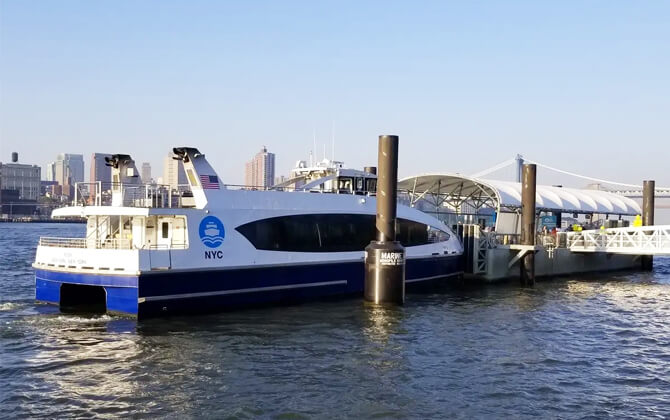
Most landings provide covered waiting and boarding areas. Riders board on a first-come, first-served basis, and tickets must be shown to the deckhand before boarding.
The fare information here does not include station parking, parking charges, or parking charges per day.
Ferry Discount Program
The Ferry Discount Program allows eligible riders to buy a reduced-fare One-Way Ticket for US$1.45 ($1.45).
Eligible riders may include senior citizens aged 65 and older, people with disabilities, and participants in the Fair Fares NYC Program.
Applications can be submitted online, in person, or by mail. Processing may take up to 30 days. Completed applications may be mailed to NYC Ferry Operated by Hornblower, Attn. Ferry Discount Program, 63 Flushing Ave, Building 5, suite 100, Brooklyn, NY 11205.
Once eligibility is verified, discounted tickets may be purchased through the NYC Ferry app. In-person ticket sales are available at Wall St./Pier 11, Monday through Sunday from 8:00 a.m. to 7:00 p.m. A valid photo ID and approval letter are required for in-person purchases.
One-Way Tickets are valid for 90 days from purchase. Once activated, the ticket may be used for up to 120 minutes for a single ride and transfers within the NYC Ferry system in the same direction.
If an application is found ineligible, the rider receives an email or letter explaining the decision. A review may be requested within 14 calendar days of the notice date.
Student Discount Program
NYC Ferry offers a Student Discount Program for eligible New York City high school students. For the 2025–2026 school year, eligible students can access discount codes in their NYC Schools Account, and student discount tickets are available for purchase starting September 1, 2025.
To enroll, a parent or guardian must log into or create a NYC Schools Account. If the student is eligible, a NYC Ferry logo and a request discount code button should appear in the Transportation tab. Parents and guardians of NYC nonpublic and charter high school students can also create an account, but may need access information from the student’s school.
- NYC Ferry App: enter the student’s unique ferry discount code in the Promo Code tab.
- Paper tickets: use the code in the Student Discount Paper Ticket Application or at the Wall St./Pier 11 ticketing window.
Student Discount Tickets are valid on weekdays only. Student codes expire at the end of August, and students must re-enroll each year with new codes. A discount code can be applied once within one NYC Ferry account and cannot be used for both app and paper ticket purchases.
Routes & Schedules
NYC Ferry operates routes across New York City, including East River, South Brooklyn, Astoria, Rockaway-Soundview, St. George, and the Governors Island Shuttle. A seasonal weekend route to Coney Island is also listed among the system’s services.
For trip planning, riders can use the route map, downloadable map, live ferry status, and schedule information. Checking the train schedule equivalent for ferries matters, especially for off-peak trips, seasonal service, and transfers between routes.
- Use the system map to review all NYC Ferry routes.
- Check live ferry status for real-time updates.
- View the timetable before heading to the terminal.
- Download and print the map if you prefer a paper copy.
Service patterns vary by route, so checking the schedule today is the safest move before you travel.
Operating Hours
NYC Ferry operates daily and connects all five boroughs. General operating hours are approximately 5 AM to 10 PM, depending on the route and season.
| Service detail | Timings |
|---|---|
| Starting time | Approximately 5 AM, depending on route and season |
| Working hours | Daily service across all five boroughs |
| Opening hours and opening times | Vary by route, season, and service pattern |
| Closing time | Approximately 10 PM on many routes, depending on route and season |
| Last train equivalent | Last ferry timing varies by route; check the route timetable before travel |
| Weekday frequency | Generally every 20 to 30 minutes |
| Weekend frequency | Generally every 45 to 60 minutes |
| Customer support | Available 24 hours a day, 7 days a week |
For complaints or lost items, NYC Ferry can be contacted by email at [email protected] or by phone at (844) 469-3377.
NYC Ferry Shuttle buses
NYC Ferry operates free shuttle buses in the Rockaways to connect riders with ferry landings and nearby neighborhoods. The shuttle service runs during the summer schedule, from 6/30/2025 to 9/7/2025, with modified weekend dates on 7/4, 7/6, 7/13, 7/20, 7/27, 8/3, 8/10, 8/17, 8/23, 8/24, 8/30, 9/6, and 9/7/2025.
There are two Rockaway shuttle lines: the Rockaway East Shuttle Bus and the Rockaway West Shuttle Bus. Both serve the Beach 108th St / Beach Channel Dr ferry terminal, and the westbound route also serves Rockaway Point Blvd / Beach 169th St on weekdays only.
| Station | Details |
|---|---|
| Rockaway East Shuttle | Beach Channel Dr / Beach 108th St Ferry Terminal, Beach Channel Dr / Beach 41st St, Beach Channel Dr / Beach 54th St, Rockaway Beach Blvd / Beach 67th St, Rockaway Beach Blvd / Beach 77th St, Rockaway Beach Blvd / Beach 86th St, Rockaway Beach Blvd / Beach 96th St, Beach Channel Dr / Beach 102nd St, Beach Channel Dr / Beach 35th St |
| Rockaway West Shuttle | Beach Channel Dr / Beach 108th St Ferry Terminal, Jacob Riis Park Rd / Bath House, Rockaway Beach Blvd / Beach 149th St, Rockaway Beach Blvd / Beach 135th St, Rockaway Beach Blvd / Beach 127th St, Rockaway Beach Blvd / Beach 118th St, Rockaway Point Blvd / Beach 169th St |
These buses are part of NYC Ferry service, free to use, and wheelchair accessible. They make ferry travel easier for riders moving around the Rockaways.
Accessibility and Safety Regulations
NYC Ferry provides inclusive, non-discriminatory service. Riders who believe they have been excluded, denied benefits, or discriminated against because of race, color, national origin, gender, age, sexuality, disability, income, or limited ability to speak English may file a formal complaint.
Under Title VI of the Civil Rights Act of 1964, NYC Ferry does not exclude people from services or deny benefits on the basis of race, color, or national origin. Written complaints may be sent to NYC Ferry Operated by Hornblower, Attn: 63 Flushing Ave, Building 5, suite 101, Brooklyn NY 11205.
Complaints may also be filed with the Federal Transit Administration, Office of Civil Rights, Attention: Complaint Team East Building, 5th Floor – TCR 1200 New Jersey Avenue SE Washington, DC 20590. Complaints must be filed in writing within 180 days of the alleged act of discrimination.
NYC Ferry also provides public notice of its ADA compliance policy and is committed to making services, vehicles, and facilities accessible to individuals with disabilities, in accordance with the Americans with Disabilities Act of 1990 and Title 49 CFR Parts 27, 37, 38, and 39.
For safety, follow crew instructions at all times. During docking, stay off stairs, ramps, and landings until the ferry has come to a complete stop. Riders should keep aisles clear and avoid leaving belongings unattended.
Life jackets are located on both decks of NYC Ferry vessels, and instructions are posted throughout the ferry. Riders and their property may be subject to screening or inspection when entering the facility, and refusal may result in denial of access.
Onboard rules prohibit disorderly or aggressive behavior, lying down on seats or benches, placing belongings on seating in a way that interferes with others, skateboarding, roller skating, rollerblading, and riding bicycles, scooters, or similar devices on board. Bicycles and non-motorized scooters must be walked through the terminal and ferry.
Smoking and electronic cigarettes are prohibited onboard. Dogs must be in a pet carrier or wearing a muzzle, except for trained service animals as defined by the Americans with Disabilities Act.
Fleet
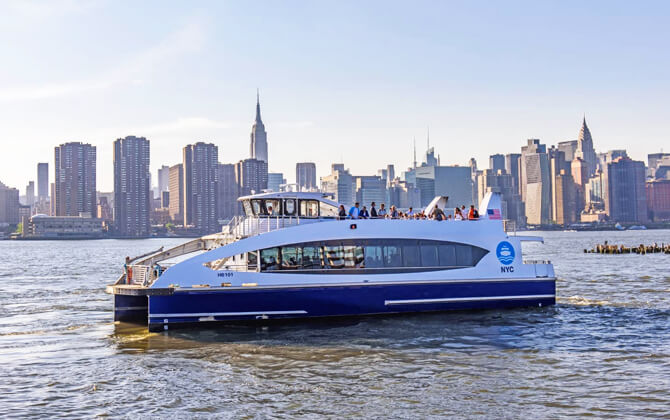
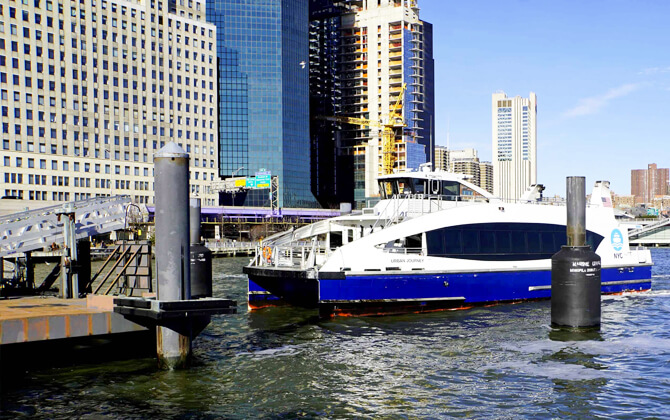
NYC Ferry operates 38 passenger vessels, making it the largest passenger fleet in the United States. The system includes 150-passenger and 350-passenger vessels, with route running time ranging from 20 to 90 minutes depending on the season.
The ferry system operates every day of the year and serves 25 ferry piers across all five boroughs. All vessels are ADA compliant and meet NYC Local Law 68 of 2005 requirements.
Fleet features include onboard washrooms, cup holders, charging outlets, work tables, and Wi-Fi. The vessels are primarily built from aluminum, a lightweight material used to improve fuel efficiency, and they are equipped with ultra-efficient T3 engines to help reduce emissions.
- 150-passenger vessels: 119 seats inside on the main deck and 28 seats outside on the upper deck.
- 350-passenger vessels: 166 seats inside on the main deck and 94 seats outside on the upper deck.
History
New York City has long depended on its waterways. Before bridges and tunnels reshaped city transport, ferries moved people and goods across the harbor, the East River, the Hudson River, and other waterways.
The earliest ferry service in New York dates to the Dutch colonial period. In 1642, Cornelius Dircksen created a ferry across the East River between New Amsterdam and what is now Brooklyn. By 1654, New Amsterdam’s government had begun regulating East River ferries. Service to New Jersey began in 1661, ferries on the Harlem River started in 1667, and a Staten Island ferry began in 1712.
Ferry service expanded over the following centuries. By 1904, 147 ferry services operated in New York City waters. In 1905, the City began its municipal ferry system by acquiring the Whitehall Street to Saint George route, which later became the Staten Island Ferry.
The decline began after the mid-1920s peak. The Stock Market Crash of 1929 and the Great Depression reduced city revenue, while bridges, tunnels, and automobile roads made many ferry routes less necessary. By 1945, only the Staten Island Ferry remained from the old municipal system.
Ferry travel revived in the 1980s and 1990s. In 2015, the city announced Citywide Ferry Service, later renamed NYC Ferry, and the first two routes opened on May 1, 2017.
NYC Ferry is not a direct recreation of the old municipal network, but it continues New York’s waterfront transportation history by linking neighborhoods, job centers, parks, and transit connections across the city.
Planned Expansions and Future Changes
NYC Ferry expansion plans include network changes and longer-term planning for new service. The New York City Economic Development Corporation announced an optimized system map with changes scheduled to begin operating on December 8, 2025. The updates are intended to give riders more places to go, improve travel times, and use ferry capacity more effectively during busy periods.
The East River route is planned to split into two routes at most times of day to increase available seats and speed up trips during high ridership periods. A local East River service will continue to connect all stops during weekday middays and winter weekends.
The Soundview and Rockaway routes are planned to combine, giving riders from Rockaway and Sunset Park direct service to Midtown and East 90th Street without a transfer. The St. George route will also be connected to Brooklyn and the rest of the system. The South Brooklyn route will provide direct Midtown access for Red Hook and Atlantic Avenue riders, with stronger summer weekend service to Sunset Park and Bay Ridge.
NYCEDC also identified infrastructure improvements, including upgrades to the East 34th Street landing with more queueing space, more vessel berths, and better passenger flow. A new homeport facility at Atlantic Basin in Red Hook has been completed.
Two possible future landing sites were identified for design and community engagement: East Harlem at 125 St along the Manhattan Greenway, and the MADE campus at Bush Terminal in Sunset Park.
NYCEDC also plans a Vision for the Future of Ferries in New York Harbor. It will examine public and private ferry service, potential new sites, full-time, part-time, and seasonal options, and infrastructure needs such as vessel charging.
NYC Ferry Travel Guide
NYC Ferry gives riders a scenic way to move between New York City neighborhoods while passing business districts, parks, cultural landmarks, bridges, and historic waterfronts. It works for commuting, sightseeing, and relaxed day trips.
On the East River route, riders pass historic landmarks and travel under the Brooklyn, Manhattan, and Williamsburg Bridges. The South Brooklyn route connects Brooklyn waterfront communities, including Red Hook and DUMBO. Astoria runs through western Queens and Roosevelt Island, while the Rockaway-Soundview route links the city with beaches and boardwalks.
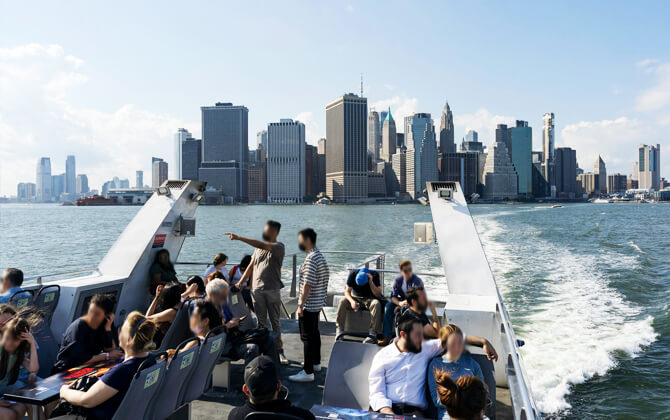
The St. George route travels between Staten Island and Manhattan along the Hudson River, with views of the Statue of Liberty. Governors Island is another popular stop for skyline views and outdoor time, with direct shuttle service on summer weekends and holidays from Wall Street/Pier 11.
Tickets can be purchased through the NYC Ferry app or at ticket kiosks on ferry landings. The app is useful for checking real-time schedules, service alerts, route maps, and timings today.
All ferries run seven days a week, but schedules vary by route. Arrive at the landing 10 to 15 minutes before departure, especially on weekends when service may run less frequently.
- Use the NYC Ferry app to buy tickets and check schedules.
- Choose the deck for the best views when weather allows.
- Avoid rush hour if you want a quieter ride.
- If leaving from Wall Street, the left side of the upper deck can offer better views.
Attractions Near NYC Ferry Stops
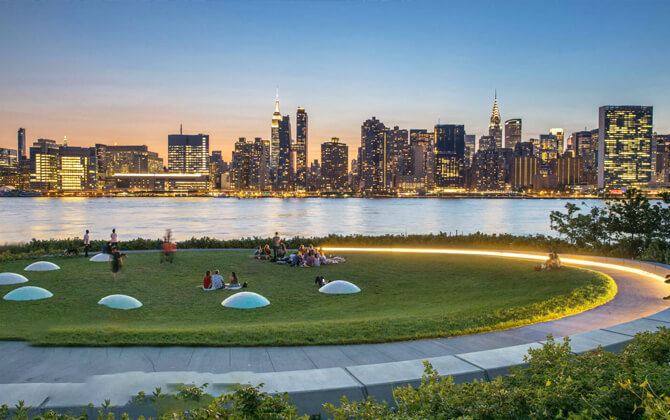
NYC Ferry connects riders to parks, museums, markets, restaurants, beaches, and waterfront views across the city. It is also one of the more scenic forms of transportation in New York, especially when the weather is good.
The East River route serves East 34th Street, Hunters Point South, Greenpoint, North Williamsburg, South Williamsburg, DUMBO, Governors Island, and Wall Street/Pier 11. It is a useful route for moving between waterfront neighborhoods and seeing the skyline from the water.
At Hunters Point South, Coffeed serves coffee, bagels, sandwiches, beer, and wine near the East River. Nearby, Hunters Point Community Library stands out on the waterfront, while Transmitter Brewing, The Creek, and The Cave add local beer, comedy, film screenings, and live music.
Greenpoint offers Transmitter Park, panoramic river views, Paulie Gee’s pizza, the Moonlight Mile, and Ovenly. North Williamsburg adds shopping, food, and nightlife, including Artists and Fleas, Smorgasburg, Rough Trade NYC, National Sawdust, Rider, OddFellows Ice Cream Co., and Brooklyn Bowl.
South Williamsburg has Baby’s All Right, Giando on the Water, and Urban Market of Williamsburg. DUMBO brings together Brooklyn Bridge Park, Empire Stores, Brooklyn Roasting Company, Jane’s Carousel, and PowerHouse Books.
Governors Island, open in warm-weather months, offers arts events, outdoor activities, food vendors, skyline views, and space to relax. Wall Street/Pier 11 places riders near the South Street Seaport, Pier 15, Watermark Bar, Industry Kitchen, and The Dead Rabbit.
The Rockaway service stops at Wall Street/Pier 11, Sunset Park, and Rockaway. Sunset Park includes Brooklyn Army Terminal and access to Industry City, while Rockaway Beach offers about 8 km (5 miles) of sand, boardwalk walks, surfing, and nearby food spots such as Cuisine by Claudette, Rockaway Beach Surf Club, Tacoway Beach, Rippers, and Thai Rock.
If you are planning a full day on the water, NYC Ferry makes it easy to combine multiple stops into one outing, with neighborhood food, waterfront parks, and city views along the way.