Edmonton Light Rail Transit, or Edmonton LRT, is the city’s light rail system and part of Edmonton Transit Service. It has three lines, 29 stations, and 37.4 km (23.2 miles) of track. Much of the route runs on a dedicated right-of-way, while parts of downtown are underground. The system opened in 1978 and, as of 2018, was the seventh busiest light rail system in North America, with more than 113,000 weekday riders.
| Key | Information |
|---|---|
| System | Edmonton Light Rail Transit (LRT), operated by Edmonton Transit Service |
| Lines | Capital Line, Metro Line, Valley Line |
| Stations | 29 |
| Network length | 37.4 km (23.2 miles) |
| Opening | Regular service began on April 22, 1978 |
| Service pattern | Frequency-based timetable with service generally running from about 5:00 a.m. to 1:00 a.m. daily |
| Operator | Edmonton Transit Service (ETS) |
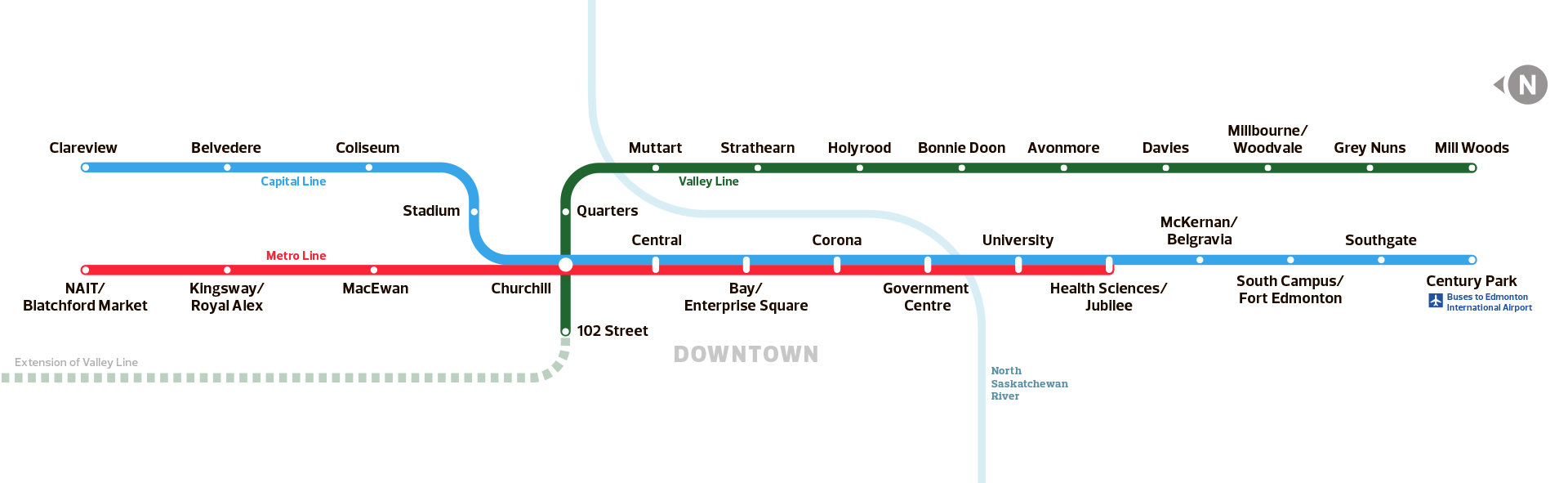
Edmonton LRT Map
Map of Edmonton LRT showing different lines. Click on the map to enlarge it or download the Edmonton LRT map in PDF format.
Lines and Stations
Edmonton LRT serves the city through three lines: the Capital Line, Metro Line, and Valley Line. The route plan mixes underground downtown sections with surface running on dedicated corridors. If you are checking the stations map or building a path train trip across the city, these three lines are the core of the system.
The Capital Line runs from Clareview in northeast Edmonton to Century Park in the south and has 15 stations. The Metro Line links NAIT/Blatchford Market with Health Sciences/Jubilee and shares part of its route with the Capital Line. The Valley Line is a low-floor line running between 102 Street downtown and Mill Woods, with westward expansion planned toward Lewis Farms.
Here is the current stations list by line.
| Station | Details |
|---|---|
| Clareview | Capital Line station; northeast terminus |
| Belvedere | Capital Line station |
| Coliseum | Capital Line station |
| Stadium | Capital Line station |
| Churchill | Capital Line and Metro Line shared station; main transfer point with the Valley Line via new street-level platforms |
| Central | Capital Line station |
| Bay/Enterprise Square | Capital Line station |
| Corona | Capital Line station |
| Government Centre | Capital Line station; access to the Dudley B. Menzies Bridge |
| University | Capital Line station |
| Health Sciences/Jubilee | Capital Line station and Metro Line southern terminus |
| McKernan/Belgravia | Capital Line station |
| South Campus/Fort Edmonton Park | Capital Line station |
| Southgate | Capital Line station |
| Century Park | Capital Line station; southern terminus and airport bus connection point |
| MacEwan | Metro Line station |
| Kingsway/Royal Alex | Metro Line station |
| NAIT/Blatchford Market | Metro Line northern terminus |
| 102 Street | Valley Line station; downtown terminus |
| Quarters | Valley Line station |
| Muttart | Valley Line station |
| Strathearn | Valley Line station |
| Holyrood | Valley Line station |
| Bonnie Doon | Valley Line station |
| Avonmore | Valley Line station |
| Davies | Valley Line station |
| Millbourne/Woodvale | Valley Line station |
| Grey Nuns | Valley Line station |
| Mill Woods | Valley Line station; southeast terminus |
Line totals are straightforward: Capital Line has 15 stations, Metro Line has 10, and Valley Line has 12. Blatchford Gate exists north of the current Metro Line route but is not open for passenger service.
Schedule
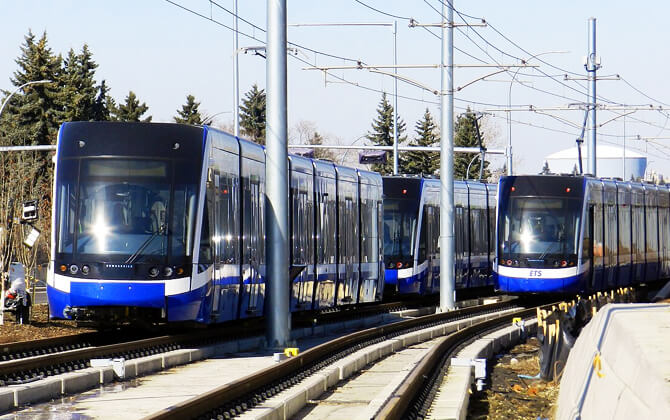
Edmonton LRT uses a frequency-based train schedule rather than a simple fixed-minute timetable. Operating hours generally run from about 5:00 a.m. to 1:00 a.m. daily, though exact opening hours, opening times, timings today, and closing time can vary by line and service period. If you are planning around the last train or checking the schedule today, it is smart to allow extra time in the evening and on weekends.
The Capital Line has the highest weekday peak frequency, the Metro Line runs less often, and the Valley Line follows its own timetable. Here is the route timetable by line.
| Service detail | Timings |
|---|---|
| Capital Line, Mon-Fri AM Peak: 6:00 a.m.-9:00 a.m. | Every 6 minutes |
| Capital Line, Mon-Fri Midday: 9:00 a.m.-2:30 p.m. | Every 10 minutes |
| Capital Line, Mon-Fri PM Peak: 2:30 p.m.-6:30 p.m. | Every 6 minutes |
| Capital Line, Mon-Fri Evening: 6:00 p.m.-end of service | Every 15 minutes |
| Capital Line, Sat-Sun all day | Every 15 minutes |
| Metro Line, Mon-Fri AM Peak: 6:00 a.m.-9:00 a.m. | Every 12 minutes |
| Metro Line, Mon-Fri Midday: 9:00 a.m.-2:30 p.m. | Every 15 minutes |
| Metro Line, Mon-Fri PM Peak: 2:30 p.m.-6:30 p.m. | Every 12 minutes |
| Metro Line, Mon-Fri Evening: 6:00 p.m.-end of service | Every 15 minutes |
| Metro Line, Sat-Sun all day | Every 15 minutes |
| Valley Line, Mon-Fri AM Peak: 6:00 a.m.-10:00 a.m. | Every 5 minutes |
| Valley Line, Mon-Fri Midday: 10:00 a.m.-2:30 p.m. | Every 10 minutes |
| Valley Line, Mon-Fri PM Peak: 2:30 p.m.-6:30 p.m. | Every 5 minutes |
| Valley Line, Mon-Fri Evening: 6:30 p.m.-9:30 p.m. | Every 10 minutes |
| Valley Line, Mon-Fri Late Night: after 9:30 p.m. | Every 15 minutes |
| Valley Line, Saturday start of service-6:30 p.m. | Every 10 minutes |
| Valley Line, Saturday 6:30 p.m.-end of service | Every 15 minutes |
| Valley Line, Sunday all day | Every 15 minutes |
For quick trip planning, the main service frequency is about every 6 minutes on the Capital Line during weekday peaks, every 12 minutes on the Metro Line during peaks, and every 5 minutes on the Valley Line during weekday peak periods. That said, evening running time between trains gets longer, especially on Capital and Metro services.
Fares and discounts
Edmonton LRT fares apply across ETS bus and rail services. You can pay with cash, an Arc card, Arc tickets, or physical or digital debit and credit cards. For proof-of-payment travel, riders should tap their ticket or card on validators at station entrances when required.
As of February 1, 2025, the standard adult fare is CA$3.75 (US$2.76) with cash, or CA$3.00 (US$2.21) with an Arc card or debit/credit card. Children 12 and under ride free when accompanied by a fare-paying rider. If you are comparing fare, price, ticket price, or cost, Arc is the cheaper option.
| Service detail | Timings |
|---|---|
| Cash fare | CA$3.75 (US$2.76) |
| Arc card fare | CA$3.00 (US$2.21) |
| Debit/credit card fare | CA$3.00 (US$2.21) |
| Children 12 and under | Free |
| Day pass (family) | CA$10.25 (US$7.54) |
| Monthly adult fare cap | CA$102.00 (US$75.04) |
| Arc card pay-as-you-go 90 min | CA$3.00 (US$2.21) |
| Arc card daily fare cap | CA$10.50 (US$7.72) |
| Arc ticket 90 min | CA$3.75 (US$2.76) |
| Arc ticket 24 hr | CA$10.50 (US$7.72) |
| ETS Arc 3-day pass | CA$24.00 (US$17.65) |
| ETS Arc 5-day pass | CA$30.00 (US$22.06) |
| ETS Airport + 3-day pass | CA$36.00 (US$26.47) |
| ETS Airport + 5-day pass | CA$42.00 (US$30.88) |
Reduced fares and special pass options are available for eligible riders, including seniors, youth, children, people with disabilities, and some agencies and employers. ETS also lists programs such as low-income senior annual passes, youth monthly caps, ETS@Work, CNIB free travel with valid ID, DATS fare rules, and the Transit Access Grant program.
Arc multi-day passes are valid only on ETS buses and LRT. They do not apply on Route 747 or regional transit services. Also worth noting: paper tickets with an expiry date of December 31, 2023, and Family/Day passes with an expiry date of 2024 are not accepted as valid fare in 2026. Until March 31, 2026, unused single ETS paper tickets and Family/Day passes can be exchanged for Arc single-use tickets at the Edmonton Service Centre.
There is no fare calculator provided here, but riders usually get the best price by using the same payment method each time they tap. Arc cards and Arc tickets are sold at vending machines, service centres, and other authorized outlets, and Arc cards can also be bought online or by phone.
Connections
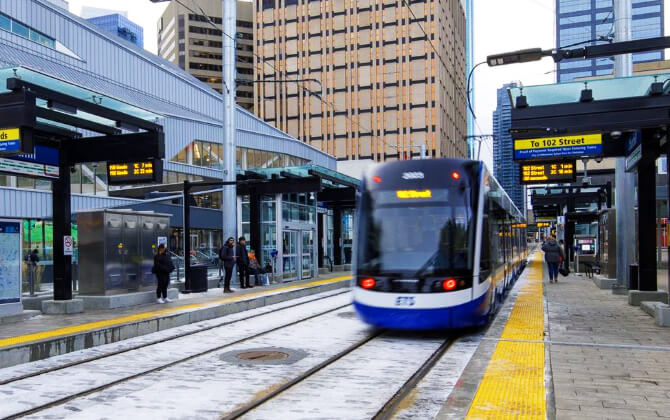
Edmonton LRT is built to make transfers fairly easy across the city transport network. Many stations connect directly to transit centres, so moving between trains and bus services is a routine part of local transport.
The Capital Line links Clareview with Century Park, the Metro Line connects NAIT/Blatchford Market with Health Sciences/Jubilee, and the Valley Line runs between Mill Woods and 102 Street. Churchill Station is the key transfer point between the Valley Line and the rest of the LRT system. Parts of the Metro Line also share track with the Capital Line, which helps knit the whole transport system together.
Downtown underground stations connect to the Edmonton Pedway system, giving riders access to nearby buildings without stepping outside. The LRT also crosses the North Saskatchewan River on the Dudley B. Menzies Bridge, a dedicated bridge for trains and pedestrians between Government Centre and University stations.
Beyond the rail network, ETS connections extend to the Edmonton International Airport and to nearby transit agencies including Leduc Transit, St. Albert Transit, and Strathcona County Transit.
Connection to the Airport
Edmonton LRT does not go directly to Edmonton International Airport. For airport public transport, riders need to take the Capital Line to Century Park Transit Centre and transfer to ETS Route 747.
Route 747 operates seven days a week from 4:10 a.m. to 12:30 a.m., with service every 30 to 60 minutes. The bus trip takes about 24 minutes and runs nonstop between Century Park and the airport. On the return trip, the bus leaves from Door 8 at the airport and stops at the Premium Outlet Collection Mall and Costco before continuing to Century Park.
The one-way ticket price for Route 747 is CA$5.00 (US$3.68), or two adult ETS tickets. A monthly pass costs CA$90.00 (US$66.21) and is not transferable to regular ETS service. No additional fare applies for holders of a UPass, a Leduc Commuter-Plus pass, or a transfer from Leduc Route 10 to Route 747.
Because ETS uses a timed-transfer system, Century Park works as the main airport connection point for transportation in Edmonton by train and bus.
Security
ETS uses several layers of security across the LRT system to help keep riders and staff safe. Measures include CCTV, operator alert systems on trains, blue emergency help phones in stations, and patrols by transit peace officers.
Transit Watch Program
The Transit Watch program lets riders report harassment, disorder, suspicious behaviour, and other safety concerns directly to ETS staff in the Control Centre. You can call or text 780-442-4900 at any time.
For emergencies, call 911 immediately.
If you text Transit Watch, include clear details such as whether you are on a bus or train, which station or vehicle is involved, and what is happening. ETS says staff monitor the line around the clock and should send a confirmation text within a minute or two.
If possible, use an emergency blue phone on LRT platforms or at transit centres. Riders are also advised not to confront suspicious individuals or touch suspicious objects, packages, or substances.
Transit peace officers and security support
Transit peace officers work with the Control Centre and police officers to respond to incidents on transit property. Transit Security Dispatchers provide additional support behind the scenes.
ETS also uses community outreach transit team support to connect people on ETS property with specialized community services, including housing, mental health, financial, and substance use support.
Emergency equipment on the LRT
Inside LRT cars, yellow passenger alarms, red alarm handles above alternating doors, and red emergency buttons next to door buttons can be used to alert the operator during an urgent situation.
Blue emergency help phones are installed in all LRT stations, major bus terminals, and some city pedways. When activated, they connect directly to the ETS Control Centre and automatically trigger camera monitoring of the area.
In underground tunnels, cell service can be unreliable. If that happens and you do not want to wait for signal, use the onboard help button to contact the operator directly.
Safety reminders
When LRT gates have been activated and the arms start going down at certain stations, the operator will not reopen the doors for boarding. When getting on or off, make sure the people traveling with you and your belongings are on the same side of the door.
In proof-of-payment areas, passengers must show valid proof of payment when asked by a transit peace officer. This includes Arc cards and transfers. Failure to provide proof of payment can result in a CA$250 fine (US$183.91).
Fun Facts
Edmonton LRT has a few standout points in its history and day-to-day operation. It opened regular service on April 22, 1978, and made Edmonton the first city in North America with a metropolitan population under one million to launch a modern light rail system.
It was also the first rapid transit system in Western Canada. The original line was 6.9 km (4.3 miles) long and opened in time for the 1978 Commonwealth Games.
Today the system covers 37.4 km (23.2 miles) and uses three different LRV models: Siemens-Duewag U2, Siemens SD-160, and Bombardier/Alstom Flexity Freedom vehicles. The North Saskatchewan River crossing on the Dudley B. Menzies Bridge is another memorable feature.
Every station built since 1983 has been fully accessible for persons with disabilities. As of 2018, the network ranked as the seventh busiest light rail system in North America, with more than 113,000 weekday riders.
The Valley Line Southeast opened on November 4, 2023, adding 11 new stops to the system. Daily working hours generally run from about 5:00 a.m. to 1:00 a.m., though train frequency and timetable details vary by line.
- Capital Line: Clareview to Century Park
- Metro Line: NAIT/Blatchford Market to Health Sciences/Jubilee
- Valley Line: 102 Street to Mill Woods
History
The history of Edmonton LRT starts with transportation studies in the 1960s and early 1970s, when rapid population growth pushed the city to look for new public transport options. In 1973, City Council approved an integrated light rail option for the northeast corridor, and construction began in 1974 with a budget of CA$65 million (US$47.82 million).
Regular service started on April 22, 1978. The original route ran 6.9 km (4.3 miles) from Belvedere to Central Station, with stops at Coliseum, Stadium, and Churchill, plus a downtown tunnel. The system was planned with future growth in mind, and every station built since 1983 has included full accessibility.
Expansion followed over the next decades. The line reached Clareview in 1981, Bay and Corona in 1983, and Government Centre in 1989. In 1992, the University extension opened and crossed the river on the Dudley B. Menzies Bridge. Later upgrades at Belvedere and Clareview added roofs and longer platforms for five-car trains.
The network kept growing with the Health Sciences extension in 2006, South Campus and McKernan/Belgravia in 2009, and Century Park in 2010, bringing the network to 21 km (13.0 miles). The Metro Line began limited service in 2015, adding a 3.3 km (2.1 miles) branch from Churchill to NAIT.
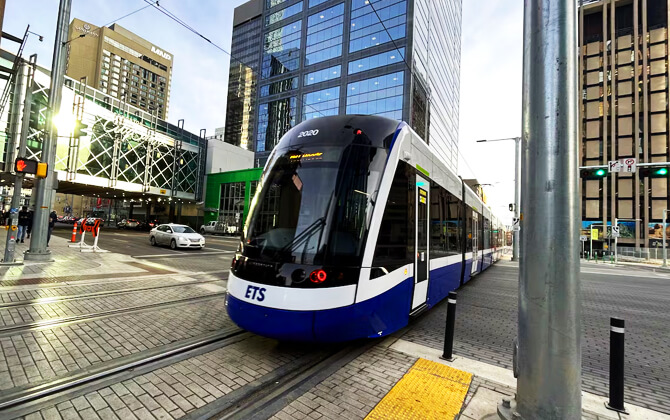
A new chapter began with the Valley Line. Construction on the first phase started in 2016, and the 13 km (8.1 miles) Valley Line Southeast opened on November 4, 2023, linking downtown with Mill Woods through 11 street-level stops and one elevated station at Davies. New street-level platforms and an entrance were also added at Churchill to improve transfers.
In January 2024, Metro Line Northwest Phase 1 opened as a 1.6 km (1.0 mile) extension with NAIT/Blatchford Market Station and Blatchford Gate Station, although Blatchford Gate is not yet open for passenger service.
Future Expansions
Expansion remains a major part of Edmonton’s long-term transport plan. Under The City Plan, future LRT projects are meant to improve transportation in Edmonton along major corridors and connect growing areas of the city.
Valley Line West is a 14 km (8.7 miles) extension from Downtown to Lewis Farms with 14 stops and two stations, and construction is expected to be complete in 2028. Metro Line Northwest Phase 2, from Blatchford to Castle Downs, has approved land acquisition, but construction funding is still not secured, so there is no firm opening timeline.
Capital Line South Phase 1 is a 4.5 km (2.8 miles) extension from Century Park to north of Ellerslie Road, and major construction began in 2025. Further plans include Metro Line Northwest Phase 3 from Castle Downs to Nakî, additional Capital Line extensions from Heritage Valley North to Desrochers/Allard and from Clareview to Gorman, plus other possible future lines in the broader route plan.
Building a new LRT line takes time. Planning, engineering, public engagement, construction, testing, and commissioning all come before service can open.
Tourist Attractions
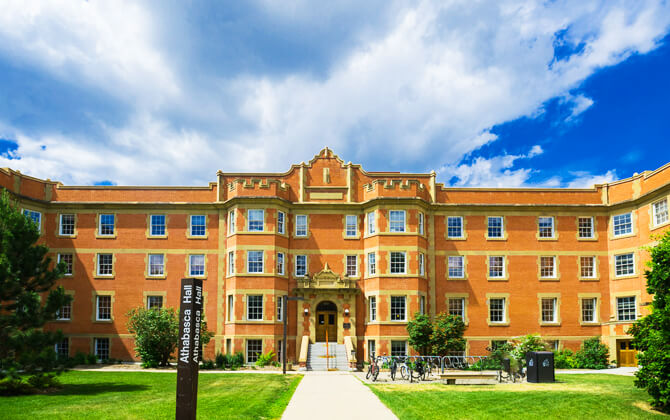
For visitors, Edmonton LRT is more useful as city transport than as a sightseeing attraction on its own. It can be a practical way to reach downtown, the University of Alberta, Southgate Mall, NAIT, and the Royal Alexandra Hospital without driving.
Rider feedback often describes it as a cost-effective option for short trips, though some reviews also mention delays, construction, cleanliness issues, and security concerns at certain stations. So, it helps to plan ahead and check the current schedule if you are using it as part of a day out.
The airport connection through Century Park can also be handy for travelers, especially if you are already using the Capital Line. In short, it works best as part of your wider local transport plan rather than as a standalone attraction.
- Good for: downtown trips, university access, and major malls and hospitals
- Travel note: some reviews mention construction, delays, and security concerns at certain stations
- Best use: a practical public transport link for getting around the city