Chongqing Rail Transit, usually called CRT or the Chongqing Metro, is the rapid transit system serving Chongqing, China. It has been operating since 2005 and covers key business, residential, and entertainment areas across the city and inner suburbs. As of February 2026, the system has 12 lines with a total network length of 574.12 km (356.74 miles). It combines heavy metro lines and high-capacity monorails, a practical fit for Chongqing’s steep hills, deep valleys, and dense urban form. The network is known for deep stations, major river crossings, and infrastructure built for sharp curves and big elevation changes, with more expansion under way.
| Key | Information |
|---|---|
| System name | Chongqing Rail Transit (CRT) |
| Also known as | Chongqing Metro |
| City | Chongqing, China |
| Opened | 2005 |
| Lines in operation | 12 |
| Network length | 574.12 km (356.74 miles) |
| System type | Heavy metro, monorail, and loop line |
| Typical daily operating hours | 6:30 am to 10:30 pm |
| Fare range | CNY 2-10 (about USD 0.28-1.39) |
| Notable features | Deep stations, monorail lines, metro-only bridges, terrain-adapted design |
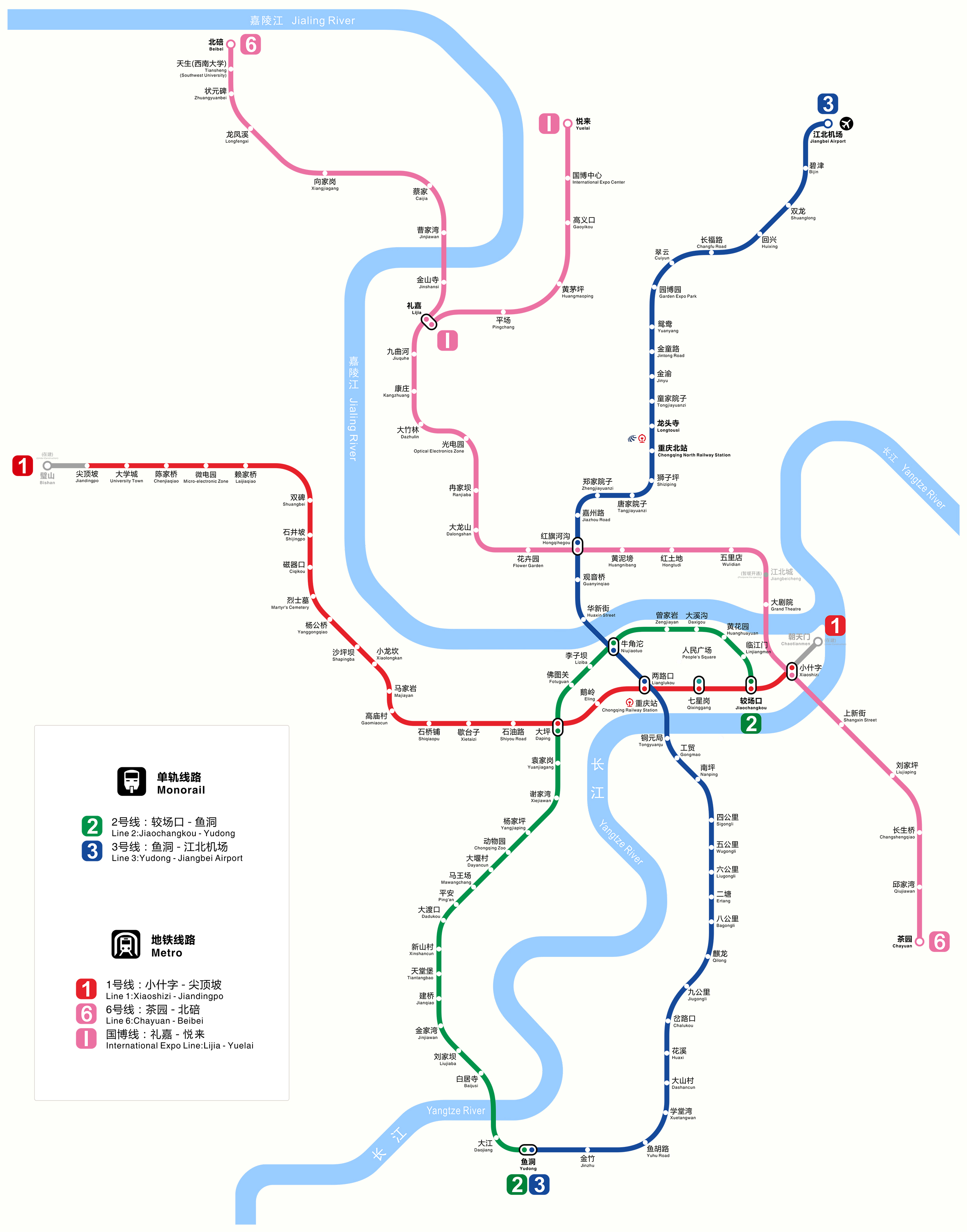
Chongqing Rail Transit Map
Map of Chongqing Rail Transit System showing different lines and stations. Click on the map to enlarge it or download the Chongqing Rail Transit System map in PDF format.
Lines and Stations
As of February 2026, Chongqing Rail Transit has 12 lines and 574.12 km (356.74 miles) of track. The system includes standard metro lines, high-capacity monorails, and a loop line linking major urban districts. It serves as a core part of city transport in Chongqing, especially in areas where hills and rivers make road travel slower.
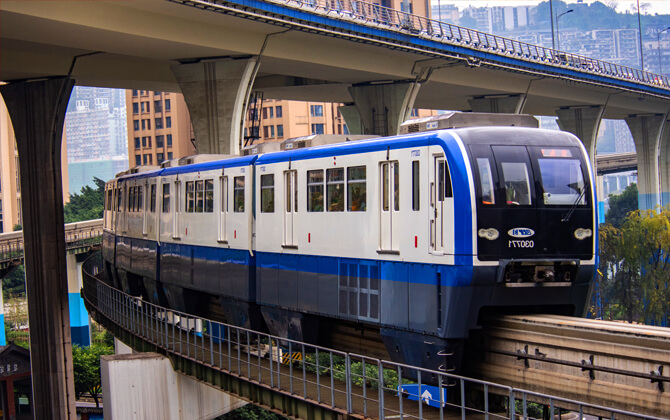
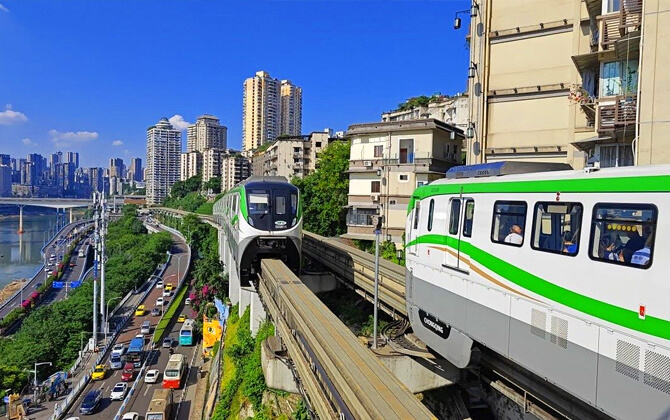
The main lines in service are Lines 1, 4, 5, 6, 9, 10, 18, the Loop line, Jiangtiao line, and Bitong line. Lines 2 and 3 are monorails. The Loop line, also called Line 0, connects major rail hubs including Chongqing North railway station, Shapingba railway station, and Chongqing West railway station.
Line 1 runs from Chaotianmen to Bishan and connects central areas such as Jiefangbei, Lianglukou, Daping, and Shapingba. Line 2 runs from Jiaochangkou to Yudong. Line 3 links Yudong with Jiangbei Airport and includes a branch between Bijin and Jurenba. Other routes include Line 4 from Min’an Avenue to Huangling, Line 5 from Yuegangbeilu to Tiaodeng, Line 6 with branches serving Beibei, Shaheba, and Chongqing East Railway Station, Line 9 from Gaotanyan to Huashigou, Line 10 from Wangjiazhuang to Lanhualu, and Line 18 from Fuhualu to Tiaodengnan. Jiangtiao line runs from Tiaodeng to Shengquansi, and Bitong line links Bishan with Tongliangxi.
| Station | Details |
|---|---|
| Loop line | 51 km (31.69 miles), 33 stations |
| Line 1 | Chaotianmen-Bishan, 43.7 km (27.15 miles), 25 stations |
| Line 2 | Jiaochangkou-Yudong, 31.4 km (19.51 miles), 25 stations |
| Line 3 | Yudong-Jiangbei Airport, 56.1 km (34.86 miles), 45 stations |
| Line 4 | Min’an Avenue-Huangling, 58 km (36.04 miles), 32 stations |
| Line 5 | Yuegangbeilu-Tiaodeng, 48.66 km (30.24 miles), 32 stations |
| Line 6 | Chayuan-Beibei, 70.1 km (43.56 miles), 43 stations |
| Line 9 | Gaotanyan-Huashigou, 40.1 km (24.92 miles), 29 stations |
| Line 10 | Wangjiazhuang-Lanhualu, 43.3 km (26.90 miles), 26 stations |
| Line 18 | Fuhualu-Tiaodengnan, 28.96 km (18.00 miles), 19 stations |
| Jiangtiao line | Tiaodeng-Shengquansi, 28.2 km (17.52 miles), 7 stations |
| Bitong line | Bishan-Tongliangxi, 37.5 km (23.30 miles), 8 stations |
| Total | 574.12 km (356.74 miles), 324 stations |
Important stations and interchanges include Shapingba, Ranjiaba, Wulidian, and Chongqing North Station South Square. If you are checking a stations map or stations list before a trip, those are some of the key points to know.
Timetable & Operating Hours
Chongqing Rail Transit runs daily, with general operating hours from 6:30 am to 10:30 pm. These opening hours and closing time apply to the network overall, though exact opening times, starting time, and last train timings can vary by line, station, and direction. For timings today or a train schedule for a specific route, it is best to check the relevant station timetable.
Peak-period frequency can be shorter on some lines. The system also offers a one-hour free transfer policy, which is useful if your route plan includes multiple lines. Keep in mind that service details may differ by line, so a route timetable checked in advance can save time.
Useful travel notes
- One-hour free transfer policy is available.
- Peak hours may have shorter train frequency on some lines.
- Schedule today, running time, and last train details can vary by line and direction.
Service overview
| Service detail | Timings |
|---|---|
| Network operating hours | 6:30 am to 10:30 pm daily |
| Opening hours note | Individual stations and lines may have different first and last train times |
| Transfer policy | One-hour free transfer policy available |
| Frequency | Shorter intervals may apply during peak hours on some lines |
Chongqing Rail Transit Fares, Tickets and Cards
CRT uses a distance-based fare system and offers several ticket options for regular riders and visitors. You can pay with single-use tickets, a pass, or transport cards used across local transport and public transport in the city.
Transport cards
CRT accepts the Life & Transport Card, also called the Chongqing Universal Card, along with compatible cards from partner cities in China. Using the Regular Card on public transport in Chongqing gives a 10% discount. When transferring between bus and metro within 1 hour, the higher fare is charged based on payment time, but this does not apply to metro-to-metro transfers.
The Regular Card can be bought at any CRT station, and the deposit is refundable if the card is returned with its receipt. The card can also be used in many shops, cinemas, and restaurants in Chongqing. Students’ Cards and Elders’ Cards need a cash sub-account to be used on the metro; that sub-account is free and gives a 50% discount.
Ticket types
- Single Journey Ticket: valid on the date of purchase for one trip only.
- Souvenir Ticket: issued for holidays and special events and not recycled after use.
- Fixed Journey Ticket: allows a set number of trips within the validity period.
- One-day Travel Pass: CNY 18 (about USD 2.50) for unlimited metro travel for 24 hours after first use.
- Chongqing Public Transportation Card (Yiju Changtong Card): works on other city transport, including bus services, and gives a 10% discount on subway fares.
Fare policy
The ticket price depends on travel distance. The standard fare ranges from CNY 2 to CNY 10 (about USD 0.28 to 1.39). All trips must be completed within 3 hours after entering the paid area, or the highest price in the system will be charged.
| Travel distance | Fare |
|---|---|
| 0-6 km (0-3.73 miles) | CNY 2 (about USD 0.28) |
| More than 6 km to 11 km (3.73-6.84 miles) | CNY 3 (about USD 0.42) |
| More than 11 km to 17 km (6.84-10.56 miles) | CNY 4 (about USD 0.56) |
| More than 17 km to 24 km (10.56-14.91 miles) | CNY 5 (about USD 0.69) |
| More than 24 km to 32 km (14.91-19.88 miles) | CNY 6 (about USD 0.83) |
| More than 32 km to 41 km (19.88-25.48 miles) | CNY 7 (about USD 0.97) |
| More than 41 km to 51 km (25.48-31.69 miles) | CNY 8 (about USD 1.11) |
| More than 51 km to 63 km (31.69-39.15 miles) | CNY 9 (about USD 1.25) |
| Over 63 km (39.15 miles) | CNY 10 (about USD 1.39) |
How to buy and use tickets
Single-use tickets are available from station vending machines and information booths. Machines have English interfaces and accept coins and notes, and some also accept WeChat payments. If you are staying in Chongqing for more than a few days, an IC Transportation card is often the easiest option. It costs about CNY 20 (about USD 2.78) as a one-time purchase, can be topped up at stations, and can be used on CRT and local bus services.
Connections to Other Systems
Chongqing Rail Transit is closely tied into the wider transport system and supports transfers between metro, suburban rail, intercity rail, bus routes, taxis, and station parking facilities. It is a major part of transportation in Chongqing and helps connect business districts, residential areas, and railway hubs across the city’s steep terrain.
Within the rail network, Line 1 connects with Line 6 at Xiaoshizi, Line 2 at Jiaochangkou, Line 3 at Lianglukou, and the Loop line at Shapingba, where an out-of-station transfer is currently needed. The Loop line links Chongqing North railway station, Shapingba railway station, and Chongqing West railway station.
CRT also connects with national railway services at Chongqing East railway station through a branch of Line 6. Line 8, Line 24, and Line 27 are planned to stop there as well, although Line 8 is still in long-term planning and has not yet been approved by the NDRC.
There are also interline operations to make travel easier. Cross-line operation among Line 4, the Loop line, and Line 5 has been introduced, and the Jiangtiao line already has through service with Line 5. This reduces transfer time and improves network convenience.
Airport Connections
Chongqing Jiangbei International Airport is connected by metro, airport shuttle bus, taxi, and intercity bus. The airport has three terminals, and free shuttle buses run between T2 and T3 from 04:30 to 22:30, with a running time of about 20 minutes.
By Metro
Line 3 and Line 10 both serve the airport. Line 3 goes to Terminal 2, while Line 10 serves both Terminal 2 and Terminal 3. Line 3 runs from 06:30 to 22:30 with a frequency of about 2.5 to 5 minutes. Line 10 operates from 06:30 to 23:00, with trains about every 10 minutes.
Fares are distance-based. Line 3 costs CNY 2-9 (about USD 0.28-1.25), and Line 10 costs CNY 2-5 (about USD 0.28-0.69). Boarding points include the parking lot, Passenger Service Area C, and T2B for Line 3, while Line 10 entrances and exits are at Terminal 2.
By Airport Shuttle Bus
Several airport bus routes connect the airport with key parts of Chongqing. K01 goes to Jiefangbei, K05 to Nanping Dadi Education School, K06 to Chongqing West Railway Station, K07 to Shapingba Railway Station, and K08 to West Daxuecheng Road.
K01 runs from 08:30 until 30 minutes after the last flight arrival, and the return service operates from 05:30 to 21:00. The fare is CNY 15 (about USD 2.08), and the trip takes about 70 minutes. K05 also costs CNY 15 (about USD 2.08) and takes about 58 minutes. K06 costs CNY 20 (about USD 2.78) and takes about 70 minutes. K07 costs CNY 15 (about USD 2.08) and takes about 70 minutes. K08 costs CNY 20 (about USD 2.78) and takes about 75 minutes.
By Taxi
Official taxi stands are located between T2A and T2B and in the T3A parking lot. English signs inside the terminal help passengers find them. Taxi fare starts at about CNY 10 (about USD 1.39) for the first 3 km (1.86 miles), then adds CNY 2 (about USD 0.28) per extra kilometer.
Typical fares from the airport are CNY 60-70 (about USD 8.34-9.73) to Jiefangbei CBD, CNY 60-70 (about USD 8.34-9.73) to Chaotianmen Dock, CNY 90-100 (about USD 12.51-13.90) to Chongqing West Railway Station, and CNY 40-50 (about USD 5.56-6.95) to Chongqing North Railway Station. Travel time is usually around 20 to 45 minutes.
Intercity Bus Connections
The long-distance bus station is between T2A and T2B. It serves suburban districts in Chongqing and cities in Sichuan, Guizhou, and Hubei, including Zigong, Neijiang, Suining, Nanchong, Guang’an, Zunyi, Chichui, Dazu, Beibei, Fuling, Langzhong, Yibin, and Bazhong.
Shorter trips include Beibei at CNY 10 (about USD 1.39) with a journey of about 40 minutes, and Guang’an at CNY 51 (about USD 7.09) with a running time of about 1.5 hours. Longer routes such as Yibin and Bazhong take about 3.5 hours and 4.5 hours.
Parking near the Metro
Near Chongqing Hongyadong Parking Lot in Jiangbei District, public transport is an easy way to continue your trip. The nearest metro station is Linjiangmen, about a 6-minute walk away. Other nearby stations are Grand Theater and Xiaoshizi.
If you are using local transport by bus, the closest stop is Xiaoshizi, around a 1-minute walk away. Other nearby stops include Linjiangmen, Wuyi Road, Xiaoshizi Small Commodities, and Hongyadong.
Metro access in the area includes Line 1, Line 2, and Line 6. Nearby bus routes include 114, 151, 262, 322, and 402.
For timings today, the first metro nearby is Line 1 at about 6:30 am. The last train mentioned for the area is Line 6 at about 11:19 pm. The first bus is Route 0491 Night Service at about 5:10 am, and the last bus is Route 181 at about 10:49 pm.
Specific parking charges, parking charges per day, and station parking rates are not provided here, but the area is well connected for park-and-go trips on foot.
Rules and Tips
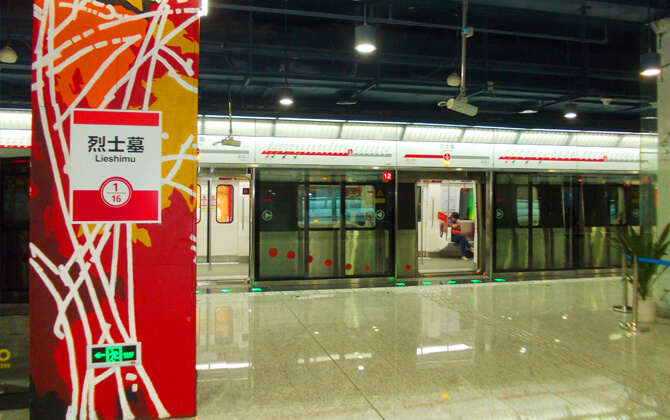
For a smoother trip, keep a few simple rules in mind. The metro works daily, with service generally starting around 6:30 am and ending around 11:30 pm in this section, though actual operating hours can vary by station and line. Try to complete your journey within 3 hours, including transfers, or the highest one-way fare may be charged.
CRT is one of the fastest ways to get around Chongqing, but stations can get crowded during peak periods and major events. At times, stations may close temporarily to manage passenger flow, so checking service notices before you travel is a smart move.
Standard metro rules apply: no smoking, vaping, drinking, or eating. Do not block the doors, and leave priority seats for passengers with mobility needs, pregnant people, older people, and people with injuries or disabilities.
Accessibility is available across almost the whole system. Nearly every station has elevators and accessible toilets, and almost every train has wheelchair locks. Some older rolling stock and older interchange passages on Line 2 are not fully accessible.
Line 10 trains have luggage racks in each car, which is handy for airport trips. Small pets in carriers and folding bicycles are allowed. QR code payment can also be used, but make sure one code is used for one person and your phone has enough battery.
The system is generally safe, but as with any busy city transport network, keep an eye on your belongings and follow station instructions.
If you travel with a transit card, you can use the free transfer policy within 60 minutes across metro lines, buses, or the Lianglukou and Kaixuan Road elevators.
History
Chongqing Rail Transit grew out of the city’s long-standing need for efficient transport in a dense and mountainous urban setting. Early proposals go back to the 1940s, when a metro was first suggested for central Chongqing. In the 1950s, a subway plan for Jiaochangkou in Yuzhong District was proposed but later suspended.
In the 1980s, the Chongqing Municipal People’s Government made rail transit a priority and began research and planning. Chongqing Rail Transit Corporation, now Chongqing Rail Transit (Group) Co., Ltd., was founded in 1992. After Chongqing became a municipality in 1997, a proposal for Line 2 was submitted to the State Council.
In 2000, the Phase I section from Jiaochangkou to Dayancun was included in China’s Western Development key projects, and construction began in December. Line 2 opened in 2005, becoming the city’s first rapid transit line.
Expansion picked up after that. Work on Lines 1 and 3 started in 2007. On 26 November 2008, total passenger volume reached 100 million. In 2009, the company was renamed Chongqing Rail Transit (Group) Co., Ltd., and Line 6 entered full construction.
Line 1 began trial operation between Xiaoshizi and Shapingba on 28 July 2011, followed by Line 3 between Lianglukou and Yuanyang on 29 September 2011. In 2012, several sections of Lines 1, 3, and 6 opened, and Line 6 expanded further in 2013. The Loop line was launched on 28 October 2013.
More sections opened through the mid-2010s and later, including parts of Lines 1, 2, and 6 in 2014, the Bijin-Jurenba branch of Line 3 in 2016, and trial operation of Lines 5 and 10 in 2017. From 2018 onward, the network added more of the Loop line, Line 4, extensions on Line 5, Line 18, the Line 4 western extension, and the Bitong line.
Chongqing’s geography heavily shaped the system’s history. Steep slopes, river valleys, and hilly plateaus made conventional alignments difficult, which is why monorail technology was adopted for Lines 2 and 3. The network also includes major metro-only bridges such as the Caijia Rail Transit Bridge on Line 6 and the Egongyan Rail Transit Bridge on the Loop line.
As of February 2026, CRT has 12 lines and remains in active expansion.
Future Extensions
Chongqing Rail Transit expansion is continuing as the city grows. Long-term plans call for a much larger system by 2050, with a target of 30 lines and about 1,473 km (915.25 miles) of network length. In the nearer term, the 14th Five-Year Plan for 2021-2025 says Chongqing aims for an operating network of about 600 km (372.82 miles) by 2025.
Projects expected to open between 2025 and 2027 include the western extension of Line 4, the eastern extension of Line 6, Line 15, the northern extension of Line 18, Line 24, Line 27, and Phase 2 of the Jiangtiao line. Construction is also planned or under preparation for Line 7 and Line 17.
These additions are meant to improve access across the main urban area and surrounding districts, strengthen links to major transport hubs, and reduce pressure on busy commuting corridors.
- Line 4: western extension
- Line 6: eastern extension to Chongqing East Station
- Line 15: Phase 1 and Phase 2
- Line 18: northern extension to Xiaoshizi
- Line 24: Phase 1
- Line 27: full line
- Jiangtiao line: Phase 2
- Line 7 and Line 17: planned Phase 1 projects
Nearby Attractions
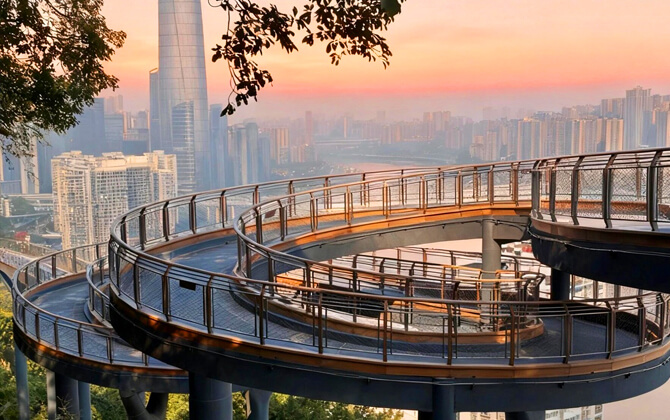
If you are visiting Liziba Station, there are several worthwhile places nearby. The area mixes rail-transit views, local history, city scenery, and food stops, so it works well for a short route.
- Liziba Anti-Japanese War Relics Park – Near Liziba Station, this site commemorates the victory of the War of Resistance Against Japan and includes historical buildings such as Liu Xiang Mansion and Li Gengu’s Former Residence.
- Three Gorges Museum – About 3 km (1.86 miles) from Liziba Station, this museum focuses on Ba-Yu and Sanxia culture and holds more than 115,000 sets of cultural relics and 18,000 rare books.
- E’ling Park – Also called Goose Neck Park, this attraction combines older architecture and private gardens with views of the Yangtze River and Chongqing.
- Liziba Old Street – Close to the station, this is a good stop for local snacks and dishes including Liziba Liangshan Chicken, Ba Xiang Yuan Wuyu Hua, Cha Pao Fan, and hotpot.
These sights pair well with a visit to Liziba Station, especially if you want a quick plan that combines photography, sightseeing, and local food.