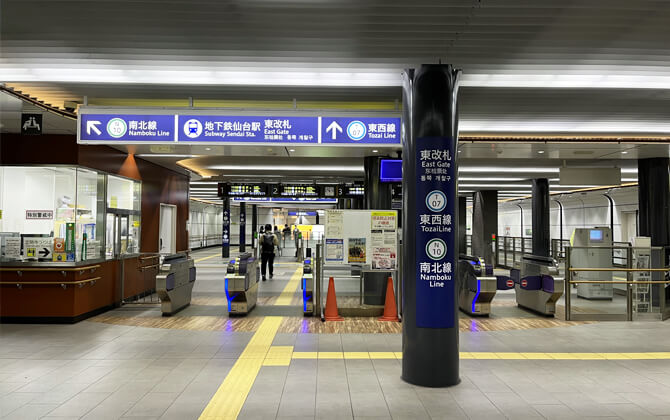
The Sendai Subway is the rapid transit system serving Sendai, the largest city in the Tohoku region and the capital of Miyagi Prefecture. Operated by the Sendai City Transportation Bureau, the system has two lines: the north-south Namboku Line and the east-west Tozai Line. Both meet at Sendai Station, the main interchange for subway, rail, bus, and wider transportation in Sendai.
| Key | Information |
|---|---|
| System | Sendai Subway, operated by the Sendai City Transportation Bureau |
| City | Sendai, Miyagi Prefecture, Japan |
| Lines | Namboku Line and Tozai Line |
| Main interchange | Sendai Station |
| Opening history | Namboku Line opened in 1987; Tozai Line opened in December 2015 |
| Network role | A key part of Sendai public transport, local transport, and city transport |
| Cards and passes | Icsca, Suica, Pasmo, One-day Subway Pass, and Loople Bus and Subway One-Day Pass |
| Earthquake service note | Damaged after the 11 March 2011 Tohoku earthquake and tsunami; reopened on 29 April 2011 |
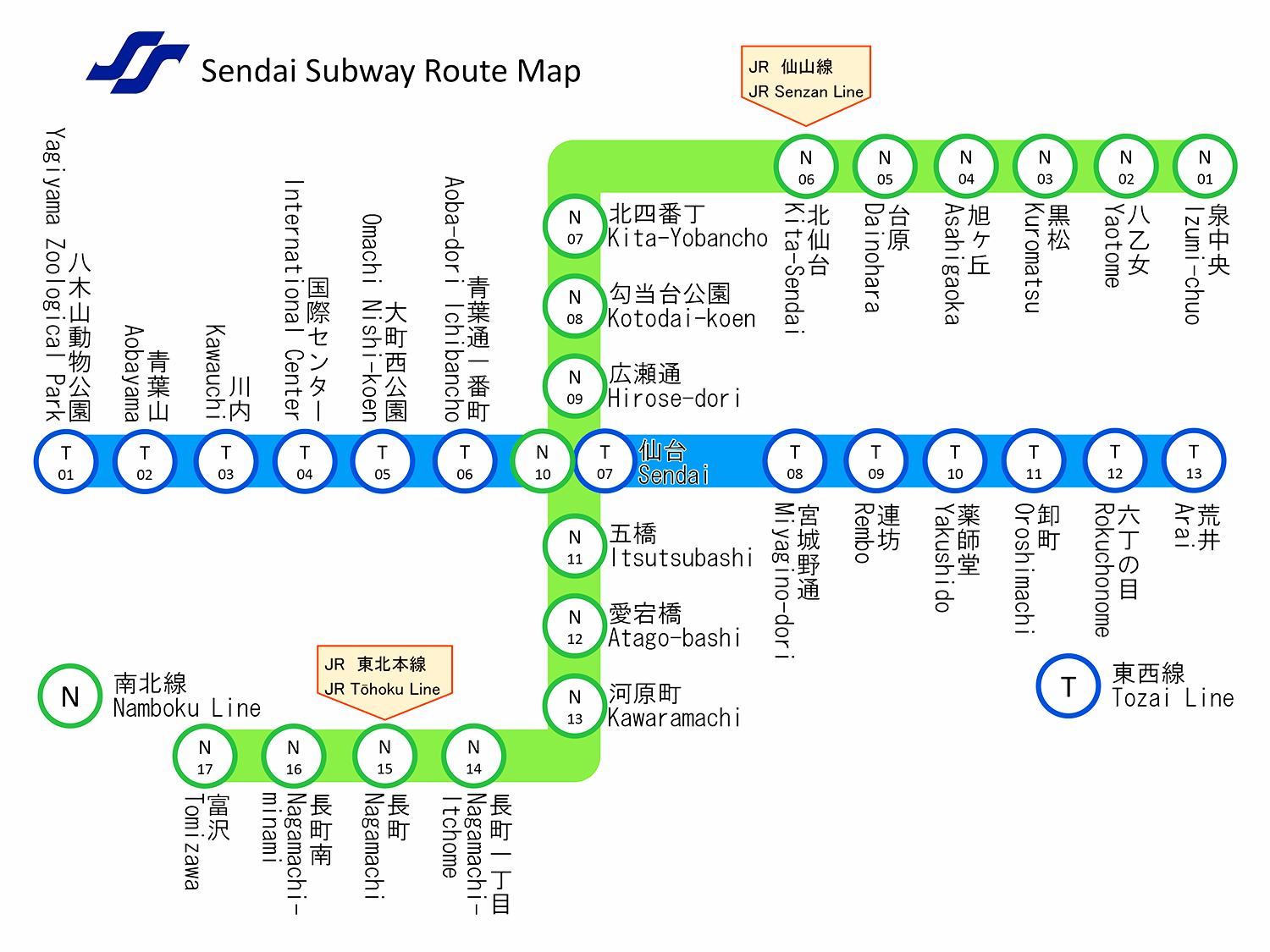
Sendai Metro Map
Map of Sendai Metro showing different lines. Click on the map to enlarge it or download the Sendai Metro map in PDF format.
Sendai Subway Lines and Stations
The Sendai Subway route plan is simple: two lines cross at Sendai Station, creating a practical north-south and east-west network. The system began service on July 15, 1987, and now has 29 active stations.
| Line | Route | Opened | Length | Stations |
|---|---|---|---|---|
| Namboku Line | Izumi-Chuo to Tomizawa | 1987 | 14.8 km / 9.2 mi | 17 |
| Tozai Line | Yagiyama Zoological Park to Arai | 2015 | 13.9 km / 8.6 mi | 13 |
Sendai Station is the main transfer point between the two subway lines. Kotodai-Koen is also an important stop for central Sendai. If you are checking a stations map or building a route timetable, start with these interchange points.
Namboku Line
The Namboku Line runs between Tomizawa and Izumi-Chuo. This stations list follows the line from south to north.
| Station | Details |
|---|---|
| Tomizawa | Southern terminal of the Namboku Line |
| Nagamachi-Minami | Namboku Line station |
| Nagamachi | Transfer point for regional rail services |
| Nagamachi-Itchome | Namboku Line station |
| Kawaramachi | Namboku Line station |
| Atagobashi | Namboku Line station |
| Itsutsubashi | Namboku Line station |
| Sendai | Main interchange with the Tozai Line and major rail services |
| Hirose-dori | Central Sendai station |
| Kotodai-Koen | Important central station on the network |
| Kita-Yobancho | Namboku Line station |
| Kita-Sendai | Transfer point for the Senzan Line |
| Dainohara | Namboku Line station |
| Asahigaoka | Namboku Line station |
| Kuromatsu | Namboku Line station |
| Yaotome | Namboku Line station |
| Izumi-Chuo | Northern terminal of the Namboku Line |
Tozai Line
The Tozai Line runs between Yagiyama Zoological Park and Arai. It forms the east-west path across the subway system.
| Station | Details |
|---|---|
| Yagiyama Zoological Park | Western terminal of the Tozai Line |
| Aobayama | Tozai Line station |
| Kawauchi | Tozai Line station |
| International Center | Convenient for nearby cultural and sightseeing spots |
| Omachi Nishi-koen | Tozai Line station |
| Aoba-dori Ichibancho | Central Sendai station |
| Sendai | Main interchange with the Namboku Line |
| Miyagino-dori | Tozai Line station |
| Rembo | Tozai Line station |
| Yakushido | Tozai Line station |
| Oroshimachi | Tozai Line station |
| Rokuchonome | Tozai Line station |
| Arai | Eastern terminal of the Tozai Line |
Together, the Namboku and Tozai lines create the basic cross-shaped layout of the Sendai Subway.
Operating Hours
Sendai Subway operating hours are generally from 5:30am to midnight, Monday through Sunday. These opening hours make the subway useful for commuting, sightseeing, and evening travel in central Sendai.
| Service detail | Timings |
|---|---|
| Regular opening times | From 5:30am to midnight, Monday to Sunday |
| Friday last train | Service extends 10 minutes later than usual, until 00:11 |
| Timetable checks | Available at stations, customer service offices, and ticket machines |
For timings today, schedule today, exact starting time, running time, frequency, closing time, and last train information, check the station timetable before you travel. The route timetable can vary by line and direction.
Ticketing and Pricing
The Sendai Subway fare depends on the number of stations or distance traveled. The base adult ticket price is 200 yen, about US$1.35. Children under 10 and passengers with physical or mental disabilities are eligible for a 50% discount.
Use the fare table or ticket machine as a quick fare calculator before buying a ticket. Child fares are calculated as half of the adult fare and rounded up to the nearest 10 yen.
| Distance | Adult fare |
|---|---|
| 1 station, 1-3 km / 0.6-1.9 mi | 200 yen / about US$1.35 |
| 2 stations, 4-6 km / 2.5-3.7 mi | 250 yen / about US$1.70 |
| 3 stations, 7-9 km / 4.3-5.6 mi | 300 yen / about US$2.00 |
| 4 stations, 10-12 km / 6.2-7.5 mi | 330 yen / about US$2.20 |
| 5 stations, 12-16 km / 7.5-9.9 mi | 360 yen / about US$2.40 |
Ticket Types
Tickets can be purchased from vending machines, and several pass and card options are available depending on your trip.
- Icsca cards are prepaid cards accepted on both subway lines and on surface public transport. They also work on railway services in Japan. Prices vary by customer type, such as adult or child, and by travel distance.
- The One-day Subway Pass gives unlimited rides on both subway lines for the day of purchase. It also offers discounts at certain facilities. On weekdays, the price is 840 yen, about US$5.60, for adults and 420 yen, about US$2.80, for children. On Saturdays, Sundays, and holidays, it costs 620 yen, about US$4.15, for adults and 310 yen, about US$2.10, for children. It is sold only from automatic ticket vending machines for same-day use, while advance and block purchases are available from the station office.
- The One-day Pass for Loople Sendai and Subway covers unlimited rides on the Namboku Line, Tozai Line, and Loople Sendai buses for one day. The price is 920 yen, about US$6.15, for adults and 460 yen, about US$3.10, for children. It is sold at the Sendai Station West Exit Bus Pool Information Booth, Sendai Transportation Bureau offices, station ticket counters, and on board Loople Sendai buses.
- A regular ticket is valid for a single ride on the Sendai Subway. It is also valid for some bus services, including Miyagi Traffic Bus and Sendai Municipal Bus, but only for one journey.
- The Subway Group Ticket is for groups of 25 people or more traveling together for the same purpose and journey. Ordinary groups receive a 10% discount, while student groups receive a 20% discount. Tickets can be purchased at the ticket counter up to 30 days before travel, and amounts under 10 yen are rounded up.
- The City Bus Group Ticket is also available through a Group Ticket Application Form at a ticket counter or Operations Office. Children aged 1 to 5 are not counted among group passengers, and passengers with free fare or a separate discount are not included in the group count.
- Skip Cards and Skip/Joy Cards are prepaid cards for regular commuters. They can be bought at station ticket machines, customer service offices, and bus terminal ticket counters. Skip Cards range from 1,000 yen to 5,000 yen, about US$6.70 to US$33.35, and a minimum balance of 200 yen, about US$1.35, is required for use.
Airport Connection
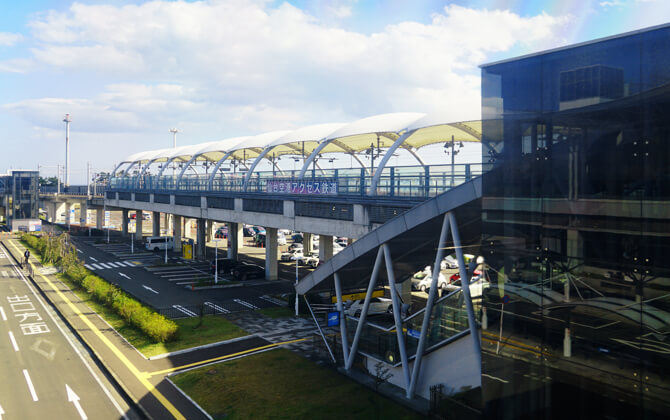
The Sendai Airport Access Line provides a direct rail connection between Sendai Airport and JR Sendai Station. From Sendai Station, passengers can continue on the JR Tohoku Main Line without changing trains, which keeps the airport route straightforward.
Sendai Airport Station is connected directly to the second floor of the airport terminal by a passageway, so access is easy even in rainy weather. The line runs all year, and tickets can be purchased at Sendai Airport Station from a cash-only ticket machine.
| Service detail | Timings |
|---|---|
| JR Sendai Station to Sendai Airport Station | Rapid service about 17 minutes; local service about 25 minutes |
| JR Natori Station to Sendai Airport Station | Rapid service about 7 minutes; local service about 10 minutes |
| From JR Sendai Station | First train 5:45; last train 23:10 |
| From Sendai Airport Station | First train 5:31; last train 23:23 |
- Advance reservation: No
- Excursion pass: Yes
- Applicable operator: Sendai Airport Transit Co., Ltd.
Other Connections
The Sendai Subway connects with several major rail services, so transfers between local transport and regional trains are usually simple.
| Station | Details |
|---|---|
| Kita-Sendai | Connects with the Senzan Line |
| Sendai | Main subway interchange between the Namboku Line and Tozai Line; also connects with the Tohoku Shinkansen, Akita Shinkansen, Tohoku Main Line, Senzan Line, Joban Line, Senseki Line, and Sendai Airport Line |
| Nagamachi | Connects with the Tohoku Main Line, Joban Line, and Sendai Airport Line |
These connections make the subway a key part of Sendai’s wider rail system, especially for trips to the city center and beyond.
Regulations
- Keep a safe distance from the platform edge and automatic platform gate until the train arrives and the doors open.
- Let passengers get off before boarding.
- Do not run inside stations or on station premises.
- Do not lean on the automatic platform gate, lean over it, or place objects against it.
- Smoking is prohibited in stations and on trains.
- Avoid eating and drinking on board, as trains and stations are public spaces.
- For safety reasons, do not bring large luggage that may block passages or entrances, dangerous goods, or items that may stain vehicles or equipment.
- If you ride past your destination or your fare is insufficient, ask for help at the station office next to the ticket gates.
- In a disaster, follow staff instructions and evacuate calmly.
Travel Tips
For sightseeing, the subway and the Loople Sendai bus are the most convenient combination. Loople Sendai serves many major attractions, while the subway is useful for quick movement around central Sendai without long waits.
If you plan to ride several times in one day, a pass can reduce your cost. The Sendai Area Pass offers unlimited travel for foreign tourists on Loople Sendai, Sendai City subway lines, buses, and JR trains in the area. The Sendai Marugoto Pass gives two days of unlimited rides on trains and buses around Sendai and nearby sightseeing spots.
The subway is visitor-friendly because announcements are made in English. Sendai Station, Hirosedori Station, and Kotodai Koen Station are among the most useful stations for tourists.
When using Loople Sendai, allow about one hour for a full circuit. The bus departs from JR Sendai Station West Exit Bus Pool Platform 16, and announcements are also made in English.
IC cards such as Icsca and Suica can be used on the subway, buses, Loople Sendai, JR trains, and the Sendai Airport Access Line. That saves time because you do not need to buy a separate ticket for every ride.
Taxis in Japan are generally safe, though many drivers speak only Japanese. If you use one, pointing to your destination is often the easiest approach. Taxis can help for late-night trips or places where public transport is less convenient.
History
Planning for the Sendai Subway began in the early 1960s, when rapid urban growth and rising motorization pushed the city to rethink transport. In 1963, the Sendai Transportation Planning Committee was established to study long-term needs and identified an underground railway as a key part of future mass transit.
Those studies led to the Namboku Line proposal, a north-south corridor linking suburban residential areas with the city center. The Sendai City Council formally approved the project in 1969. Around the same period, road congestion was affecting the city tram, tramway, and bus network, making a subway more practical as a long-term solution.
In 1972, the planning committee proposed a seven-line network totaling 45.52 km / 28.29 mi. In 1975, the Ministry of Transport’s Sendai Land Transport Bureau recommended urgent construction of an underground high-speed railway from the Nanakita area in present-day Izumi Ward via Sendai Station.
Construction of the Namboku Line began in May 1981 after an operating license was obtained in May 1980. The first 13.6 km / 8.5 mi section, between Yaotome and Tomizawa, opened on July 15, 1987, with 16 stations. It had a major effect on surface congestion.
The line was extended north on July 15, 1992, when the 1.2 km / 0.7 mi section from Yaotome to Izumi-Chuo opened. That brought the line to 14.8 km / 9.2 mi and 17 stations. No further Namboku Line extensions have been made since then.
The Tozai Line was approved in August 2005 after operating authorization had been granted in September 2003. Construction was entrusted to the Japan Railway Construction, Transport and Technology Agency in November 2005 and continued despite delays caused by the 2011 Tohoku earthquake. The line opened on December 6, 2015, running 13.9 km / 8.6 mi between Arai and Yagiyama Zoological Park with 13 stations.
The Sendai Subway was damaged by the 11 March 2011 Tohoku earthquake and tsunami. It shut down after the disaster and reopened on 29 April 2011.
| Line | Opened | Last extended | Length | Stations |
|---|---|---|---|---|
| Namboku Line | 1987 | 1992 | 14.8 km / 9.2 mi | 17 |
| Tozai Line | 2015 | N/A | 13.9 km / 8.6 mi | 13 |
Planned during Japan’s high-growth era and completed through changing urban conditions, the Sendai Subway became the backbone of the city’s rail-based public transport system.
Planned Expansion Projects
The Sendai Subway reached its current cross-shaped network when the Tozai Line opened in 2015. No further line extensions have been completed since then, and the system continues to operate as a two-line network.
Future planning has focused more on station-area improvements and route-related adjustments than on confirmed new line openings. One proposed idea is a station to better serve the Izumi Chuo direction, responding to increased traffic along the national highway in that area and helping ease congestion.
For the Tozai Line, station modifications have also been discussed along the route. These ideas are linked to the growth of schools, universities, residential developments, and other academic facilities near the line.
Other ideas include extending Park and Ride coverage near Yagiyama Zoological Park, along with maintenance and possible landscape improvements. At International Center Station, plans have been noted to connect the Sendai International Center with a major Tohoku University campus and add parking facilities in the station area.
No confirmed major expansion has been completed after 2015, but future development appears to center on targeted station upgrades and local access projects.
Interesting Facts
- The Sendai Subway serves the largest city in the Tohoku region and is operated by the Sendai City Transportation Bureau.
- The Namboku Line opened on July 15, 1987, and was extended northward in 1992.
- The Tozai Line opened on December 6, 2015, completing the system’s cross-shaped layout.
- Both subway lines meet at Sendai Station, the main transfer point in the network.
- The system was damaged by the Tohoku earthquake and tsunami on March 11, 2011, and service resumed on April 29, 2011.
- According to the available material, the Namboku Line uses fuzzy logic to control train speed and acceleration, described there as a world first.
- Accessibility is a major focus. Stations have movable platform fences, while subway cars include tactile paving and features designed to support passengers with disabilities.
Nearby Attractions
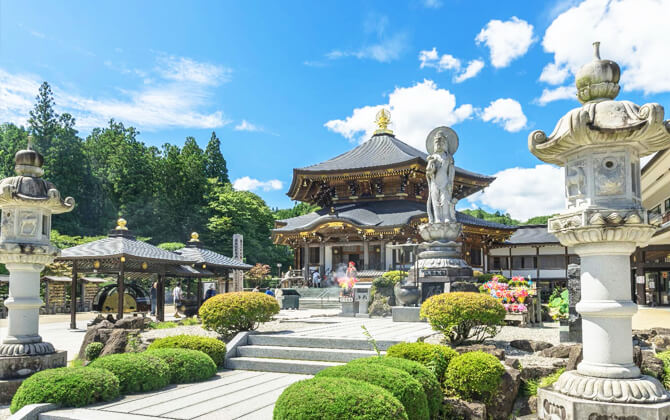
The Sendai Subway makes it easy to reach many of the city’s best-known sights, especially along the Tozai Line. For a sightseeing day, it connects well with museums, historic landmarks, a zoo, and lively central streets.
| Station | Details |
|---|---|
| International Center | Good for Sendai Castle, about a 20-minute uphill walk; Sendai City Museum, about 5 to 8 minutes away; and Miyagi Museum of Art, about a 7-minute walk from International Center or Kawauchi |
| Omachi Nishikoen | Useful for Zuihoden, about a 15-20 minute walk from the station |
| Yagiyama Zoological Park | Next to Sendai Yagiyama Zoo, convenient for families |
| Sendai | Within about a 10-minute walk of Sendai Anpanman Museum and the Kamei Collection Museum |
| Aobayama | Close to the Tohoku University Museum of Natural History |
| Rembo | Can be used for Rakuten Kobo Stadium Miyagi, also reachable by the Senseki Line to Miyaginohara Station; about a 15-20 minute walk north from Rembo |
| Kotodai-Koen | Convenient for Sendai Mediatheque, about a 6-minute walk west of the station |
| Aoba-dori Ichibancho | Access to Bunka Yokocho and Iroha Yokocho, two atmospheric alleys about a 2-minute walk away |
For a full day of sightseeing, the Loople Bus and Subway One-Day Pass allows unlimited rides on both the Sendai Subway and the Loople Bus, making it easier to visit places such as Aoba-jo, also known as Sendai Castle, and Zuihoden on the same day.