Rapid Metro Gurgaon, also known as Rapid Metrorail Gurgaon, is a light metro system in Gurgaon, Haryana, India. It serves key commercial areas, works as a feeder route to the Delhi Metro, and connects with the Yellow Line at Sikanderpur. The fully elevated system is 12.85 kilometres (7.98 miles) long, has 11 stations, uses standard-gauge tracks, and runs three-car trains powered by 750 V DC through a third rail. Commercial service began in phases: the first phase opened on 14 November 2013, and the second phase opened on 31 March 2017.
| Key | Information |
|---|---|
| System | Light metro serving Gurgaon, Haryana, India |
| Route length | 12.85 kilometres (7.98 miles) |
| Stations | 11 stations on one operational line |
| Main interchange | Sikanderpur, with the Delhi Metro Yellow Line |
| Opening dates | Phase 1 opened on 14 November 2013; Phase 2 opened on 31 March 2017 |
| Operating hours | 06:05 to 22:00 daily |
| Frequency | About every 4 minutes on the main service pattern |
| Train type | Three-coach trains on a fully elevated route |
Rapid Metrorail Gurgaon Map
Map of Rapid Metrorail Gurgaon showing different lines and stations. Click on the map to enlarge it or download the Rapid Metrorail map in PDF format.
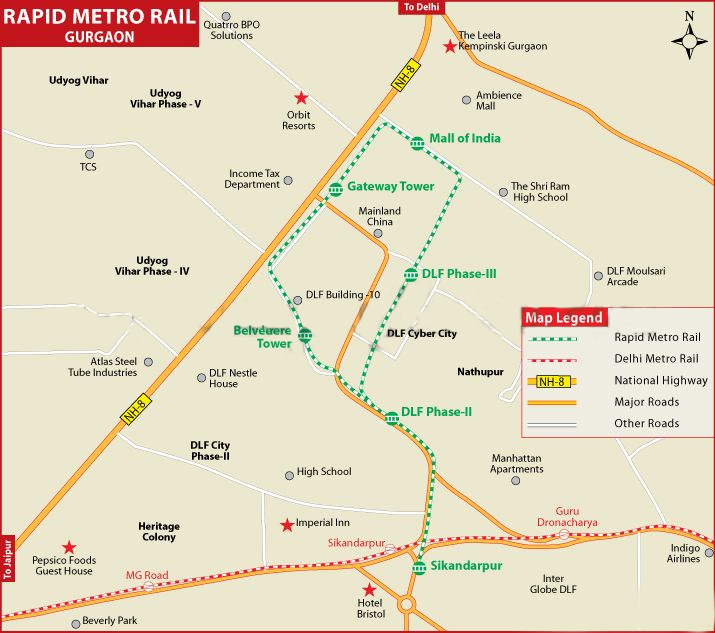
Rapid Metrorail Line and Stations
Rapid Metro Gurgaon has one operational line, Line 1. The route links Gurgaon’s commercial districts with the Delhi Metro Yellow Line at Sikanderpur, making it useful for daily public transport trips around Cyber City, Golf Course Road, and nearby office areas.
The line is fully elevated and runs between Sikanderpur and Sector 55-56. Its first phase covered the DLF Cyber City section, while the second phase extended the system south along Golf Course Road. If you are checking a route plan or stations map, Sikanderpur is the key transfer point to remember.
| Station | Details |
|---|---|
| Gurugram Sector 55-56 | Line 1 station on the Rapid Metro route |
| Gurugram Sector 54 Chowk | Line 1 station on the Golf Course Road side of the route |
| Gurugram Sector 53-54 | Line 1 station serving the sector corridor |
| Gurugram Sector 42-43 | Line 1 station serving nearby commercial and residential areas |
| DLF Phase 1 | Line 1 station serving DLF Phase 1 |
| Sikanderpur | Main interchange with the Delhi Metro Yellow Line |
| DLF Phase 2 | Line 1 station serving DLF Phase 2 |
| Belvedere Towers | Line 1 station serving the Belvedere Towers area |
| Cyber City | Station serving the Cyber City business district |
| Moulsari Avenue | Line 1 station serving the Moulsari Avenue area |
| DLF Phase 3 | Line 1 station serving DLF Phase 3 |
Several future routes have been proposed for Gurgaon, including links toward Palam Vihar, Manesar, Faridabad, Dwarka, Gurugram Railway Station, and Vatika Chowk. These corridors are not part of the current operating network.
Timetable & Operating Hours
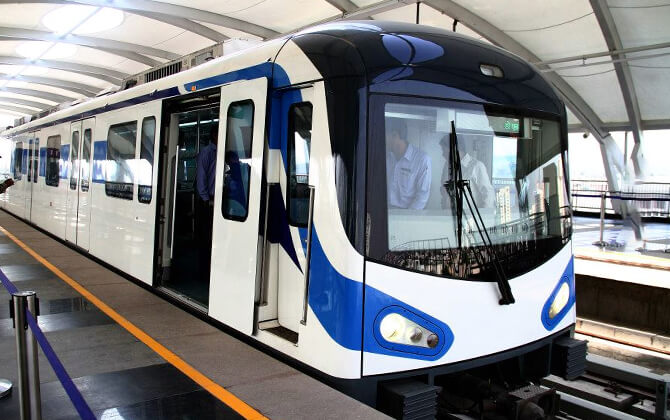
Rapid Metro Gurgaon runs daily from 06:05 to 22:00. These opening hours are the most important timetable detail for passengers checking the schedule today, timings today, or the system’s regular working hours.
Trains operate with a 4-minute headway on the main service pattern. Published materials also note that frequency may vary by time of day, with longer gaps in quieter periods and shorter intervals during peak hours. The separate end-to-end running time is not listed in the provided material.
| Service detail | Timings |
|---|---|
| Starting time | 06:05 daily |
| Closing time | 22:00 daily |
| Opening times | 06:05 to 22:00 |
| Train schedule | Frequent service throughout the operating window |
| Frequency | About every 4 minutes on the main service pattern |
| Train formation | Three coaches per train |
For most trips, the route timetable is simple: check the first service time, allow for the 22:00 close, and plan to reach the platform before the last train period.
Rapid Metrorail Tickets
Rapid Metro Gurgaon has a flat fare of ₹20, approximately US$0.24, for travel on the line after the recent fare increase. Token fares can also range from ₹20 to ₹35, about US$0.24 to US$0.42, depending on distance and route.
Delhi Metro passengers do not need a separate ticket for Gurgaon Metro. The same Delhi Metro token or smart card is accepted on Rapid Metro, which keeps transfers at Sikanderpur simple.
For regular riders, a Smart Card or Value Card costs ₹150, about US$1.80, including a refundable ₹50 deposit, about US$0.60. The card can be loaded in multiples of ₹100, about US$1.20, up to ₹3,000, about US$36.00. It remains valid for 10 years from purchase or recharge, whichever is later.
Tourist Cards are available for short visits:
- Single Day Tourist Card: ₹150, about US$1.80, including a ₹50 security deposit, about US$0.60. This works as a day pass option.
- 3 Day Tourist Card: ₹300, about US$3.60, including a ₹50 security deposit, about US$0.60.
If you are comparing ticket price, fare, and cost before travel, check the displayed station fare or use the available fare information for your route. Customer care desks are available at stations during operating hours, and passengers can also use the 24-hour toll-free helpline.
Connections to Other Systems
Rapid Metro Gurgaon is built to support city transport by feeding passengers into the Delhi Metro network. Its main interchange is Sikanderpur, where riders can change to the Delhi Metro Yellow Line.
The transfer uses a 90 m × 9 m walkway, equal to about 0.09 km × 0.009 km, or 0.06 miles × 0.006 miles. Delhi Metro tokens and smart cards are accepted on Rapid Metro, so passengers using both systems do not need to buy another token.
The line connects Gurgaon’s commercial areas with wider transportation in Delhi NCR, especially for trips to and from Cyber City and the Golf Course Road corridor. Future transit plans also mention possible links with new metro or RRTS services, but those projects are still in planning and are not part of the active system.
Airport Connections
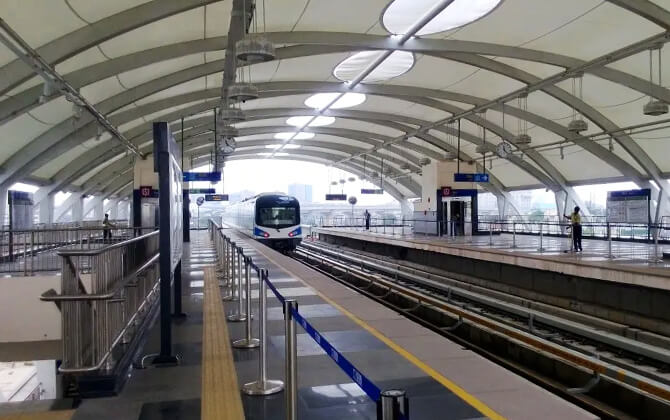
Rapid Metro Gurgaon does not go directly to the airport. For now, the practical airport connection is via Sikanderpur, where passengers transfer to the Delhi Metro Yellow Line and continue through the wider network toward airport-linked services.
Planning material also mentions future proposals to improve airport access for Gurugram. One proposed route would connect Yashobhoomi Dwarka Sector 25 on the Airport Line with Gurugram IFFCO Chowk, linking Gurugram with IGI Airport and Bijwasan Railway Station. Another proposal refers to extending the Airport Line corridor toward Rezang La Chowk.
At present, the route through Sikanderpur remains the key airport-related path for Rapid Metro users.
Parking near the Metro
Station parking is an important part of the Rapid Metro Gurgaon network, especially for commuters who want a Park and Ride option before switching to rail. The available material highlights parking proposals and facilities at several stations, with the goal of reducing road congestion and making local transport easier.
Designated parking spots near Sikanderpur and Sector 56 were identified as priority areas. These were described as HUDA-acquired lands proposed for Park and Ride development. Rapid Metro also requested that suitable car parking sites be identified at each station, with HUDA helping to facilitate them.
The material notes that five Gurgaon stations, including HUDA City Centre, IFFCO Chowk, M G Road, Sikanderpur, and Guru Dronacharya, would have parking lots. HUDA City Centre was described as having a large parking space, and the Gurgaon stretch was expected to increase the overall parking count in the Delhi Metro network.
Parking charges apply where station parking is used, but the provided material does not list parking charges per day. If you plan to drive to a station, check the posted price at the parking area before leaving your vehicle.
At Sikanderpur, the skywalk connection to Delhi Metro adds another layer of convenience, combining parking, pedestrian access, and metro transfer in one station area.
Rapid Metrorail Rules and Tips
Rapid Metro Gurgaon is easy to use if you remember the basics: change at Sikanderpur for the Delhi Metro Yellow Line, keep your ticket or smart card ready, and check the opening hours before traveling.
The system includes lifts and wheelchair facilities for disabled passengers. A women’s help desk is available at each station, and every coach has a Press to Talk button so passengers can contact the driver in an emergency. There is also a 24-hour toll-free helpline, which helps keep the system safe and passenger-friendly.
- Check the schedule before you travel: trains start at 06:05 and operate until 22:00.
- Use the same Delhi Metro token or smart card when transferring from the Yellow Line.
- Allow extra time at Sikanderpur during peak hours, as it is the main interchange.
- If you use station parking, remember that parking fees apply.
- For a short route across Gurgaon’s commercial areas, Rapid Metro is often simpler than road traffic.
The line has a straightforward route and a simple fare structure, which makes it practical for commuting between Sikanderpur and the Gurgaon stations it serves.
History
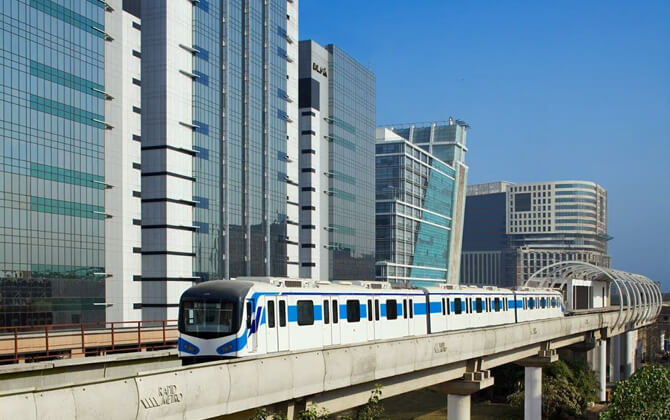
Rapid Metro Gurgaon was first proposed in September 2007 as a 3.2 km (1.99 miles) line between Sikanderpur and National Highway 8. In 2008, the Haryana Urban Development Authority invited bids on a built-operate-transfer basis with a 99-year lease. A new tender followed in July 2008, and the DLF-IL&FS consortium emerged as the only bidder.
The project was developed as a public-private partnership, with no investment from the Union Government, the Government of Haryana, or any public sector undertaking. The contract for the ₹9 billion scheme, roughly US$108 million, was awarded in July 2009, and the foundation stone was laid on 11 August 2009.
The line was built by Rapid Metro Gurgaon Limited and was originally planned to open in 2012. The first phase began operations on 14 November 2013. By October 2012, the project cost was estimated at ₹10.88 billion, roughly US$131 million.
Phase 2 was announced in June 2013 after IL&FS Engineering and Construction Company Limited said it had won contracts for the elevated viaducts and five elevated stations. Construction began in April 2013. The extension was first expected to open in July 2015, but the deadline changed several times before the second phase opened on 31 March 2017.
In September 2019, IL&FS said it no longer had the resources to keep operating Rapid Metro and sought a new entity to fund and run the service. After a dispute with the Haryana government and a ruling by the Punjab and Haryana High Court, Delhi Metro Rail Corporation took over operations.
Rapid Metro Gurgaon was the world’s first fully privately financed modern light metro system. It was also the first metro system in India to auction naming rights for its stations.
Future Extensions
The existing Rapid Metro Gurgaon network is a 12.85 km (7.98 miles), 11-station light rapid transit line. Wider Gurugram metro expansion plans, however, point to a much larger future network across the city and beyond.
The Haryana Mass Rapid Transit Corporation has plans for an additional metro network spanning 188 kilometres (116.82 miles) in Gurugram, with Gurugram Metro Rail Limited responsible for construction, maintenance, and operations. The proposed network includes links toward Delhi, Faridabad, Manesar, Dwarka, and other parts of Gurugram.
- West Gurugram connections toward Delhi, including routes to IFFCO Chowk and Rezang La Chowk.
- A central corridor linking Manesar with Old Gurugram.
- A proposed Gurugram-Faridabad link.
- An Old Gurugram loop connecting Millennium City Centre to Cyber City.
- Additional routes toward Dwarka Expressway, Golf Course Extension Road, and Bhondsi.
The future network is also expected to integrate with other major transport systems, including Delhi Metro and planned regional rail projects. Several route options are still subject to change, and not every corridor may be built exactly as currently mapped.
For Rapid Metro itself, the most important future development is possible integration with the broader Gurugram metro network, especially around interchange points such as Sikanderpur and Moulsari Avenue.
Nearby Attractions
Rapid Metro Gurgaon is especially useful for reaching business districts, hotels, shopping areas, and office clusters. Several stations sit close to major workplaces, which makes the line practical for commuting and short city visits.
| Station | Details |
|---|---|
| Sikanderpur | Access to Sikanderpur Village, DLF Phase 1, Emaar MGF Business Park, and DLF City Court; also the interchange with the Delhi Metro Yellow Line |
| DLF Phase 2 | Close to DLF Phase 2 and Building No. 5, which is less than a 2-minute walk away |
| Vodafone Belvedere Towers | Serves Belvedere Towers, DLF Square, Building No. 10, and DLF Atria |
| IndusInd Bank Cyber City | Access to Cyber Hub, Shankar Chowk, Ericsson Building, Udyog Vihar, Gateway Towers, Infinity Towers, Trident Hotel, and nearby office buildings |
| Moulsari Avenue | Near Ambience Mall, Building No. 6, and the National Media Centre |
| DLF Phase 3 | Connects to Building No. 7, 9, and 14, as well as Cyber Green |
| DLF Phase 1 | Close to Mega Mall, Plaza Tower, Prima Med, and DLF Hamilton Court |
| Sector 42-43 | Serves Global Foyer, One Horizon Centre, Exl Office, American Express Campus, DLF The Magnolias, Carlton 1 and 4, The Aralias, and DLF Golf View |
| Sector 53-54 | Connects to The Belaire Condominiums, IBIS Hotel, Paras Downtown Center, Palm Spring Plaza, and Alchemist |
| Sector 54 Chowk | Near Vatika Tower, La Lagune North and South Block, Ansal University, Park Hospital, and Paras Twin Towers |
| Sector 55-56 | Access to Lemon Tree and Red Fox Hotel, Hong Kong Bazaar, Sushant Lok 2, Grand Hyatt Gurugram Residences, and Ireo City |
Cyber Hub is one of the best-known destinations on the route, while Ambience Mall is a major shopping landmark near Moulsari Avenue. For wider travel across Gurgaon and Delhi, Sikanderpur remains the most important interchange station.