Valley Metro is the regional public transport brand for the Phoenix metropolitan area, bringing bus, light rail, streetcar, paratransit, microtransit, vanpool and rideshare services under one system name. Valley Metro Bus handles the broad bus network, while Valley Metro Rail oversees light rail and the Tempe Streetcar. The brand has been in use since 1993, and the network connects Phoenix with Tempe, Mesa and other communities across the Valley.
| Key | Information |
|---|---|
| Official organization | Valley Metro Regional Public Transportation Authority |
| Service area | Phoenix metropolitan area, with bus service across Maricopa County and beyond |
| Main modes | Bus, light rail, streetcar, paratransit, microtransit, vanpool and rideshare |
| Rail cities served | Phoenix, Tempe and Mesa |
| Headquarters | 101 North 1st Avenue, Phoenix, Arizona |
| Brand launch | 1993 |
| Rail network size | 50 stations over 38.5 miles, about 62 km, as of June 2025 |
| Airport link | PHX Sky Train connects Valley Metro Rail at 44th Street and Washington with Phoenix Sky Harbor International Airport |
Valley Metro Phoenix Map
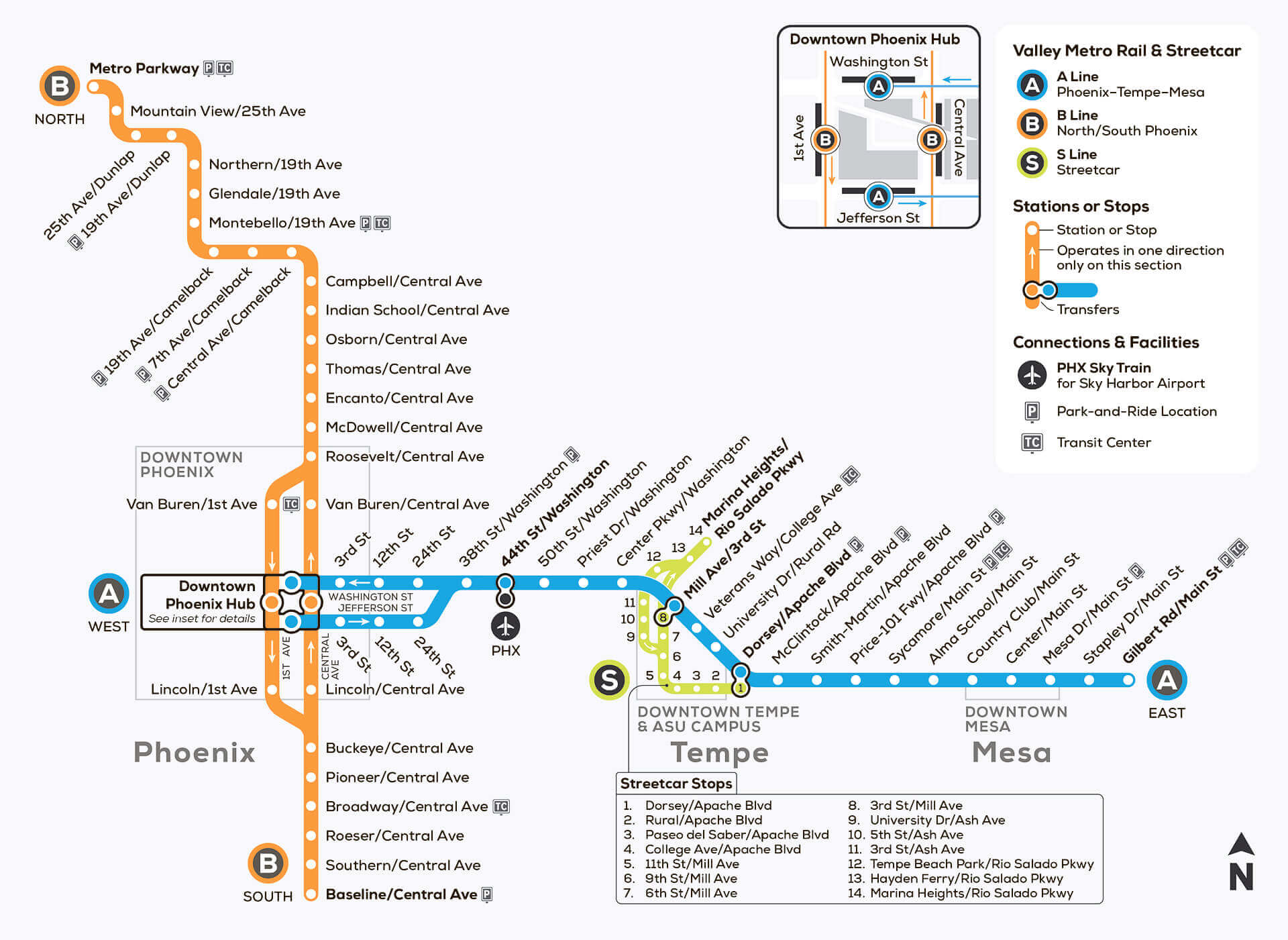
The Valley Metro Phoenix map shows all available lines and stops. Click on the map to enlarge it or download the Valley Metro Phoenix map in PDF format.
Valley Metro Phoenix Transit Lines, and Routes
Valley Metro Phoenix combines city transport, local transport and regional public transportation in one network. The system includes light rail, the Tempe Streetcar and a large bus route network, so riders can plan a short neighborhood trip or a cross-city commute using the same regional brand.
Valley Metro Rail operates the A Line and B Line, which meet at the Downtown Phoenix Hub. The A Line runs between Downtown Phoenix Hub and Gilbert Road/Main Street, while the B Line connects Metro Parkway with Baseline/Central Avenue. The S Line Streetcar runs in Tempe from Dorsey/Apache Boulevard to Marina Heights/Rio Salado Parkway.
Valley Metro Bus provides the wider route plan across the region. It includes local, regional, express, shuttle, circulator, paratransit, RAPID and rural services. Available service information lists 104 routes and 17 hubs, with routes serving Phoenix, Mesa, Tempe, Chandler, Glendale, Scottsdale and other nearby cities.
Many local bus routes follow Phoenix-area street-grid logic. Route 0 runs along Central Avenue, Route 35 serves 35th Avenue, Route 50 follows Camelback Road, Route 72 serves Scottsdale and Rural Roads, and Route 104 runs along Alma School Road. This makes the route timetable easier to understand once you know the street grid.
Valley Metro Rail: A Line and B Line
Valley Metro Rail is the light rail system in the Phoenix metropolitan area. Since the South Central Extension opened on June 7, 2025, rail service has operated as two lines: the A Line and the B Line.
The A Line runs east-west between Downtown Phoenix Hub and Gilbert Road/Main Street. The B Line runs north-south between Metro Parkway and Baseline/Central Avenue. Both lines connect at Downtown Phoenix Hub, the main transfer point for the rail route.
As of June 2025, Valley Metro Rail serves 50 stations across 38.5 miles, about 62 km, of track in Phoenix, Tempe and Mesa. The system began service on December 27, 2008. The South Central Extension added 5.5 miles, about 8.9 km, of track and eight stations.
| Station | Details |
|---|---|
| A Line | 28 stations; Downtown Phoenix Hub to Gilbert Road/Main Street |
| B Line | 24 stations; Metro Parkway to Baseline/Central Avenue |
| Downtown Phoenix Hub | Transfer point between the A Line and B Line |
During the day, trains run every 12 minutes on weekdays and Saturdays and every 20 minutes on Sundays. From 8:00 p.m. until the end of service, trains run every 20 minutes. Full rail service starts at about 4:30 a.m. on weekdays and about 4:50 a.m. on weekends, with full service ending around 11:00 p.m. daily.
Valley Metro Streetcar
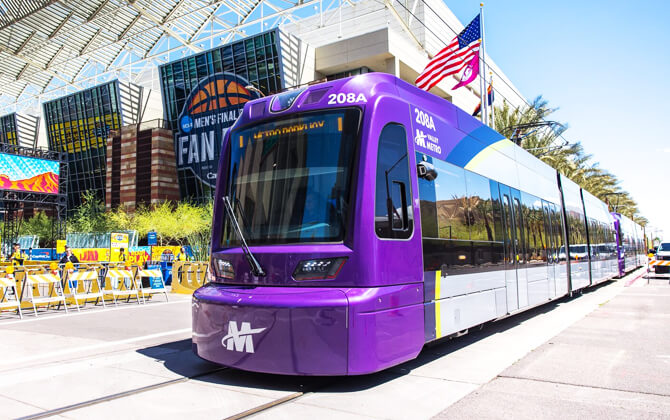
The Valley Metro Streetcar, also called the S Line, is a modern streetcar in Tempe. It is a 3-mile, about 4.8 km, line serving downtown Tempe, Tempe Town Lake and the Arizona State University Tempe campus.
The streetcar opened on May 20, 2022, after construction began in 2017. Its route forms a C-shape through Tempe, running from Dorsey/Apache Boulevard to Marina Heights/Rio Salado Parkway through downtown Tempe. It operates mostly in mixed traffic, using curbside lanes downtown and center lanes elsewhere.
| Station | Details |
|---|---|
| Dorsey/Apache Boulevard | Streetcar endpoint and light rail connection area |
| Mill Avenue/3rd Street | Streetcar stop with a direct light rail connection |
| Marina Heights/Rio Salado Parkway | Streetcar endpoint near Tempe Town Lake |
Since June 7, 2025, the streetcar has run every 15 minutes on weekdays and Saturdays until 7:00 p.m., then every 20 minutes after that. Sunday service runs every 20 minutes all day. The line launched with free service, and fare collection began on August 4, 2025. The streetcar fare is $1 USD, with payment by Copper Card or the Valley Metro app.
If you search for trams or tramway service in Phoenix-area public transport, this Tempe Streetcar is the relevant Valley Metro service.
Local Bus Routes
Valley Metro’s local bus network is built around a super-grid pattern. As of 2026, the system includes 60 local bus routes, with route numbers often tied to the streets they serve.
Route 35 follows 35th Avenue, Route 0 runs along Central Avenue, Route 50 follows Camelback Road, Route 72 serves Scottsdale and Rural Roads, and Route 104 runs along Alma School Road. Routes 7 and 8 both serve the 7th Street and 7th Avenue corridors, with Route 8 numbered one digit higher to reduce confusion.
Community circulators supplement the standard grid by linking neighborhoods with nearby business districts. Most are free, while Avondale Zoom routes have a $0.50 USD fare. Examples listed in the service materials include Scottsdale Neighborhood Trolley, Tempe Orbit Jupiter and Phoenix SMART.
The bus route network covers Phoenix and nearby cities including Scottsdale, Chandler, Sun City, Gilbert, Glendale, Tempe, Mesa, Peoria and Avondale. Riders should check the latest stations list, route timetable and train schedule tools before traveling, because service can vary by route, day and time.
Express, RAPID, Circulator, and Rural Bus Services
Valley Metro Bus also provides express, RAPID, circulator and rural bus services across the Phoenix Metropolitan Area and in the community of Ajo in Pima County. The bus service area is listed as 525 square miles, about 1,360 square km, with more than 100 contracted routes.
Express and RAPID routes are limited-stop commuter services. RAPID routes operate in Phoenix and connect Park and Ride lots near major freeways with downtown Phoenix, including the Arizona State Capitol complex. Express routes follow a similar commuter pattern from suburban pickup points outside Phoenix and use higher fares than standard local routes.
- 51x routes serve Scottsdale.
- 52x routes serve Tempe.
- 53x routes serve Mesa and Gilbert.
- 54x routes serve Chandler.
- 56x routes serve the Southwest Valley.
- 57x routes serve the Northwest Valley.
Rural bus service includes the Gila Bend Regional Connector, which links Maryvale Village and Ajo. Service levels differ by route: the busiest bus routes can reach peak 10-minute frequency and run until 1:00 a.m., while lower-use routes may run every 30 minutes off-peak and end around midnight.
Schedule, Frequency, and Real-Time Updates
Valley Metro operating hours, opening hours and frequency depend on the line, the day and the time of travel. Full light rail service begins at about 4:30 a.m. on weekdays and about 4:50 a.m. on Saturdays and Sundays. Full service ends at about 11:00 p.m. daily.
Because a complete light rail trip has a running time of about 110 minutes, full end-to-end service does not cover the entire early-morning or late-night span. Limited rail service operates before and after full service, extending opening times to as early as 3:30 a.m. and the latest service to as late as 1:00 a.m.
| Service detail | Timings |
|---|---|
| Full rail starting time on weekdays | About 4:30 a.m. |
| Full rail starting time on Saturdays and Sundays | About 4:50 a.m. |
| Full rail closing time | About 11:00 p.m. daily |
| Limited rail operating hours | As early as 3:30 a.m. and as late as 1:00 a.m. |
| Light rail daytime frequency | Every 12 minutes on weekdays and Saturdays; every 20 minutes on Sundays |
| Light rail evening frequency | Every 20 minutes from 8:00 p.m. until close |
| Streetcar daytime frequency | Every 15 minutes on weekdays and Saturdays until 7:00 p.m.; every 20 minutes on Sundays |
| Streetcar evening frequency | Every 20 minutes after 7:00 p.m. |
For schedule today, timings today, the next bus, the last train or any service alert, use the Valley Metro app or official service tools. Real-time updates are useful because working hours and route changes can shift around construction, events and service adjustments.
Typical Service Patterns
Valley Metro Rail and the Streetcar both follow a simple pattern: more frequent service during the daytime, then reduced service in the evening and on Sundays. Rail service is most frequent on weekdays and Saturdays, while Sunday service runs at a 20-minute frequency all day.
| Service detail | Timings |
|---|---|
| Valley Metro Rail weekday daytime schedule | Trains every 12 minutes |
| Valley Metro Rail Saturday daytime schedule | Trains every 12 minutes |
| Valley Metro Rail Sunday schedule | Trains every 20 minutes all day |
| Valley Metro Rail evening schedule | Trains every 20 minutes from 8:00 p.m. to the end of service |
| Valley Metro Streetcar weekday and Saturday schedule | Every 15 minutes until 7:00 p.m., then every 20 minutes |
| Valley Metro Streetcar Sunday schedule | Every 20 minutes all day |
In the early morning and late night, limited rail service operates between Priest Drive/Washington and Gilbert Road/Main Street, and between 50th Street/Washington and Metro Parkway. Check the latest timetable before you travel, especially if your trip depends on the first train or last train.
Fares, Tickets, and Payment Options
Valley Metro uses fare options for bus, light rail and streetcar riders, including Smart Fare through the Copper Card and the Valley Metro app. Fare rules differ by service type, so the ticket price for local bus, light rail, streetcar and Express/RAPID service is not always the same.
Current fare information in the provided materials lists local bus and light rail at $2 USD for a single ride and a $4 USD daily cap. Streetcar is listed at $1 USD for a single ride. Reduced fares are available for eligible riders, including seniors age 65 and older, children ages 6 to 18, people with disabilities and Medicare beneficiaries.
Smart Fare works like a fare calculator for regular riders: each paid trip counts toward daily, weekly and monthly maximums. Valley Metro no longer sells daily, weekly and monthly passes up front under the current Smart Fare system, and paper magnetic stripe passes stopped being honored on October 28, 2024.
Local Bus and Light Rail Fares
Local bus and light rail share the same fare system. The standard local single-ride fare is listed as $2 USD, with a $4 USD daily cap. Reduced local bus and light rail single rides are listed at $1 USD for eligible riders.
Valley Metro Rail uses proof of payment. Riders buy or validate fare before boarding, and fare inspections are conducted randomly across the system. Tickets for light rail can be purchased from fare vending machines at station entrances, and app-based payment is also available.
Children age 10 and younger ride free when accompanied by a paying adult, with a limit of four children per adult. Youth reduced fare eligibility is listed for ages 6 through 18, and riders using reduced fare need valid proof of eligibility.
Streetcar and Express/RAPID Fare Notes
The Streetcar has its own price: $1 USD for a standard single ride and $0.50 USD for a reduced single ride. Fare collection on the Tempe Streetcar began on August 4, 2025.
Express and RAPID routes are limited-stop commuter services and are priced higher than standard local service. Community circulators are generally free, except Avondale Zoom routes, which have a $0.50 USD fare.
If your trip mixes local bus, rail, streetcar or Express/RAPID service, check the current fare before boarding. It is a small step, but it helps avoid paying the wrong cost for the route.
Valley Metro App, Smart Fare, and Copper Card
Valley Metro accepts payment through the Copper Card and the Valley Metro app. Both support Smart Fare, which lets riders pay as they go while the system tracks fare caps.
Choose either a Copper Card or the Valley Metro app for your account. A Copper Card and an app account cannot be combined, and each has its own balance and Smart Fare progress.
The Copper Card is a reloadable card with a one-time $4 USD issuance charge. Riders can register the card, reload it online, at retail locations across the Valley or at fare vending machines, and set up autoload.
When riding, tap the Copper Card on the purple fare reader on buses and at light rail stations. Tapping every time is required. In the app, fare can be purchased with a credit or debit card, Apple Pay, Google Pay or cash through the retail network.
Connections with Other Transportation Options
Valley Metro is the main public transport brand for transportation in the Phoenix metropolitan area. It links Phoenix with Tempe, Mesa, Glendale, Scottsdale and other communities through bus, light rail, streetcar, paratransit and rideshare services.
Bus connections carry the largest share of the network. Valley Metro Bus includes local, regional, express, RAPID and circulator routes operated by Phoenix, the Regional Public Transportation Authority and other local operators.
Rail connections link major destinations across Phoenix, Tempe and Mesa. Valley Metro Rail operates the A Line and B Line, while the S Line Streetcar extends local rail-style service through downtown Tempe and the Arizona State University area.
Paratransit options include Valley Metro Paratransit, Phoenix Dial-A-Ride, Glendale Dial-A-Ride and Peoria Dial-A-Ride. Some overflow trips are handled through taxi or non-emergency medical transportation providers.
Other connections include PHX Sky Train to Phoenix Sky Harbor International Airport, intercity bus service through Greyhound and FlixBus, and Amtrak connections via Maricopa and Amtrak Thruway buses from Phoenix Sky Harbor International Airport to Flagstaff.
Airport Connection: Phoenix Sky Harbor
Phoenix Sky Harbor International Airport connects with Valley Metro through the free PHX Sky Train and several bus routes. This makes it possible to travel between the airport, light rail, bus service, terminals, parking areas and the Rental Car Center without driving.
Bus Route 13 stops at the 24th Street PHX Sky Train Station. Bus Route 44 connects with the airport at the 44th Street PHX Sky Train Station. The 44th Street station is also the key transfer point between PHX Sky Train and Valley Metro Rail.
The PHX Sky Train operates 24 hours a day and connects Valley Metro Rail at 44th and Washington streets with Terminal 3, Terminal 4, East Economy Parking, 24th Street Economy Parking and the Rental Car Center.
Getting to PHX Sky Train from Valley Metro Rail
To reach Phoenix Sky Harbor from Valley Metro Rail, ride to 44th Street and Washington, then follow signs to the PHX Sky Train. From the airport, travelers can take the Sky Train from Terminal 3 or Terminal 4 back to the rail connection at 44th Street Station.
At 44th Street Station, Valley Metro Rail tickets can be purchased at ticket machines on Level 2. Boarding pass kiosks are also available for participating airlines before passengers continue to the terminal.
For late-night travel, staged busing is available at 44th Street Station between 10:00 p.m. and 5:00 a.m. Buses depart from the south side of the station and provide direct service to Terminal 3 outer curb by door 8 and Terminal 4 Level 2 outside door 22.
Traveling Between Airport Terminals, Rental Cars, and Light Rail
The PHX Sky Train is the free automated train for airport circulation. It links the light rail connection at 44th and Washington with airport terminals, parking areas and the Rental Car Center.
Light rail does not operate around the clock, so check Valley Metro opening times and last train information before planning a late-night airport trip. The Sky Train itself runs 24/7, but overnight maintenance can reduce frequency.
Between 10:00 p.m. and 5:00 a.m., service frequency may be reduced, and staged busing may support direct trips from 44th Street Station to Terminal 3 and Terminal 4. Allow extra time during those hours.
- The PHX Sky Train is free to the public.
- It operates 24 hours a day, seven days a week.
- 44th Street Station is the transfer point for Valley Metro Rail.
- The Rental Car Center is connected by Sky Train.
- Overnight travel may include reduced frequency or bus support.
Parking and Park-and-Ride
Valley Metro park-and-ride lots let riders leave a car and continue by bus or light rail. These lots are free for normal use, so parking charges are $0 USD for same-day transit use. Parking for more than 24 hours is not permitted.
A special permit is required for parking between 1:00 a.m. and 4:00 a.m., so overnight parking is not allowed without approval. Not every light rail station has parking, and riders should check the stations map before choosing a lot.
| Station | Details |
|---|---|
| 19th Ave./Dunlap | Park-and-ride location listed for Valley Metro riders |
| 19th Ave./Montebello | Park-and-ride location listed for Valley Metro riders |
| 19th Ave./Camelback | Park-and-ride location listed for Valley Metro riders |
| 7th Ave./Camelback | Park-and-ride location listed for Valley Metro riders |
| Central Ave./Camelback | Park-and-ride location listed for Valley Metro riders |
| 38th St./Washington | Park-and-ride location listed for Valley Metro riders |
| Dorsey/Apache Blvd. | Park-and-ride location listed for Valley Metro riders |
| McClintock/Apache Blvd. | Park-and-ride location listed for Valley Metro riders |
| Price-101 Fwy/Apache Blvd. | Park-and-ride location listed for Valley Metro riders |
| Sycamore/Main St. | Park-and-ride location listed for Valley Metro riders |
| Mesa Dr./Main St. | Park-and-ride location listed for Valley Metro riders |
| Gilbert Rd./Main St. | Park-and-ride location listed for Valley Metro riders |
Some park-and-ride locations are served only by bus routes, while others connect directly to light rail. If you are comparing station parking options, check the route plan and pick the lot that best matches your trip.
Where Park-and-Ride Is Useful
Park-and-ride lots are useful when you want to avoid traffic or skip the search for parking in busy parts of Phoenix, Tempe or Mesa. They work well for downtown trips, events and regular commuting.
The Central Avenue/Camelback Road park-and-ride is one example of a convenient hub for Valley Metro riders. Lots along the rail corridor also help riders reach work, entertainment districts or major venues without driving all the way in.
- You want free same-day parking before taking transit.
- You are heading to downtown Phoenix or another busy area.
- You prefer to avoid parking shortages near your destination.
- You want a straightforward transfer to light rail or bus service.
Parking Rules and Overnight Parking Limits
Valley Metro park-and-ride rules are clear: parking for more than 24 hours is not allowed, and overnight parking is not permitted without special approval. A permit is required for parking between 1:00 a.m. and 4:00 a.m.
Downtown Phoenix street parking follows separate rules. Metered parking is generally enforced from 8:00 a.m. to 10:00 p.m. daily, and posted time limits often range from 1 to 2 hours, although some spaces allow longer stays.
If you need to leave a vehicle overnight, do not assume a park-and-ride lot will allow it. Use legal posted parking and check signs carefully, because violations can lead to ticketing or towing.
Accessibility, Safety, and Rider Rules
Valley Metro provides accessible public transportation options for riders with disabilities. The system includes ADA-accessible bus service, paratransit options and a reasonable modification process for eligible riders.
For safe boarding, arrive at the stop at least five minutes early, let exiting passengers leave first and use handrails when boarding or exiting. On buses, check the route number and destination sign before boarding so you follow the correct path.
Riders should have fare ready before boarding. Buses stop only at designated stops, and once a bus pulls away, it will not stop again. To request a stop, signal about one block before your destination.
Basic rider rules are enforced. Open containers and consumption of food or beverages are not allowed on buses, and drinks must have secure lids. Offensive language, loud music and unruly behavior are prohibited. Use headphones at a reasonable volume.
Service animals are allowed but must remain under control and off seats. Non-service animals must be in carriers. Riders who need accessibility help can contact Valley Metro customer service or use the reasonable modification process.
Future Expansions and Service Improvements
Valley Metro Rail has expanded several times since opening in 2008, including the 50th Street/Washington infill station, the Tempe Streetcar, Northwest Extension Phase II and the South Central Extension.
The South Central Extension opened on June 7, 2025. It added 5.5 miles, about 8.9 km, of rail and eight stations, extended service south to Baseline/Central Avenue and created a new downtown transfer hub.
Northwest Extension Phase II opened on January 27, 2024, extending service to the Metrocenter area with three new stations. Earlier expansion projects extended the line farther east into Mesa and north to 19th Avenue/Dunlap.
Future expansion planning includes the Capitol Extension, intended to run west from Downtown Phoenix to 15th Avenue, and the I-10 West Extension toward Desert Sky Mall and Desert Sky Transit Center. A possible future service study to Glendale has also been part of long-range planning.
Brief History
The Regional Public Transportation Authority was formed in 1985 after Phoenix-area voters approved a half-percent sales tax increase to expand freeway and mass transit systems. At the time, most transit service in the Phoenix area was operated by Phoenix Transit System.
In the mid-1980s, Phoenix Transit System routes were reorganized from a downtown-focused hub-and-spoke network into a point-to-point system. That structure became the basis for today’s local bus network.
In 1989, the region considered the ValTrans plan, which included expanded bus service and elevated rail. Voters rejected it, but some route concepts and color designations influenced later planning. Tempe voters later approved a dedicated transit sales tax in 1996.
Valley Metro began operating under its own brand identity in 1993, when transit providers chose the Valley Metro name and merged Phoenix Transit System and Mesa Sunrunner into the regional network. The change created a unified brand and fare structure for the Phoenix metropolitan area.
In 2000, Phoenix voters approved the Transit 2000 Regional Transportation Plan, which aimed to improve bus service and add bus rapid transit and light rail. Construction on the first light rail line began in March 2005, and the first segment opened on December 27, 2008, linking Phoenix, Tempe and Mesa.
Phoenix voters approved Proposition 104 in 2015, increasing the transit sales tax and helping fund future bus and rail improvements. By June 2025, Valley Metro Rail served 50 stations on 38.5 miles, about 62 km, of track.
Nearby Attractions by Valley Metro
Valley Metro makes it easy to reach downtown Phoenix attractions, Tempe destinations and Mesa activity centers without a car. The downtown Phoenix area around 101 N 1st Ave is especially convenient for dining, public art, museums, sports venues and entertainment.
Downtown Phoenix Attractions
Downtown Phoenix is one of the easiest areas to explore by Valley Metro Rail. Near 101 N 1st Ave, riders can reach public art, theaters, museums and restaurants within a short walk.
Nearby arts and culture stops include Public Art Projects: Si’alik Hiosik and Bernie the Robot, the Heard Building, the Orpheum Theatre and The Gallery @ City Hall. Other downtown points of interest listed in the materials include Phoenix Police Museum, Maricopa County Justice Museum and Learning Center, Phoenix Symphony and CityScape Phoenix.
Dining options near the stop include Bosa Donuts – 101 North, Céntrico, The Rose Garden and Unfiltered Natural Wine and More. The area works well for a quick meal before an event or a short downtown visit.
Museums, Sports Venues, and Entertainment Districts
Downtown Phoenix is a strong base for culture, sports and nightlife on Valley Metro Rail. Stations near Washington/Central and the surrounding downtown core put riders close to museums, theaters, arenas and entertainment districts.
Cultural stops include the Heard Building, Public Art Projects: Si’alik Hiosik and Bernie the Robot, the Orpheum Theatre and The Gallery @ City Hall. Educational and museum destinations include the Maricopa County Justice Museum and Learning Center, Phoenix Police Museum at Historic City Hall and the Arizona Latino Arts & Cultural Center.
For sports and major events, downtown connects to the wider district that includes Footprint Center and Chase Field. Rail access also helps visitors move between hotels, dining spots and pre-event gathering areas without needing station parking downtown.
- Arts and culture: public art, the Heard Building, Orpheum Theatre and The Gallery @ City Hall.
- Dining nearby: Bosa Donuts, Céntrico, The Rose Garden and Unfiltered Natural Wine and More.
- Museums: Maricopa County Justice Museum and Learning Center, Phoenix Police Museum and Arizona Latino Arts & Cultural Center.
- Sports and events: downtown rail access to the Footprint Center and Chase Field area.
Tempe and Mesa Destinations
Valley Metro Rail connects Phoenix with major destinations in Tempe and Mesa, including downtown areas, campuses and activity centers along the corridor. The starter line opened on December 27, 2008, with service from Phoenix through Tempe to Mesa.
In Tempe, rail serves the Arizona State University campus area, while the Tempe Streetcar adds 14 stops on a 3-mile, about 4.8 km, alignment through downtown Tempe. Streetcar stops at Mill Avenue/3rd Street and Dorsey/Apache Boulevard connect directly with light rail.
In Mesa, the Central Mesa Extension brought rail service into downtown Mesa with Main Street stations including Alma School Road, Country Club Drive, Center Street and Mesa Drive. The line continues east to Gilbert Road/Main Street.
- A Line: Downtown Phoenix Hub to Gilbert Road/Main Street.
- B Line: Metro Parkway to Baseline/Central Avenue.
- Tempe Streetcar: 14 stops in downtown Tempe.
- Direct rail access: Arizona State University area and downtown Mesa.