Kolkata Metro is a rapid transit system serving Kolkata and the Kolkata Metropolitan Region in West Bengal, India. Opened in 1984, it was the first rapid transit system in South Asia and remains a core part of public transport in the city. The system has five color-coded lines, 58 operational stations, and a total network length of 73.42 km (45.62 mi). It includes underground, at-grade, and elevated sections, uses both broad-gauge and standard-gauge tracks, and runs on a 750 V DC third-rail system.
| Key | Information |
|---|---|
| System | Rapid transit system in Kolkata and the Kolkata Metropolitan Region |
| Opened | 1984 |
| Regional significance | First rapid transit system in South Asia |
| Operational lines | 5 |
| Operational stations | 58 |
| Network length | 73.42 km (45.62 mi) |
| Daily ridership | More than 800,000 passengers |
| Daily train trips | Around 300 |
| Service types | Underground, at-grade, and elevated |
| Power supply | 750 V DC third rail |
| Typical operating hours | 06:30 to 22:44 IST |
| Operator | Metro Railway, Kolkata and Kolkata Metro Rail Corporation |
| Special note | Only metro system in India controlled entirely by Indian Railways |
Kolkata Metro Map
Map of Kolkata Metro showing different lines and stations. Click on the map to enlarge it or download the Kolkata Metro map in PDF format.
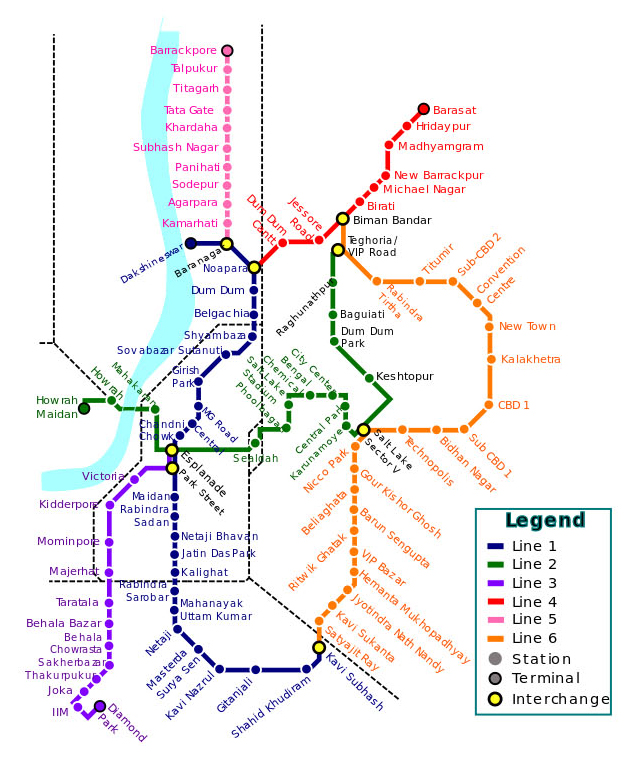
Kolkata Metro Lines and Stations
Kolkata Metro has a multi-line route plan that serves key parts of the city and surrounding metropolitan area. The network mixes older corridors with newer extensions, so the stations map is still evolving as expansion work continues.
The system includes underground, elevated, and at-grade stations, with different construction styles across the network. Daily service generally runs from 06:30 to 22:44 IST, though exact opening hours and closing time vary by line.
Operational lines
| Station | Details |
|---|---|
| Blue Line | Dakshineswar to Kavi Subhash; 26 stations; 32.13 km (19.96 mi) |
| Green Line | Howrah Maidan to Salt Lake Sector V; 12 stations in service, with further expansion underway |
| Purple Line | Joka to Majerhat; 7 operational stations |
| Yellow Line | Noapara to Jai Hind; 4 operational stations |
| Orange Line | Kavi Subhash to Hemanta Mukhopadhyay, with service extending further east; 9 operational stations |
Key interchange and major stations
| Station | Details |
|---|---|
| Esplanade | Interchange for the Blue Line and Green Line; also planned for future Purple Line interchange arrangements; described as the largest station in the system |
| Noapara | Interchange between the Blue Line and Yellow Line |
| Kavi Subhash | Interchange point for the Blue Line and Orange Line |
| Salt Lake Sector V | Connects the Green Line with the Orange Line |
| Jai Hind | Major station on the Yellow Line with connection to the Orange Line |
| Howrah | Deepest metro station in India, at 34 m |
The stations list will keep growing as work continues on the Purple, Yellow, and Orange lines, along with other approved and proposed extensions.
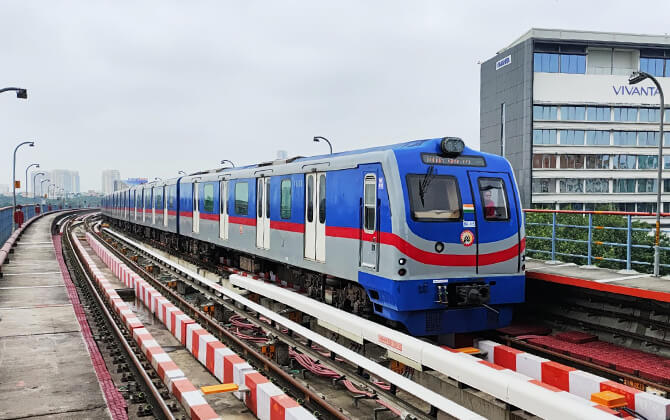
Kolkata Metro Timings
Kolkata Metro operating hours depend on the line, the day of the week, and whether special services are running. If you need timings today or a route timetable for a specific journey, it is best to check the latest schedule before you travel.
Current operating hours by line
| Service detail | Timings |
|---|---|
| Blue Line | 06:40 to 22:29 on weekdays, Saturdays, and holidays; 09:00 to 22:29 on Sundays |
| Green Line-1 (Sealdah – Salt Lake Sector V) | 06:55 to 21:58 Monday to Friday; 06:55 to 22:00 on Saturdays; special service on holidays |
| Green Line-2 (Howrah Maidan – Esplanade) | 07:00 to 21:53 on weekdays, Saturdays, and holidays; no service on Sundays |
| Purple Line | 08:30 to 15:51 on weekdays and holidays; no service on Saturdays and Sundays |
| Orange Line | 09:00 to 16:52 on weekdays and holidays; no service on Saturdays and Sundays |
These opening times, working hours, and service timings reflect the material provided. On some routes, trains do not run on Sundays, while others operate reduced or special schedules.
General timetable note
The Kolkata Metro timetable is line-specific rather than system-wide. That means the starting time, last train window, running time availability, and close of service can differ quite a bit depending on your route.
Kolkata Metro Tickets, Fares and Cards
Kolkata Metro is known for low ticket price levels compared with many road-based transport options in the city. The fare depends on the route and distance between stations, with separate fare slabs for different lines.
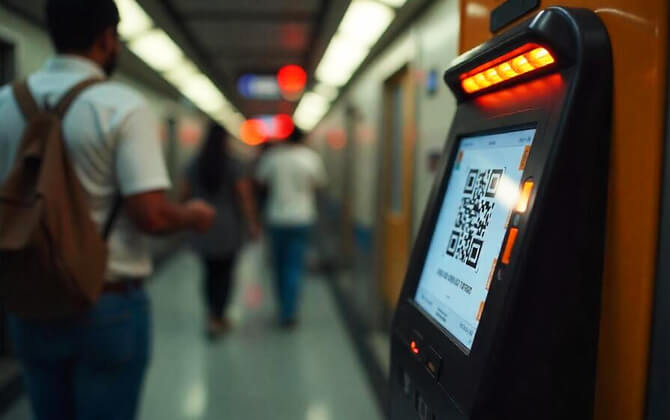
Fare structure by line
Green Line fare ranges from Rs. 5 to Rs. 20 (about $0.06 to $0.24). The section includes stations such as Salt Lake Sector V, Karunamoyee, Central Park, City Centre, Bengal Chemical, Salt Lake Stadium, Phoolbagan, and Sealdah. The Howrah section includes Howrah Maidan, Howrah Metro, Mahakaran, and Esplanade, with fare from Rs. 0 to Rs. 10 (about $0.00 to $0.12), depending on the station pair.
Purple Line fare ranges from Rs. 5 to Rs. 20 (about $0.06 to $0.24). Stations include Joka, Thakurpukur, Sakher Bazar, Behala Chowrashtra, Behala Bazar, Taratala, and Majherhat.
Orange Line fare ranges from Rs. 5 to Rs. 20 (about $0.06 to $0.24). Stations include Kavi Subhash, Satyajit Ray, Jyotirindra Nandi, Kavi Sukanta, and Hemanta Mukhopadhyay.
Blue Line has a wider fare range, from Rs. 5 to Rs. 25 (about $0.06 to $0.30). It includes stations such as Dakshineswar, Baranagar, Noapara, Dum Dum, Belgachia, Shyambazar, Shobhabazar, Girish Park, Mahatma Gandhi Road, Central, Chandni Chowk, Esplanade, Park Street, Maidan, Rabindra Sadan, Netaji Bhavan, Jatin Das Park, Kalighat, Rabindra Sarobar, Mahanayak Uttam Kumar, Netaji, Masterda Surya Sen, Gitanjali, Kavi Nazrul, Shahid Khudiram, and Kavi Subhash.
Tickets and smart cards
Passengers can buy single-journey ticket options, and smart cards are available for regular travel. A General Smart Card was introduced in 2013, and online smart card recharge began on 1 July 2020.
Recharge bonus values are listed as follows:
- Rs. 100 recharge gives ride value of Rs. 110 (about $1.21 value on about $1.09 recharge)
- Rs. 200 recharge gives ride value of Rs. 220 (about $2.42 value on about $2.18 recharge)
- Rs. 300 recharge gives ride value of Rs. 330 (about $3.63 value on about $3.27 recharge)
- Rs. 500 recharge gives ride value of Rs. 550 (about $6.05 value on about $5.45 recharge)
- Rs. 1000 recharge gives ride value of Rs. 1100 (about $12.10 value on about $10.90 recharge)
Tourist Smart Cards
Two tourist card options are available for unlimited rides within their validity period:
- Tourist Smart Card I: Rs. 250 (about $2.72), valid for one day
- Tourist Smart Card II: Rs. 550 (about $6.00), valid for three days
A refundable security deposit of Rs. 60 (about $0.65) applies to both cards. While not described as a day pass in the source, the one-day tourist card works in a similar way for unlimited travel during its validity.
Child travel policy
Up to three children of 90 cm (0.9 m / 2.95 ft) or less in height may travel free with an accompanying adult. This does not apply to group bookings. Children above 90 cm (0.9 m / 2.95 ft) are charged full fare.
Useful fare notes
The starting fare is Rs. 5 (about $0.06). Since the fare structure can change through metro notifications, travelers should check the latest fare, cost, and ticket rules before using the system. The source does not provide a fare calculator.
Connections to Other Systems
Kolkata Metro is closely linked with the city’s wider transport network, especially at major interchange stations such as Dum Dum, Sealdah, Esplanade, and Howrah. These links make transportation in Kolkata easier by connecting metro services with the Kolkata Suburban Railway.
The Green Line was designed to connect major railway terminals on both sides of the Hooghly River. It links Howrah and Sealdah and also connects with the Blue Line at Esplanade. Future interchange with the Purple and Orange lines is also mentioned in the source material.
The Blue Line has an important interchange role too. Noapara connects with the Yellow Line, Kavi Subhash links with the Orange Line, and Esplanade was upgraded with a subway for interchange access between the Blue Line, Green Line, and future Purple Line.
Other key metro-to-metro links include Salt Lake Sector V with the Orange Line, and Jai Hind with the Orange Line and Yellow Line. Together, these interchanges help the metro function as part of a larger city transport and local transport system rather than as a standalone network.
| Station | Details |
|---|---|
| Dum Dum | Blue Line and Kolkata Suburban Railway connections |
| Noapara | Blue Line and Yellow Line |
| Kavi Subhash | Blue Line and Orange Line |
| Esplanade | Blue Line, Green Line, and future Purple Line |
| Salt Lake Sector V | Green Line and Orange Line |
| Jai Hind | Yellow Line and Orange Line |
| Howrah | Green Line and Kolkata Suburban Railway connections |
| Sealdah | Green Line and Kolkata Suburban Railway connections |
Airport Connections
Kolkata Airport Metro Station, also called Jai Hind Metro Station or Biman Bandar, connects the airport area with the city through the Yellow Line. In the current phase, this path train route runs between Noapara and Jai Hind, with stations at Noapara, Dumdum Cantonment, Jessore Road, and Jai Hind.
The metro entrance is on the right-hand side of the terminal area near Gate 1. Reaching the station may involve using the subway, lifts, or escalators and following airport metro signs. Inside the station, trains toward Noapara use Platform 2, while arriving trains from Noapara to Jai Hind use Platform 1.
For onward travel, Noapara is the main interchange. From there, passengers can switch to the Blue Line for North and South Kolkata. The available information also notes an indirect route to Howrah by changing at Noapara and then at Esplanade.
Published airport fare details include:
- Noapara to Kolkata Airport Metro Station: Rs. 20 (about $0.24)
- Dumdum Cantonment to Kolkata Airport Metro Station: Rs. 10 (about $0.12)
- Jessore Road to Kolkata Airport Metro Station: Rs. 5 (about $0.06)
Other published fares cover destinations such as Esplanade, Park Street, Howrah, Sealdah, and Kavi Subhash. Frequency is stated as about 10 to 15 minutes.
Future extensions mentioned for this corridor include New Barrackpore, Barasat, and Suripukur.
Parking
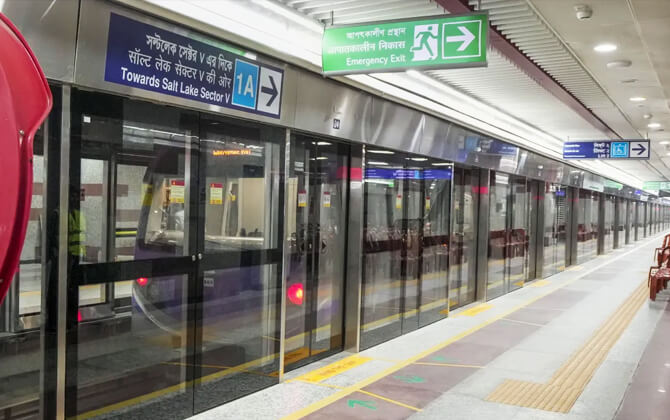
An underground station parking plaza for 900 cars is planned at Esplanade, which is expected to become a major interchange for three metro routes. The state government will spend Rs. 450 crore (about $54.5 million) on the project, and a detailed project report is to be prepared next.
The facility is planned under the existing Esplanade bus terminus, with three entry and exit points proposed near Press Club Kolkata, Curzon Park, and the bus terminus area. The project is intended to support higher passenger volumes once major corridors are fully operational.
Passengers would be able to park at Esplanade and continue by metro. The source does not provide parking charges, parking charges per day, or a ticketed station parking tariff.
Rules and Tips
Kolkata Metro asks passengers to follow basic rules so travel stays safe, orderly, and comfortable. It’s pretty straightforward: follow staff instructions, respect station facilities, and allow extra time for security checks.
Travel and Ticketing
- Ticket booking counters open during specified working hours.
- Adequate counters are provided to reduce waiting time.
- Smart Tokens and Smart Cards are used for access.
- Incorrect token use, short journey travel, or token-less travel can lead to penalties.
Refunds and Claims
- Refunds are made across the counter for valid Smart Cards in good condition.
- If a refund cannot be settled immediately, a Smart Card Deposit Receipt is issued and the claim is ordinarily settled within seven days.
- Smart Tokens usually cannot be refunded once the passenger has entered the paid area.
- Full refund is allowed at the token-issuing station within the validity period if the paid area has not been entered.
- No refund claim is accepted for lost tokens or damaged and broken Smart Cards.
Passenger Conduct
- Let passengers get off before boarding.
- Be courteous and follow instructions from metro staff.
- Use bins and keep stations clean.
- Do not eat, drink, smoke, spit, or litter inside trains or stations.
- Do not block, force open, or lean on train doors.
- Stay behind the yellow line on platforms.
- Do not run in stations or sit on the platform for long periods.
Safety Rules
- Never walk on the track bed; the third rail carries 750 volts of electricity.
- Step carefully across the gap between the train and the platform.
- Report unattended packages to station staff or transit police.
- Follow emergency instructions calmly.
- On escalators, stand to the right, hold the handrail, and do not run or sit on the steps.
Baggage Rules
- Only small personal baggage may be carried, such as a tiffin basket, small handbag, or attaché case, along with an umbrella or walking stick for personal use.
- Baggage should not exceed 10 kg (22.05 lb) and should not be bulky.
- Offensive articles, dangerous articles, and dead bodies are not permitted as accompanied baggage.
Concessions and Amenities
- Concessions are given only to school students, Madrasa students, and students of vocational institutions up to Class XII or equivalent.
- Basic amenities at stations include booking counters, seating, drinking water, lifts, escalators, and wheelchairs.
- Trains have lighting, modern seats, fans, onboard announcements, and destination boards.
Cleanliness and Cooperation
- Help keep stations and trains clean and hygienic.
- Do not carry inflammable items into metro premises.
- Cooperate with staff during security checks and other safety procedures.
Metro Railway also publishes service information, special train schedule updates, and passenger notices through station announcements and CCTV screens.
History
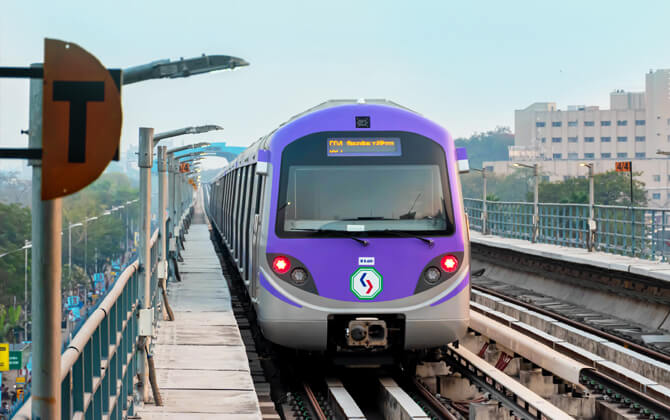
The history of Kolkata Metro goes back to the 1920s, when early ideas for an underground railway first appeared. A 1923 proposal did not move forward because of funding limits. After independence, the idea was revisited in 1949–1950, but survey work by French experts still did not produce a final project.
A more formal plan began in 1969 with the Metropolitan Transport Project. In 1971, it prepared a master plan for five rapid-transit lines, with the north-south corridor between Dum Dum and Tollygunge given top priority. Work on this route was approved on 1 June 1972, the foundation stone was laid on 29 December 1972, and construction began in 1973–74.
The first metro service opened on 24 October 1984 on a 3.40 km (2.11 mi) stretch between Esplanade and Bhowanipur, now Netaji Bhawan. A northern commuter section between Dum Dum and Belgachhia followed on 12 November 1984. The line was later extended southward to Tollygunge on 29 April 1986, and the originally planned stretch became fully operational on 27 September 1995.
The north-south line was extended to Noapara in 2013 and to Dakshineswar in 2021. Construction mainly used cut-and-cover methods, with shield tunneling in selected sections.
The East-West Corridor, now known as the Green Line, was sanctioned in 2008 and its foundation stone was laid in 2009. The first section opened in 2020. This line later became especially notable for the tunnel under the Hooghly River and for Howrah station, the deepest metro station in India.
Newer corridors followed in the 2020s: the Purple Line opened in 2022, the Orange Line in 2024, and the Yellow Line in 2025. By 2025, Kolkata Metro had grown into a major multi-line transport system and remained the only metro in India fully controlled by Indian Railways.
Future Extensions
Kolkata Metro expansion is ongoing, with corridors under construction, approved projects, and longer-term proposals aimed at better airport access, stronger interchange, and wider coverage across the metropolitan area.
Under construction
| Station | Details |
|---|---|
| Purple Line | Majerhat to Esplanade; 5 stations over 6.5 km (4.04 mi); tentative completion in 2028 |
| Yellow Line | Jai Hind to Michael Nagar; 2 stations over 2.06 km (1.28 mi); tentative completion in 2027 |
| Orange Line | Beleghata to Jai Hind; 15 stations over 19.97 km (12.41 mi); tentative completion in 2026 |
Approved extensions
| Station | Details |
|---|---|
| Green Line Extension | Salt Lake Sector V to Teghoria; 5 stations over 6.65 km (4.13 mi) |
| Purple Line | Eden Gardens to Esplanade; 1 station over 1.6 km (0.99 mi) |
| Purple Line | IIM-Joka to Joka; 1 station over 1.7 km (1.06 mi) |
| Purple Line Branch | IIM-Joka to Diamond Park; 1 station over 1.69 km (1.05 mi) |
| Yellow Line | Michael Nagar to Barasat; 4 stations over 7.6 km (4.72 mi) |
| Pink Line | Baranagar to Barrackpore; 10 stations over 12.50 km (7.77 mi) |
Planned directions
One proposed Purple Line branch would run from Mahanayak Uttam Kumar to Diamond Park. Earlier planning for the Green Line also included a direct extension from Salt Lake Sector V to Teghoria and a possible further extension from Howrah Maidan to the Santragachi bus terminus.
These projects reflect the broader route expansion vision for Kolkata Metro and show how the system may continue reaching airport-linked corridors and growing suburban areas.
Places of Interest
Kolkata Metro makes it easier to reach many of the city’s best-known landmarks by rail. For sightseeing, it is one of the most practical ways to move around without relying only on bus, tramway, trams, or road traffic.
| Station | Details |
|---|---|
| Dum Dum | Netaji Subhash Chandra Bose International Airport, about 17 km (10.56 mi) from the city center |
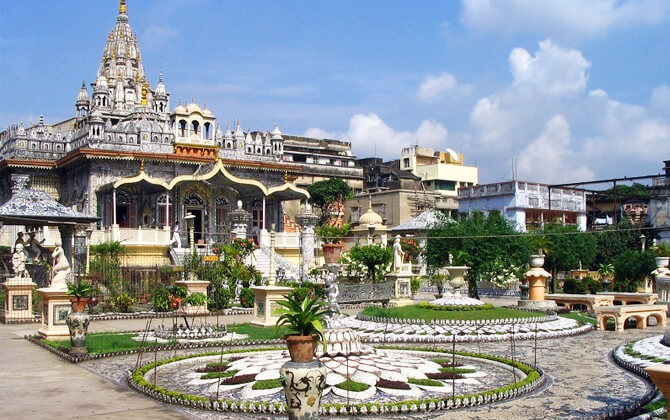
| Belgachia | Parashnath Temple, also known as the Calcutta Jain Temple, built in 1867 |
| Mahatma Gandhi Road | Thakurbari, the ancestral home of the Tagore family, and Mahajati Sadan |
| Central | Writers’ Building, Kolkata Medical College, and the University of Calcutta |
| Esplanade | Raj Bhavan, Assembly House, Eden Gardens, and Shahid Minar |
| Park Street | Indian Museum and the Asiatic Society |
| Maidan | Birla Planetarium, Aurobindo Bhavan, and St. Paul’s Cathedral Church |
| Rabindra Sadan | Rabindra Sadan, Victoria Memorial, and Nandan |
| Netaji Bhavan | Netaji Subhash Chandra Bose’s house and the Netaji Research Bureau |
| Kalighat | Kalighat Kali Temple |
| Rabindra Sarovar | Rabindra Sarovar Lake in south Kolkata |
Some routes also offer access to nearby attractions such as Dakshineswar Kali Temple, Kumartuli, and the Indian Museum area. If you are planning a trip, checking the route, stations map, and train schedule in advance will make things smoother.