The Lille Metro, or Métro de Lille, is a driverless light metro system serving Lille and its wider metropolitan area in northern France. It was the first metro in the world to use VAL technology, developed in the early 1970s at the University of Lille. Today, the system has two mostly underground lines, 60 stations, and about 45 kilometers (28 miles) of route, and it is operated by Ilévia as part of the city transport network alongside the tramway and bus system.
| Key | Information |
|---|---|
| System type | Driverless light metro |
| Operator | Ilévia |
| Lines | 2 |
| Stations | 60 |
| Network length | About 45 km (28 miles) |
| Notable fact | First metro in the world to use VAL technology |
| Ridership | More than 110 million trips in 2016 |
Lille Metro Map
Map of Lille Metro showing next lines and stations. Click on the map to enlarge it or download the Lille Metro map in PDF format.
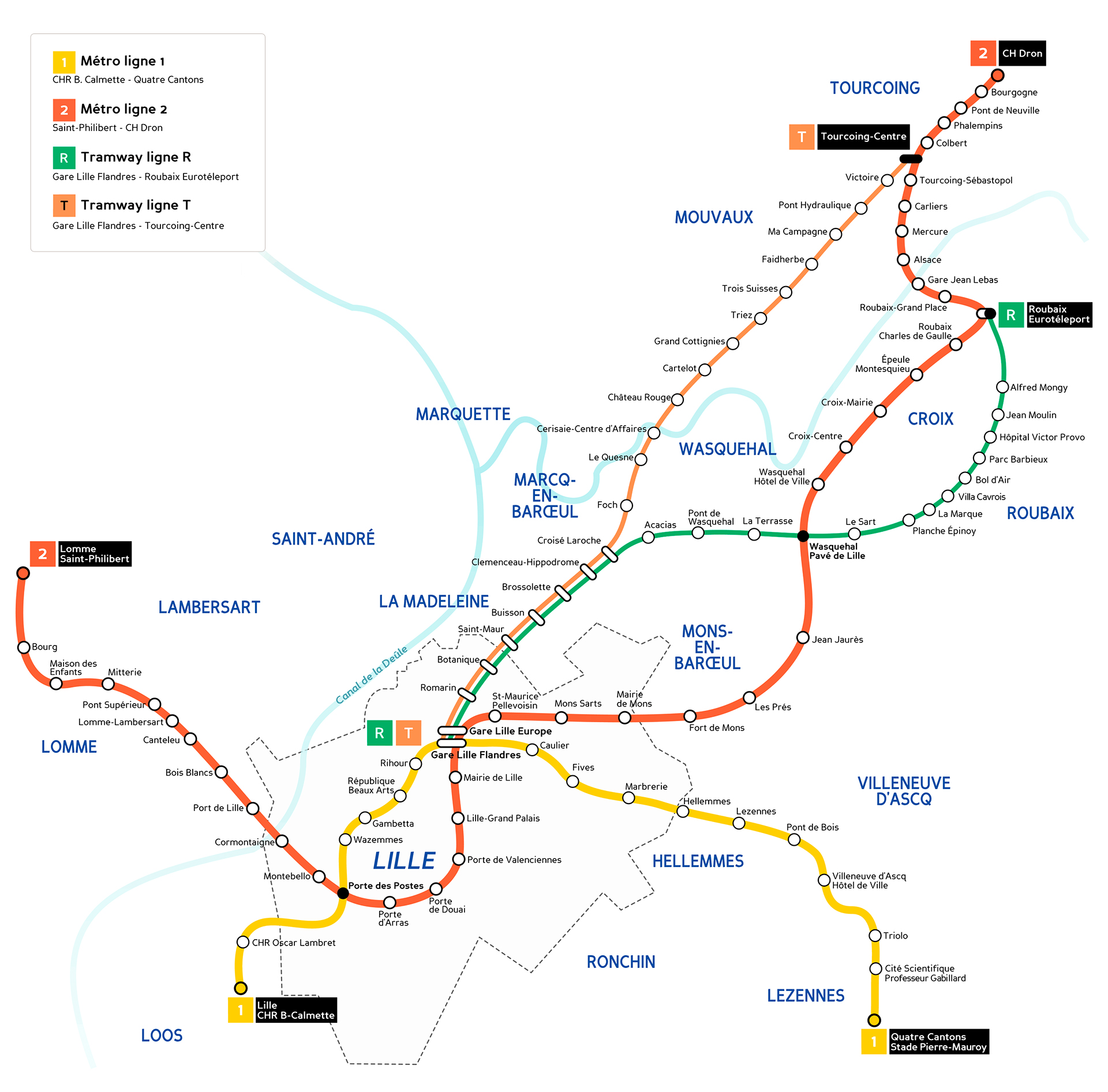
Lille Metro Lines and Stations
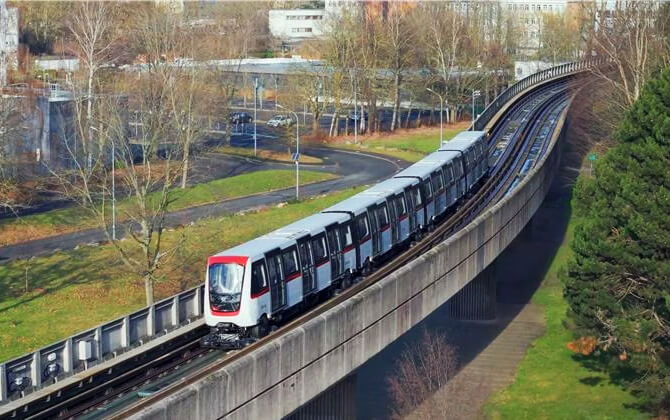
The Lille Metro system is built around two main lines and forms a core part of public transport in the city. It is a driverless, rubber-tyred metro with about 45 km (28 miles) of route across the metropolitan area.
Line 1 opened in 1983 and runs from Quatre Cantons – Stade Pierre-Mauroy to CHU – Eurasanté. It serves 18 stations over about 12.5 km (7.8 miles), linking Villeneuve-d’Ascq with Lille through key areas such as the university campus, central Lille, and the hospital district.
Line 2 opened in 1989 and was completed in 2000. It runs from Saint-Philibert to CH Dron, serving 44 stations over about 31.1 km (19.3 miles). This route connects Lille with Lomme, Mons-en-Barœul, Villeneuve-d’Ascq, Wasquehal, Croix, Roubaix, and Tourcoing.
The two lines connect at Gare Lille-Flandres and Porte des Postes, which are the main interchange stations in the network. Most stations are underground, though there are also elevated and surface sections on both lines.
Several stations have been renamed over time. Examples include Gares becoming Gare Lille-Flandres, CHR B-Calmette becoming CHU – Eurasanté, Lezennes becoming Square Flandres, and Hellemmes becoming Mairie d’Hellemmes.
| Station | Details |
|---|---|
| Quatre Cantons – Stade Pierre-Mauroy | Line 1 terminus |
| CHU – Eurasanté | Line 1 terminus |
| Saint-Philibert | Line 2 terminus |
| CH Dron | Line 2 terminus near the Belgian border |
| Gare Lille-Flandres | Main interchange between Lines 1 and 2 |
| Porte des Postes | Interchange station between Lines 1 and 2 |
| Triolo | Surface station on Line 1 |
| Villeneuve-d’Ascq – Hôtel de Ville | Surface station on Line 1 |
For a quick route plan, Line 1 is the shorter east-west path train across Lille, while Line 2 is the longer cross-metropolitan route. Together, the stations list covers major rail hubs, shopping areas, university sites, and Lille University Hospital.
| Station | Details |
|---|---|
| Line 1 | Quatre Cantons – Stade Pierre-Mauroy ↔ CHU – Eurasanté; opened 1983; 12.5 km (7.8 miles); 18 stations |
| Line 2 | Saint-Philibert ↔ CH Dron; opened 1989; 31.1 km (19.3 miles); 44 stations |
Lille Metro Fares, Tickets and Cards
The Lille Metro fare system is managed by Ilévia. For occasional trips, you can buy a single ticket, a ZAP ticket, a 10-ticket booklet, or a day pass. If you travel more often, there are weekly, monthly, and annual pass options.
| Type of ticket | Price |
|---|---|
| One-way ticket | EUR 1.80 (USD 1.98) |
| Ticket Zap (3 interstations) | EUR 1.15 (USD 1.27) |
| Notebook of 10 tickets | EUR 15.40 (USD 16.94) |
| Daily pass (unlimited transportation) | EUR 5.30 (USD 5.83) |
| Weekly pass | EUR 15.00 (USD 16.50) |
| Monthly pass | EUR 54.00 (USD 59.40) |
| Annual pass | EUR 540.00 (USD 594.00) |
The system also uses the Pass Pass card, a rechargeable card valid on the metro, bus, and tramway. It comes in personalized and anonymous versions, which makes it handy for regular public transport users.
- Youth Card: discounts for young people aged 4 to 25.
- Senior Card: special offers for passengers aged 65 and over.
- Tourist Pass: visitor pass options with unlimited transportation for one day or more.
- Work subscriptions: reduced fare options for workers in the metropolitan area.
Tickets are sold in metro stations, while subscriptions are also available at Ilévia agencies. Some subscriptions can be purchased online if you already have a personalized Pass Pass card, with a 24-hour processing time.
For a simple fare calculator approach, occasional riders may find the one-way ticket or 10-ticket booklet practical, while frequent users usually get better value from a day pass, subscription, or card.
Lille Metro Timings, Frequency and Schedule
The Lille Metro runs daily, with operating hours starting early in the morning and continuing until around midnight or a little later depending on the line and day. Because it is automated, the train schedule stays regular through most of the day.
Line 1 opening hours are generally from 5:00 a.m. to midnight. The usual frequency is every 1.5 to 4 minutes, with peak timings as short as 66 seconds. Early mornings and evenings are less frequent, usually every 6 to 8 minutes. On Sundays, trains run about every 2 to 6 minutes.
Line 2 also runs daily, except on May 1 when both lines close for maintenance. In regular service, trains usually arrive every 2 to 3 minutes off-peak. Since January 18, 2021, peak-hour frequency on the central section has improved to 78 seconds, while the rest of the line runs every 150 seconds during those periods. Weekend and public holiday timings are lower before 6:00 a.m. and after 10:00 p.m., when trains run every 6 to 8 minutes.
Extra late-night or overnight service may be added during major events such as Fête de la Musique and Braderie de Lille. If you need the timetable, route timetable, or schedule today, it is worth checking by line and direction, since the starting time and last train can vary by station.
| Service detail | Timings |
|---|---|
| Line 1 operating hours | 5:00 a.m. to midnight |
| Line 1 frequency | Every 1.5 to 4 minutes; about 66 seconds at rush hour |
| Line 1 Sunday frequency | Every 2 to 6 minutes |
| Line 1 early morning and evening frequency | Every 6 to 8 minutes |
| Line 2 operating hours | Daily service, with last train around midnight or shortly after |
| Line 2 off-peak frequency | Every 2 to 3 minutes |
| Line 2 peak frequency on central section | Every 78 seconds |
| Line 2 peak frequency on rest of line | Every 150 seconds |
| Weekend and holiday early/late service | Every 6 to 8 minutes before 6:00 a.m. and after 10:00 p.m. |
| Maintenance closure | Both lines close on May 1 |
Connections to Other Systems
The Lille Metro is part of an integrated public transport system under the Ilévia brand, which also includes the tramway and bus network. That makes it a useful base for local transport and transportation in Lille more broadly.
Inside the metro system, the two lines connect at Gare Lille-Flandres and Porte des Postes. Gare Lille-Flandres is also a key rail hub in the city center, while Lille Europe and Lille Flandres railway stations provide access to national and international trains, including TGV, Eurostar, and Thalys services.
Line 2 extends the network toward Roubaix and Tourcoing, reaching CH Dron near the Belgian border. Across the city transport network, metro passengers can transfer to bus and tramway services at multiple points.
- Metro-to-metro transfers: Gare Lille-Flandres and Porte des Postes
- Rail connections: Lille Europe and Lille Flandres stations
- Other public transport: Ilévia bus and tramway lines
- Airport access: shuttle bus via Gare Lille-Flandres
Airport Connections
Lille-Lesquin Airport can be reached by several transport options, depending on where you are heading in the metropolitan area.
- Airport shuttle to Lille city centre: a direct service linking the airport with the Lille station district, including Lille Europe and Lille Flandres. The running time is about 20 minutes, and the shuttle runs daily, including public holidays.
- Ilévia line 68: a bus route connecting 4 Cantons Stade Pierre Mauroy with Lesquin Airport.
- Arc en Ciel regional coaches: interurban services in the Pévèle Carembault area that can also be used for airport travel.
The airport shuttle is operated by the airport company rather than the Ilévia system. Tickets can be bought from the driver, and the shuttle stops in Lille near the railway station area and at the airport drop-off area near entrance B.
If you want the fastest option, the direct shuttle is presented as the most comfortable choice because it avoids unnecessary stops. Regular public transport remains available through line 68 and regional coach services.
Parking
Lille has a network of park-and-ride sites and other station parking options designed to make travel into the city easier. The Ilévia network provides nearly 5,300 spaces across 12 park-and-ride locations, all near major roads and linked to a metro station, bus interchange, or TER rail station.
These sites are reserved for Ilévia or TER users through the Pass Pass system. They are meant to help drivers switch from car travel to public transport before entering the city centre.
Park-and-ride services
Some sites offer extra services. Reserved spaces for carpoolers are available at Porte des Postes, CHU – Eurasanté, Porte d’Arras, Les Prés, Lomme St Philibert, Armentières, and 4 Cantons. Electric vehicle charging points are available at 4 Cantons, St Philibert, and Don Sainghin.
Staff are present on site except at La Bassée, Pont de Neuville, Porte des Postes, and Porte d’Arras. Height barriers are also in place, so tall vehicles such as trucks, camper vans, and caravans may not be able to enter.
Parking near Lille Metro
Parking is listed near several metro and rail stations, including Lille Europe, Lille Flandres, Porte des Postes, Porte d’Arras, Rihour, République Beaux Arts, Mairie de Lille, Gambetta, Wazemmes, and Porte de Douai.
Other listed locations include Gare d’Hellemmes, Gare de Lille CHR, Gare de Mont-de-Terre, Métro Bois Blancs, Métro Canteleu, Métro Caulier, Métro Cormontaigne, Métro Fives, Métro Lezennes, Métro Lille Grand Palais, Métro Marbrerie, Métro Montebello, Métro Port de Lille, Métro Porte de Valenciennes, Métro Saint Maurice Pellevoisin, and the tram stations Gare Lille Europe and Gare Lille Flandres.
One available park-and-ride site for metro users is Porte des Postes, at Pl. Barthélémy Dorez, 59000 Lille, France. The source material does not specify parking charges or parking charges per day.
History
The history of the Lille Metro goes back to the 1960s, when parts of the Lille region were poorly served by public transport and the city centre faced heavy congestion. In 1968, this led to the creation of the Lille East development public establishment, known as EPALE.
During the 1970s, planners developed a four-line light metro proposal and chose the VAL system over conventional rail technology. The concept was developed at the University of Lille and later advanced by Matra with support from the Lille urban community.
Construction of Line 1
Construction of Line 1 began in 1978. The first section opened on 25 April 1983 between Quatre Cantons and République. On 2 May 1984, the line was completed between CHR B Calmette and Quatre Cantons via Gare de Lille Flandres.
This was a major step for Lille, as it became the first metro system in the world to use VAL technology.
Line 2 and network expansion
Construction of Line 2 began in April 1985, and a depot opened at Villeneuve d’Ascq. Line 1 became fully operational in late 1988 after several months of testing.
In 1989, COMELI, the metro operator, merged with COTRALI, which ran the bus and tram networks, creating a unified transport body. That same year, Line 2 opened on 3 April 1989. It was later extended to CH Dron near the Belgian border on 27 October 2000.
The section linking Lille with Roubaix and Tourcoing opened in four stages. The first extension entered service on 5 May 1994 and included a 500-meter (0.5 km / 0.3 mile) underground section connecting the Euralille business area to the rest of Lille. Another major section opened in March 1999, and the final one was inaugurated on 27 October 2000 by Prime Minister Lionel Jospin.
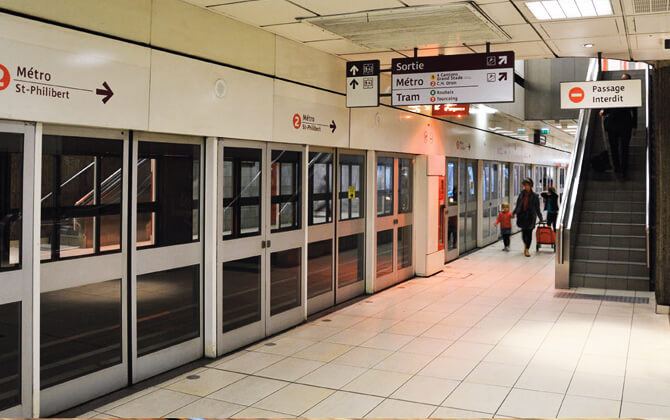
Both lines have platform screen doors at every station, making Lille Metro the second metro system to use platform doors after the Saint Petersburg Metro.
Plans for third and fourth lines
Although four lines were originally planned, only two were built. In June 2000, Lille Métropole Urban Community stated in its urban transport plan that the cost of subway construction would not allow new projects. In 2003, a third line was estimated at EUR 810 million (USD 891 million), which was considered too expensive, so the focus shifted to surface transport instead.
By 2010, the priority had clearly moved to buses, urban tramway, and tram-train development.
Modernization of Line 1
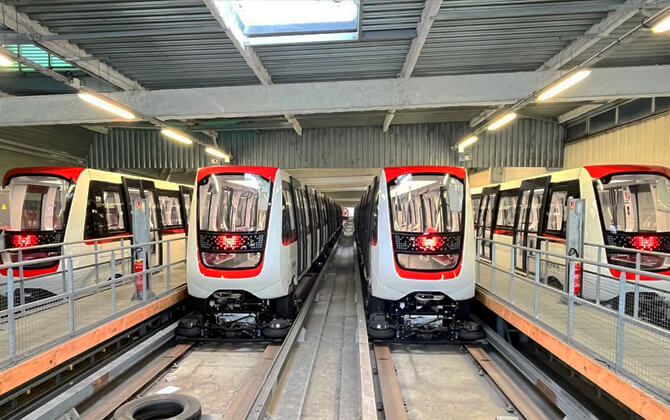
In January 2013, work began to double the capacity of Line 1. Platforms were lengthened for new 52-meter (0.052 km / 0.03 mile) trains built by Alstom. The project was first expected to finish in autumn 2017 but was ultimately completed in February 2026, with the first 12 long trains available from 14 February.
The former VAL 208 trains from Line 1 were then transferred to Line 2 to increase capacity there as well.
Future Extensions
Future expansion of the Lille Metro appears limited in the available material, but one possible extension has been mentioned for Line 2. The Métropole Européenne de Lille proposed a 1.8 km (1.1 miles) extension west of Saint-Philibert toward Pérenchies station during public consultations on regional transport. The idea was to improve connections with TER Hauts-de-France rail services and strengthen links within the Ilévia network.
There is also a confirmed case of a cancelled extension. A planned eastward continuation from Roubaix–Charles-de-Gaulle to Wattrelos was abandoned, although a switch for that route remains installed between Roubaix–Charles-de-Gaulle and Eurotéléport.
For now, the main development is service improvement rather than new construction. Line 2 operates below maximum capacity, and 27 VAL 208 trainsets are expected to transfer from Line 1 to improve frequency after the Line 1 upgrade program.
Tips and Rules
Before you travel, buy your ticket or use a valid card and make sure it is validated before boarding. Keep it until the end of your trip, as ticket inspections do take place.
Some items are not allowed on board. Large packages are prohibited, and anything bigger than 0.75 meters (0.47 miles) should be avoided. Scooters, shopping trolleys, and empty strollers are not allowed. Bikes are not permitted during rush hours, and you cannot board or get off with a bike at Lille Flandres station.
Dangerous materials, weapons, and infectious substances are also banned. For a smoother and safe journey, do not take extra seats with your belongings, do not eat or drink except water, do not trigger false alarm signals, do not spit, and do not use sound devices without permission.
The system is easy to navigate, with digital screens showing arrival information and clearly marked stations. If you are connecting to the tramway or bus network, check that your ticket or pass is valid for the whole route.
Nearby Attractions
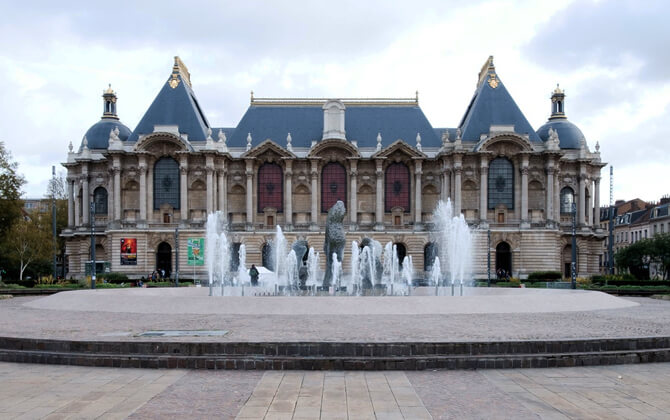
The Lille Metro gives easy access to many of the city’s best-known sights. Some are right by central stations, while others are just a short walk away.
- Grand Place — Rihour station, Line 1. Historic center with emblematic buildings and a lively atmosphere.
- Palais des Beaux-Arts — République – Beaux-Arts station, Line 1. Art museum with a vast European collection.
- Beffroi de l’Hôtel de Ville — Mairie de Lille station, Line 2. A 104-meter (0.1 km / 0.06 mile) tower with panoramic city views.
- La Citadelle — Cormontaigne station, Line 2. A seventeenth-century fortress surrounded by parkland.
- Vieux Lille — Gare Lille Flandres station, Lines 1 and 2. Historic district with cobbled streets, shops, and restaurants.
- Marché de Wazemmes — Gambetta station, Line 1. A lively market known for local products and textiles.
- Hospice Comtesse — Rihour station, Line 1. A former medieval hospital turned museum.
- Gare Saint-Sauveur — Lille Grand Palais station, Line 2. A former railway station now used for exhibitions and events.
In central Lille, walking is often a good option too, especially around Vieux Lille where several attractions sit close together.